
Aerosol Packaging Market Report Scope & Overview:
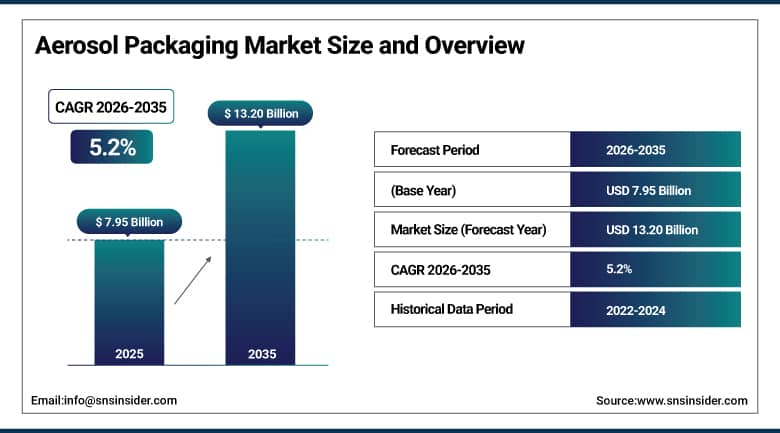
The Aerosol Packaging Market was valued at USD 7.95 Billion in 2025 and is expected to reach USD 13.20 Billion by 2035, growing at a CAGR of 5.2% from 2026–2035.
Aerosol packaging is the pressurized can or container that turns a liquid, powder, or foam into a controlled, even spray, deodorant, hairspray, spray paint, whipped cream, insect repellent, all delivered the same basic way despite covering wildly different products. Aluminum has become the dominant material because it's lightweight, corrosion-resistant, and endlessly recyclable, which matters increasingly as regulators start treating aerosol cans as a genuine recycling stream rather than hazardous waste headed for a landfill. Personal care remains the category's anchor application, but automotive maintenance and food and beverage uses quietly account for a meaningful share of volume too.
Ball Corporation, the aerosol packaging market's single largest player with roughly 17.9% share in 2025, is developing a second generation of its ReAl aluminum aerosol container technology targeting 75% recycled content by 2030. Ball and the four other largest manufacturers, Ardagh Group, Crown Holdings, CCL Industries, and AptarGroup, together control just under half the global market, a level of concentration that gives recycled-content commitments from a handful of companies an outsized effect on the industry's overall sustainability trajectory.
To Get More Information On Aerosol Packaging Market - Request Free Sample Report
Aerosol Packaging Market Trends
-
Regulators are increasingly treating aerosol cans as a distinct, manageable recycling stream rather than hazardous waste, with the U.S. EPA's December 2025 addition of aerosol cans to the Universal Waste Regulations under RCRA expanding legal recycling pathways.
-
Aluminum recycled-content commitments from the largest manufacturers are reshaping raw material sourcing across the industry, as companies invest in expanded rolling and remelting capacity to support higher recycled-alloy formulations.
-
Refillable and reusable aerosol bottle formats are gaining traction in personal care and household categories, letting brands offer a genuine circular alternative to traditional single-use cans.
-
Smart packaging integration, including IoT and sensor technologies embedded in aerosol cans, is emerging as a way to give users personalized usage data and timely replenishment reminders.
-
Expansion of e-commerce distribution channels continues reinforcing demand for aerosol packaging that can survive shipping and handling stress beyond what traditional retail shelf distribution required.
U.S. Aerosol Packaging Market Outlook
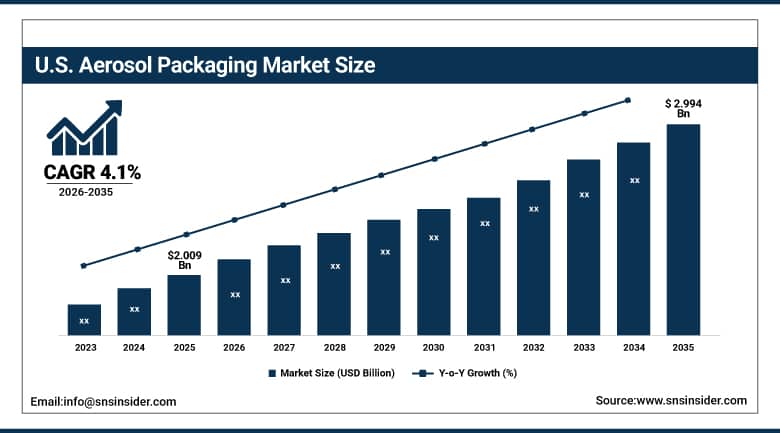
The U.S. Aerosol Packaging Market was valued at approximately USD 2.009 Billion in 2025 and is expected to reach approximately USD 2.994 Billion by 2035, growing at a CAGR of approximately 4.1%.
Demand in the United States is anchored by a mature personal care industry alongside meaningful automotive maintenance and food and beverage applications that don't get the same attention as deodorant and hairspray but still move real volume. Strict regulatory frameworks and strong sustainability awareness among American consumers continue pushing manufacturers toward recyclable and lower-carbon-footprint packaging formats. A concentration of the world's largest aerosol packaging manufacturers headquartered or operating major facilities domestically gives U.S. brand owners particularly deep access to the latest sustainable packaging technology.
North America's aerosol can market is expanding on the strength of two less obvious demand sources beyond personal care: automotive maintenance products, where aerosol cans deliver paints and lubricants to both consumer and commercial vehicle maintenance markets, and food and beverage applications like whipped cream and cooking spray. That diversification beyond the category's traditional deodorant-and-hairspray image is part of why the region's aerosol can segment specifically is projected to reach roughly USD 26.78 billion by 2030, according to a February 2025 industry analysis.
Aerosol Packaging Market Segment Analysis
-
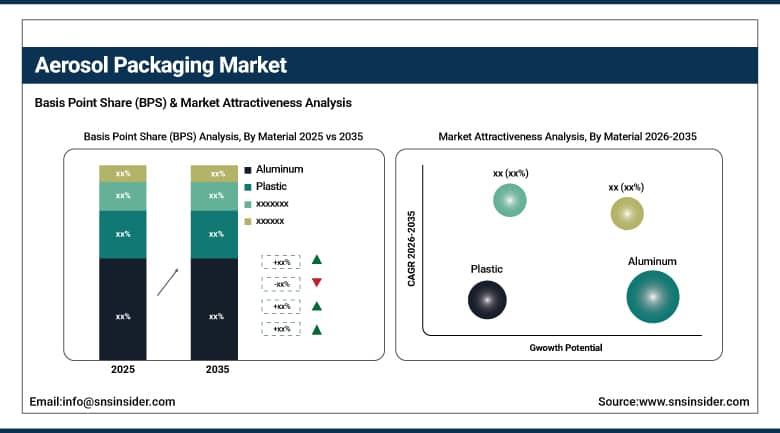
By Material, the Aluminum segment dominated the Aerosol Packaging Market with approximately 52.14% share in 2025, while the Plastic segment is the fastest growing with a CAGR of approximately 7.2%.
-
By Product/Container Type, the Cans segment dominated the Aerosol Packaging Market with approximately 44.03% share in 2025, while the Bottles segment is the fastest growing with a CAGR of approximately 6.8%.
-
By Application, the Personal Care segment dominated the Aerosol Packaging Market with approximately 38.62% share in 2025, while the Household segment is the fastest growing with a CAGR of approximately 7.4%.
By Material, aluminum dominates, plastic grows fastest
Aluminum held the largest share of the material segment in 2025, valued for its lightweight nature, corrosion resistance, and strong recyclability profile relative to steel, plastic, or glass alternatives. Its ability to be recycled indefinitely without losing quality has made it the material of choice as brand owners and regulators alike push harder on packaging circularity commitments.
Plastic is growing fastest as manufacturers look for lower-cost, lighter-weight alternatives suited to specific applications where aluminum's premium cost isn't justified by the product inside. Its design flexibility and compatibility with a broader range of dispensing valve technologies are helping plastic gain ground in household and industrial categories in particular, where cost sensitivity often outweighs the recyclability advantage aluminum offers.
By Product/Container Type, cans dominate, bottles grow fastest
Cans held the largest share of the container-type segment in 2025, offering the structural strength, protective capabilities, and low weight that continue supporting widespread adoption across personal care, household, automotive, and food applications. Their compatibility with high-speed filling lines and established recycling infrastructure keeps cans the default aerosol container format.
Bottles are growing fastest as premium personal care and household brands increasingly favor bottle formats that offer differentiated shelf presence and, in some cases, refillable design that traditional cans can't easily replicate. That premiumization trend is pulling bottle format adoption upward faster than the broader, more commoditized can segment.
By Application, personal care dominates, household grows fastest
Personal care accounted for the largest application share in 2025, spanning deodorants, hair care, oral care, and skin care products that represent the category's oldest and highest-volume use case. Rising consumer demand for premium personal care products continues reinforcing this application's dominant position, since manufacturers increasingly turn to aerosols as an efficient, controlled delivery method for higher-value formulations.
Household is the fastest-growing application as air fresheners, cleaning agents, and insecticides continue expanding alongside rising consumer focus on home hygiene and convenience. Growing e-commerce distribution of household aerosol products, combined with sustained demand for effective, easy-to-use cleaning and pest control solutions, is reinforcing this above-average growth trajectory.
Regional Analysis
|
Region |
Major Country |
Share within Region, 2025 (%) |
|---|---|---|
|
North America |
United States |
81.0% |
|
Europe |
Germany |
24.0% |
|
Asia Pacific |
China |
38.0% |
|
Latin America |
Brazil |
36.0% |
|
Middle East & Africa |
Saudi Arabia |
29.0% |
North America Aerosol Packaging Market Insights
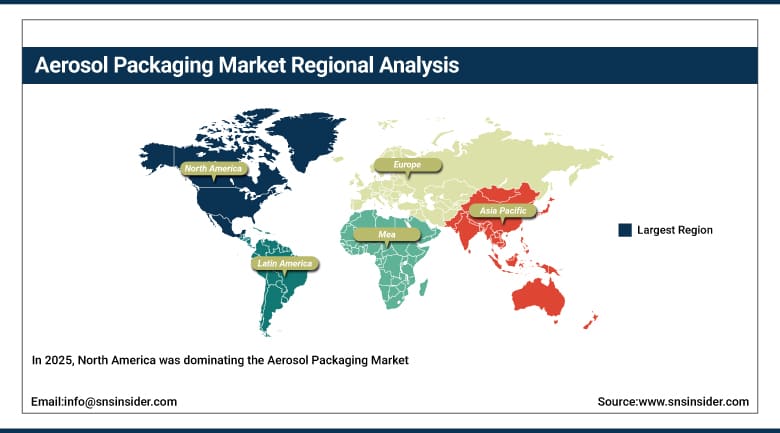
In 2025, North America was dominating the Aerosol Packaging Market due to strong regulatory policies, sustainable practices, and the development of technology in aerosol production. The United States is the main contributor for North America's dominance since it has an established industry of personal care products, along with large aerosol packaging producers around the world.
A considerable share is provided by Canada due to its personal care and household products industry, while Mexico has a rising market along with increasing investments in consumer goods manufacturing. Supply chain connections bind the demand in most cases within North America, with the main producers being active in all three countries.
Get Customized Report as Per Your Business Requirement - Enquiry Now
Asia Pacific Aerosol Packaging Market Insights
The Asia Pacific region is likely to witness the fastest regional growth rate up to 2035 on account of investments in upgrading production facilities, development in sustainable packaging research and development, and automation of manufacturing plants by China, Japan, and South Korea. Disposable income levels and increased consumption of personal care products in the region will continue fueling growth.
China’s huge manufacturing industry of consumer goods forms the basis for the region's demand, whereas the growth of India’s personal care and household products industry is attracting substantial investments. Japan and South Korea are mature markets and technologically advanced markets. Southeast Asia continues to follow a consumption-based growth path.
Europe Aerosol Packaging Market Insights
The Europe aerosol packaging market is mature and sustainability-oriented because of the presence of extended producer responsibility regimes and demand from consumers for environmentally friendly aerosol packaging products. The European aerosol packaging market has Germany at its core owing to its strong base of manufacturing units that manufacture personal care and household products and aerosol packaging products.
France, Italy, and the UK also add volumes to this market since they have large personal care and household product manufacturing industries which are becoming increasingly sensitive to EU regulations regarding packaging waste management.
MEA & Latin America Aerosol Packaging Market Insights
The Middle East and Africa represent a smaller but developing aerosol packaging market, with Saudi Arabia driving demand through growing personal care and household product retail investment tied to broader economic diversification goals. Manufacturers across South Africa and the broader region are increasingly focused on creating sustainable, recyclable aerosol packaging to meet growing personal care demand and adhere to expanding environmental regulations.
Latin America is a growing market led by Brazil, where expanding personal care and household product manufacturing continues driving demand for aerosol packaging. Mexico and Argentina contribute meaningful secondary demand, tied to their own growing consumer goods manufacturing sectors.
Market Dynamics
Growth Drivers: Personal care premiumization and household product demand fueling adoption
Rising consumer demand for premium personal care products is one of the clearest forces behind rising aerosol packaging demand, as manufacturers increasingly turn to aerosols as an efficient delivery method that supports higher-value formulations and controlled, consistent product application. That premiumization trend continues pulling more brand owners toward aerosol formats even in product categories that historically used simpler packaging.
Growing household product consumption adds a second major driver, as air fresheners, cleaning agents, and insecticides continue expanding alongside rising consumer focus on home hygiene and convenience. Expansion of e-commerce distribution channels is reinforcing this demand base further, improving product accessibility and supporting efficient distribution of aerosol-packaged household goods.
Restraints: Raw material price volatility and regulatory compliance costs limiting margin stability
Volatile aluminum and steel costs create uncertainty in terms of real expenses for manufacturers, because metal is still the most dominant material, and volatility in commodity prices affects production costs and project budgets for brand owner clients accordingly. Manufacturers that do not have contracts for metal supplies are especially vulnerable to such volatility, even when there is no change in packaging demand.
Increased regulatory focus on the proper use of the products and packaging quality creates another constraint for manufacturers due to higher requirements and regulations in such categories as household and personal care products. This requirement for regulatory compliance is especially burdensome for small manufacturers who lack a regulatory affairs function.
Opportunities: Recycled content innovation and smart packaging integration opening new growth avenues
Recycled aluminum content innovation offers manufacturers a genuine path to capturing premium business from brand owners chasing credible sustainability commitments ahead of tightening packaging regulation. Companies that build strong recycled-content sourcing and processing capability, backed by expanded rolling and remelting infrastructure, are positioned to capture a growing share of business from environmentally conscious brand owners.
Smart packaging integration represents a second significant opportunity, letting manufacturers offer aerosol cans embedded with IoT and sensor technology that provide personalized usage data and replenishment reminders. Companies that build genuine smart packaging capability are positioned to differentiate meaningfully from competitors still selling purely mechanical dispensing containers.
Recent Developments:
-
November 2025: The Brazilian Aerosol Association confirmed its Administrative Council for the 2026-2027 biennium, reflecting continued industry organization and coordination across Latin America's aerosol packaging sector.
-
2026: Paris Packaging Week announced finalists for its Innovation Awards in the aerosol and dispensing systems category, highlighting continued product innovation across the sector.
-
2025: Ball Corporation continued expanding its Infinity aluminum bottle and refillable aluminum bottle formats for personal care and household applications beyond traditional aerosol cans.
-
2025: Multiple major manufacturers continued investing in lightweight aluminum alloy development and expanded rolling and remelting capacity to support higher recycled-content aerosol packaging.
Aerosol Packaging Market Key Players
-
Ball Corporation
-
Ardagh Group S.A.
-
Crown Holdings, Inc.
-
CCL Industries, Inc.
-
AptarGroup, Inc.
-
Sonoco Products Company
-
Precision Valve Corporation
-
CCL Container LLC
-
Lindal Group
-
Montebello Packaging
-
Nussbaum Matzingen AG
-
Trivium Packaging
-
Tubex GmbH
-
Weener Plastics Holding B.V.
-
Mauser Packaging Solutions
-
DS Containers, Inc.
-
Exal Corporation
-
Toyo Seikan Group Holdings, Ltd.
-
Colep Consumer Products S.A.
-
Hindustan Tin Works Ltd.
Aerosol Packaging Market Report Scope:
| Report Attributes | Details |
|---|---|
| Market Size in 2025 | USD 7.95 Billion |
| Market Size by 2035 | USD 13.20 Billion |
| CAGR | CAGR of 5.2% From 2026 to 2035 |
| Base Year | 2025 |
| Forecast Period | 2026-2035 |
| Historical Data | 2022-2024 |
| Report Scope & Coverage | Market Size, Segments Analysis, Competitive Landscape, Regional Analysis, DROC & SWOT Analysis, Forecast Outlook |
| Key Segments | • by Material (Aluminum, Tinplate & Steel, Plastic, Glass, Others) • by Product/Container Type (Cans, Bottles, Tubes, Others) • by Application (Personal Care, Household, Automotive, Industrial, Others) |
| Regional Analysis/Coverage | North America (US, Canada, Mexico), Europe (Eastern Europe [Poland, Romania, Hungary, Turkey, Rest of Eastern Europe] Western Europe] Germany, France, UK, Italy, Spain, Netherlands, Switzerland, Austria, Rest of Western Europe]), Asia Pacific (China, India, Japan, South Korea, Vietnam, Singapore, Australia, Rest of Asia Pacific), Middle East & Africa (Middle East [UAE, Egypt, Saudi Arabia, Qatar, Rest of Middle East], Africa [Nigeria, South Africa, Rest of Africa], Latin America (Brazil, Argentina, Colombia, Rest of Latin America) |
| Company Profiles | Ball Corporation, Ardagh Group S.A., Crown Holdings, Inc., CCL Industries, Inc., AptarGroup, Inc., Sonoco Products Company, Precision Valve Corporation, CCL Container LLC, Lindal Group, Montebello Packaging, Nussbaum Matzingen AG, Trivium Packaging, Tubex GmbH, Weener Plastics Holding B.V., Mauser Packaging Solutions, DS Containers, Inc., Exal Corporation, Toyo Seikan Group Holdings, Ltd., Colep Consumer Products S.A., Hindustan Tin Works Ltd. |
Frequently Asked Questions
Key players in the Aerosol Packaging Market include Ball Corporation, Ardagh Group S.A., Crown Holdings, Inc., CCL Industries, Inc., and AptarGroup, Inc., among others.
Key opportunities in the Aerosol Packaging Market include recycled aluminum content innovation for sustainability-focused brand owners and smart packaging integration with IoT and sensor technology for personalized usage data.
The market is driven by rising consumer demand for premium personal care products, along with growing household product consumption and expanding e-commerce distribution channels.
The Aluminum segment dominated the Aerosol Packaging Market, accounting for approximately 52.14% market share.
The North America region dominated the Aerosol Packaging Market in 2025 with a 31.2% share, driven by strict regulatory frameworks, strong sustainability awareness, and technological advancements in aerosol production.
