
Aerospace Artificial Intelligence Market Size & Trends:
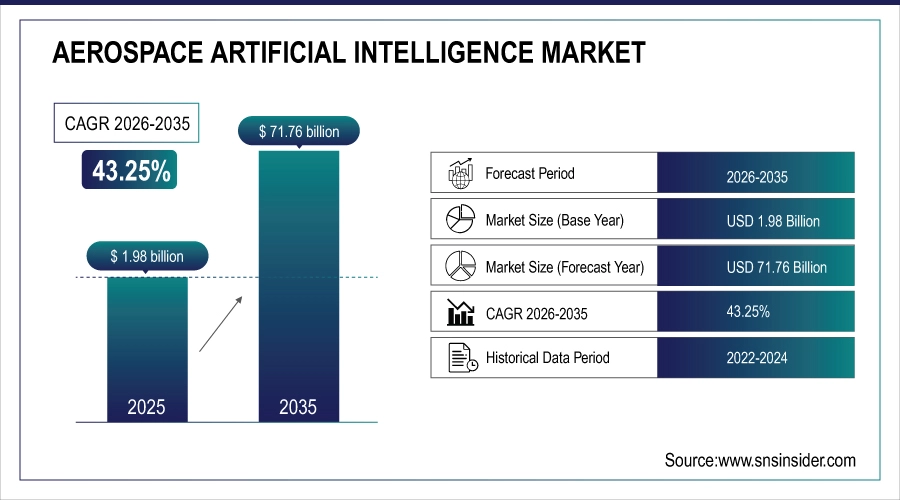
The Aerospace Artificial Intelligence Market size was valued at USD 1.98 billion in 2025 and is projected to reach USD 71.76 billion by 2035, growing at a CAGR of 43.25% during 2026–2035.
The Aerospace Artificial Intelligence market is witnessing significant growth due to increasing adoption of AI in predictive maintenance, autonomous flight systems, and flight operations optimization. AI applications, including machine learning, computer vision, and real-time data analytics, enhance aircraft performance, fuel efficiency, and operational safety. Growing demand from commercial airlines, defense, and space programs is accelerating AI integration in design, embedded software, and simulation processes.
To Get more information on Infrastructure as a Service Market - Request Free Sample Report
Trends in the Aerospace Artificial Intelligence Market:
-
Rising adoption of AI for predictive maintenance to reduce aircraft downtime and extend component lifespan.
-
Increasing integration of autonomous flight systems and AI-enabled cockpit technologies.
-
AI-driven flight analytics optimizing fuel efficiency and reducing operational costs.
-
Machine learning and computer vision improving defect detection, inspection, and quality control.
-
Deployment of AI in air traffic management to enable real-time decision-making and congestion reduction.
-
Growing investment in AI for defense and space programs, expanding applications in advanced aerospace analytics.
-
Strategic partnerships between AI software providers and aerospace OEMs to accelerate digital transformation.
U.S. Aerospace Artificial Intelligence Market Size Outlook:
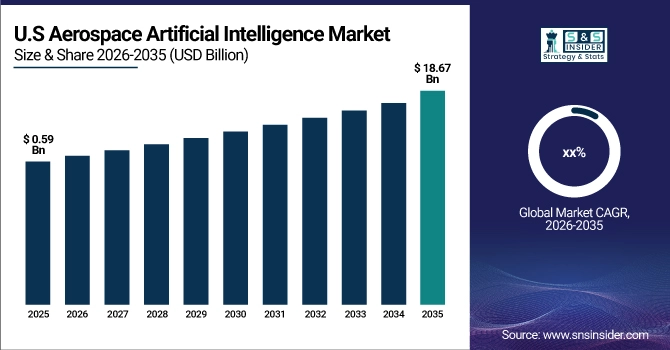
The U.S. Aerospace Artificial Intelligence Market was valued at USD 0.59 billion in 2025 and is projected to reach USD 18.67 billion by 2035, driven by growing adoption of AI in flight operations, predictive maintenance, and autonomous systems. Expansion in defense programs and commercial airline fleets, along with advancements in machine learning and computer vision for real-time analytics, is further fueling market growth, enhancing operational efficiency, safety, and cost-effectiveness across the aerospace ecosystem.
Market Driver: Rapid Adoption of AI-Powered Predictive Maintenance in Commercial and Defense Aviation Drives Aerospace Artificial Intelligence Market Growth
The growing demand for AI-powered predictive maintenance is driving the Aerospace Artificial Intelligence Industry as airlines and defense operators seek to minimize unplanned downtime, reduce maintenance costs, and enhance aircraft reliability. Predictive analytics powered by machine learning enables real-time monitoring of critical aircraft components, anticipating failures before they occur, which directly improves operational efficiency. Increasing aircraft production and fleet expansions have accelerated AI integration, as operators aim to optimize maintenance schedules while complying with strict safety standards. Adoption of AI solutions in commercial, defense, and space programs ensures faster data-driven decision-making, enhanced safety, and reduced operational costs, creating a positive feedback loop that boosts market expansion. Investments in AI platforms by major aerospace players and partnerships with software providers further accelerate the market’s growth trajectory.
In March 2025, a leading U.S. airline implemented an AI-driven predictive maintenance system, which reduced unscheduled aircraft downtime by 18%, optimizing fleet utilization and reducing operational expenditures.
Market Restraint: High Implementation Costs and Data Security Concerns Hinder Aerospace Artificial Intelligence Market Growth
The Aerospace Artificial Intelligence Market faces restraint from high implementation costs, which include investment in AI platforms, cloud infrastructure, sensor integration, and skilled personnel. Organizations also encounter challenges related to cybersecurity and data privacy, as sensitive flight, operational, and defense data is processed and stored digitally. The need to comply with strict aviation regulatory standards while maintaining AI system accuracy creates additional complexity, limiting adoption by smaller operators or emerging markets. These factors discourage immediate large-scale AI deployment, slowing the overall market growth despite its promising long-term benefits. Providers must balance cost, system reliability, and data security to gain industry trust.
In January 2025, a mid-sized aerospace component manufacturer delayed AI adoption due to estimated implementation costs exceeding USD 2.3 million and potential regulatory compliance risks, demonstrating the financial and security barriers facing smaller operators.
Market Opportunity: Integration of AI-Enabled Autonomous Flight Systems in Commercial and Defense Aviation Presents Key Market Opportunity
The Aerospace Artificial Intelligence Industry is seeing a significant opportunity through the integration of AI-enabled autonomous and semi-autonomous flight systems, which enhance operational efficiency, safety, and cost-effectiveness. These systems rely on real-time machine learning and computer vision algorithms to optimize flight paths, detect obstacles, and automate routine operations. Increasing interest from airlines and defense organizations in reducing pilot workload, improving fuel efficiency, and enabling advanced air mobility solutions is accelerating adoption. Partnerships between aerospace OEMs and AI software developers are fostering innovation, while government initiatives supporting autonomous aircraft testing and deployment further expand market opportunities. These developments are enabling aerospace operators to leverage AI for both commercial and strategic advantages, driving long-term growth.
In July 2025, a European defense agency successfully conducted autonomous flight trials using AI-powered aircraft, demonstrating improved navigation accuracy, obstacle avoidance, and operational efficiency, highlighting the opportunity for commercial and defense applications.
Aerospace Artificial Intelligence Market Segmentation Analysis:
By Offering, Software Leads Market While Services Segment Registers Fastest Growth
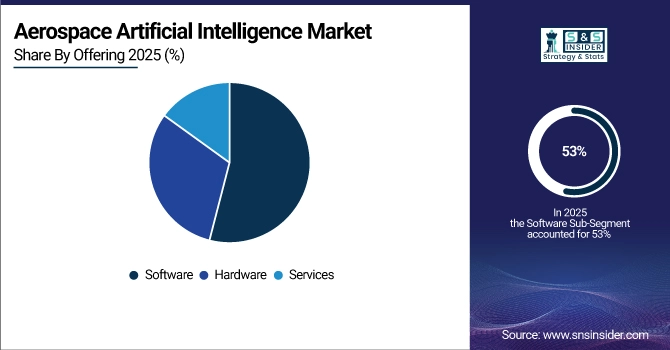
The Software segment dominates with 53% of revenue in 2025 due to the growing deployment of AI platforms for predictive maintenance, autonomous systems, and flight analytics. The development of advanced AI software, including machine learning algorithms and computer vision applications, enables real-time monitoring, data-driven decision-making, and operational efficiency. Aerospace operators increasingly rely on AI software to reduce downtime, optimize fuel usage, and enhance safety, directly contributing to the expansion of the Aerospace Artificial Intelligence Industry globally.
The Services segment is growing at the fastest CAGR of 47.45% during 2026–2035, driven by rising demand for AI implementation, integration, consulting, and maintenance support. Managed services and AI deployment programs allow aerospace companies to implement predictive analytics, autonomous flight systems, and inspection solutions without heavy capital investment. These service offerings facilitate faster adoption of AI solutions across commercial, defense, and space sectors, enhancing operational efficiency, safety, and cost savings while accelerating the overall market growth.
By Technology, Machine Learning Leads Market While Computer Vision Segment Registers Fastest Growth
The Machine Learning segment dominates with 42% of revenue in 2025 as airlines, defense agencies, and space operators leverage algorithms to predict component failures, optimize flight paths, and improve operational efficiency. Real-time data analytics and predictive insights allow operators to minimize costs, reduce downtime, and enhance safety. Continuous development of ML models and integration into AI platforms further solidifies this segment’s leadership in driving adoption within the Aerospace Artificial Intelligence Market globally.
The Computer Vision segment is projected to grow at the highest CAGR of 45.22% during 2026–2035 due to increasing demand for automated inspections, defect detection, and autonomous aircraft navigation. AI-powered vision systems detect structural anomalies, monitor maintenance needs, and support autonomous operations, reducing human error and operational risks. Enhanced imaging technologies and machine learning integration are accelerating adoption, positioning computer vision as a critical enabler for efficiency, safety, and growth in the Aerospace Artificial Intelligence Market.
By Application, Predictive Maintenance Leads Market While Autonomous Systems Segment Registers Fastest Growth
Predictive Maintenance dominates with 39% of revenue in 2025 as aerospace operators adopt AI to monitor engines, avionics, and structural components. Real-time predictive insights reduce unplanned downtime, optimize maintenance scheduling, and extend asset lifespan. The development of AI-driven sensor analytics, anomaly detection, and maintenance software ensures proactive interventions, directly enhancing operational efficiency and safety. These factors are driving increased AI integration and fueling the expansion of the Aerospace Artificial Intelligence Market.
The Autonomous Systems segment is expected to grow at the fastest CAGR of 48.68% during 2026–2035 due to rising investment in AI-enabled drones, autonomous aircraft, and UAVs. These systems leverage machine learning and computer vision to navigate, optimize flight paths, and detect obstacles with minimal human intervention. Enhanced safety, fuel efficiency, and operational flexibility encourage commercial and defense operators to adopt autonomous systems, significantly accelerating growth in the market globally.
By End Use, Aircraft Manufacturers (OEMs) Lead Market While Airlines Segment Registers Fastest Growth
Aircraft Manufacturers dominate with 35% of revenue in 2025 as OEMs integrate AI solutions into design, manufacturing, and operational processes. Predictive maintenance, autonomous flight systems, and AI-driven analytics optimize aircraft production and fleet performance. Continuous software and AI technology development allows OEMs to deliver advanced, safer, and more efficient aircraft, directly driving the adoption of Aerospace Artificial Intelligence solutions across global markets.
The Airlines segment is growing at the fastest CAGR of 45.83% during 2026–2035 due to increasing adoption of AI for operational efficiency, predictive maintenance, and autonomous flight assistance. Airlines use AI analytics to optimize scheduling, monitor engine performance, and improve passenger safety. Integration of AI-driven software and services reduces costs, enhances fuel efficiency, and increases operational reliability, contributing significantly to the growth of the Aerospace Artificial Intelligence Market worldwide.
Aerospace Artificial Intelligence Market Regional Insights:
North America Dominates Aerospace Artificial Intelligence Market in 2025
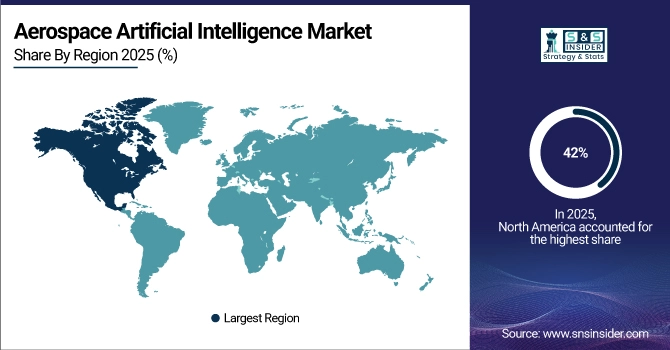
North America holds an estimated 42% market share in 2025, driven by strong aerospace infrastructure, high AI adoption in aviation, and government-funded R&D initiatives. The United States dominates the North American Aerospace Artificial Intelligence Market due to its mature aerospace ecosystem, robust AI research, and extensive commercial and defense aviation networks. Major U.S. aircraft manufacturers and airlines are integrating AI for predictive maintenance, autonomous systems, and flight analytics to improve operational efficiency, safety, and cost management. Advanced government programs, partnerships with AI startups, and investment in next-generation AI-enabled aircraft further strengthen U.S. leadership, making it the primary driver of regional market growth and innovation.
Get Customized Report as per Your Business Requirement - Enquiry Now
Asia-Pacific is the Fastest-Growing Region in Aerospace Artificial Intelligence Market 2026–2035
Asia-Pacific is projected to grow at an estimated CAGR of 45.98%, fueled by increasing aerospace investments, emerging AI startups, and rising demand for autonomous aircraft. China leads the Asia-Pacific Aerospace Artificial Intelligence Industry as the country expands its commercial aviation sector, UAV deployments, and defense aerospace programs. Rapid development of AI technologies, government-backed R&D incentives, and partnerships with global AI software providers support the integration of predictive maintenance, computer vision, and autonomous systems into aviation operations. Increasing air traffic, modernization of airports, and fleet expansion drive AI adoption, positioning China as the region’s primary growth engine in the Aerospace Artificial Intelligence Market.
Europe Aerospace Artificial Intelligence Market Insights, 2025
In 2025, Europe accounted for a significant share of the Aerospace Artificial Intelligence Market, supported by strong aerospace manufacturing, digital transformation initiatives, and AI adoption in aviation safety and maintenance. Germany drives Europe’s market growth due to its advanced aircraft manufacturing industry and adoption of AI in predictive maintenance, autonomous flight systems, and operational analytics. Government incentives for smart aerospace technologies and collaborations between OEMs and AI developers accelerate adoption, improving efficiency, reducing downtime, and enhancing safety. Germany’s innovation-driven aerospace ecosystem makes it the leading European country contributing to regional AI market expansion.
Middle East & Africa and Latin America Aerospace Artificial Intelligence Market Insights, 2025
In 2025, the Middle East & Africa demonstrated steady growth in the Aerospace Artificial Intelligence Industry due to investments in modern airports, defense aviation modernization, and AI-enabled fleet operations. The UAE leads the region, leveraging AI for predictive maintenance and autonomous air traffic systems, improving safety and operational efficiency.
Latin America showed moderate market expansion, led by Brazil and Mexico, as airlines and defense agencies integrate AI for fleet optimization, predictive maintenance, and flight analytics. Government support for digital aviation initiatives and modernization of infrastructure further strengthens AI adoption, positioning these countries as emerging hubs for aerospace AI technologies in the region.
Competitive Landscape for the Aerospace Artificial Intelligence Market:
Lockheed Martin
Lockheed Martin is a U.S.-based global aerospace and defense leader, specializing in advanced aircraft, satellites, and AI-enabled systems. The company integrates artificial intelligence into autonomous flight platforms, predictive maintenance solutions, and sensor analytics for commercial and defense aviation. With decades of aerospace engineering expertise, Lockheed Martin develops AI technologies that enhance operational efficiency, flight safety, and mission reliability. Its role in the Aerospace Artificial Intelligence Industry is critical, providing end-to-end AI solutions that optimize aircraft performance and support global aerospace innovation.
-
In May 2025, Lockheed Martin unveiled an AI-driven predictive maintenance platform for military aircraft, integrating machine learning to anticipate component failures, reduce downtime, and improve fleet readiness across global defense operations.
Boeing
Boeing is a U.S.-based multinational aerospace company, renowned for commercial and military aircraft, space systems, and AI-integrated aviation solutions. Boeing leverages AI for autonomous flight systems, predictive maintenance, and operational analytics to improve fleet efficiency, safety, and cost-effectiveness. By combining its engineering expertise with advanced AI platforms, Boeing plays a pivotal role in the Aerospace Artificial Intelligence Market, enabling airlines, defense operators, and space programs to adopt intelligent aviation technologies at scale.
-
In March 2025, Boeing launched an AI-powered analytics system for commercial airlines that monitors engine performance, predicts maintenance needs, and optimizes flight operations, reducing operational costs and improving overall fleet reliability.
Airbus
Airbus is a European aerospace leader specializing in commercial aircraft, defense systems, and AI-enhanced aviation technologies. The company integrates artificial intelligence in predictive maintenance, autonomous flight management, and aircraft design optimization. Airbus’s focus on AI improves operational efficiency, reduces unplanned downtime, and enhances passenger safety, solidifying its influence in the Aerospace Artificial Intelligence Industry globally. Continuous innovation and partnerships with AI software providers strengthen Airbus’s leadership in deploying advanced aviation intelligence solutions.
-
In June 2025, Airbus introduced an AI-assisted autonomous inspection system for its A320 and A350 fleets, using computer vision and machine learning to detect structural anomalies and maintenance requirements, significantly improving operational safety and efficiency.
Northrop Grumman
Northrop Grumman is a U.S.-based aerospace and defense technology leader, focusing on autonomous systems, unmanned aircraft, and AI-driven defense solutions. The company develops AI algorithms for flight navigation, predictive maintenance, and surveillance systems, enhancing operational readiness, safety, and mission efficiency. Northrop Grumman’s expertise in aerospace AI positions it as a key contributor to the market, providing advanced solutions for commercial, defense, and space applications globally.
-
In April 2025, Northrop Grumman deployed an AI-based autonomous UAV platform capable of real-time obstacle detection and adaptive flight path optimization, improving mission efficiency and operational safety for defense operations.
Aerospace Artificial Intelligence Companies are:
-
Boeing
-
Airbus
-
Northrop Grumman
-
Raytheon Technologies
-
IBM
-
NVIDIA
-
Thales Group
-
Honeywell Aerospace
-
BAE Systems
-
Leidos Holdings
-
Palantir Technologies
-
SITA
-
Indra Sistemas
-
SparkCognition
-
Collins Aerospace
-
Intel
-
Infosys
-
Shield AI
| Report Attributes | Details |
|---|---|
| Market Size in 2025 | USD 1.98 Billion |
| Market Size by 2035 | USD 71.76 Billion |
| CAGR | CAGR of 43.25 % From 2026 to 2035 |
| Base Year | 2025 |
| Forecast Period | 2026-2035 |
| Historical Data | 2022-2024 |
| Report Scope & Coverage | Market Size, Segments Analysis, Competitive Landscape, Regional Analysis, DROC & SWOT Analysis, Forecast Outlook |
| Key Segments | • By Offering (Software, Hardware, Services) – Software; Services • By Technology (Machine Learning, Computer Vision, Natural Language Processing, Others) – Machine Learning; Computer Vision • By Application (Flight Operations, Predictive Maintenance, Manufacturing, Autonomous Systems) – Predictive Maintenance; Autonomous Systems • By End Use (Airlines, Defense & Military, Aircraft Manufacturers (OEMs), Space Agencies) – Aircraft Manufacturers (OEMs); Airlines |
| Regional Analysis/Coverage | North America (US, Canada), Europe (Germany, UK, France, Italy, Spain, Russia, Poland, Rest of Europe), Asia Pacific (China, India, Japan, South Korea, Australia, ASEAN Countries, Rest of Asia Pacific), Middle East & Africa (UAE, Saudi Arabia, Qatar, South Africa, Rest of Middle East & Africa), Latin America (Brazil, Argentina, Mexico, Colombia, Rest of Latin America). |
| Company Profiles | Lockheed Martin, Boeing, Airbus, Northrop Grumman, Raytheon Technologies, GE Aviation, IBM, NVIDIA, Thales Group, Honeywell Aerospace, BAE Systems, Leidos Holdings, Palantir Technologies, SITA, Indra Sistemas, SparkCognition, Collins Aerospace, Intel, Infosys, Shield AI. |
Frequently Asked Questions
Key companies include Lockheed Martin, Boeing, Airbus, and Northrop Grumman.
North America dominates, while Asia-Pacific is the fastest-growing region due to rising aerospace investments and AI adoption.
Predictive maintenance, autonomous flight systems, flight operations optimization, and manufacturing process improvements are primary applications.
Machine Learning leads due to predictive analytics, failure detection, and operational efficiency in aerospace applications.
It refers to AI technologies applied in aerospace for predictive maintenance, autonomous systems, flight operations, and manufacturing optimization.
