
Agricultural Biologicals Market Report Scope & Overview:
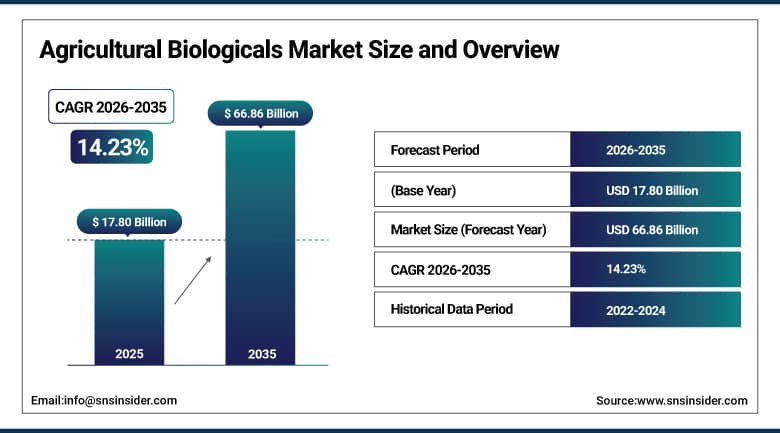
The Agricultural Biologicals Market was valued at USD 17.80 Billion in 2025 and is expected to reach USD 66.86 Billion by 2035, growing at a CAGR of 14.23% from 2026–2035.
The agricultural biologicals market is witnessing rapid growth worldwide owing to an increase in the demand for sustainable agriculture and organic food products. Farmers and agri-businesses are increasingly relying on the application of agricultural biologicals like biopesticides, biofertilizers, biostimulants, and biofungicides in place of traditional chemical pesticides. The growing influence of this trend is being witnessed due to the strict regulations regarding pesticides, consumer preferences for residue-free crops, and government policies for green farming solutions. The advancement in microbial and botanical science is leading to higher effectiveness of the product, whereas climate change is encouraging resilient solutions.
Andermatt Biocontrol has aggressively grown its international reach in the field of agriculture biologicals. The firm currently has more than 450 registrations of products spread out in more than 60 countries through its portfolio of over 35 proprietary products and 30+ third-party products. Through its acquisition of Entocare C.V., Andermatt Biocontrol reinforced its biological plant protection line of products in 2025 and bolstered its business in the production of beneficial insects. Regulatory successes such as the registration of Helicovex baculovirus solution in Australia with reduced dosing have also aided Andermatt Biocontrol in growing its presence in the industry.
To Get More Information On Agricultural Biologicals Market - Request Free Sample Report
Agricultural Biologicals Market Trends
-
The increasing inclination towards consumption of organic and residue-free produce is compelling farmers to opt for biological-based products as greener substitutes to artificial products.
-
The increasing implementation of stringent bans on chemical pesticides is promoting the use of bio-pesticides, bio-fertilizers, and biostimulants.
-
The increasing variability in climatic conditions and degrading quality of soil is encouraging the use of biological-based products that promote crop resilience and soil fertility.
-
Large corporations are acquiring innovative small companies to diversify their portfolio and expand globally.
-
There is ongoing development of products in liquid, dry, and encapsulated forms and Growing demand for climate-resilient solutions such as drought-, heat-, and stress-tolerant biostimulants.
U.S. Agricultural Biologicals Market Size Outlook.
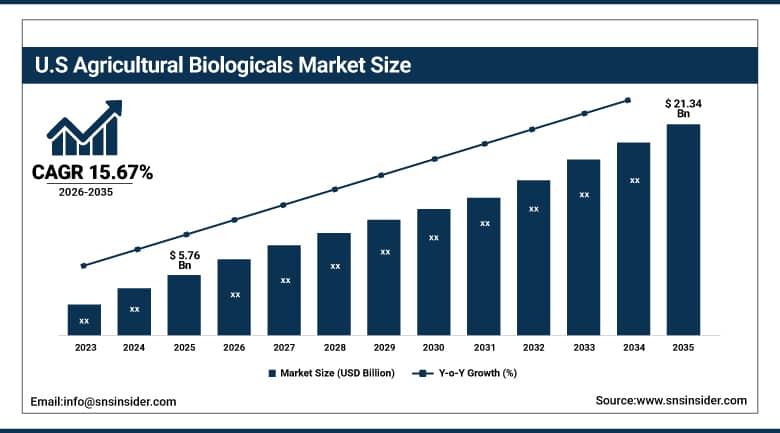
The U.S. Agricultural Biologicals Market was valued at USD 5.76 Billion in 2025 and is expected to reach around USD 21.34 Billion by 2035, growing at a CAGR of 15.67% from 2026–2035.
U.S. agricultural biologicals market is expected to grow due to increasing trends of sustainability in agriculture and organic farming practices. There is a growing trend among farmers to use biological products as substitutes to synthetic compounds such as biopesticides, biofertilizers, biostimulants, and biofungicides. This growth will be influenced by the existing strict regulation on chemical pesticides as well as policies and regulations that promote organic agriculture solutions. Technological advancements related to microbial research and botanicals will contribute to higher efficiency and longer shelf life of biological products, making them easier to implement on large areas of farmlands. Application of seed treatment, foliar spray, and soil application will grow in cereals & grains, fruits & vegetables, and oilseeds & pulses.
Gowan Company expanded its presence in the US agricultural biologicals market with portfolio expansion and collaboration. In 2025, the company completed integration of Ceradis, bringing new bio-mineral technology in disease management along with innovative products for crop protection that provide multiple sites of action across more than 15 programs.
Agricultural Biologicals Market Segment Analysis
-
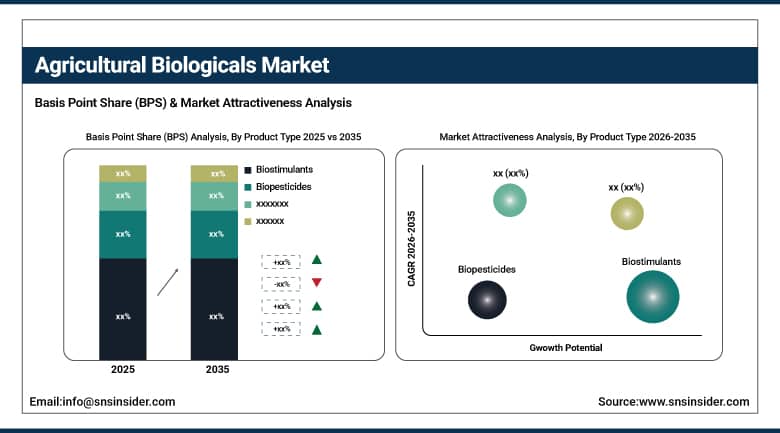
By Product Type, biostimulants segment dominated the agricultural biologicals market with 32.89 % share in 2025 and it is also fastest growing segment.
-
By Source, microbial-based segment dominated the agricultural biologicals market with 45.23% share in 2025; while Biochemical-based is the fastest growing segment.
-
By Application, foliar spray dominated the agricultural biologicals market with 41.56% share in 2025; while it is also the fastest growing segment.
-
By Crop Type, cereals & grains dominated the agricultural biologicals market with 46.52% share in 2025; while Fruits & vegetables are the fastest growing segment.
-
By Formulation, liquid formulations segment dominated the agricultural biologicals market with 50.14% share in 2025; while encapsulated formulations are the fastest growing segment.
By Product Type, biostimulants segment dominates the agricultural biologicals market and is also the fastest growing segment.
The biostimulants category made up the largest share in terms of revenue within the agricultural biologicals market in 2025. The growing global need for agricultural products that can provide sustainable solutions for enhancing the efficiency of nutrient uptake, improving plant metabolism, root growth, and abiotic stress resistance regardless of the climatic conditions experienced is driving this trend. Adoption of agricultural biostimulants has increased because farmers appreciate how well they fit into organic, regenerative, and precision agriculture practices. They are beneficial to yield quality, crop resistance, and soil microbial community health and don't have to rely significantly on chemical fertilizers. Growth will be at the fastest compound annual growth rate during the period 2026–2035 because of the degradation of soils, climate change, decreasing arable land productivity, and more stringent global laws about synthetic agrochemicals.
By Source, microbial-based segment dominates the agricultural biologicals market while biochemical-based is also the fastest growing segment.
Agricultural biologicals based on microorganisms constituted the dominant segment in terms of revenue share in the year 2025. Microbial-based agricultural biologicals have become very popular because of wide usage of microbes such as bacteria, fungi, and other strains of microbes that help improve soil quality and increase nutrients in the soil by using natural biological processes. They are being used in IPM practices and sustainable agriculture because of the agronomically proven benefits and their positive impact on soil.
Biochemical-based agricultural biologicals emerged as the fastest-growing segments owing to significant advances in the field of biochemical products including plant extracts, enzymes, amino acids, and bioactive compounds that offer physiological benefits to crops. Moreover, increasing consumer preference towards residue-free foods, rapid adoption of organic farming, and regulatory measures for reducing dependence on chemicals in farming have contributed to growth in this segment.
By Application, foliar spray dominates the agricultural biologicals market and is also the fastest growing segment.
Foliar spray held a dominant position in the agricultural biologicals industry, with the highest revenue share in 2025. This is attributed to the high efficiency of delivering essential nutrients and biostimulants to plants via this method, facilitating quick absorption and effective physiological reactions within the plants. Foliar application is highly favored by farmers owing to its easy-to-administer process, applicability using current spray devices, and effectiveness in dealing with nutrient deficiency and crop stress problems in real-time situations. This category is projected to register the highest CAGR during the forecast period from 2026 to 2035 because of the increased use of precision farming methods and nutrient management techniques.
By Crop Type, cereals & grains dominate the agricultural biologicals market while fruits & vegetables are the fastest growing segment.
Cereals & Grains held the leading share of revenues in the global biologicals market in 2025. This is attributed to the widespread cultivation of staple foods like wheat, rice, corn, barley, and sorghum, all of which constitute a major portion of food security across the world, which needs to be enhanced in terms of productivity, fertility, and stress tolerance.
The fruits and vegetables segment is also witnessing a significant growth owing to rising consumer inclination towards organically-grown products with high nutrition content and safety. Growing trend towards cultivation of horticulture crops for exports is also boosting the segment’s growth.Food safety rules, along with increasing health consciousness among consumers, are also adding impetus to the market's growth trajectory.
By Formulation, liquid formulations segment dominates the agricultural biologicals market while encapsulated formulations are also the fastest growing segment.
The liquid formulations sector was leading the agricultural biologicals market with the largest revenue share in 2025 owing to the high solubility properties, ease of use, quick absorption by crops, and greater compatibility with the latest irrigation systems, fertigation techniques, and foliar spray systems. The use of liquid formulations is highly favored among farmers due to its effective results and easy integration in their farming operations.
The encapsulated formulations sector was growing at the fastest pace owing to advancements in controlled release technology and higher product efficacy in the fields. The increasing demand for precision farming techniques, sustainability in inputs, and long-term cost-efficiency of agricultural biologics will drive the growth of the encapsulated formulations segment.
Regional Insights:
|
Region |
Major Country |
Share within Region, 2025(%) |
|---|---|---|
|
North America |
United States |
84.61% |
|
Europe |
Germany |
37.19% |
|
Asia Pacific |
China |
42.48% |
|
Middle East & Africa |
UAE |
16.89% |
|
Latin America |
Brazil |
21.78% |
North America Agricultural Biologicals Market Insights.
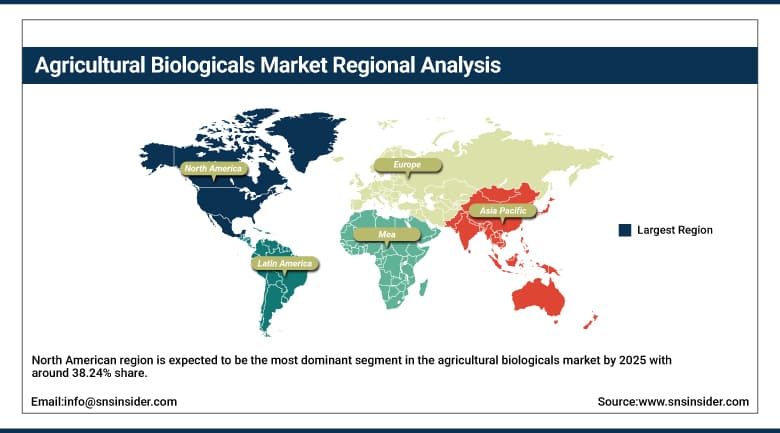
The North American region is expected to be the most dominant segment in the agricultural biologicals market by 2025 with around 38.24% share in terms of global revenue mainly due to high implementation of sustainable agriculture practices and production of organic food. This can be attributed to the availability of prominent companies operating in this industry including BASF, Bayer, Syngenta, Corteva, and FMC which are working hard in enhancing their biological product portfolio. Stringent regulations set forth by the EPA that restrict the usage of chemical pesticides, along with several government programs to promote green products have boosted the adoption of biological-based pesticides, fertilizers, and biostimulants among farmers. Growing consumers' inclination towards organic food consumption, along with rising consciousness regarding soil fertility and diversity, will remain a key investment area in this sector in both the U.S. and Canada.
Marrone Bio Innovations continues to advance next-generation bioinsecticide and biostimulant platforms, focusing on expanded microbial strain libraries and AI-assisted discovery models that have improved microbial hit rates from 2.45% historically to over 25.42% in advanced screening pipelines, significantly accelerating product development cycles for sustainable agriculture applications across the U.S.
Get Customized Report as Per Your Business Requirement - Enquiry Now
Europe Agricultural Biologicals Market Insights.
Europe is one of the markets where agricultural biologicals have been well-established, earning substantial revenue share from the stringent regulation of GDPR and effective digital governance infrastructure in 2025. Biopesticides, biofertilizers, and biostimulants have been adopted effectively in countries like Germany, France, UK, and the Netherlands. The focus on data protection, transparency, sustainability, and food safety in European regulations makes enterprises and farmers adopt agricultural biologicals for their benefits. In addition to that, European citizens’ preference for organic food further adds value to the innovative use of agricultural biologicals in Europe.
Koppert’s field program shows that there is a 60% decrease in chemical pesticides when integrated with biological farming in a controlled environment. Also, the company's move towards biostimulant-based soil enhancement solutions reflects the growing demand for residual free products.
Asia Pacific Agricultural Biologicals Market Insights.
Asia Pacific is one of the fastest-growing segments with regard to the Asia Pacific agricultural biologicals market which contributed to consistent global revenues in 2025. Further, this regional market is expected to register a CAGR of 15.69% between 2026 and 2035. This is due to the rapid digitization of the sector, higher internet penetration, and strict regulatory environment surrounding agriculture and the environment in countries like China, India, Japan, and South Korea. Government policies like data protection rules of China, DPDP of India, and privacy reforms in Japan have led to rapid expansion of the market. Increasing investment in digital technologies and sustainable agriculture practices are helping boost the growth rate.
Bayer AG has been expanding its biologicals-related digital agriculture ecosystem in Asia Pacific by incorporating agricultural innovations with artificial intelligence-based farm advisory systems. Further, Bayer AG is making advancements in microbial seed treatment products that will be able to offer 15% increase in yields by improving germination rates in crops.
Middle East & Africa and Latin America Agricultural Biologicals Market Insights.
Middle East & Africa and Latin America markets made up a significant part of the agricultural biologicals industry, propelled by the quick development of digitization and cloud-based services along with the emergence of cybersecurity risks faced by both companies and governmental organizations. The UAE, Saudi Arabia, South Africa, Brazil, and Mexico are among the countries that make heavy investments in developing their security frameworks for enterprises and governments. The fast-paced growth of e-commerce and fintech solutions, alongside awareness of the necessity to comply with international legislation regarding data protection and the increase of cyberattacks, drives the implementation of more advanced biological solutions.
Bioceres Crop Solutions (Argentina) is emerging as a key regional innovator in microbial-based crop nutrition and biological seed treatment solutions. Recent developments include increased deployment of stress-tolerance biological seed treatments and nitrogen-use efficiency solutions aimed at reducing synthetic fertilizer dependence by 25% in field trials across Argentina and Brazil.
Growth Drivers: Rapid digital transformation and increasing volume of enterprise data across cloud and connected ecosystems
The rise of digital transformation is causing large amounts of both structured and unstructured data to be created through cloud computing, enterprise applications, and IoT systems. Businesses are increasingly relying on cloud infrastructure, working from home models, and artificial intelligence apps, thus increasing the need for data security and protection. In addition, there is an increase in the number and complexity of data environments making it difficult to track all risks associated with data. There is a need for automation technologies for discovering, categorizing, encrypting, and monitoring all data risks.
Restraints: Lack of skilled professionals and technical expertise in data governance and privacy management systems
Implementation of successful agricultural biologicals relies on highly qualified individuals who have the relevant skills in areas like data governance, cybersecurity, compliance models, and advanced digital agriculture technologies. Unfortunately, the available workforce in these areas is inadequate, which results in poor adoption of advanced technology and inefficiency. Lack of such qualified personnel continues to be a serious challenge in successfully implementing modern digital solutions. Ongoing training and reskilling will help in keeping up with changing digital tools and standards. This deficiency continues to pose significant barriers, especially in developing agricultural economies worldwide.
Opportunities: Agricultural Biologicals market are being shaped by the integration of artificial intelligence and automation into next-generation farming solutions.
AI and machine learning are providing automated means of crop monitoring, analysis of soil health, detecting pests, and modeling the yields for decision-making that benefit farmers. Such technologies minimize the need for human interaction, ensure greater precision, and facilitate optimal use of biological pesticides, fertilizers, and growth stimulators. Intelligent platforms using biology provide the ability to assess risks in real-time associated with plant diseases and environmental hazards, whereas prediction models may be used to determine any threats before they become critical.
Recent Developments
-
2026: BASF SE bolstered its biologicals product portfolio with microbial crop protection and biostimulant solutions, thus fortifying its approach towards sustainable agriculture in Europe, North America, and Latin America. Moreover, the organization increased its investments in R&D activities focused on developing bio-based solutions for better soil management, higher nutrients efficiency, and more resilient crop growth in key agricultural regions.
-
2025: Bayer AG continued its progress in the Agricultural Biologicals division through the integration of digital technologies into the company’s operations related to bio-inputs, namely through precision application of biostimulants and microbial solutions. Moreover, the company bolstered its pipeline of sustainable agriculture initiatives through the establishment of new partnerships and experimental field tests worldwide.
-
2026: Next generation biologicals for crop protection by Syngenta Group were developed using microbial and fermentation technologies to improve pest management and enhance soil properties. Large scale field application activities were expanded by the company in the regions of Asia-Pacific and Latin America as part of the sustainability efforts in agriculture and reducing reliance on chemical fertilizers.
-
2025: Corteva Inc. accelerated research into seed applied biologicals and microbial inoculants to support early growth and stress tolerance in crops. Biologicals development was driven via strategic acquisitions and partnerships to develop innovative technologies that boost plant yield sustainably in key row crops cultivated in North America and Europe.
Agricultural Biologicals Market Key Players are:
-
BASF SE
-
Bayer AG
-
Syngenta Group
-
Corteva Inc.
-
FMC Corporation
-
UPL Ltd.
-
Sumitomo Chemical Co. Ltd.
-
Nufarm Ltd.
-
Lallemand Inc.
-
Novonesis
-
Marrone Bio Innovations
-
Gowan Company
-
Valent Biosciences
-
Koppert Biological Systems
-
Vegalab SA
-
Trade Corporation International
-
Biovert S.L.
-
Certis Biologicals
-
AgroSpheres
-
Andermatt Biocontrol
Agricultural Biologicals Market Report Scope:
| Report Attributes | Details |
|---|---|
| Market Size in 2025 | USD 17.80 Billion |
| Market Size by 2035 | USD 66.86 Billion |
| CAGR | CAGR of 14.23% From 2026 to 2035 |
| Base Year | 2025 |
| Forecast Period | 2026-2035 |
| Historical Data | 2022-2024 |
| Report Scope & Coverage | Market Size, Segments Analysis, Competitive Landscape, Regional Analysis, DROC & SWOT Analysis, Forecast Outlook |
| Key Segments | • By Process Type (Wet-Mix Sprayed Concrete, Dry-Mix Sprayed Concrete, Robotic Spraying Systems, Manual Spraying Systems, Others), • By System Type (Open System, Closed System, Dense Flow System, Dilute Flow System, Others), • By Application (Underground Construction (Tunnels & Mining), Repair & Rehabilitation, Water Retaining Structures, Protective Coatings & Linings, Others), • By End-Use Industry (Construction & Infrastructure, Mining, Oil & Gas, Water & Wastewater Management, Others), • By Material Type (Fiber-Reinforced Sprayed Concrete, Polymer-Modified Sprayed Concrete, Silica Fume-Based Sprayed Concrete, Standard Cement-Based Sprayed Concrete, Others) |
| Regional Analysis/Coverage | North America (US, Canada), Europe (Germany, UK, France, Italy, Spain, Russia, Poland, Rest of Europe), Asia Pacific (China, India, Japan, South Korea, Australia, ASEAN Countries, Rest of Asia Pacific), Middle East & Africa (UAE, Saudi Arabia, Qatar, South Africa, Rest of Middle East & Africa), Latin America (Brazil, Argentina, Mexico, Colombia, Rest of Latin America). |
| Company Profiles | BASF SE, Bayer AG, Syngenta Group, Corteva Inc., FMC Corporation, UPL Ltd., Sumitomo Chemical Co. Ltd., Nufarm Ltd., Lallemand Inc., Novonesis, Marrone Bio Innovations, Gowan Company, Valent Biosciences, Koppert Biological Systems, Vegalab SA, Trade Corporation International, Biovert S.L., Certis Biologicals, AgroSpheres, Andermatt Biocontrol. |

Frequently Asked Questions
The Agricultural Biologicals market is expected to grow at a CAGR of 14.23% from 2026 to 2035.
The Agricultural Biologicals market was valued at USD 17.80 billion in 2025.
The market is primarily driven by the rising demand for sustainable farming practices, increasing adoption of organic food, and stringent regulations limiting chemical pesticide use.
Biostimulants segment dominated the market in 2025 due to scalable deployment and centralized data governance.
North America dominated the market in 2025 for Agricultural Biologicals.
