
AI Drug Repurposing Market Report Scope & Overview:
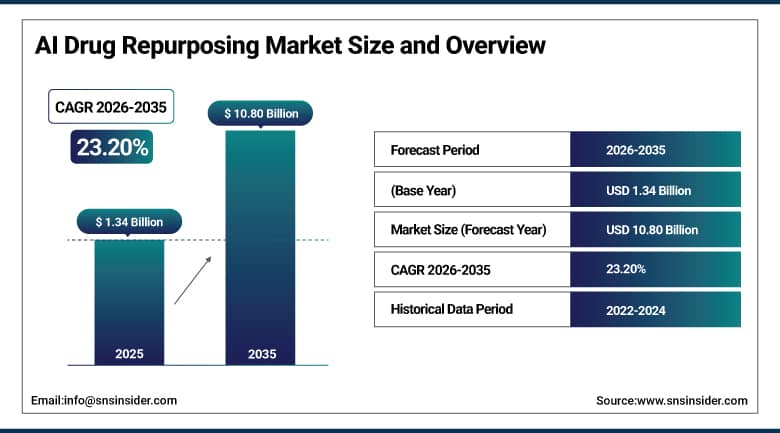
The AI Drug Repurposing Market was valued at USD 1.34 Billion in 2025 and is expected to reach USD 10.80 Billion by 2035, growing at a CAGR of 23.20% from 2026 to 2035.
There is steady growth in the market for AI Drug Repurposing Market, fueled by the need for faster and economical options compared to conventional drug development. Devising a new molecule can take longer than a decade and cost many billions of dollars. The use of artificial intelligence software for mining genomic, proteomic, and transcriptomic data as well as actual clinical data to find novel therapies from approved and abandoned drugs is becoming common practice. Growing prevalence of oncology, rare, orphan, and infectious diseases with limited treatment options is prompting pharmaceutical and biotechnology companies to adopt machine learning, deep learning, natural language processing, knowledge graph, and generative AI tools to systematically screen approved drug libraries against novel disease targets.
Insilico Medicine and Recursion Pharmaceuticals both expanded their generative AI-driven target discovery platforms in 2026 to accelerate identification of repurposing candidates for oncology and rare disease indications amid growing pharmaceutical industry demand for faster, lower-cost drug development pathways.
To Get More Information On AI Drug Repurposing Market - Request Free Sample Report
AI Drug Repurposing Market Trends:
-
Rising integration of generative AI and large language models is accelerating drug-target hypothesis generation across repurposing pipelines.
-
Growing use of knowledge graphs and network-based AI is improving drug-disease relationship mapping for complex and rare conditions.
-
Expanding pharma-AI collaborations are increasing repurposing candidate validation and clinical translation across oncology and infectious disease programs.
-
Increasing adoption of multi-omics data integration is enhancing precision in identifying novel indications for approved compounds.
-
Rising government and academic funding for computational drug repositioning is broadening repurposing research across neurological and orphan diseases.
U.S. AI Drug Repurposing Market Outlook:
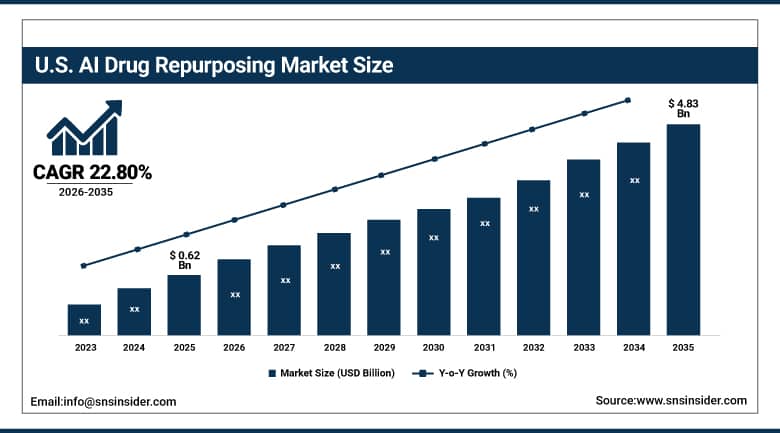
The U.S. AI Drug Repurposing Market was valued at USD 0.62 Billion in 2025 and is projected to reach USD 4.83 Billion by 2035, growing at a CAGR of 22.80% during 2026–2035.
The US continues to stay ahead in AI-assisted drug repurposing thanks to a web of AI-native biotechnology startups, large R&D investments from venture and pharmaceutical sources, and synergistic relations between academic medical institutions and computational drug discovery companies. The best homegrown pharmas and biotechs are now relying on machine learning and generative AI technologies in their early pipeline decisions to discover novel indications for already approved or forgotten drugs. This is especially the case in oncology, rare diseases, and infectious diseases where shortened development times and good regulatory environment make repurposed molecules highly desirable. With growing cloud computing infrastructure, growing availability of real-world and genomic datasets, and continuous federal investments in computational drug repurposing, the domestic innovation system is fostering the advanced development of AI-assisted drug repurposing platforms.
In 2026, Recursion Pharmaceuticals expanded its Recursion OS phenomics mapping platform with additional automated screening capacity, strengthening its ability to identify novel repurposing candidates for U.S. pharmaceutical and biotechnology partners across oncology and rare disease programs.
AI Drug Repurposing Market Segment Analysis:
-
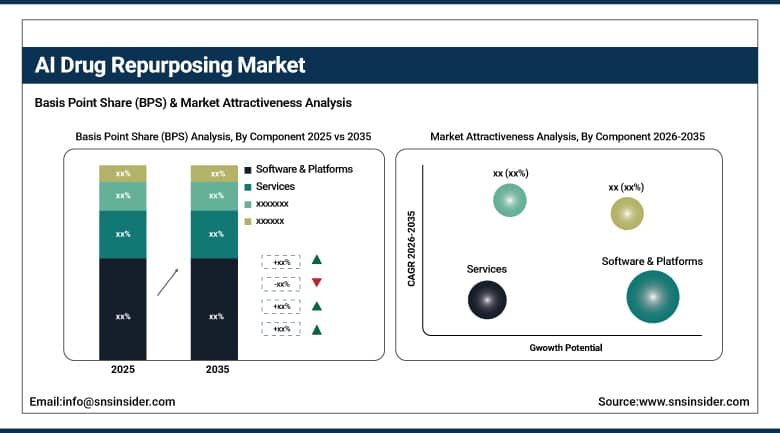
By Component, Software & Platforms dominated the AI Drug Repurposing Market with a 65.80% share in 2025, while Services is the fastest-growing segment with a CAGR of 26.40% from 2026–2035.
-
By Technology, Machine Learning/Deep Learning dominated the AI Drug Repurposing Market with a 42.60% share in 2025, while Generative AI & Large Language Models is the fastest-growing segment with a CAGR of 27.80% from 2026–2035.
-
By Application, Oncology dominated the AI Drug Repurposing Market with a 34.50% share in 2025, while Infectious Diseases is the fastest-growing segment with a CAGR of 26.90% from 2026–2035.
-
By End Use, Pharmaceutical & Biotechnology Companies dominated the AI Drug Repurposing Market with a 58.40% share in 2025, while Academic & Research Institutes is the fastest-growing segment with a CAGR of 25.30% from 2026–2035.
By Component, Software & Platforms dominated the AI Drug Repurposing Market, while Services is the fastest-growing segment.
The Software & Platforms segment led the AI Drug Repurposing Market in 2025, having a revenue share of 65.80%. Essential for drug repurposing processes are computing platforms that have been designed with the ability to perform tasks based on machine learning, deep learning, knowledge graphs, and generative AI engines. The platforms help pharma and biotech companies to perform massive virtual screening processes, drug-target mapping, and biomarker identification inside their licensed or proprietary software. Thanks to such platforms, research organizations can easily cross-reference their drug libraries with thousands of possible targets, thus saving much time for literature research and wet-lab screening required to find suitable candidates for drug repurposing. Moreover, efforts of AI-first drug discovery companies aimed at improving platforms, models, and databases, as well as rising number of licensing agreements with leading pharma companies, contribute to the market dominance of the software & platforms segment.
The Services segment is expected to register the fastest CAGR of 26.40% during the forecast period 2026-2035. Growing demand for specialized data curation, model validation, regulatory-alignment support, and custom pipeline integration services is driving strong adoption among pharmaceutical and biotechnology companies that lack extensive in-house computational drug discovery expertise. As AI-driven repurposing platforms mature and increasingly commoditize, service providers offering deployment support, dataset preparation, and clinical translation guidance are capturing a growing share of overall spending, reflecting a broader industry shift from one-time software licensing toward ongoing advisory and technical partnership models. Rising outsourcing of computational biology and bioinformatics workflows by mid-sized biotechnology firms and academic research institutions is further supporting the above-average growth rate of the services category relative to the broader AI Drug Repurposing Market.
By Technology, Machine Learning/Deep Learning dominated the AI Drug Repurposing Market, while Generative AI & Large Language Models is the fastest-growing segment.
The Machine Learning and Deep Learning component occupied the top position in terms of market shares in the AI Drug Repurposing Market in 2025, contributing 42.60% of the total revenue. The dominance of the component can be attributed to its extensive use in predicting interactions between drugs and targets, modeling properties of molecules, and predicting responses of patients. These features of the component have been possible because of more than a decade-long history of development of algorithms as well as availability of a large number of training data sets that have been proven to be reliable through genomics, proteomics, and clinical trial data. Moreover, these technologies have already established themselves in structure-activity modeling, compound-disease association scoring, and compatibility with current pharmaceutical informatics infrastructure.
The Generative AI & Large Language Models segment is expected to witness the highest CAGR of 27.80% during the forecast period 2026-2035. Rapid adoption of foundation models capable of hypothesizing novel drug-target interactions, generating candidate molecular structures, and mining vast bodies of biomedical literature and patent data is propelling segment growth. Increasing deployment of large language models for automated evidence synthesis across scientific publications, clinical trial registries, and regulatory filings is enabling research teams to identify previously overlooked repurposing opportunities far faster than manual review, driving the above-average growth rate of this segment relative to the rest of the AI Drug Repurposing Market.
By Application, Oncology dominated the AI Drug Repurposing Market, while Infectious Diseases is the fastest-growing segment.
The Oncology segment held a market share of 34.50% of the AI Drug Repurposing Market in 2025. Oncology remains the largest application category as molecular profiling and biomarker-defined patient populations generate extensive, well-structured datasets that AI platforms can readily compare against known drug activity profiles, enabling identification of new indications for existing oncology therapies as well as novel combination regimens. The established practice of tumor genomic sequencing and the availability of large public and proprietary cancer datasets continue to make oncology the most data-rich and commercially prioritized application area for AI-driven repurposing programs across both large pharmaceutical companies and AI-native biotechnology firms.
Infectious Diseases Market is projected to witness the highest growth rate of 26.90% CAGR in 2026-2035 due to rising issues of microbial resistance, requirements for preparedness in pandemic situation, and the need for fast therapeutic responses. Growing apprehension about antimicrobial resistance, needs of preparedness in pandemics, and the need for rapid responses to find out existing antivirals, antibacterials, and antiparasitic drugs having unrecognized efficacy against emerging or drug-resistant microbes are resulting in an increased use of AI-assisted virtual screening for finding out new applications for already discovered drugs in infectious diseases.
By End Use, Pharmaceutical & Biotechnology Companies dominated the AI Drug Repurposing Market, while Academic & Research Institutes is the fastest-growing segment.
The Pharmaceutical & Biotechnology Companies segment dominated the AI Drug Repurposing Market with a revenue share of 58.40% in 2025. These organizations remain the primary end users as they control the approved and shelved compound libraries, clinical trial infrastructure, and development budgets required to advance AI-identified repurposing candidates from computational hypothesis through regulatory approval, while increasingly building or licensing dedicated AI teams and platforms to mine internal and external biomedical data for novel therapeutic indications across their existing portfolios.
The Academic & Research Institutes segment is expected to witness the fastest CAGR of 25.30% during the forecast period 2026-2035. Growing computational biology and bioinformatics research programs, expanding government and non-profit grant funding for drug repositioning research, and increasing partnerships between universities and AI-native drug discovery companies are gradually broadening the role of academic institutions beyond early-stage target identification toward more active participation in candidate validation and translational research pipelines.
Regional Analysis:
|
Region |
Major Country |
Share within Region, 2025 (%) |
|---|---|---|
|
North America |
United States |
85.40% |
|
Europe |
United Kingdom |
24.80% |
|
Asia Pacific |
China |
38.60% |
|
Middle East & Africa |
UAE |
26.40% |
|
Latin America |
Brazil |
36.90% |
North America AI Drug Repurposing Market Insights
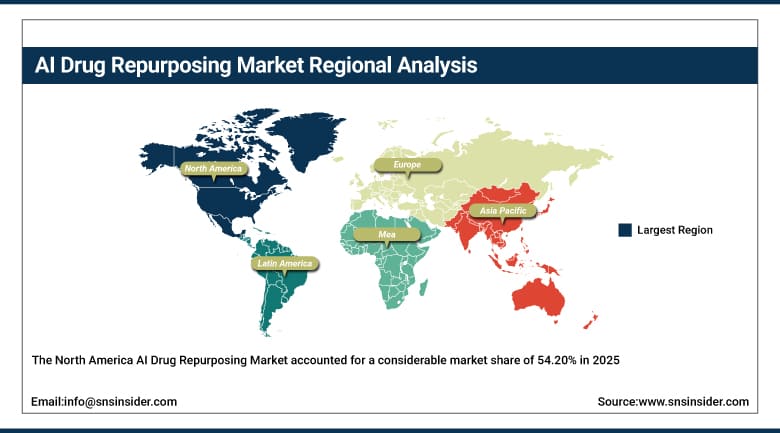
The North America AI Drug Repurposing Market accounted for a considerable market share of 54.20% in 2025 due to its high density of native AI drug discovery organizations, significant R&D spending on pharmaceuticals and biotech, and the presence of a sound venture capital network that finances computational drug discovery at an early and growth stage. Positive regulatory approval of repurposed/repositioned assets along with wide collaboration between academia and industry in top-tier research institutions and hospitals keeps up good acceptance of AI drug repurposing solutions in oncology, rare diseases, and infectious diseases.
The US was the leading country within the North America AI Drug Repurposing Market in 2025 with a market share of 85.40% of the regional market, driven by an extensive base of AI-native drug discovery companies, strong federal and private research funding, and growing integration of generative AI and machine learning tools across pharmaceutical pipeline decision-making. Canada is contributing to regional growth through its own expanding artificial intelligence and computational biology research sector and growing collaboration between domestic AI firms and international pharmaceutical companies.
Get Customized Report as Per Your Business Requirement - Enquiry Now
Europe AI Drug Repurposing Market Insights
The Europe region was a major contributor to the AI Drug Repurposing Market in 2025, expected to register comparatively higher growth for customized computational repurposing platforms during the forecast period. This is attributed to the region's strong regulatory support for data-driven drug development, well-established pharmaceutical manufacturing and research base, and growing consumer and institutional preference for accelerated, evidence-based approaches to identifying new therapeutic uses for existing approved compounds across member states pursuing broader healthcare innovation objectives.
The United Kingdom is one of the major markets in Europe owing to its strong academic-industry AI research ecosystem and the presence of leading AI-native drug discovery and repurposing companies serving both domestic and international pharmaceutical customers. Other countries such as France, Germany, and Switzerland, home to several leading global pharmaceutical companies and computational biology research centers, are also contributing to market growth through extensive drug repurposing research and development investment.
Asia Pacific AI Drug Repurposing Market Insights
The Asia Pacific AI Drug Repurposing Market is expected to witness the fastest growth rate during the forecast period 2026-2035, at a CAGR of 25.60%. The market growth is driven by rapidly expanding domestic biotechnology investment, growing government initiatives supporting artificial intelligence adoption in pharmaceutical research, and increasing collaboration between regional AI drug discovery companies and global pharmaceutical partners across the region's major and emerging healthcare markets pursuing accelerated therapeutic innovation strategies.
China is one of the main growth drivers in the Asia Pacific AI Drug Repurposing Market, owing to its large AI-native drug discovery ecosystem and rapidly growing domestic computational biology research capability supporting both local and export-oriented pharmaceutical customers. India and Japan, both major global pharmaceutical manufacturing and research hubs, are also contributing to regional growth through expanding computational drug discovery capacity and increasing adoption of AI-based repurposing platforms across academic and industry research programs.
Middle East & Africa and Latin America AI Drug Repurposing Market Insights
Middle East & Africa and Latin American regions are gradually expanding adoption of AI-driven drug repurposing platforms as healthcare digitization and biotechnology investment grow across both regions, supported by increasing government focus on advanced healthcare research infrastructure and growing collaboration with international pharmaceutical and AI technology companies.
Brazil is set to be a prominent Latin American market fueled by its substantial domestic pharmaceutical manufacturing base and growing investment in computational biology research capability. The Middle East & Africa region has the UAE and Saudi Arabia investing in advanced healthcare and biotechnology research infrastructure that is gradually increasing adoption of AI-driven drug repurposing platforms across their expanding pharmaceutical and academic research sectors.
Market Dynamics:
Growth Drivers: Rising demand for cost-effective, faster drug development driving market growth
The rising cost and lengthy timelines associated with traditional de novo drug discovery, combined with growing prevalence of chronic, rare, and infectious diseases with limited treatment options, are among the primary drivers of the AI Drug Repurposing Market. AI-driven repurposing platforms provide a substantially faster and more cost-effective pathway to identifying new therapeutic uses for existing approved or shelved compounds, leveraging established safety and toxicity data to compress development timelines and reduce clinical trial risk across virtually every major therapeutic area, from oncology and neurology through infectious disease and rare disorder treatment.
Technological advancements in artificial intelligence have significantly increased the accuracy and scale of computational drug-target screening, with recent innovations in generative AI, knowledge graphs, and multi-omics data integration improving the precision of repurposing candidate identification. Rising pharmaceutical industry adoption of machine learning-based pipeline decision tools, growing integration of real-world clinical and genomic data into discovery workflows, and continued venture and corporate investment expanding AI-native drug discovery company capacity are further supporting demand across the forecast period, as computational repurposing methods continue displacing slower, more resource-intensive traditional discovery approaches across an increasingly broad range of pharmaceutical and biotechnology applications.
Restraints: Data quality challenges and regulatory uncertainty limiting market expansion
One of the most critical obstacles to market growth is the inconsistent quality, completeness, and standardization of the biomedical, genomic, and clinical datasets required to train and validate AI-driven repurposing models. Fragmented data ownership across pharmaceutical companies, healthcare systems, and research institutions, combined with limited data interoperability standards, continues to constrain the accuracy and generalizability of computational predictions, requiring substantial additional curation investment before AI-identified candidates can be reliably advanced toward clinical evaluation.
In addition, ever-changing and contradictory regulatory environments concerning evaluation of AI-generated drug repurposing evidence in major markets present challenges for both drug manufacturers and technology suppliers, in terms of what amount of computational validation should be performed to back up the regulatory applications. Moreover, the large amount of expertise and investment needed for the construction and maintenance of valid prediction models, along with computational biologists’ expertise and cloud computing capabilities, implies the need for significant research and development investments.
Opportunities: Expansion into rare disease and infectious disease applications creating new growth avenues
The growing need for effective, rapidly deployable therapeutic options for rare and orphan diseases, combined with rising interest in AI-driven infectious disease and antimicrobial resistance research, will provide substantial growth opportunities in the AI Drug Repurposing Market. The increasing availability of real-world clinical data, expanding multi-omics datasets, and greater emphasis on generative AI and knowledge graph innovation due to increased biotechnology funding will ensure sustained future growth as pharmaceutical companies pursue faster, evidence-based pathways to expanding existing drug portfolios.
There are ample opportunities for growth in the development of platforms based on AI research on the rare disease and orphan indication fronts, where the economics of the process is at its least favorable point and the benefits from drug repurposing are at their maximum. With the increasing investments in the infrastructure of computational drug discovery in developing regions of Asia Pacific and Latin America, and with growing government support in health care research with AI, demand for the services will keep increasing.
Recent Developments:
-
2025: Insilico Medicine advanced rentosertib, its lead AI-discovered candidate identified using its Pharma.AI generative platform, into expanded clinical evaluation for idiopathic pulmonary fibrosis, reinforcing the clinical viability of its end-to-end computational discovery approach.
-
2025: Isomorphic Labs expanded its structure-based drug design collaboration with Eli Lilly, deploying its AlphaFold-derived modeling engine to identify novel repurposing and combination opportunities across oncology and immunology drug targets.
-
2026: Owkin expanded its Kelun-Owkin oncology data platform with additional multimodal real-world datasets, supporting pharmaceutical partners in identifying repurposing opportunities for existing oncology therapies across new tumor indications.
-
2026: Healx partnered with SCI Ventures in a USD 2 million collaboration to accelerate its Healnet platform's identification of repurposed drug candidates for rare and orphan disease indications.
AI Drug Repurposing Market key players are:
-
Insilico Medicine
-
BenevolentAI plc
-
Recursion Pharmaceuticals, Inc.
-
Atomwise, Inc.
-
Healx Ltd.
-
Innophore GmbH
-
Owkin, Inc.
-
Schrödinger, Inc.
-
XtalPi Inc.
-
Isomorphic Labs Limited
-
Iktos SAS
-
twoXAR, Inc.
-
Verge Genomics, Inc.
-
Deep Genomics, Inc.
-
Valo Health, Inc.
-
Cellarity, Inc.
-
Genesis Therapeutics, Inc.
-
BostonGene Corporation
-
Iambic Therapeutics, Inc.
-
BullFrog AI Holdings, Inc.
AI Drug Repurposing Market Report Scope:
| Report Attributes | Details |
|---|---|
| Market Size in 2025 | USD 1.34 Billion |
| Market Size by 2035 | USD 10.80 Billion |
| CAGR | CAGR of 23.20% From 2026 to 2035 |
| Base Year | 2025 |
| Forecast Period | 2026-2035 |
| Historical Data | 2022-2024 |
| Report Scope & Coverage | Market Size, Segments Analysis, Competitive Landscape, Regional Analysis, DROC & SWOT Analysis, Forecast Outlook |
| Key Segments | • By Component (Software & Platforms, Services) • By Technology (Machine Learning/Deep Learning, Natural Language Processing (NLP), Knowledge Graphs & Network-Based AI, Generative AI & Large Language Models (LLMs), Computer Vision, Others) • By Application (Oncology, Neurology, Cardiology, Infectious Diseases, Rare & Orphan Diseases, Others) • By End Use (Pharmaceutical & Biotechnology Companies, Academic & Research Institutes, Contract Research Organizations (CROs), Others) |
| Regional Analysis/Coverage | North America (US, Canada, Mexico), Europe (Eastern Europe [Poland, Romania, Hungary, Turkey, Rest of Eastern Europe] Western Europe] Germany, France, UK, Italy, Spain, Netherlands, Switzerland, Austria, Rest of Western Europe]), Asia Pacific (China, India, Japan, South Korea, Vietnam, Singapore, Australia, Rest of Asia Pacific), Middle East & Africa (Middle East [UAE, Egypt, Saudi Arabia, Qatar, Rest of Middle East], Africa [Nigeria, South Africa, Rest of Africa], Latin America (Brazil, Argentina, Colombia, Rest of Latin America) |
| Company Profiles | Insilico Medicine, BenevolentAI plc, Recursion Pharmaceuticals, Inc., Atomwise, Inc., Healx Ltd., Innophore GmbH, Owkin, Inc., Schrödinger, Inc., XtalPi Inc., Isomorphic Labs Limited, Iktos SAS, twoXAR, Inc., Verge Genomics, Inc., Deep Genomics, Inc., Valo Health, Inc., Cellarity, Inc., Genesis Therapeutics, Inc., BostonGene Corporation, Iambic Therapeutics, Inc., BullFrog AI Holdings, Inc. |

Frequently Asked Questions
Key players in the AI Drug Repurposing Market include Insilico Medicine, BenevolentAI plc, Recursion Pharmaceuticals Inc., Atomwise Inc., Healx Ltd., Innophore GmbH, Owkin Inc., among others.
Key opportunities include expansion into rare and orphan diseases, infectious diseases, antimicrobial resistance research, multi-omics integration, and generative AI-based drug discovery.
The market is driven by rising demand for faster, cost-effective drug development, growing prevalence of chronic and rare diseases, and continued advancement of generative AI and machine learning technologies.
The Oncology segment dominated the AI Drug Repurposing Market in 2025, accounting for approximately 34.50% market share.
The North America region dominated the AI Drug Repurposing Market in 2025 with a 54.20% market share, driven by a dense concentration of AI-native drug discovery companies and strong pharmaceutical R&D investment.
The Asia Pacific AI Drug Repurposing Market is the fastest-growing region, projected to expand at a CAGR of 25.60% from 2026 to 2035.
