
Silicon Photonics for AI Computing Market Report Scope & Overview:
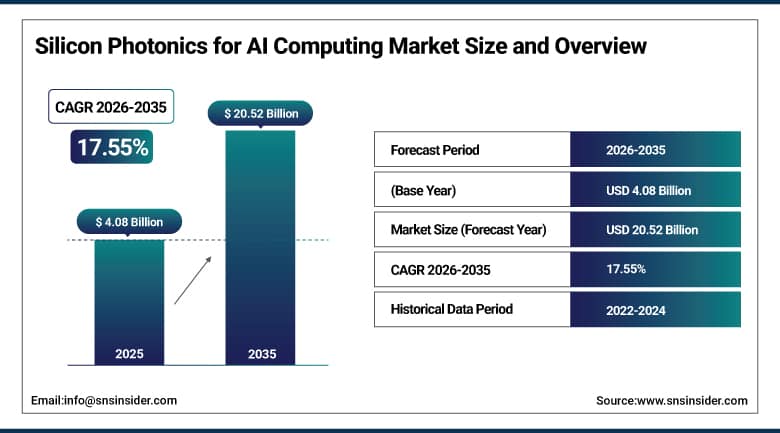
The Silicon Photonics for AI Computing Market size was valued at USD 4.08 Billion in 2025 and is expected to reach USD 20.52 Billion by 2035, growing at a CAGR of 17.55% from 2026–2035.
The silicon photonics for AI computing market is experiencing significant growth due to the increasing demand for high-speed, low-latency, and energy-efficient connectivity in AI and high-performance computing infrastructure. The rapid adoption of AI accelerators, GPUs, hyperscale data centers, and machine learning workloads is increasing the need for high-bandwidth optical interconnects, thereby supporting market expansion. Investments in advanced optical technologies such as silicon photonics, co-packaged optics, optical I/O, and photonic integrated circuits are enabling faster data transmission between AI processors, servers, and networking systems. Companies are increasingly focusing on higher data rates, lower power consumption, improved signal integrity, and scalable optical connectivity.
In May 2026, NVIDIA announced that its Vera Rubin platform had entered full production for next-generation AI factories worldwide, with NVIDIA Spectrum-X Ethernet Photonics combining co-packaged optics and switching technology to support large-scale AI infrastructure. The development is expected to accelerate adoption of silicon photonics and optical interconnect technologies as AI data centers increasingly require higher bandwidth, lower latency, and improved energy efficiency.
To Get More Information On Silicon Photonics for AI Computing Market - Request Free Sample Report
Silicon Photonics for AI Computing Market Trends
-
Growing adoption of advanced AI computing infrastructure is driving demand for silicon photonics solutions that enable high-speed, low-latency, and energy-efficient optical connectivity.
-
Rising deployment of AI data centers, hyperscale computing infrastructure, and GPU clusters is increasing demand for high-bandwidth optical interconnects and silicon photonics-based transceivers.
-
Increasing demand for efficient connectivity between GPUs, AI accelerators, servers, and networking systems is supporting the development of advanced silicon photonics technologies.
-
Growing focus on improving data transmission speeds, reducing power consumption, enhancing signal integrity, and increasing interconnect density is creating opportunities for silicon photonics manufacturers.
-
Advancements in silicon photonics, photonic integrated circuits, co-packaged optics, optical I/O, and high-speed optical transceivers are improving connectivity performance and supporting market adoption.
U.S. Silicon Photonics for AI Computing Market Size Outlook:
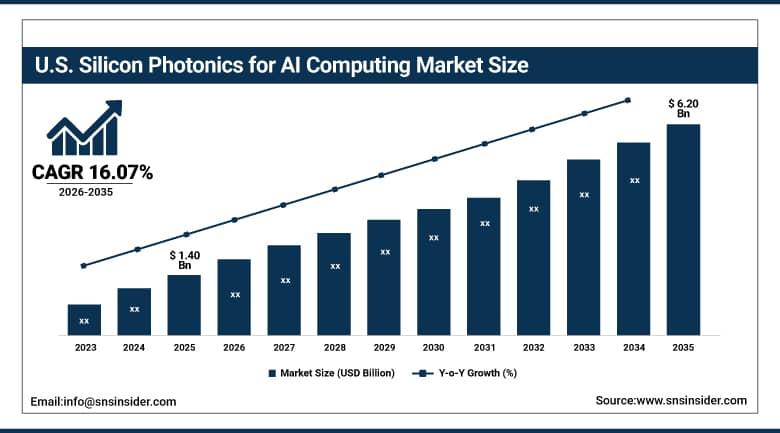
The U.S. Silicon Photonics for AI Computing Market was valued at USD 1.40 Billion in 2025 and is expected to reach around USD 6.20 Billion by 2035, growing at a CAGR of 16.07% from 2026–2035.
The U.S. market for silicon photonics for AI computing is growing steadily due to strong demand for high-speed optical connectivity, low-latency data transmission, and energy-efficient interconnect technologies. The rapid adoption of AI accelerators, GPUs, hyperscale data centers, and high-performance computing infrastructure is increasing the need for advanced optical connectivity solutions. Significant investments are being made in silicon photonics, photonic integrated circuits, co-packaged optics, and optical I/O technologies to improve bandwidth, power efficiency, signal integrity, and interconnect density. The expansion of AI data centers and advanced computing infrastructure across the country is further supporting demand for silicon photonics-based optical transceivers and related components. Market participants are increasingly focusing on higher data rates, improved optical performance, scalable architectures, and integration of photonic technologies with next-generation AI computing systems.
In July 2026, GlobalFoundries signed a letter of intent with the U.S. Department of Commerce for a USD 300 million award to accelerate research and development of next-generation silicon photonics technologies in the United States. The initiative is expected to strengthen domestic silicon photonics manufacturing capabilities and support faster, more energy-efficient optical connectivity for AI data centers and advanced computing applications.
Silicon Photonics for AI Computing Market Segment Analysis
-
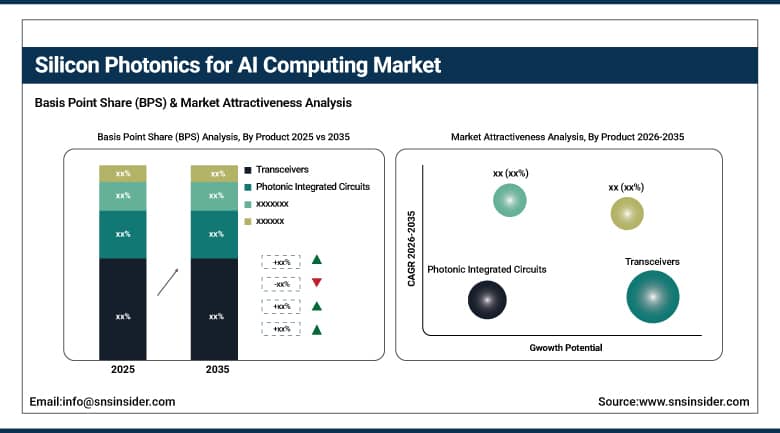
By Product, transceivers dominated the silicon photonics for AI computing market with a 35.80% share in 2025, while photonic integrated circuits are projected to be the fastest-growing segment, registering a 22.59% CAGR during 2026–2035.
-
By Component, photodetectors dominated the silicon photonics for AI computing market with a 31.60% share in 2025, while modulators are projected to be the fastest-growing segment, registering a 20.99% CAGR during 2026–2035.
-
By Technology, silicon photonics dominated the silicon photonics for AI computing market with a 44.20% share in 2025, while silicon photonics is projected to be the fastest-growing segment, registering a 19.48% CAGR during 2026–2035.
-
By Data Rate, 100–400 Gbps dominated the silicon photonics for AI computing market with a 30.40% share in 2025, while above 800 Gbps is projected to be the fastest-growing segment, registering a 23.68% CAGR during 2026–2035.
-
By Application, AI data centers dominated the silicon photonics for AI computing market with a 32.60% share in 2025, while AI accelerators are projected to be the fastest-growing segment, registering a 23.55% CAGR during 2026–2035.
-
By End User, cloud service providers dominated the silicon photonics for AI computing market with a 30.80% share in 2025, while government & defense is projected to be the fastest-growing segment, registering a 23.85% CAGR during 2026–2035.
By Product, transceivers dominated the silicon photonics for AI computing market, while photonic integrated circuits are expected to grow fastest.
The transceivers segment held a dominant position in the market in 2025 due to their critical role in enabling high-speed optical connectivity across AI data centers, GPU clusters, and advanced computing infrastructure. The growing demand for high-bandwidth, low-latency data transmission between servers, processors, and networking systems is increasing the adoption of silicon photonics-based transceivers. Continued improvements in optical performance, data rates, power efficiency, and integration are expected to further support demand for transceiver solutions.
The photonic integrated circuits segment is anticipated to grow at the highest CAGR throughout the forecast period of 2026 to 2035. The increasing integration of optical functions onto compact photonic chips, along with rising demand for scalable and energy-efficient optical interconnects in AI computing environments, is encouraging the development and deployment of advanced photonic integrated circuits.
By Component, photodetectors dominated the silicon photonics for AI computing market, while modulators are expected to grow fastest.
The photodetectors segment held a dominant position in the market in 2025 due to their essential role in converting optical signals into electrical signals within silicon photonics-based communication systems. The increasing deployment of high-speed optical interconnects in AI data centers, hyperscale infrastructure, and high-performance computing is supporting demand for advanced photodetectors with improved sensitivity, speed, and reliability.
The modulators segment is projected to exhibit the highest growth rate over the forecast period of 2026 to 2035. The growing need for higher data transmission speeds, improved bandwidth efficiency, and lower power consumption is encouraging the adoption of advanced optical modulators in AI computing and next-generation data center interconnects.
By Technology, silicon photonics dominated the silicon photonics for AI computing market, while silicon photonics is expected to grow fastest.
The silicon photonics segment held a dominant position in the market in 2025 due to its ability to support high-speed optical communication while providing lower power consumption, compact integration, and scalability for AI computing infrastructure. The increasing deployment of AI data centers, hyperscale computing systems, and high-performance computing platforms is strengthening demand for silicon photonics-based optical interconnect solutions.
The silicon photonics segment is anticipated to grow at the highest CAGR throughout the forecast period of 2026 to 2035. The rapid expansion of AI workloads, increasing interconnect bandwidth requirements, and growing emphasis on energy-efficient data transmission are accelerating investments in silicon photonics technologies for next-generation AI computing architectures.
Regional Analysis
|
Region |
Major Country |
Share within Region, 2025(%) |
|---|---|---|
|
North America |
United States |
88.90% |
|
Europe |
Germany |
34.30% |
|
Asia Pacific |
China |
48.54% |
|
Middle East & Africa |
Saudi Arabia |
23.50% |
|
Latin America |
Brazil |
23.00% |
North America silicon photonics for AI computing market insights
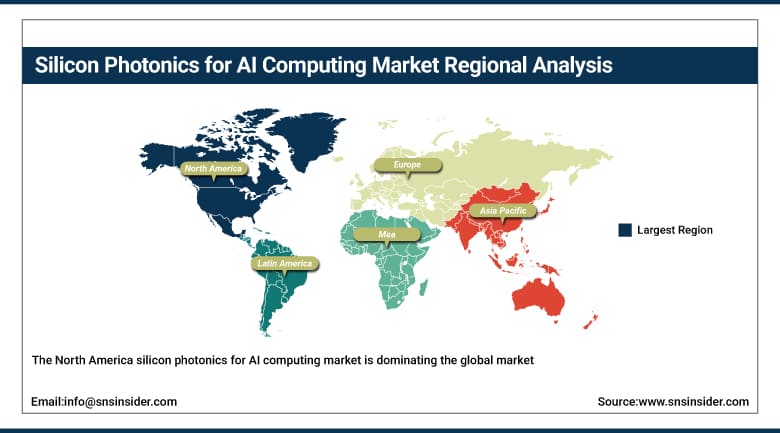
The North America silicon photonics for AI computing market is dominating the global market and is expected to maintain its leading position during 2026–2035, driven by increasing demand for high-speed optical connectivity, AI data centers, GPU clusters, and energy-efficient interconnect solutions. North America dominated the silicon photonics for AI computing market in 2025, accounting for a 38.60% market share, and is expected to retain its leading position throughout the forecast period. The region is benefiting from significant investments in AI infrastructure, hyperscale data centers, silicon photonics, photonic integrated circuits, co-packaged optics, and high-speed optical networking technologies.
The United States is expected to dominate the regional market of the North America market share in 2025. The country’s dominance is supported by strong data center infrastructure, widespread deployment of AI and cloud platforms, increasing investments in AI computing, and the presence of leading technology and semiconductor companies. Canada is also expected to contribute to regional growth, supported by increasing investments in data centers, AI infrastructure, high-performance computing, and advanced optical communication technologies.
Get Customized Report as Per Your Business Requirement - Enquiry Now
Europe silicon photonics for AI computing market insights
The Europe silicon photonics for AI computing market will experience steady growth over the forecast period due to increasing deployment of AI data centers, expansion of high-performance computing infrastructure, rising demand for high-bandwidth optical connectivity, and investments in advanced semiconductor and photonic technologies. Increased attention to energy-efficient computing and the need to support growing AI workloads are driving demand for silicon photonics, optical interconnects, and photonic integrated circuits.
Germany is anticipated to continue being one of the key national markets in Europe, fueled by its strong industrial and automotive technology sectors, expanding data center infrastructure, advanced semiconductor ecosystem, and increasing adoption of AI and high-performance computing. In addition, countries such as the UK, France, Italy, and the Netherlands will contribute to regional demand through investments in AI infrastructure, cloud computing, telecommunications, and advanced optical technologies.
Asia Pacific silicon photonics for AI computing market insights
The Asia Pacific silicon photonics for AI computing market is the fastest-growing with CAGR 19.85% during 2026–2035, supported by rapid expansion of AI infrastructure, increasing deployment of hyperscale data centers, growing adoption of GPUs and AI accelerators, and rising demand for high-speed optical interconnects. The region is also benefiting from expanding semiconductor manufacturing capabilities, investments in photonic technologies, and the development of energy-efficient computing infrastructure.
China will continue to be a major market in the Asia Pacific region due to its large technology ecosystem, extensive data center infrastructure, increasing AI adoption, and growing investments in semiconductor and optical communication technologies. Japan and South Korea will continue to play significant roles due to their established electronics, semiconductor, telecommunications, and advanced manufacturing industries, while India is expected to witness increasing demand with the growth of AI adoption, cloud services, data centers, and digital infrastructure.
Middle East & Africa and Latin America Silicon Photonics for AI Computing Market Insights
There will be consistent growth within the silicon photonics for AI computing markets in the Middle East & Africa and Latin America from 2026 to 2035, driven by the expansion of data center infrastructure, increasing AI adoption, cloud computing investments, digital transformation, and growing demand for high-speed networking solutions. Increasing investments in AI computing and hyperscale infrastructure are creating opportunities for silicon photonics, optical interconnects, and high-bandwidth communication technologies across these regions.
Saudi Arabia will continue to be an important market in the Middle East & Africa, due to investments in AI infrastructure, data centers, cloud computing, digital transformation, and advanced technology initiatives. In Latin America, Brazil will continue to be an important country-level market due to its expanding data center infrastructure, increasing cloud adoption, digital transformation, and growing investments in AI and high-performance computing. Other Latin American countries will also contribute to regional growth through increasing AI adoption, cloud infrastructure deployment, telecommunications modernization, and investments in advanced computing technologies.
Market Dynamics
Growth Driver: Increasing demand for high-speed optical connectivity in AI infrastructure is driving market growth
One of the key driving forces behind the growth of the global silicon photonics for AI computing market is the increasing demand for high-bandwidth, low-latency, and energy-efficient connectivity within AI data centers and high-performance computing environments. The rapid deployment of AI workloads, large-scale GPU clusters, and accelerated computing systems is increasing the need for optical interconnect solutions capable of handling growing data volumes and communication requirements.
In addition, advancements in silicon photonics, optical I/O, co-packaged optics, photonic integrated circuits, and optical engines are improving data transmission performance and reducing power consumption. Increasing investments in AI data centers, hyperscale computing infrastructure, and advanced semiconductor technologies are further supporting the adoption of silicon photonics solutions.
Restraint: High manufacturing complexity and integration challenges can limit market adoption
The complex manufacturing and integration requirements associated with silicon photonics can pose challenges to market adoption. Integrating optical components such as photodetectors, lasers, modulators, and waveguides with advanced semiconductor platforms requires precise manufacturing processes, specialized equipment, and advanced packaging capabilities. These requirements can increase production costs and create challenges for large-scale commercialization.
Moreover, thermal management, optical alignment, packaging complexity, and integration with existing electronic systems can affect the performance and reliability of silicon photonics solutions. The need for specialized manufacturing expertise and compatibility with established semiconductor fabrication processes may also create barriers for smaller technology providers and organizations transitioning from conventional electrical interconnect technologies.
Opportunity: Growing AI data center deployment and demand for energy-efficient optical interconnects creates new market opportunities
The rapid expansion of AI data centers presents substantial opportunities for silicon photonics manufacturers. As AI accelerators, GPU clusters, and high-performance computing systems require increasingly higher data-transfer rates, silicon photonics can provide high-bandwidth optical connectivity while helping reduce power consumption and transmission losses. The increasing deployment of advanced data rates, including 400–800 Gbps and above 800 Gbps solutions, is creating additional opportunities for next-generation optical interconnect technologies.
Further, the growing adoption of co-packaged optics, optical I/O, photonic integrated circuits, and optical engines is creating opportunities for technology providers to develop more integrated and scalable solutions. Increasing investments by cloud service providers, hyperscale data centers, semiconductor manufacturers, and AI infrastructure companies are expected to support the expansion of the silicon photonics for AI computing market through 2035.
Recent Developments
-
2026: Lightmatter launched the Open Silicon Photonics for AI Systems initiative within the Open Compute Project, supported by a 19-company industry coalition, to establish a common co-packaged optics architecture for scaling AI clusters and accelerating silicon photonics adoption.
-
2026: Lumentum reported strong fiscal 2026 fourth-quarter revenue and highlighted increasing demand for high-speed optical connectivity, including 1.6T optical modules, driven by the rapid expansion of AI data centers.
-
2026: GlobalFoundries introduced its SCALE optical module solution for co-packaged optics, based on its silicon photonics technology, to support higher bandwidth density and scalable optical connectivity for advanced AI data centers.
-
2026: Coherent demonstrated next-generation 1.6T, 3.2T, and higher-speed optical technologies at OFC 2026, including silicon-photonics-based photonic integrated circuits and co-packaged optics architectures designed for AI and high-performance computing.
-
2026: Lightmatter demonstrated 1.6 Tbps throughput per fiber using its Passage co-packaged optics chiplet and 16-wavelength DWDM architecture, supporting higher-bandwidth optical interconnects for AI computing infrastructure.
-
2026: Ayar Labs joined the NVIDIA NVLink Fusion ecosystem to advance co-packaged optical connectivity for rack-scale AI infrastructure, focusing on high-bandwidth, low-latency, and power-efficient interconnects.
Silicon Photonics for AI Computing Companies are:
-
Intel Corporation
-
NVIDIA Corporation
-
Cisco Systems, Inc.
-
Marvell Technology, Inc.
-
Coherent Corp.
-
Lumentum Holdings Inc.
-
TAIwan Semiconductor Manufacturing Company Limited
-
Ayar Labs, Inc.
-
Lightmatter, Inc.
-
RANOVUS Inc.
-
POET Technologies Inc.
-
MACOM Technology Solutions Inc.
-
Tower Semiconductor Ltd.
-
STMicroelectronics N.V.
-
IBM Corporation
-
Sumitomo Electric Industries, Ltd.
-
imec
-
Rockley Photonics Holdings Limited.
Silicon Photonics for AI Computing Market Report Scope:
| Report Attributes | Details |
|---|---|
| Market Size in 2025 | USD 4.08 Billion |
| Market Size by 2035 | USD 20.52 Billion |
| CAGR | CAGR of 17.55% From 2026 to 2035 |
| Base Year | 2025 |
| Forecast Period | 2026-2035 |
| Historical Data | 2022-2024 |
| Report Scope & Coverage | Market Size, Segments Analysis, Competitive Landscape, Regional Analysis, DROC & SWOT Analysis, Forecast Outlook |
| Key Segments | • By Product Type (Transceivers, Optical Engines, Active Optical Cables, Photonic Integrated Circuits, Optical Multiplexers, Others) • By Component (Photodetectors, Lasers, Modulators, Waveguides, Others) • By Technology (Silicon Photonics, Co-Packaged Optics, Optical I/O, Hybrid Silicon Photonics, Others) • By Data Rate (Less than 40 Gbps, 40–100 Gbps, 100–400 Gbps, 400–800 Gbps, Above 800 Gbps) • By Application (AI Data Centers, High-Performance Computing, AI Accelerators, GPU Clusters, Machine Learning Infrastructure, Others) • By End User (Cloud Service Providers, Hyperscale Data Centers, Enterprise Data Centers, Research & HPC Institutions, Government & Defense, Others) |
| Regional Analysis/Coverage | North America (US, Canada), Europe (Germany, UK, France, Italy, Spain, Russia, Poland, Rest of Europe), Asia Pacific (China, India, Japan, South Korea, Australia, ASEAN Countries, Rest of Asia Pacific), Middle East & Africa (UAE, Saudi Arabia, Qatar, South Africa, Rest of Middle East & Africa), Latin America (Brazil, Argentina, Mexico, Colombia, Rest of Latin America) |
| Company Profiles | Intel Corporation, Broadcom Inc., NVIDIA Corporation, Cisco Systems, Inc., Marvell Technology, Inc., Coherent Corp., Lumentum Holdings Inc., GlobalFoundries Inc., Taiwan Semiconductor Manufacturing Company Limited, Ayar Labs, Inc., Lightmatter, Inc., RANOVUS Inc., POET Technologies Inc., MACOM Technology Solutions Inc., Tower Semiconductor Ltd., STMicroelectronics N.V., IBM Corporation, Sumitomo Electric Industries, Ltd., imec, Rockley Photonics Holdings Limited. |

Frequently Asked Questions
The silicon photonics for AI computing market is expected to grow at a CAGR of approximately 17.55% from 2026 to 2035.
The silicon photonics for AI computing market was valued at approximately USD 4.08 million in 2025.
The market is primarily driven by the increasing deployment of AI data centers, rapid growth of GPU clusters and AI accelerators, rising demand for high-bandwidth and low-latency connectivity, expansion of hyperscale computing infrastructure, and growing adoption of energy-efficient optical interconnect technologies.
