
Optical Interconnects for AI Data Centers Market Report Scope & Overview:
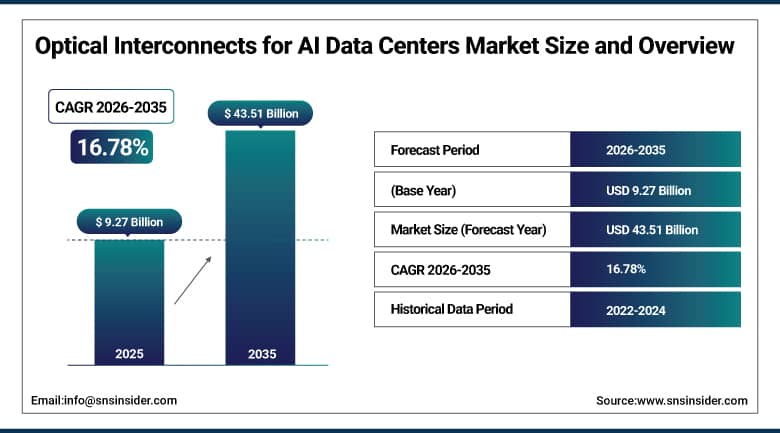
Optical Interconnects for AI Data Centers Market was valued at USD 9.27 billion in 2025 and is expected to reach USD 43.51 billion by 2035, growing at a CAGR of 16.78% from 2026-2035.
The Optical Interconnects for AI Data Centers Market is experiencing fast growth because of increased workloads of AI, hyperscale data centers, and the demand for high-speed, low latency data transfer. The increased usage of GPUs, AI accelerators, and other high-performance computing devices has led to the increasing requirement for advanced optical interconnection technologies which will be able to handle higher bandwidth requirements. Also, the popularity of cloud computing, generative AI, and distributed computing has led to higher investment in data center networking infrastructure. Further, improvements in optical transceivers, silicon photonics, optical engine, and photonic IC have improved the efficiency of the transmission process.
Global data-center electricity consumption is projected to reach approximately 945 TWh by 2030, more than doubling from 2024 levels, with AI identified as the most important driver of this growth.
To Get More Information On Optical Interconnects for AI Data Centers Market - Request Free Sample Report
Optical Interconnects for AI Data Centers Market Trends
-
Rising deployment of AI workloads and high-performance computing is driving demand for high-bandwidth optical interconnects across data center architectures.
-
Increasing adoption of GPUs, AI accelerators, and distributed computing systems is accelerating demand for low-latency, high-speed data transmission solutions.
-
Growing expansion of hyperscale and AI-focused data centers is creating significant demand for advanced optical transceivers, cables, and optical engines.
-
Increasing transition toward 800G and emerging higher-speed Ethernet technologies is supporting adoption of next-generation optical interconnect solutions.
-
Advancements in silicon photonics, co-packaged optics, and optical engine technologies are improving transmission efficiency, scalability, power consumption, and network performance.
U.S. Optical Interconnects for AI Data Centers Market Outlook
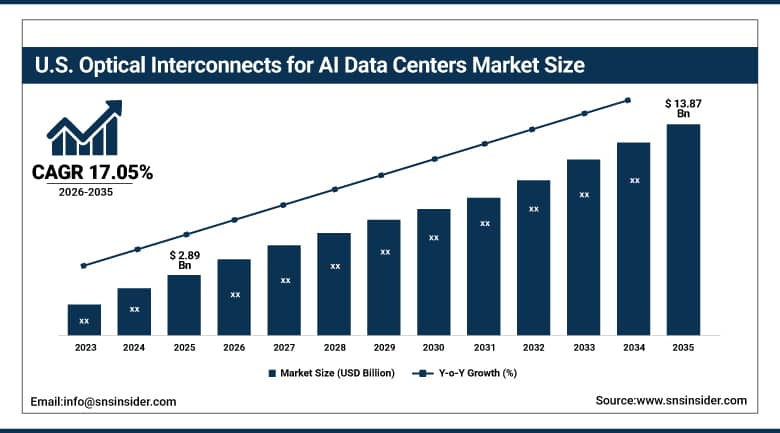
U.S. Optical Interconnects for AI Data Centers Market was valued at USD 2.89 billion in 2025 and is expected to reach USD 13.87 billion by 2035, growing at a CAGR of 17.05% from 2026-2035.
The U.S. Optical Interconnects for AI Data Centers Market is witnessing rapid growth due to increasing AI workloads, expanding hyperscale data centers, and rising demand for high-bandwidth, low-latency connectivity. There is increasing usage of GPUs, AI accelerators, and high-performance computing, which requires more optical interconnects that can support intensive data transfer. Moreover, there is exponential growth in cloud computing, generative AI, and data-intensive applications that require investment in advanced data center infrastructure. There are improvements in optical transceivers, silicon photonics, optical engines, and photonic integrated circuits that enhance network capabilities. Increasing demand for energy efficiency and reliability in connectivity is helping in expanding the market in the United States.
DOE projects U.S. data-center electricity consumption could increase to 325–580 TWh by 2028, driven substantially by data-center expansion and AI workloads.
Optical Interconnects for AI Data Centers Market Segment Analysis
-
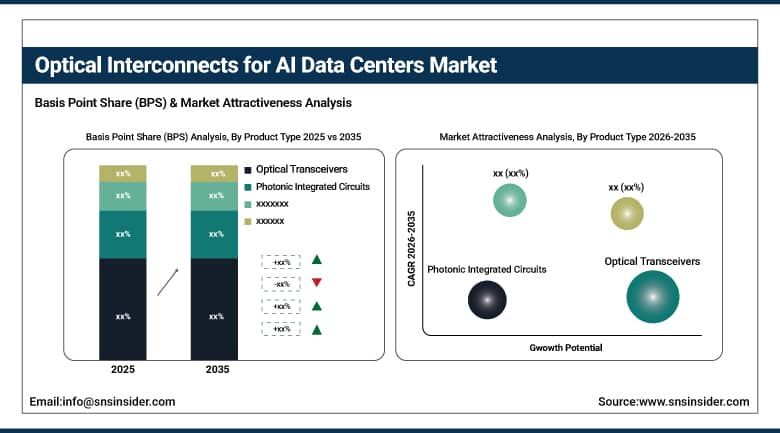
By Product Type, Optical Transceivers dominated the Optical Interconnects for AI Data Centers Market with 49% share in 2025; Photonic Integrated Circuits are expected to grow at the fastest CAGR of 19.40% from 2026–2035.
-
By Technology, Silicon Photonics dominated the Optical Interconnects for AI Data Centers Market with 44% share in 2025; Silicon Photonics (SIEM) is expected to grow at the fastest CAGR of 17.53% from 2026–2035.
-
By Data Rate, Above 100 Gbps dominated the Optical Interconnects for AI Data Centers Market with 73% share in 2025; Above 100 Gbps is expected to grow at the fastest CAGR of 17.05% from 2026–2035.
-
By Application, Data Centers dominated the Optical Interconnects for AI Data Centers Market with 39% share in 2025; AI Accelerators are expected to grow at the fastest CAGR of 18.21% from 2026–2035.
-
By End-User, IT & Telecommunications dominated the Optical Interconnects for AI Data Centers Market with 48% share in 2025; Government is expected to grow at the fastest CAGR of 20.02% from 2026–2035.
By Product Type, Optical Transceivers dominate the optical interconnects for AI data centers market, Photonic Integrated Circuits grow fastest.
Optical Transceivers segment dominated the Optical Interconnects for AI Data Centers Market with the highest revenue share of about 49% in 2025 because of rising demand for faster data transfer between servers, switches, and computing systems. Optical transceivers ensure secure and fast connectivity without loss in signals. Fast AI tasks, growing data centers, and high network traffic have further enhanced the global usage of optical transceivers.
Photonic Integrated Circuits segment is expected to grow at the fastest CAGR of 19.40% from 2026-2035 because of growing need for miniature, energy-efficient, and bandwidth-intensive optical interconnect solutions. In PIC, several optical functionalities are combined on one chip, increasing its scalability and energy efficiency. The rising demands in AI computations, sophisticated data center designs, and development of silicon photonic technologies will help increase its global usage.
By Technology, Silicon Photonics dominates the optical interconnects for AI data centers market and grows fastest.
Silicon Photonics segment dominated the Optical Interconnects for AI Data Centers Market with the highest revenue share of about 44% in 2025 because of the capacity of the technology to provide high bandwidth, lower power consumption, and efficient incorporation into existing semiconductor fabrication processes. The rise in AI processing demands fast interconnections, while the rising number of hyperscale data centers and optical connectivity needs promote silicon photonics adoption worldwide.
Silicon Photonics (SIEM) segment is expected to grow at the fastest CAGR of 17.53% from 2026-2035 because of the growing need for scalability, efficiency, and speed in optical interconnects for AI architectures. Silicon photonics makes it possible to achieve high density, high-speed transmissions, and low power consumption. With an increase in AI accelerators, the development of hyperscale data centers, and new technologies, the trend will continue to grow.
By Data Rate, Above 100 Gbps dominates the optical interconnects for AI data centers market and grows fastest.
Above 100 Gbps segment dominated the Optical Interconnects for AI Data Centers Market with the highest revenue share of about 73% in 2025 Because of the rapid growth in data production caused by AI workloads, HPC applications, and distributed computing. The high-speed optical interconnects help facilitate faster communications between servers, switches, and accelerators. The growing complexity of AI models and hyperscale data center deployments only reinforce the global need for this technology.
Above 100 Gbps segment is expected to grow at the fastest CAGR of 17.05% from 2026-2035 due to rising workloads in artificial intelligence, higher GPU connectivity needs, and rising east-west communication in data centers. Higher bandwidth leads to faster transfer of very large amounts of data from one computer resource to another. Expansion of hyperscale facilities and future AI clusters will fuel the global uptake.
By Application, Data Centers dominate the optical interconnects for AI data centers market, AI Accelerators grow fastest.
Data Centers segment dominated the Optical Interconnects for AI Data Centers Market with the highest revenue share of about 39% in 2025 because of the increased use of hyperscale facilities, cloud computing infrastructure, and AI data centers. Data centers need high-speed, low-latency, and power-efficient interconnections between servers and networking equipment. Increased data traffic and AI workloads further boost the demand for optical interconnects around the world.
AI Accelerators segment is expected to grow at the fastest CAGR of 18.21% from 2026-2035 Due to the rapid deployment of GPUs, TPUs, and other specialized AI chips that require high-bandwidth connectivity. Optical interconnect enables effective data transfer between the accelerators with reduced latency and power requirements. Higher loads due to generative AI, training of models, and increasing the AI infrastructure will lead to widespread adoption globally.
By End User, IT & Telecommunications dominates the optical interconnects for AI data centers market, Government grows fastest.
IT & Telecommunications segment dominated the Optical Interconnects for AI Data Centers Market with the highest revenue share of about 48% in 2025 because of widespread use of cloud computing, telecom networks, hyperscale data centers, and AI infrastructures. Increase in data volume and rising need for fast and low latency connectivity among computing systems further boost the adoption of optical interconnections.
Government segment is expected to grow at the fastest CAGR of 20.02% from 2026-2035 As a result of increased investments in AI systems, supercomputing capabilities, defense systems, secure data centers, and digitization programs. Government institutions will demand fast optical links for processing large data sets and AI workloads. Increased government investments in computing infrastructure are anticipated to spur adoption rates across the globe.
Regional Analysis
|
Region |
Major Country |
Share within Region, 2025 (%) |
|---|---|---|
|
North America |
United States |
90.0% |
|
Europe |
Germany |
23.0% |
|
Asia Pacific |
China |
43.0% |
|
Middle East & Africa |
UAE |
19.0% |
|
Latin America |
Brazil |
35.0% |
North America Optical Interconnects for AI Data Centers Market Insights
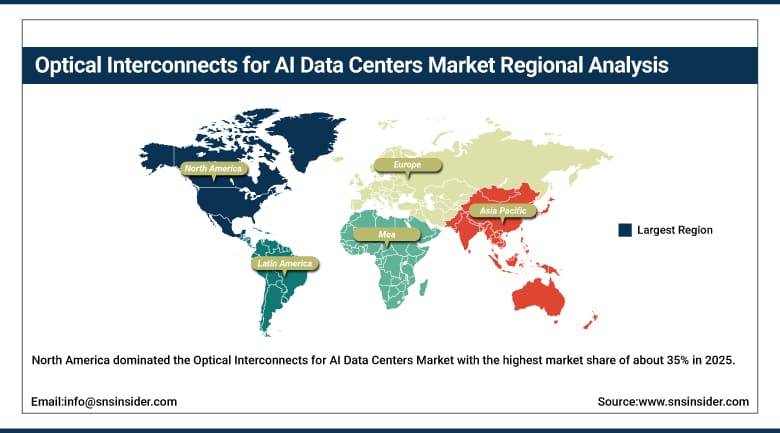
North America dominated the Optical Interconnects for AI Data Centers Market with the highest market share of about 35% in 2025, because of the large number of AI data center applications, hyperscale cloud infrastructure, and substantial investments made in high-speed networks. The combination of growing demands for high bandwidth and low latency, coupled with leading technology suppliers and state-of-the-art fiber optic networks, results in regional dominance.
The U.S. Optical Interconnects for AI Data Centers Market accounted for a market share of 90.0%, backed up by an extensive presence of hyperscale and AI data centers, modern cloud infrastructure, and heavy investments into high-speed optical networking technologies. Increasing demands from AI workloads, high-bandwidth and low-latency connectivity requirements, as well as the presence of major technology companies, are making more countries opt for optical interconnects.
Get Customized Report as Per Your Business Requirement - Enquiry Now
Europe Optical Interconnects for AI Data Centers Market Insights
Europe Optical Interconnects for AI Data Centers Market is witnessing steady growth, backed by growing AI workloads, hyperscale data center building, cloud services, and growing demand for high-speed connectivity. Data centers are implementing fiber optic solutions, optical transceivers, and energy-efficient networking technologies. Increasing infrastructure investments in AI, digital transformation, implementation of 5G, and the need for low-latency and high-speed data transfer are driving the regional market growth.
The Germany Optical Interconnects for AI Data Centers Market accounted for a market share of 23.0%, Driven by increasing infrastructural build-up for data centers, AI uptake, and growing cloud computing demands. The increased need for faster and energy-efficient data transfer is helping optical interconnection solutions find their feet. Investments made towards optical networking infrastructure, digital transformation, AI infrastructure, and hyperscale and colocation solutions are driving market growth in Germany.
Asia Pacific Optical Interconnects for AI Data Centers Market Insights
Asia Pacific is expected to grow at the fastest CAGR of about 17.89% from 2026–2035, Backed by fast AI penetration, growth of hyperscale data centers, infrastructure for the cloud and increased digitization. Investments in AI computing infrastructure, 5G technology, high-speed optics, and data centers especially in countries like China, Japan, South Korea, and India are driving market growth in the region.
The China Optical Interconnects for AI Data Centers Market accounted for a market share of 43.0%, underpinned by the fast adoption of AI, hyperscale data center expansion, cloud infrastructure investment, and digitalization. The growing need for high bandwidth and low latency is pushing the use of optical interconnects. The development of digital infrastructure through government support, 5G expansion, AI computing, and data center capacity is making the market growth stronger for China.
Middle East & Africa and Latin America Optical Interconnects for AI Data Centers Market Insights
The Middle East & Africa and Latin America Optical Interconnects for AI Data Centers Market is gradually expanding, driven by increasing cloud adoption, AI investments, data-center construction, and digital transformation. The rise in the need for high-speed, low-latency connection is driving the adoption of optical networking technology. Investment in hyperscale infrastructure, 5G, fiber-optic network, and AI computing is further driving the adoption of optical interconnect technology in these regions.
The UAE Optical Interconnects for AI Data Centers Market captured a market share of 19.0% driven by fast data center growth, rising investment in AI, and increased cloud adoption. There is an increased demand for optical networking due to the requirement for fast and low-latency connections. There is increased adoption of optical interconnect technology in the UAE because of digital transformation efforts from the government, hyperscale investments, 5G, and increased development of the fiber-optic network.
Market Dynamics
Growth Drivers: Rapid expansion of AI workloads and hyperscale data centers is accelerating demand for high-speed optical interconnects globally
Rapid growth of artificial intelligence workloads is significantly driving demand for optical interconnects in data centers. The AI training and inference infrastructures need vast numbers of GPUs, AI accelerators, servers, and storage facilities that keep exchanging large amounts of data with each other. Traditional electrical connections are becoming more and more limited in terms of the bandwidth, latency, power usage, and distances of data transmission with growing demands on networks. Optical connections have very high bandwidth, low latency, and effective data transmission, which makes them more and more relevant for AI infrastructures. Major hyperscale cloud operators and data center providers are actively building AI-focused facilities for generative AI, machine learning, and HPC use cases. That, in its turn, leads to growing demand on optical transceivers, cables, engines, and photonics.
Restraints: High manufacturing costs and complex photonic integration can limit widespread adoption of advanced optical interconnect technologies
High manufacturing costs and complex integration requirements remain significant challenges for the Optical Interconnects for AI Data Centers Market. State-of-the-art photonic manufacturing technologies, precise packaging technologies, advanced laser technologies, optical engines, and unique testing methodologies are required for the production of highly advanced optical components. Development of technologies such as silicon photonics and co-packaged optics might require substantial investment into fabrication facilities, packaging machines, and expertise in engineering. Manufacturing of optical devices at a high yield level along with high requirements for performance and reliability parameters might increase the cost of manufacturing even further. Investment into upgrades of traditional electric connections in data centers requires additional capital expenditures on their part.
Opportunities: Rapid growth of generative AI and hyperscale computing creates significant opportunities for next-generation optical interconnect providers
The rapid expansion of generative AI and hyperscale computing is creating substantial opportunities for optical interconnect manufacturers. There is a need for powerful accelerators and inter-cluster communications to train deep learning AI models, resulting in significant networking challenges. Optical interconnects can meet such challenges through provision of high-speed and low-latency connectivity with higher range and lower power consumption. Cloud service providers and hyperscale data center operators have increased their investments in AI hardware, thus driving demand for innovative 800G and next-generation optical components at terabit range. Innovation in optical engines, silicon photonics, co-packaged optics, and optical transceivers can enhance network performance. The suppliers that have the capability to offer scalable and power-efficient high-density networking solutions will gain from expansion of AI-centric data center infrastructure.
Recent Developments:
-
2026 – Ayar Labs continued developing optical I/O technology designed to replace electrical chip-to-chip connections, enabling scalable bandwidth and lower data-movement power consumption for AI systems.
-
2026 –NVIDIA continued advancing optical networking for AI infrastructure, supporting higher-bandwidth connectivity required by increasingly large-scale GPU clusters and next-generation AI data centers.
-
2026 –Broadcom expanded high-speed optical connectivity technologies toward 800G and 1.6T networking, addressing rapidly increasing bandwidth requirements across AI-scale data-center infrastructure.
-
2026 –Coherent continued scaling 800G and 1.6T optical transceiver technologies, supporting high-bandwidth connectivity between GPUs, switches, and other components within AI data-center networks.
Optical Interconnects for AI Data Centers Market key players are:
-
NVIDIA Corporation
-
Broadcom Inc.
-
Coherent Corp.
-
Lumentum Holdings Inc.
-
Marvell Technology, Inc.
-
Cisco Systems, Inc.
-
Intel Corporation
-
InnoLight Technology (TeraHop)
-
Eoptolink Technology Inc., Ltd.
-
Accelink Technologies Co., Ltd.
-
Applied Optoelectronics, Inc.
-
Fabrinet
-
Source Photonics, Inc.
-
Sumitomo Electric Industries, Ltd.
-
Furukawa Electric Co., Ltd.
-
Ciena Corporation
-
Ayar Labs, Inc.
-
Ranovus Inc.
-
Credo Technology Group Holding Ltd.
-
Celestial AI
Optical Interconnects for AI Data Centers Market Report Scope:
| Report Attributes | Details |
|---|---|
| Market Size in 2025 | USD 9.27 Billion |
| Market Size by 2035 | USD 43.51 Billion |
| CAGR | CAGR of 16.78% From 2026 to 2035 |
| Base Year | 2025 |
| Forecast Period | 2026-2035 |
| Historical Data | 2022-2024 |
| Report Scope & Coverage | Market Size, Segments Analysis, Competitive Landscape, Regional Analysis, DROC & SWOT Analysis, Forecast Outlook |
| Key Segments | • By Product Type (Optical Transceivers, Optical Cables, Optical Engines, Photonic Integrated Circuits, Others) • By Technology (Silicon Photonics, VCSEL, Free Space Optics, Others) • By Data Rate (Less than 40 Gbps, 40–100 Gbps, Above 100 Gbps) • By Application (Data Centers, High-Performance Computing, AI Accelerators, Others) • By End-User (IT & Telecommunications, BFSI, Healthcare, Government, Others) |
| Regional Analysis/Coverage | North America (US, Canada), Europe (Germany, UK, France, Italy, Spain, Russia, Poland, Rest of Europe), Asia Pacific (China, India, Japan, South Korea, Australia, ASEAN Countries, Rest of Asia Pacific), Middle East & Africa (UAE, Saudi Arabia, Qatar, South Africa, Rest of Middle East & Africa), Latin America (Brazil, Argentina, Mexico, Colombia, Rest of Latin America). |
| Company Profiles | NVIDIA Corporation, Broadcom Inc., Coherent Corp., Lumentum Holdings Inc., Marvell Technology, Inc., Cisco Systems, Inc., Intel Corporation, InnoLight Technology, Eoptolink Technology Inc., Ltd., Accelink Technologies Co., Ltd., Applied Optoelectronics, Inc., Fabrinet, Source Photonics, Inc., Sumitomo Electric Industries, Ltd., Furukawa Electric Co., Ltd., Ciena Corporation, Ayar Labs, Inc., Ranovus Inc., Credo Technology Group Holding Ltd., and Celestial AI. |

Frequently Asked Questions
The Optical Interconnects for AI Data Centers Market is expected to grow at a CAGR of 16.78% from 2026 to 2035.
The Optical Interconnects for AI Data Centers Market was valued at USD 9.27 billion in 2025.
The major growth factor is rapid expansion of AI workloads and hyperscale data centers, driving demand for high-bandwidth, low-latency, and energy-efficient optical interconnects to connect GPUs and AI accelerators.
The Optical Transceivers segment dominated the Optical Interconnects for AI Data Centers Market in 2025.
North America dominated the Optical Interconnects for AI Data Centers Market in 2025.
