
Multi-Agent AI Platforms Market Report Scope & Overview:
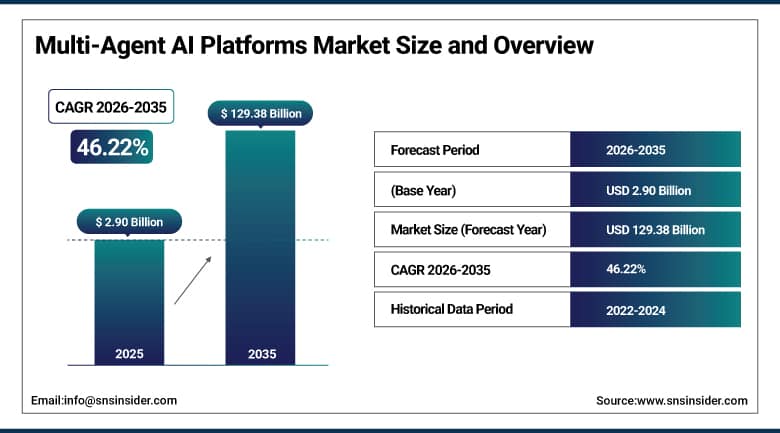
The Multi-Agent AI Platforms Market was valued at USD 2.90 Billion in 2025 and is expected to reach USD 129.38 Billion by 2035, growing at a CAGR of 46.22% from 2026–2035.
The multi-agent AI platforms market is witnessing significant growth due to rising adoption of autonomous AI solutions and the increasing need for intelligent platforms that can coordinate multiple AI agents. Rising developments in generative AI, enterprise automation, cloud infrastructure, and agentic workflows are increasing the demand for the solutions in various business and technology verticals.
With the advent of advanced AI technologies such as multi-agent orchestration, agent coordination, communication architecture, and autonomous agents platforms, the ability of organizations to automate workflows, decisions, software development, customer service, and IT operations is improving. The key areas of interest for organizations include agent interoperability, orchestration, scalability, reliability, security, and autonomous task execution. Technological developments are being made owing to rising demand for enterprise automation and intelligent decision support solutions. Integration of multi-agent AI platforms with cloud infrastructure, enterprise software, data platforms, and AI development tools is further boosting the market.
In February 2025, Rabbit demonstrated a generalist AI agent capable of autonomously performing tasks across Android applications, highlighting advances in agent-based automation and cross-application interaction. The company also indicated plans for a cross-platform multi-agent system, supporting the development of coordinated AI agents for more complex workflows.
To Get More Information On Multi-Agent AI Platforms Market - Request Free Sample Report
Multi-Agent AI Platforms Market Trends
-
Growing adoption of multi-agent AI systems is driving demand for advanced platforms capable of coordinating autonomous agents for complex enterprise workflows and decision-making.
-
Rising deployment of generative AI and agentic AI technologies is increasing demand for platforms that enable multiple specialized agents to collaborate, communicate, and execute tasks autonomously.
-
Increasing demand for enterprise automation, software development, customer service, cybersecurity, and intelligent decision support is supporting the growth of multi-agent AI platform solutions.
-
Growing focus on improving agent coordination, interoperability, scalability, reliability, security, and operational efficiency is creating opportunities for multi-agent AI platform providers.
-
Advancements in multi-agent orchestration, agent communication frameworks, AI model integration, workflow automation, and autonomous task execution are improving platform capabilities and supporting market adoption.
U.S. Multi-Agent AI Platforms Market Outlook
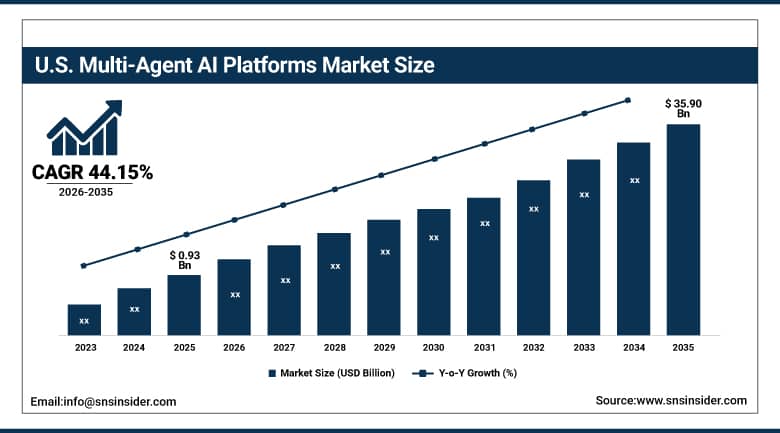
The U.S. Multi-Agent AI Platforms Market was valued at USD 0.93 Billion in 2025 and is expected to reach around USD 35.90 Billion by 2035, growing at a CAGR of 44.15% from 2026–2035.
The market for multi-agent AI platforms in the United States is experiencing high growth because of the significant demand for artificial intelligence technologies, enterprise automation, and autonomous task performance. The growing number of businesses using generative AI, AI agents, cloud computing, and intelligent software applications is contributing to the rising demand for platforms that help several AI agents perform their tasks and coordinate complex processes. Increasing investments in AI infrastructures, agent orchestration technologies, and enterprise AI applications that increase operational effectiveness and productivity of enterprises are expected to fuel the market growth. Adoption of AI technologies in technology, finance, healthcare, manufacturing, retail, and many other industries is expected to drive demand for multi-agent AI platforms in the country.
May 2026: Amazon Web Services announced the general availability of multi-agent collaboration in Amazon Bedrock, enabling developers to build, deploy, and manage networks of AI agents that collaborate on complex, multi-step workflows.
Multi-Agent AI Platforms Market Segment Analysis
-
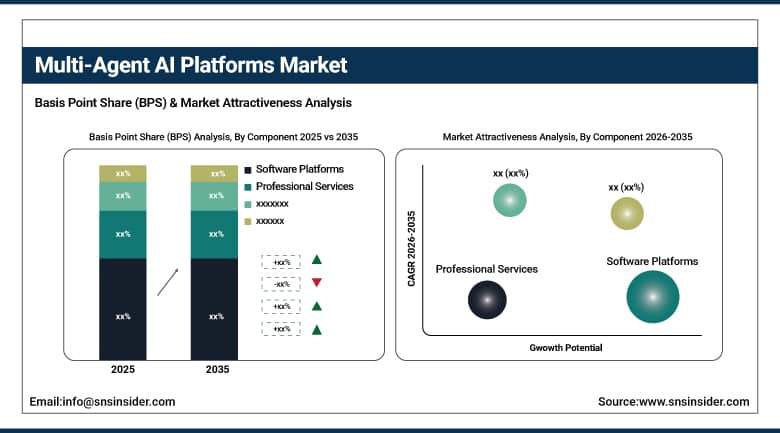
By Component, software dominated the multi-agent AI platforms market with a 68.00% share in 2025, while professional services are projected to be the fastest-growing segment, registering a 52.13% CAGR during 2026–2035.
-
By Platform Type, multi-agent orchestration platforms dominated the multi-agent AI platforms market with a 35.00% share in 2025, while autonomous-agent SaaS is projected to be the fastest-growing segment, registering a 53.45% CAGR during 2026–2035.
-
By Deployment, cloud-based dominated the multi-agent AI platforms market with a 73.00% share in 2025, while on-premises is projected to be the fastest-growing segment, registering a 52.45% CAGR during 2026–2035.
-
By Organization size, large enterprises dominated the multi-agent AI platforms market with a 72.00% share in 2025, while small & medium enterprises are projected to be the fastest-growing segment, registering a 50.68% CAGR during 2026–2035.
-
By End-Use Industry, manufacturing dominated the multi-agent AI platforms market with a 25.00% share in 2025, while healthcare & life sciences are projected to be the fastest-growing segment, registering a 53.20% CAGR during 2026–2035.
By Component, software dominated the multi-agent AI platforms market, while professional services are expected to grow fastest.
The segment of software held a strong market share in the market in 2025 owing to their important role in designing, deployment, orchestration, and management of several AI agents in the enterprise ecosystem. Rising use of generative AI, autonomous agents, workflow automation, and AI in the enterprise is raising the demand for software platforms that can coordinate and integrate multiple agents.
Professional services are projected to record the highest CAGR during the forecast period from 2026 to 2035. The rising complexity associated with the design and deployment of multi-agent AI solutions has created the need for consulting, integration, customization, implementation, training, and maintenance services. There is a growing trend among enterprises to look out for professional assistance to integrate multi-agent platforms with their existing processes.
By Platform Type, multi-agent orchestration platforms dominated the multi-agent AI platforms market, while autonomous-agent SaaS is expected to grow fastest.
The multi-agent orchestration category was the leader in the market in 2025 due to its capability to collaborate multiple specialized AI agents, coordinate task performance, and facilitate complicated enterprise workflows. Adoption of agentic AI in automation, decision making, software development, and IT operations is helping drive the need for orchestration technology to ensure efficient collaboration between AI agents.
The autonomous-agent SaaS category is expected to have the highest CAGR during the forecast period from 2026 to 2035. With the increasing demand for scalable and subscription-based AI technology that can perform business tasks on its own, enterprises are moving towards autonomous-agent SaaS platforms.
By Deployment, cloud-based dominated the multi-agent AI platforms market, while on-premises is expected to grow fastest.
The cloud-based deployment model dominated the market in 2025 owing to factors such as scalability, flexibility of infrastructure, fast deployment, and reduced infrastructure requirements at the initial stage. The growing adoption of cloud-based AI services and enterprise applications is helping in the deployment of multi-agent AI platforms via cloud-based models.
The on-premise deployment model is expected to witness the highest CAGR over the forecast period of 2026 to 2035. Data security, regulatory, privacy issues, and control over sensitive enterprise data are driving the adoption of multi-agent AI platforms through the on-premise deployment model.
Regional Insights
|
Region |
Major Country |
Share within Region, 2025(%) |
|---|---|---|
|
North America |
United States |
78.00% |
|
Europe |
Germany |
34.30% |
|
Asia Pacific |
China |
48.54% |
|
Middle East & Africa |
Saudi Arabia |
23.50% |
|
Latin America |
Brazil |
23.00% |
North America multi-agent AI platforms market insights
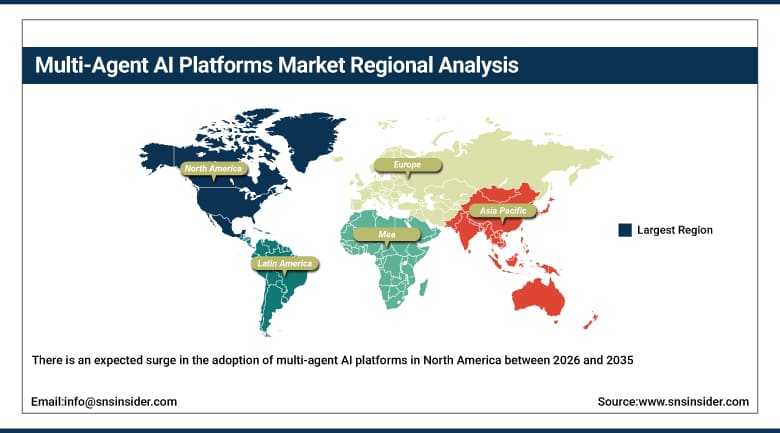
There is an expected surge in the adoption of multi-agent AI platforms in North America between 2026 and 2035, owing to the growing use of generative AI, agentic AI, enterprise automation, cloud computing, and autonomous AI. North America was dominant in the multi-agent AI platforms market in 2025, contributing 41.00% share, and will maintain this dominance throughout 2035 because of advanced AI infrastructure, technology ecosystem, and enterprise adoption. The US led the North American multi-agent AI platforms market in 2025 with 78.00% share and will continue to do so throughout the forecast period. The US leads because of advanced technology ecosystem, presence of AI firms, AI infrastructure investment, enterprise AI adoption, and deployment of autonomous/multi-agent AI.
Canada had a 22.00% share of the North American multi-agent AI platforms market in 2025 and is expected to have steady growth throughout 2035, owing to investment in artificial intelligence, cloud infrastructure, enterprise automation, and AI research and development.
Get Customized Report as Per Your Business Requirement - Enquiry Now
Europe multi-agent AI platforms market insights
The European multi-agent AI platform market is forecasted to witness robust growth in the forecast period driven by increasing adoption of artificial intelligence in enterprises, increasing need for automation, digitization and modernization drives, and investments in sophisticated AI infrastructure. The increasing focus on responsible AI, data management, cybersecurity, and regulatory compliance is also driving enterprises to deploy multi-agent AI platforms that can be controlled and scaled effectively.
Germany is forecasted to continue to be among the significant national markets in Europe backed by its manufacturing and automotive industry, rising automation in industries, digitization of enterprises, and adoption of AI-enabled products. Other European countries such as the UK, France, Italy, and others are contributing to the regional demand by making investments in AI in enterprises, software development, financial sector, health care, and industrial applications.
Asia Pacific multi-agent AI platforms market insights
Asia Pacific region is expected to be the fastest-growing region in the market for multi-agent AI platforms during the forecast period 2026-2035 due to increasing adoption of generative AI, growing digital economy, increasing enterprise automation, growing cloud infrastructure, and huge investments in artificial intelligence technologies in the region. Technology ecosystem in the region along with increasing application of AI in manufacturing, telecommunication, financial services, healthcare, and retail sectors is boosting the growth of the market.
China is going to remain a leading market in the Asia Pacific region because of large size of technology industry, huge investments in artificial intelligence, growing cloud infrastructure, and increasing adoption of AI enterprise applications. Japan and South Korea will be playing important roles owing to well-established automotive, electronics, manufacturing, and technology industries in these countries, while India is expected to experience high demand due to rapid digital transformation, increasing IT services, increasing enterprise AI adoption, and AI infrastructure investments.
Middle East & Africa and Latin America multi-agent AI platforms market insights
Multi-agent AI Platforms Markets in the Middle East & Africa (MEA) and Latin America are forecasted to witness constant growth from 2026 to 2035, led by digital transformation, adoption of cloud computing technologies, enterprise automation, AI projects in the governments, and investments in technology infrastructures. Growing demand for customer service automation, cybersecurity, financial services, healthcare, and business processes automation offers new opportunities for multi-agent AI platform vendors.
Saudi Arabia is forecasted to continue being one of the key countries in the MEA region as a result of investments into artificial intelligence, digital transformation, smart city projects, cloud infrastructures, and economic diversification projects. In Latin America, Brazil is forecasted to continue being one of the key countries at the national level owing to its large economy, development of technology sector, financial services industry, digital transformation, and adoption of enterprise AI systems.
Growth Driver: Increasing demand for enterprise automation and intelligent AI systems is driving market growth
One of the significant factors fueling the growth of the worldwide multi-agent AI platform market is the rising need for intelligent automation among enterprises. Businesses are increasingly relying on AI agents to automate their processes and aid in decision making, customer interactions, and software engineering. The rise in the adoption of generative AI and autonomous AI is creating the need for multi-agent platforms to undertake the execution of complex tasks.
Moreover, developments in areas like multi-agent orchestration, multi-agent coordination, integration of AI models, cloud infrastructure, and enterprise software solutions are aiding market growth. Growing spending on AI infrastructure and digital transformation is adding impetus to this trend.
Restraint: Complex integration and governance challenges can limit market adoption
The intricacies involved in combining several AI agents with the already installed enterprise systems make it quite challenging for the use of multi-agent AI platforms. There could be challenges faced by organizations when it comes to data integration, compatibility, interoperability, system robustness, and agent coordination.
Furthermore, businesses will need adequate controls for data privacy, cybersecurity, AI management, compliance, and monitoring when using autonomous agents. The high cost of implementation, scarcity of AI specialists, and complexity in the management of different AI agents are some of the other factors that make things difficult.
Opportunity: Growing adoption of autonomous AI and enterprise agentic workflows creates new market opportunities
The fast adoption of autonomous AI and agentic flows is creating significant growth opportunities for multi-agent AI platforms. There is a rising need for autonomous AI systems that are capable of autonomously handling complicated processes, coordinating specialized agents and automating the complete flow of business processes.
Furthermore, with increasing investment in cloud AI infrastructure, enterprise AI applications and software development involving AI, there are significant growth opportunities for scalable multi-agent platforms. The growth in autonomous agent software as a service (SaaS), better interoperability between AI and agents, and demand for custom enterprise AI solutions are anticipated to fuel the growth of the market.
Recent Developments
-
2026: Microsoft expanded its enterprise AI capabilities through Microsoft 365 Copilot Wave 3 and introduced Agent 365, enabling organizations to observe, govern, secure, and scale AI agents across enterprise workflows.
-
2026: Google expanded its multi-agent capabilities through Google Antigravity 2.0, enabling users to orchestrate multiple autonomous AI agents to execute tasks in parallel across development and other workflows.
-
2026: Salesforce advanced its Agentforce platform with Single-Org Multi-Agent (SOMA) orchestration, enabling multiple specialized Agentforce agents to collaborate under a primary orchestrator for complex enterprise tasks.
-
2026: Google introduced new agentic capabilities across Gemini, including information agents and Gemini Spark, supporting autonomous, long-running tasks and multi-agent interactions across digital workflows.
-
2026: Google DeepMind announced up to $10 million in funding for multi-agent AI safety research, supporting research into the safe coordination and interaction of large numbers of AI agents across digital environments.
-
2026: Enovix continued advancing its silicon-anode battery technology for high-performance applications, supporting the broader commercialization of silicon-based anode materials and next-generation lithium-ion batteries.
Multi-Agent AI Platforms Market Key Players
-
Google LLC
-
Amazon Web Services, Inc.
-
IBM Corporation
-
Salesforce, Inc.
-
ServiceNow, Inc.
-
OpenAI
-
Anthropic
-
LangChain, Inc.
-
UiPath, Inc.
-
Oracle Corporation
-
SAP SE
-
NVIDIA Corporation
-
Databricks, Inc.
-
LlamaIndex
-
Relevance AI
-
Moveworks, Inc.
-
n8n
-
Hugging Face, Inc.
Multi-Agent AI Platforms Market Report Scope:
| Report Attributes | Details |
|---|---|
| Market Size in 2025 | USD 2.90 Billion |
| Market Size by 2035 | USD 129.38 Billion |
| CAGR | CAGR of 46.22% From 2026 to 2035 |
| Base Year | 2025 |
| Forecast Period | 2026-2035 |
| Historical Data | 2022-2024 |
| Report Scope & Coverage | Market Size, Segments Analysis, Competitive Landscape, Regional Analysis, DROC & SWOT Analysis, Forecast Outlook |
| Key Segments | • By Component (Software, Hardware Infrastructure, Professional Services) • By Platform Type (Agent Development Frameworks, Multi-Agent Orchestration Platforms, Agent Coordination & Communication Platforms, Simulation & Digital-Twin Platforms, Autonomous-Agent SaaS, Others) • By Deployment (Cloud-Based, On-Premises, Hybrid) • By Organization Size (Large Enterprises, Small & Medium Enterprises) • By End-Use Industry (BFSI, IT & Telecommunications, Healthcare & Life Sciences, Manufacturing, Automotive, Retail & E-commerce, Others) |
| Regional Analysis/Coverage | North America (US, Canada), Europe (Germany, France, UK, Italy, Spain, Russia, Poland, Rest of Europe), Asia Pacific (China, India, Japan, South Korea, Australia, ASEAN Countries, Rest of Asia Pacific), Middle East & Africa (UAE, Saudi Arabia, Qatar, South Africa, Rest of Middle East & Africa), Latin America (Brazil, Argentina, Mexico, Colombia, Rest of Latin America) |
| Company Profiles | Microsoft Corporation, Google LLC, Amazon Web Services, Inc., IBM Corporation, Salesforce, Inc., ServiceNow, Inc., OpenAI, Anthropic, LangChain, Inc., CrewAI, UiPath, Inc., Oracle Corporation, SAP SE, NVIDIA Corporation, Databricks, Inc., LlamaIndex, Relevance AI, Moveworks, Inc., n8n, Hugging Face, Inc. |

Frequently Asked Questions
The multi-agent AI platforms market is expected to grow at a CAGR of 46.22% from 2026 to 2035.
The multi-agent AI platforms market was valued at approximately USD 2.90 billion in 2025.
The market is primarily driven by the increasing adoption of generative AI, autonomous AI agents, enterprise workflow automation, cloud-based AI platforms, multi-agent orchestration, and growing investments in AI infrastructure and digital transformation.
Software platforms dominated the multi-agent AI platforms market in 2025, accounting for a 68.00% share.
North America dominated the multi-agent AI platforms market in 2025, accounting for a 41.00% share.
