
AI in Clinical Trials Market Report Scope & Overview:
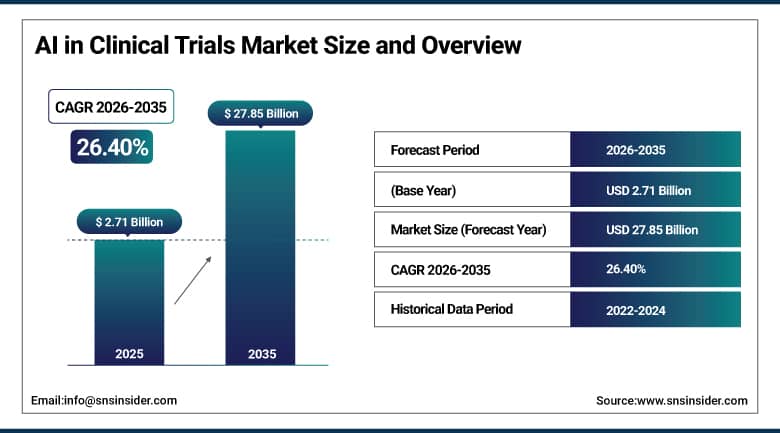
The AI in Clinical Trials Market was valued at USD 2.71 Billion in 2025 and is expected to reach USD 27.85 Billion by 2035, growing at a CAGR of 26.40% from 2026 to 2035.
The AI in Clinical Trials Market is growing steadily due to increasing adoption of machine learning and predictive analytics across trial design, patient recruitment, and safety monitoring, growing pressure on pharmaceutical and biotechnology companies to shorten clinical development timelines while controlling escalating trial costs, and continuous advancements in natural language processing enabling faster extraction of insights from unstructured clinical data. AI-based platforms are increasingly deployed across virtually every stage of the clinical trial lifecycle, from protocol design and site selection through patient recruitment, real-time safety monitoring, and regulatory submission, allowing sponsors and contract research organizations to identify eligible patients faster, detect adverse events earlier, and make data-driven decisions with greater precision.
⮞In 2026, Tempus AI and IQVIA both expanded their oncology-focused clinical trial matching and predictive analytics platforms to meet rising sponsor demand for faster patient identification and site-level risk monitoring amid growing adoption of decentralized and hybrid trial designs across pharmaceutical and biotechnology research programs worldwide.
To Get More Information On AI in Clinical Trials Market - Request Free Sample Report
AI in Clinical Trials Market Trends:
-
Rising adoption of generative AI for synthetic control arm generation is accelerating late-stage oncology and rare disease trial timelines.
-
Growing use of natural language processing to mine unstructured electronic health records is speeding up patient eligibility screening.
-
Expanding integration of AI-enabled risk-based monitoring is improving real-time safety signal detection across multi-site global trials.
-
Increasing deployment of AI-powered decentralized trial technologies is reducing site-level operational burden for sponsors.
-
Strategic collaborations between pharmaceutical sponsors and AI technology vendors are accelerating application-specific trial intelligence platforms.
U.S. AI in Clinical Trials Market Outlook:
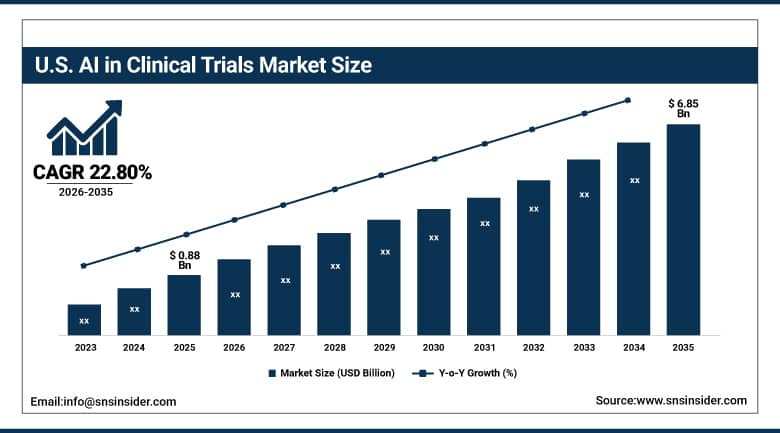
The U.S. AI in Clinical Trials Market was valued at USD 0.88 Billion in 2025 and is projected to reach USD 6.85 Billion by 2035, growing at a CAGR of 22.80% during 2026–2035.
The leading pharmaceutical, biotechnology, and contract research organizations within the country continue to expand their application of AI across trial design, patient recruitment, and safety monitoring due to improvements in machine learning infrastructure, growing need for faster regulatory approvals, and increased applications across therapeutic areas such as oncology, neurology, and infectious disease. The growing capability for domestic real-world data aggregation that supports AI-driven patient matching, alongside the expansion of decentralized trial infrastructure among leading domestic sponsors, helps to ensure growing demand for advanced clinical trial intelligence platforms.
⮞In 2026, IQVIA expanded its U.S. AI-powered patient recruitment platform through integration of additional real-world data sources, strengthening its ability to match eligible patients to oncology and rare disease trials for domestic pharmaceutical and biotechnology sponsors.
AI in Clinical Trials Market Segment Analysis:
-
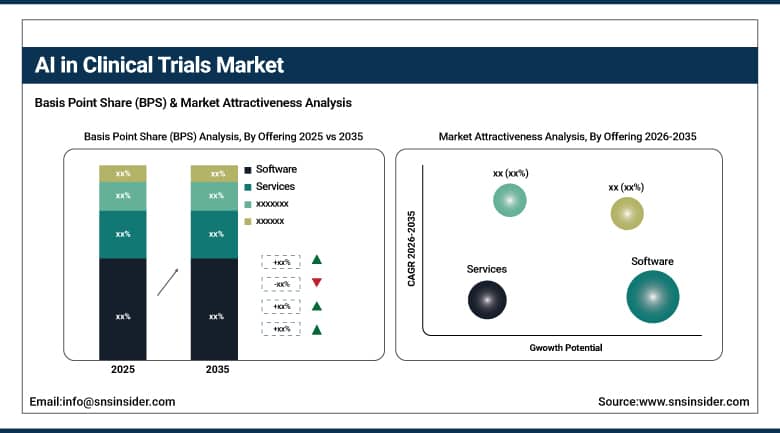
By Offering, Software dominated the AI in Clinical Trials Market with a 65.40% share in 2025, while Services is the fastest-growing offering segment with a CAGR of 28.80% from 2026–2035.
-
By Technology, Machine Learning dominated the AI in Clinical Trials Market with a 36.80% share in 2025, while Natural Language Processing is the fastest-growing technology segment with a CAGR of 31.20% from 2026–2035.
-
By Application, Patient Recruitment & Enrollment dominated the AI in Clinical Trials Market with a 31.60% share in 2025, while Risk-Based Monitoring & Safety Surveillance is the fastest-growing application segment with a CAGR of 29.60% from 2026–2035.
-
By End User, Pharmaceutical & Biotechnology Companies dominated the AI in Clinical Trials Market with a 55.20% share in 2025, while Contract Research Organizations is the fastest-growing end-user segment with a CAGR of 28.40% from 2026–2035.
By Offering, Software led the market, while Services is expanding fastest.
Software dominated the AI in Clinical Trials Market, primarily due to the increasing adoption of AI-powered platforms for trial design, patient recruitment, data management, monitoring, and predictive analytics. These solutions help pharmaceutical and biotechnology companies automate complex clinical workflows, improve data accuracy, reduce operational costs, and accelerate decision-making. Growing integration of machine learning, natural language processing, and predictive algorithms into clinical trial management systems further strengthens software demand across research organizations.
Services is projected to be the fastest-growing offering segment in the AI in Clinical Trials Market. Rapid growth is driven by increasing demand for specialized AI consulting, implementation, integration, validation, and technical support among pharmaceutical companies and contract research organizations. Many organizations lack the in-house expertise required to deploy and manage sophisticated AI solutions, encouraging partnerships with specialized service providers. Additionally, evolving regulatory requirements and the need for customized AI applications are accelerating service adoption.
⮞In July 2026, EDETEK launched a sponsor partnership program supporting the FDA’s Real-Time Clinical Trials initiative, combining its AI-enabled R&D Cloud with implementation support for continuous clinical data visibility, safety monitoring, and regulatory engagement.
By Technology, Machine Learning led the market, while NLP is expanding fastest.
The Machine Learning segment dominated the AI in Clinical Trials Market. Machine learning-based platforms account for the largest technology share due to their broad applicability across patient stratification, predictive enrollment modeling, and adverse event forecasting, combined with a mature ecosystem of validated algorithms that regulatory agencies and sponsors have grown comfortable deploying across late-stage trials. The established track record of machine learning models in improving site selection accuracy and reducing patient screen-failure rates across oncology, cardiovascular, and metabolic disease trials has reinforced this technology's dominant position, with leading sponsors continuing to expand machine learning deployment across an increasingly broad range of therapeutic areas and trial phases worldwide.
The Natural Language Processing segment is anticipated to grow at the fastest rate during the forecast period 2026-2035. Rising volumes of unstructured clinical data, including physician notes, patient-reported outcomes, and regulatory documentation, are driving strong demand for NLP-based extraction and summarization tools that can accelerate protocol feasibility assessment and eligibility screening. Growing integration of large language models into clinical trial documentation workflows, including automated adverse event coding and informed consent simplification, is further expanding NLP adoption across sponsors and contract research organizations seeking to reduce manual data abstraction burden and improve consistency in regulatory submissions across multi-site global trials.
By Application, Patient Recruitment & Enrollment led the market, while Risk-Based Monitoring is expanding fastest.
The Patient Recruitment & Enrollment segment dominated the AI in Clinical Trials Market. Patient recruitment remains the largest application category because AI-driven matching platforms directly address one of the most persistent and costly bottlenecks in clinical development, enabling sponsors to identify eligible patients from electronic health records, claims data, and genomic databases far faster than traditional manual screening methods. The ability of AI recruitment platforms to reduce trial enrollment timelines and screen-failure rates while expanding access to diverse and underrepresented patient populations has driven sustained adoption across oncology, rare disease, and chronic condition trials, reinforcing this application's dominant position across the global clinical research industry.
The Risk-Based Monitoring & Safety Surveillance segment is expected to register the fastest CAGR during the forecast period 2026-2035. Growing regulatory emphasis on proactive risk detection and the increasing complexity of decentralized and hybrid trial designs are driving strong demand for AI-enabled monitoring platforms that can flag data anomalies, protocol deviations, and adverse events in real time across dispersed trial sites. Rising sponsor investment in centralized statistical monitoring and predictive safety analytics, combined with growing adoption of wearable and remote patient monitoring devices generating continuous data streams, is significantly expanding the addressable use case for AI-based risk monitoring across late-phase and post-marketing surveillance studies worldwide.
⮞In July 2026, EDETEK introduced an AI-enabled clinical development initiative supporting near-real-time safety and efficacy signal monitoring, helping sponsors strengthen continuous data oversight and identify emerging trial risks during early-phase development.
By End User, Pharmaceutical & Biotechnology Companies led the market, while CROs is expanding fastest.
The Pharmaceutical & Biotechnology Companies segment dominated the AI in Clinical Trials Market. Pharmaceutical and biotechnology sponsors remain the largest end-user category as these organizations bear direct responsibility for trial outcomes, timelines, and regulatory submissions, giving them the strongest incentive to invest in AI platforms capable of reducing development costs and accelerating time to market across increasingly competitive therapeutic areas. Large pharmaceutical companies with substantial R&D budgets continue to expand internal AI capabilities and strategic vendor partnerships spanning trial design, patient recruitment, and safety monitoring, reinforcing this end-user segment's dominant position across both established and emerging clinical research organizations globally.
The Contract Research Organizations segment is expected to witness the fastest CAGR during the forecast period 2026-2035. Growing outsourcing of clinical trial operations by small and mid-sized biotechnology sponsors lacking in-house AI infrastructure is driving strong demand for CRO-managed AI platforms capable of handling patient recruitment, site monitoring, and regulatory documentation across increasingly complex global trial networks. Expanding CRO investment in proprietary AI-enabled trial management platforms and growing strategic partnerships with specialized AI technology vendors are further accelerating adoption of advanced clinical trial intelligence tools across the contract research organization segment worldwide.
⮞In May 2026, Taimei Technology and South Korea’s C&R Research established a strategic partnership to develop AI-enabled clinical trial operations, incorporating intelligent electronic data capture, automated eCRF generation, and AI agents into CRO-managed clinical research workflows.
Regional Analysis:
|
Region |
Major Country |
Share within Region, 2025 (%) |
|---|---|---|
|
North America |
United States |
84.50% |
|
Europe |
Germany |
22.80% |
|
Asia Pacific |
China |
34.60% |
|
Middle East & Africa |
UAE |
24.20% |
|
Latin America |
Brazil |
36.40% |
North America AI in Clinical Trials Market Insights
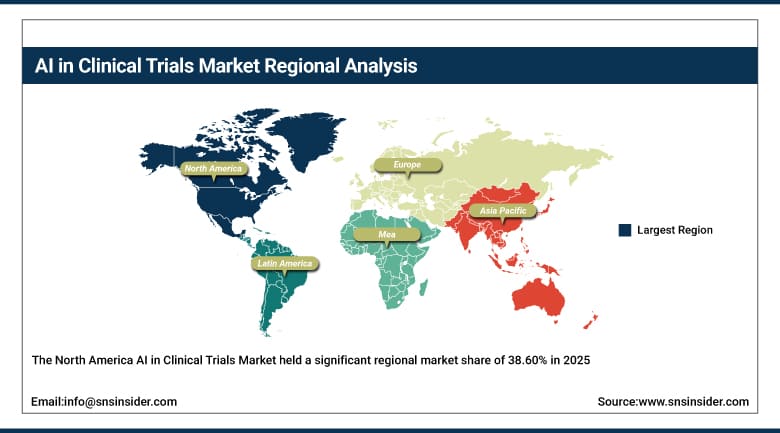
The North America AI in Clinical Trials Market held a significant regional market share of 38.60% in 2025, owing to the region's mature pharmaceutical and biotechnology R&D ecosystem, extensive availability of electronic health record and real-world data infrastructure, and early and widespread adoption of AI-enabled trial design, patient recruitment, and safety monitoring platforms across leading sponsors and contract research organizations. The region's advanced regulatory framework, including the FDA's growing guidance on AI-enabled drug development tools, continues to support sponsor confidence in deploying machine learning and natural language processing platforms across increasingly complex, multi-site global trials, while substantial venture capital and pharmaceutical R&D investment continues to fund development of next-generation clinical trial intelligence platforms across the region.
The US was the leading country within the North America AI in Clinical Trials Market in 2025, driven by extensive domestic pharmaceutical R&D infrastructure, strong presence of leading AI clinical trial technology vendors, and growing sponsor transition toward AI-enabled decentralized and hybrid trial models. Canada is contributing to regional growth through its own expanding biotechnology and digital health sector and growing adoption of AI-driven patient recruitment and remote monitoring platforms across academic medical centers and emerging biotechnology companies.
Get Customized Report as Per Your Business Requirement - Enquiry Now
Europe AI in Clinical Trials Market Insights
The Europe region was a major contributor to the AI in Clinical Trials Market in 2025, expected to register comparatively higher growth for AI-enabled trial design and patient recruitment solutions during the forecast period. This is attributed to the region's strong regulatory emphasis on data-driven drug development under the European Medicines Agency's evolving digital health guidance, well-established pharmaceutical and clinical research infrastructure, and growing cross-border collaboration among academic institutions, sponsors, and AI technology vendors pursuing broader clinical development efficiency objectives across member states.
Germany is one of the major markets in Europe owing to its strong pharmaceutical manufacturing and clinical research base, along with presence of leading AI-enabled contract research organizations serving both domestic and international sponsors. Other countries such as the United Kingdom, France, and Switzerland, home to several leading global pharmaceutical companies and AI technology vendors, are also contributing to market growth through extensive clinical trial activity and continued digital health research and development investment.
⮞In June 2026, the Innovative Health Initiative introduced GENz-trials, a collaborative research project applying artificial intelligence and data science to clinical trial design, patient recruitment, and evaluation, aiming to improve research efficiency, inclusiveness, and scientific rigor.
Asia Pacific AI in Clinical Trials Market Insights
The Asia Pacific AI in Clinical Trials Market is expected to witness the fastest growth rate during the forecast period 2026-2035. The market growth is driven by rapidly expanding clinical trial activity across the region's major pharmaceutical manufacturing economies, growing government investment in digital health and AI infrastructure, and increasing cost-efficiency advantages that continue to attract sponsors seeking to expand trial capacity across emerging and established markets pursuing broader biotechnology industrialization strategies.
China is one of the main growth drivers in the Asia Pacific AI in Clinical Trials Market, owing to its massive clinical trial ecosystem and rapidly growing domestic AI technology capability supporting both local and multinational pharmaceutical sponsors. India and Japan, both major global clinical trial and pharmaceutical manufacturing hubs, are also contributing to regional growth through expanding trial capacity and increasing adoption of AI-enabled patient recruitment and site monitoring platforms across contract research organizations and academic medical centers.
⮞In May 2026, Shanghai-based Taimei Technology partnered with South Korea’s C&R Research to develop an AI-powered clinical trial operations system, integrating AI agents, intelligent data capture, and automated clinical data management into multinational research workflows.
Middle East & Africa and Latin America AI in Clinical Trials Market Insights
Middle East & Africa and Latin American regions are gradually expanding AI in clinical trials adoption as pharmaceutical and biotechnology investment grows across both regions, supported by increasing regional clinical trial activity and growing government focus on modernizing healthcare and drug development infrastructure.
Brazil is set to be a prominent Latin American market fueled by its substantial clinical research industry requiring efficient AI-enabled patient recruitment and trial monitoring solutions, and growing domestic biotechnology sector investment. The Middle East & Africa region has the UAE and Saudi Arabia investing in modern healthcare and clinical research infrastructure that is gradually increasing demand for AI-enabled clinical trial platforms across their expanding pharmaceutical and biotechnology research sectors.
⮞In October 2025, Abu Dhabi’s Department of Health signed strategic agreements with Capgemini, Statista, and Mohamed bin Zayed University of Artificial Intelligence to advance AI, data analytics, and healthcare research innovation across the emirate’s digital health ecosystem.
⮞In September 2026, Brazil’s National Research Ethics Authority (Inaep) approved guidance governing artificial intelligence in scientific research, establishing ethical assessment parameters and introducing an online risk-classification tool to support responsible use of AI in studies involving human participants.
Market Dynamics:
Growth Drivers: Rising clinical trial complexity and cost pressure driving AI adoption across trial operations
The rising complexity and cost of clinical trials across oncology, rare disease, and chronic condition research, combined with growing pressure on pharmaceutical and biotechnology sponsors to shorten development timelines and improve trial success rates, are among the primary drivers of the AI in Clinical Trials Market. AI-enabled platforms provide sponsors with faster, more accurate patient identification, real-time safety monitoring, and predictive trial design capabilities, replacing conventional manual processes across virtually every stage of the clinical trial lifecycle, from protocol design and site selection through patient recruitment, safety surveillance, and regulatory submission preparation.
Technological advancements in machine learning and natural language processing have significantly increased the accuracy of patient matching and adverse event detection, with recent innovations improving real-world data integration and predictive analytics across commercial trial management platforms. Rising adoption of decentralized and hybrid trial models requiring AI-enabled remote monitoring, growing integration of generative AI into synthetic control arm generation and protocol optimization, and continued pharmaceutical R&D investment expanding AI deployment capacity are further supporting demand across the forecast period, as AI platforms continue displacing conventional manual trial operations across an increasingly broad range of therapeutic areas.
⮞In April 2026, the U.S. FDA announced two real-time clinical trial proofs of concept and a proposed AI-enabled early-phase trial pilot, targeting faster data evaluation, improved safety oversight, and more efficient regulatory decision-making.
Restraints: Data privacy concerns and algorithm validation challenges limiting market expansion
One of the most critical obstacles to market growth comes in the form of stringent data privacy and patient confidentiality regulations governing the use of electronic health records, genomic data, and real-world data across clinical trial AI applications. This comes down to the fact that sponsors and technology vendors must navigate complex, jurisdiction-specific data governance frameworks, which can slow platform deployment and limit cross-border data sharing required for training robust, generalizable machine learning models across diverse patient populations.
Moreover, the lack of standardized regulatory guidance for validating and approving AI-enabled clinical trial tools directly impacts sponsor confidence and creates uncertainty around long-term compliance requirements for both manufacturers and end users in the form of pharmaceutical companies that must justify AI-driven decisions to regulatory authorities. Besides, the high technical requirements in terms of integrating AI platforms with legacy clinical trial management systems and electronic data capture infrastructure require considerable IT investment and specialized technical expertise.
Opportunities: Expansion of decentralized trials and generative AI applications creating new growth avenues
The increasing need for AI-enabled patient recruitment and remote monitoring solutions to support decentralized and hybrid clinical trial models, the rise of generative AI applications in synthetic control arm generation and protocol design, and greater emphasis on innovation in predictive trial analytics due to increased biotechnology funding will provide ample growth opportunities in the AI in Clinical Trials Market. The need for faster, more cost-efficient drug development processes that reduce patient burden and improve trial success rates will ensure future growth as sponsors face intensifying competitive and regulatory pressure worldwide.
There is immense potential for growth in the area of AI-enabled real-world evidence generation that supports post-marketing surveillance and regulatory submissions, reducing costs for pharmaceutical sponsors while improving safety monitoring accuracy. The increase in clinical trial activity across emerging economies of Asia Pacific and Latin America, along with growing government efforts toward digital health infrastructure modernization, will drive growth in demand for AI-enabled clinical trial platforms.
⮞In September 2026, HanchorBio partnered with InSilicoTrials to evaluate AI-enabled digital twins and external-control approaches for HCB101 clinical development, exploring whether virtual patient modeling could reduce conventional control-group requirements and improve trial efficiency.
Recent Developments:
-
2025: Medidata introduced a generative AI expansion of its "Medidata AI" enterprise suite, integrating synthetic control arm generation into protocol design workflows to help sponsors reduce trial design timelines and patient recruitment burden.
-
2026: IQVIA expanded its "IQVIA Connected Intelligence" platform with new real-time risk-based monitoring capabilities, enabling sponsors to detect site-level data anomalies and safety signals earlier across decentralized global trials.
-
2026: ConcertAI launched a new generative AI module within its "RWD360" platform, enabling automated extraction of structured clinical insights from unstructured oncology electronic health records for faster trial feasibility assessment.
AI In Clinical Trials Market Key Players Are:
-
IQVIA Inc.
-
Medidata Solutions, Inc. (a Dassault Systèmes company)
-
Oracle Corporation
-
ICON plc
-
Parexel International Corporation
-
Certara, Inc.
-
Saama Technologies, Inc.
-
AiCure, LLC
-
Unlearn.AI, Inc.
-
ConcertAI, LLC
-
Tempus AI, Inc.
-
Median Technologies
-
Deep 6 AI, Inc.
-
Phesi, Inc.
-
H1 Insights, Inc.
-
Formation Bio (TrialSpark)
-
Antidote Technologies Ltd.
-
Reify Health, Inc.
-
Lindus Health Ltd.
-
Suvoda LLC
AI in Clinical Trials Market Report Scope:
| Report Attributes | Details |
|---|---|
| Market Size in 2025 | USD 2.71 Billion |
| Market Size by 2035 | USD 27.85 Billion |
| CAGR | CAGR of 26.40% From 2026 to 2035 |
| Base Year | 2025 |
| Forecast Period | 2026-2035 |
| Historical Data | 2022-2024 |
| Report Scope & Coverage | Market Size, Segments Analysis, Competitive Landscape, Regional Analysis, DROC & SWOT Analysis, Forecast Outlook |
| Key Segments | • By Offering (Software, Services) • By Technology (Machine Learning, Deep Learning, Natural Language Processing, Computer Vision & Other Technologies) • By Application (Patient Recruitment & Enrollment, Trial Design & Protocol Optimization, Data Management & Monitoring, Risk-Based Monitoring & Safety Surveillance) • By End User (Pharmaceutical & Biotechnology Companies, Contract Research Organizations (CROs), Academic & Research Institutes) |
| Regional Analysis/Coverage | North America (US, Canada), Europe (Germany, France, UK, Italy, Spain, Russia, Poland, Rest of Europe), Asia Pacific (China, India, Japan, South Korea, Australia, ASEAN Countries, Rest of Asia Pacific), Middle East & Africa (UAE, Saudi Arabia, Qatar, South Africa, Rest of Middle East & Africa), Latin America (Brazil, Argentina, Mexico, Colombia, Rest of Latin America) |
| Company Profiles | IQVIA Inc., Medidata Solutions Inc. (a Dassault Systèmes company), Oracle Corporation, ICON plc, Parexel International Corporation, Certara Inc., Saama Technologies Inc., AiCure LLC, Unlearn.AI Inc., ConcertAI LLC, Tempus AI Inc., Median Technologies, Deep 6 AI Inc., Phesi Inc., H1 Insights Inc., Formation Bio (TrialSpark), Antidote Technologies Ltd., Reify Health Inc., Lindus Health Ltd., Suvoda LLC |

Frequently Asked Questions
Key players include IQVIA Inc., Medidata Solutions Inc. (a Dassault Systèmes company), Oracle Corporation, ICON plc, and Parexel International Corporation, among others.
Key opportunities include increasing clinical trial complexity, AI-driven patient recruitment, predictive analytics, decentralized trials, automated data management, and growing demand for faster and cost-efficient drug development.
The market is driven by rising clinical trial complexity and cost pressure, growing sponsor demand for faster patient recruitment and safety monitoring, and continued advancement of machine learning and generative AI technologies.
The Patient Recruitment & Enrollment segment dominated the AI in Clinical Trials Market in 2025, accounting for approximately 31.60% market share.
The North America region dominated the AI in Clinical Trials Market in 2025 with a market share of 38.60%, driven by the region's mature pharmaceutical R&D ecosystem and early adoption of AI-enabled trial platforms.
