
AI in Pathology Slide Digitization Market Report Scope & Overview:
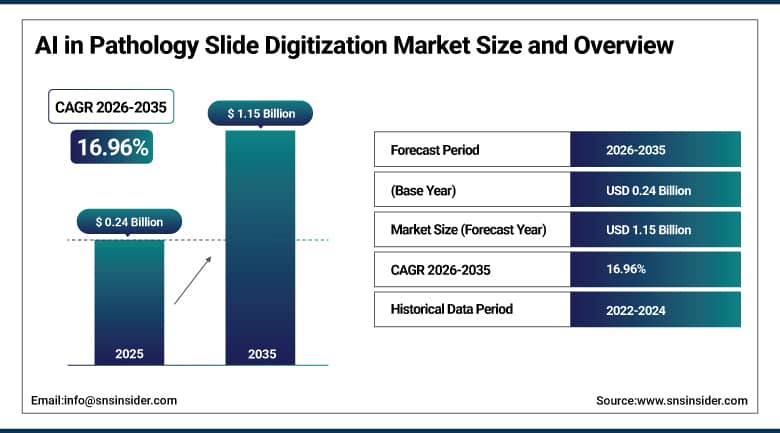
The AI in Pathology Slide Digitization Market was valued at USD 0.24 Billion in 2025 and is projected to reach USD 1.15 Billion by 2035, expanding at a CAGR of 16.96% during the forecast period 2026–2035.
AI-powered pathology slide digitization technology market throughout the world is experiencing revolutionary changes because health organizations are adopting the practice of shifting from traditional microscopy to complete digital pathology with AI integration. The adoption of whole-slide imaging systems, image analysis software powered by artificial intelligence, cloud-based pathology technology platform, and workflow management solutions is improving the diagnostic performance, efficiency of laboratories, and turnaround time. The growth in the need for precision oncology, increasing prevalence of cancers, growing laboratory automation, and adoption of computational pathology is contributing towards the investments made by hospitals, diagnostic laboratories, pharmaceutical organizations, and research institutions.
During the period 2025, some pathology technology companies hastened the pace of commercialization of artificial intelligence-based slide digitization technology that included whole slide imaging, automated tissue analysis, cloud-based connectivity, and decision support system for diagnosis purposes.
To Get More Information On AI in Pathology Slide Digitization Market - Request Free Sample Report
AI in Pathology Slide Digitization Market Trends
-
Increasing adoption of AI-assisted whole-slide imaging platforms for cancer diagnostics.
-
Rising commercialization of cloud-based digital pathology ecosystems.
-
Growing deployment of AI-powered image analysis software for pathology workflow automation.
-
Expansion of precision oncology supported by computational pathology platforms.
-
Increasing integration of digital pathology with laboratory information systems and electronic medical records.
The U.S. AI in Pathology Slide Digitization Market Size Outlook
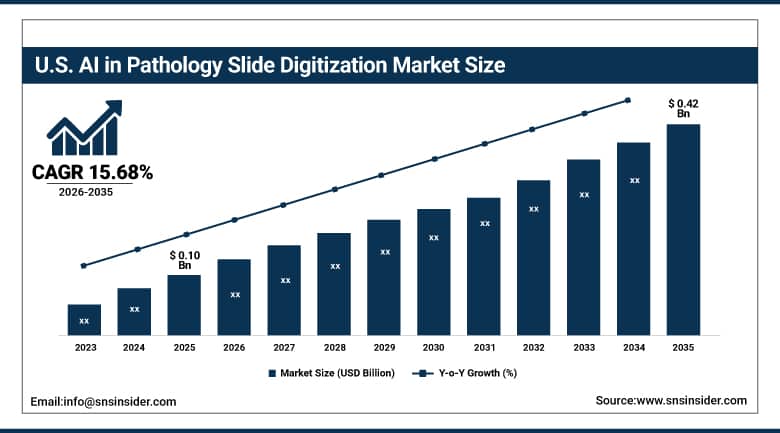
The U.S. AI in Pathology Slide Digitization Market was valued at USD 0.10 billion in 2025 and is expected to reach approximately USD 0.42 billion by 2035, expanding at a CAGR of 15.68% during 2026–2035.
The United States continues to dominate the market because of advanced pathology laboratory systems, high rates of digital technology adoption in the field of healthcare, favorable regulation and greater investment in AI applications in diagnostics. Increasing trends for hospitals, medical centers, reference laboratories and pharmaceutical companies include the utilization of pathology systems that involve artificial intelligence technologies including whole-slide imaging, image analysis, cloud collaboration and predictive analytics to improve accuracy and efficiency of diagnoses. Precision oncology, personalized medicine and lab process improvement play an important role in growing the market and promoting digital pathology application.
In 2025, the U.S. Food and Drug Administration continued to expand its regulatory reach regarding the medical devices based on artificial intelligence technologies within its Digital Health and AI-enabled medical device initiatives.
AI in Pathology Slide Digitization Market Segment Analysis
-
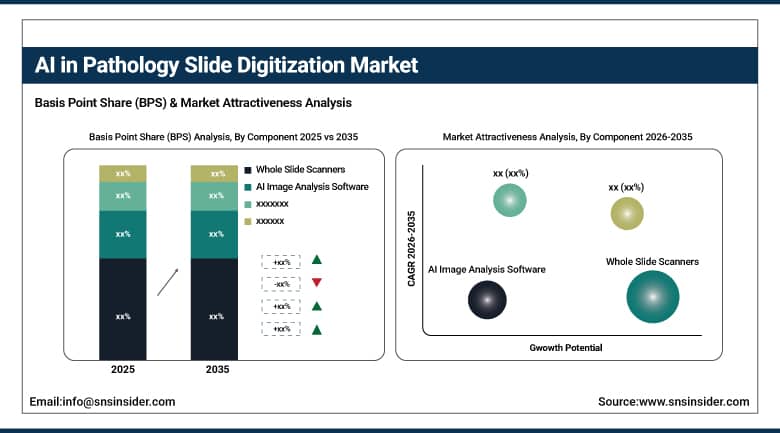
By Component, whole slide scanners dominated the market with 38.00% share in 2025, while AI image analysis software is projected to witness the fastest growth with 20.37% CAGR during the forecast period.
-
By Deployment, on-premise dominated the market with 44.00% share in 2025, while cloud-based is projected to witness the fastest growth with 21.06% CAGR during the forecast period.
-
By Application, cancer diagnosis dominated the market with 42.00% share in 2025, while companion diagnostics is projected to witness the fastest growth with 19.33% CAGR during the forecast period.
-
By End User, hospitals & diagnostic laboratories dominated the market with 39.00% share in 2025, while pharmaceutical & biotechnology companies are projected to witness the fastest growth with 19.19% CAGR during the forecast period.
By Component, whole slide scanners dominated, while AI image analysis software emerged fastest-growing segment.
The Whole Slide Scanners segment held the largest revenue share of 38.00% in 2025 as a result of rising digitization of pathology labs and increasing usage of high-throughput whole-slide imaging technology in hospitals, reference labs, and cancer centers. The scanners constitute the basis for all digital pathology operations through the process of scanning of glass slides into high-quality digital images for storing, viewing, and AI-based analysis. Advancements in scanning speed, image quality, automation levels, and system integration with lab information systems have resulted in increased commercial adoption in the context of health care facilities moving towards completely digital pathology practices.
The AI Image Analysis Software segment is estimated to grow at the highest CAGR of 20.37% from 2026 to 2035 because of increasing demand for automation of tissue classification, cancer diagnosis, biomarker quantitation, and workflow improvement with artificial intelligence. Artificial intelligence algorithms reduce workloads of pathologists and increase reproducibility of diagnoses on large pathology data sets. Commercialization of AI solutions in pathology is accelerated by integrating such solutions with cloud computing, deep learning algorithms, and clinical decision support systems.
By Deployment, on-premise dominated the market, while cloud-based fastest-growing segment.
On-premise deployment is expected to dominate with a major market share of 44.00% during the year 2025 on account of the extensive use of this form of deployment by hospitals and diagnostic labs needing complete control over patient data, pathology images repository and laboratory infrastructure. Healthcare establishments are still making heavy investments in enterprise-level digital pathology solutions installed on their secured internal networks to ensure regulatory compliance, low-latency image processing and smooth integration with laboratory information systems. The On-Premise deployment continues to be the best choice for pathology laboratories that require high volume pathology services needing uninterrupted services and cyber security measures.
Cloud-based deployment is likely to experience the highest growth rate of 21.06% during the forecast period due to rising demands for remote pathology consultation, collaboration, scalable storage infrastructure and cloud-based image analysis powered by AI. Cloud deployment is enabling health organizations to have access to pathology data from different geographical locations through telepath ology, centralized reporting and collaboration capabilities. Improvements in cloud security, interoperability standards and AI-driven workflow automation are contributing to the rapid adoption of cloud deployment. During 2025, many digital pathology companies launched cloud-based pathology solutions enabling AI-assisted diagnosis and remote pathology collaboration.
By Application, cancer diagnosis dominated, while companion diagnostics is fastest growth.
Cancer diagnosis was observed to garner the largest revenue market share of 42.00% in 2025, driven by the rising incidence of cancers across the globe and increased use of digital pathology solutions for the accurate histopathology assessment. Incorporation of AI pathology platforms helps detect cancerous tissues quickly, standardizes grading, and increases accuracy in the diagnosis and classifying of tumors. More and more incorporation of Whole Slide Imaging with AI algorithms into hospitals and cancer care facilities is helping increase the accuracy of diagnosing and decrease turnaround time while allowing for the initiation of precision oncology programs.
The fastest-growing market segment is companion diagnostics with a compound annual growth rate (CAGR) of 19.33% over the review period of 2026-2035. The increasing adoption of biomarker-based therapies and precision medicine is contributing to the growth rate of this market segment. Increasing adoption of AI pathology platforms by drug manufacturers to help discover predictive biomarkers and target therapies and facilitate development of clinical trials is contributing to the growth rate of this market segment. Over 2025-2026, multiple digital pathology solution providers have released AI algorithms for biomarker quantification and companion diagnostics for oncology applications.
Regional Analysis
|
Region |
Major Country |
Share within Region, 2025 (%) |
|---|---|---|
|
North America |
United States |
94.00% |
|
Europe |
Germany |
29.00% |
|
Asia Pacific |
China |
20.00% |
|
Middle East & Africa |
UAE |
4.00% |
|
Latin America |
Brazil |
3.00% |
North America AI in Pathology Slide Digitization Market Insights
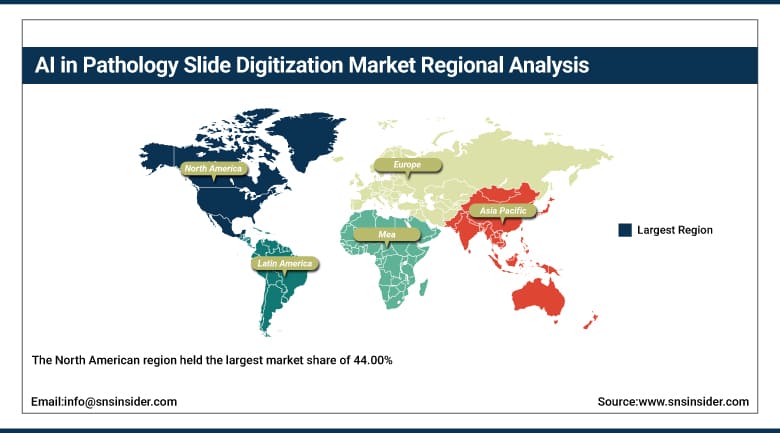
The North American region held the largest market share of 44.00%, owing to the fast adoption of the digital pathology infrastructure, wide use of AI-enabled diagnostic tools, and availability of the world-class producers of pathology equipment in the United States and Canada. The region's healthcare providers, research institutions, pharmaceutical firms, and diagnostic labs are making huge investments in the development of whole slide imaging systems, image analysis software, cloud pathology platforms, and automation technologies. Increasing cases of cancer disease, rising precision diagnostics needs, and favorable regulatory environment have made North America dominate the digital pathology space. In 2025, the FDA of the U.S. kept improving its guidance on SaMDs that use AI technology.
Get Customized Report as Per Your Business Requirement - Enquiry Now
Europe AI in Pathology Slide Digitization Market Insights
Europe symbolized support through higher digitization of healthcare, increased efforts towards pathology modernization, and increased adoption of AI-driven diagnostic procedures in Germany, the United Kingdom, France, Italy, Spain, and other European healthcare frameworks. Hospitals and pathology laboratories have increasingly adopted whole-slide imaging systems, AI-driven imaging systems, and digital pathology networks to ensure greater diagnostic uniformity and laboratory efficiency and for facilitating pathology reporting. The increase in investment in areas such as precision oncology, biomarkers, and digital healthcare transformation has been driving the regional market growth. In 2025, various European healthcare institutions witnessed increased adoption of digital pathology platforms driven by AI for cancer diagnosis and laboratory automation under regional digital health projects.
Asia Pacific AI in Pathology Slide Digitization Market Insights
The Asia Pacific market is estimated to have the highest CAGR of 21.39% during the forecast period owing to the growth of healthcare infrastructure, increasing incidence of cancer, laboratory automation, and government funding in digital healthcare technologies in China, Japan, India, South Korea, Singapore, and Australia. Healthcare organizations are adopting AI enabled pathology solutions to overcome the shortage of trained pathologists and improve efficiency in diagnostics. Investment in precision medicines, artificial intelligence R&D, and cloud-based healthcare infrastructure will provide immense business opportunities for providers of pathology technology in this region. In 2025, various healthcare organizations in Asia will adopt digital pathology by using AI powered slide analysis platforms that support precision oncology and telepath ology.
Middle East & Africa and Latin America AI in Pathology Slide Digitization Market Insights
The Middle East and Africa region will continue growing as a result of rising adoption of healthcare modernization strategies, investments in smart hospitals, and application of digital diagnosis technologies in the UAE, Saudi Arabia, South Africa, and neighboring countries. The adoption of digital pathology platforms with AI integration allows for improvement in the diagnostic process of cancers, laboratory efficiency, and development of precision medicine programs within healthcare organizations. Government healthcare modernization strategies and investments in healthcare technology infrastructure will further contribute to future commercial opportunities in the region.
Sustained growth of Latin America region is expected due to gradual modernization of diagnostic laboratories, cancer screening programs, and increasing adoption of digital healthcare technologies in Brazil, Mexico, Argentina, and Chile. Digital pathology solutions have been invested in by healthcare facilities to increase diagnosis quality, cut down the time, and enable remote consultations in underprivileged areas. Although the adoption rate remains low in comparison with that of advanced markets, increased healthcare investments from both governments and private enterprises will help generate favorable market opportunities.
Market Dynamics
Growth Drivers: Higher uptake of AI-assisted digital pathology platforms for precise diagnoses.
The higher shift from traditional microscopy to AI-integrated digital pathology platforms remains the major driver that boosts the market growth globally. Hospitals, diagnostic labs, and medical research centers are gradually embracing whole slide imaging solutions that incorporate artificial intelligence. The use of AI-assisted image analysis helps the pathologists in detecting cancer cases, classifying tissues, determining biomarker levels, and prioritizing tasks. Laboratories can handle their increasing number of diagnostic cases using AI-assisted imaging.
Increasing numbers of precision oncology solutions, cancer cases, investments in lab digitalization, and demand for remote pathology consultations keep improving the commercialization prospects in both developed and emerging health care sectors. Cloud-based pathology ecosystems and interoperable laboratory information systems boost operational efficiencies and facilitate collaborations. By 2025, FDA continues developing the regulatory framework for Artificial Intelligence and Machine Learning-based Software as a Medical Device (AI/ML SaMD).
Restraints: High cost of implementation, regulatory difficulties, and compatibility problems.
Although there have been remarkable advancements in technology, the implementation of artificial intelligence-based pathology slide digitization technology has been hindered by the high cost of investment in whole-slide scanning equipment, cloud infrastructure for storing image data, artificial intelligence software, cyber security, and laboratory implementation. Many hospitals and independent laboratories still use older laboratory information systems that need a lot of improvements in order to support full digitalization processes.
Moreover, regulatory approval process for artificial intelligence-supported diagnostic software, privacy issues with data, image standardization problem, and limited compatibility across healthcare IT platforms hamper the commercialization process. Small healthcare organizations experience financial restrictions associated with digitalization projects. In 2025, the regulatory bodies emphasized the importance of validation, transparency, cyber security, and lifecycle monitoring aspects of artificial intelligence-based medical software used for clinical diagnostics.
Opportunities: Growth in precision oncology, cloud pathology, and biomarker discovery via AI.
Several significant long-term opportunities are available due to increasing efforts related to precision medicine, pharmaceutical research, and digital healthcare. AI-enabled pathology systems have been contributing to biomarker discovery, companion diagnostics, stratification of patients in clinical trials, and drug discovery through automation of quantitative tissue analysis. Cloud-based pathology systems facilitate centralized image management, remote collaboration, AI adoption, and collaborative work between different healthcare organizations.
Increasing investments in computational pathology, development of digital biomarkers, collaboration between different research centers, and pathology analysis via AI will generate considerable commercial opportunities for hospitals, pharmaceutical firms, and research organizations during the forecast period. In 2025, several pharmaceutical firms entered into partnerships with AI pathology technology vendors to promote digital biomarker discovery and precision oncology research through computational pathology platforms.
Recent Developments
-
2026 – Roche Diagnostics expanded its digital pathology portfolio by enhancing AI-powered pathology workflows and strengthening integration between VENTANA DP 600 slide scanners and AI-assisted image analysis platforms to improve precision oncology diagnostics and laboratory efficiency.
-
2026 – Philips Digital & Computational Pathology advanced its cloud-enabled digital pathology ecosystem by expanding enterprise image management capabilities and AI-assisted pathology collaboration solutions for hospitals and pathology laboratories.
-
2025 – Leica Biosystems strengthened its Aperio Digital Pathology portfolio with enhanced whole-slide imaging capabilities and AI-compatible workflow solutions designed to accelerate pathology digitization and improve diagnostic efficiency.
-
2025 – Paige AI expanded deployment of its FDA-authorized AI applications for cancer diagnosis, supporting pathologists with AI-assisted prostate and breast cancer detection through enterprise digital pathology platforms.
AI in Pathology Slide Digitization Market Key Players are:
-
Leica Biosystems
-
F. Hoffmann-La Roche Ltd.
-
Koninklijke Philips N.V.
-
Hamamatsu Photonics K.K.
-
PathAI Inc.
-
Paige AI Inc.
-
Proscia Inc.
-
Visiopharm A/S
-
Indica Labs Inc.
-
Aiforia Technologies Plc
-
Ibex Medical Analytics Ltd.
-
FUJIFILM Healthcare Americas Corporation
-
Huron Digital Pathology Inc.
-
3DHISTECH Ltd.
-
Olympus Corporation
-
Mindpeak GmbH
-
OptraSCAN Inc.
-
Nucleai Ltd.
-
Deep Bio Inc.
-
Lunit Inc.
AI in Pathology Slide Digitization Market Report Scop:
| Report Attributes | Details |
|---|---|
| Market Size in 2025 | USD 0.24 Billion |
| Market Size by 2035 | USD 1.15 Billion |
| CAGR | CAGR of 16.96% From 2026 to 2035 |
| Base Year | 2025 |
| Forecast Period | 2026-2035 |
| Historical Data | 2022-2024 |
| Report Scope & Coverage | Market Size Analysis, Revenue Forecasting, Segment Analysis, Competitive Landscape, Regional Analysis, Retail Automation Assessment, Smart Checkout Technology Trends, AI-Enabled Retail Infrastructure Analysis, DROC & SWOT Analysis, Investment Trends, Supply Chain Evaluation, Consumer Transaction Technology Assessment, and Future Market Opportunity EvaluationChain Evaluation, Industrial Packaging Demand Analysis, Sustainability Assessment, DROC & SWOT Analysis, Regulatory Framework Analysis, Innovation Benchmarking, and Future Market Opportunity Evaluation |
| Key Segments | • By Component (Subscription Management Platforms, Provisioning Software, Managed Services, Security Solutions, Others) • By Deployment (Cloud, On-Premise, Hybrid) • By Application (Consumer Electronics, Automotive, Industrial IoT, Smartphones & Tablets, Others) • By End User Industry (Telecom Operators, Automotive OEMs, Consumer Electronics Manufacturers, Industrial Enterprises, Others) |
| Regional Analysis/Coverage | North America (US, Canada), Europe (Germany, UK, France, Italy, Spain, Russia, Poland, Rest of Europe), Asia Pacific (China, India, Japan, South Korea, Australia, ASEAN Countries, Rest of Asia Pacific), Middle East & Africa (UAE, Saudi Arabia, Qatar, South Africa, Rest of Middle East & Africa), Latin America (Brazil, Argentina, Mexico, Colombia, Rest of Latin America). |
| Company Profiles | Leica Biosystems, F. Hoffmann-La Roche Ltd., Koninklijke Philips N.V., Hamamatsu Photonics K.K., PathAI Inc., Paige AI Inc., Proscia Inc., Visiopharm A/S, Indica Labs Inc., Aiforia Technologies Plc, Ibex Medical Analytics Ltd., FUJIFILM Healthcare Americas Corporation, Huron Digital Pathology Inc., 3DHISTECH Ltd., Olympus Corporation, Mindpeak GmbH, OptraSCAN Inc., Nucleai Ltd., Deep Bio Inc., Lunit Inc. |

Frequently Asked Questions
Whole Slide Scanners accounted for the largest revenue share of 38.00% in 2025.
The market is projected to reach USD 1.15 Billion by 2035.
The market is expected to expand at a CAGR of 16.96% during the forecast period.
North America dominated the global market.
