
Generative AI in Clinical Trials Market Report Scope & Overview
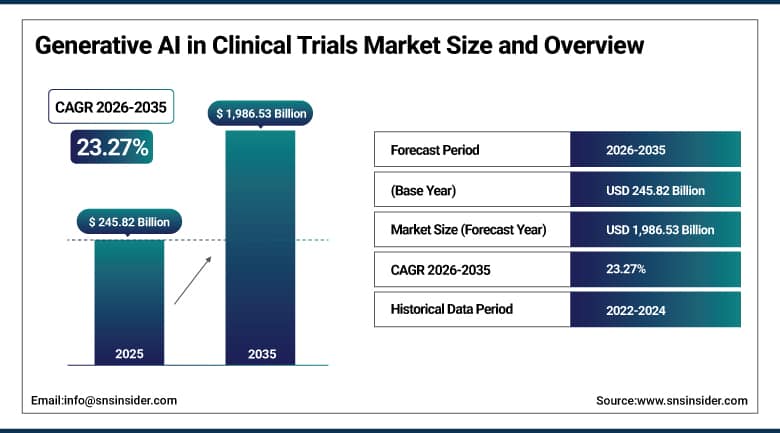
The Generative AI in Clinical Trials Market was valued at USD 245.82 Billion in 2025 and is expected to reach USD 1,986.53 Billion by 2035, growing at a CAGR of 23.27% from 2026 to 2035.
The market is growing due to rising pressures on pharmaceutical companies to reduce the timelines of clinical trials, improve the efficiency of patient recruitment and optimize protocol design processes. Clinical development workflows are increasingly adopting generative AI technologies to automate documentation, generate synthetic patient datasets, identify trial participants and improve decision-making across the research lifecycle. Organizations are capitalizing on the increased adoption of machine learning and large language models to drive operational efficiencies and cut the cost and resource intensity of trials.
In March 2026 Medidata added leading generative AI capabilities to its AI-driven clinical development platform to optimize protocols and plan clinical trials. IQVIA Extends AI-Powered Clinical Research Capabilities to Improve Patient Matching, Site Selection and Clinical Trial Workflow Efficiency for Global Pharmaceutical Studies May 2025.
To Get More Information On Generative AI in Clinical Trials Market - Request Free Sample Report
Market Trends
-
Growing adoption of generative AI for clinical trial design, protocol optimization, and study planning workflows.
-
Increasing use of AI-powered patient recruitment platforms to accelerate enrollment and improve participant matching.
-
Rising implementation of synthetic patient data for trial simulation, feasibility assessment, and predictive modeling.
-
Expanding deployment of large language models for automated clinical documentation and regulatory reporting processes.
-
Growing investments in AI-enabled drug development ecosystems to reduce trial timelines and improve research efficiency.
U.S. Generative AI In Clinical Trials Market Outlook
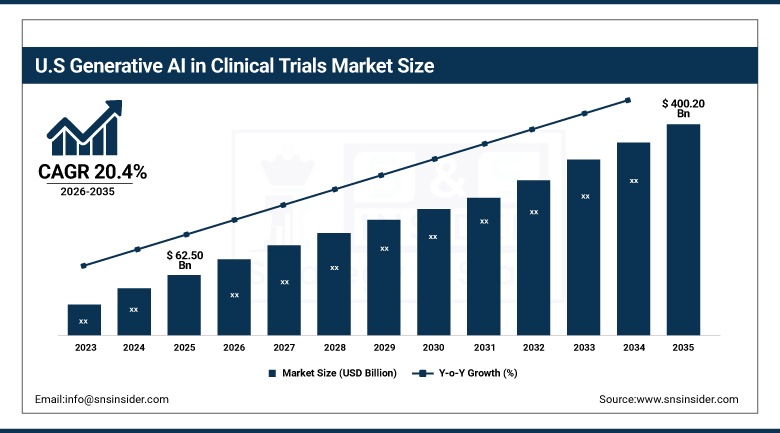
The U.S. Generative AI in Clinical Trials Market was valued at approximately USD 62.50 Billion in 2025 and is projected to reach approximately USD 400.20 Billion by 2035, growing at a CAGR of 20.4% from 2026 to 2035
The market is driven by the growing demand for faster and cost-effective drug development processes in the pharmaceutical and biotechnology industries. The use of generative AI technologies by clinical trial sponsors to optimize protocol design, improve patient recruitment, automate documentation and enhance clinical data analysis is increasing. Increasing complexity of clinical studies and pressure to reduce development timelines are driving adoption of AI-powered research platforms. Robust investments in healthcare AI, extensive digital health infrastructure, and growing collaboration between pharma companies, CROs, and technology vendors remAIn driving the development of generative AI applications throughout clinical trial workflows.
In January 2026, Tempus AI expanded its AI-enabled clinical research solutions with advanced generative AI functionality to enhance efficiency in patient enrolment and matching patients and trials in oncology trials. IQVIA continues to build upon its AI-enabled solutions for clinical trials through the addition of generative AI tools to the process of optimizing protocols, patient enrolment and process automation.
Generative AI In Clinical Trials Market Segment Analysis
-
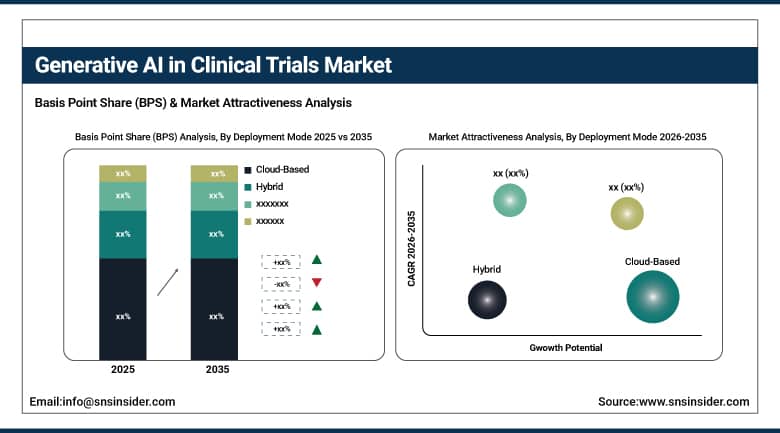
By Deployment Mode, Cloud-Based Solutions dominated the generative AI in clinical trials market with 63.40% share in 2025, while Hybrid Deployment is the fastest-growing deployment segment from 2026 to 2035.
-
By Application, Patient Recruitment & Matching dominated the generative AI in clinical trials market with 34.80% share in 2025, while Clinical Trial Design & Protocol Optimization is the fastest-growing application segment from 2026 to 2035.
-
By End User, Pharmaceutical & Biotechnology Companies dominated the generative AI in clinical trials market with 52.60% share in 2025, while Contract Research Organizations (CROs) are the fastest-growing end-user segment from 2026 to 2035.
-
By Trial Phase, Phase III Trials dominated the generative AI in clinical trials market with 39.20% share in 2025, while Phase I Trials are the fastest-growing trial phase segment from 2026 to 2035.
By Deployment Mode, Cloud-Based Solutions dominate, Hybrid Deployment grows fastest
Cloud-Based Solutions dominated the market in 2025 and accounted for approximately 63.40% market share. The key driving factors behind this segment include scalability, lower cost of infrastructure, and capacity to deal with bigger volumes of clinical and patient data effectively. More often than not, now pharmaceutical organizations are implementing their AI models in the cloud to ensure collaboration of global clinical research operations through the exchange of real-time data.
Hybrid Deployment is estimated to register the fastest CAGR due to increasing worries over data privacy, compliance issues, and cybersecurity threats. Organizations are adopting hybrid architectures in order to keep control over their sensitive patient data while still being able to use cloud computing power to process this data using artificial intelligence models.
By Application, Patient Recruitment & Matching dominate, Clinical Trial Design & Protocol Optimization grows fastest
Patient Recruitment & Matching dominated the generative AI in clinical trials market in 2025 and held approximately 34.80% market share. The segment is driven by its features such as scalability, low cost of infrastructure, and capability to process large amounts of clinical and patient data. Pharmaceutical organizations are increasingly using AI models in cloud infrastructure, thus facilitating collaboration and real-time sharing of data by global clinical research processes.
Hybrid Deployment is anticipated to be growing at the fastest CAGR due to increasing concerns over issues of data privacy, compliance, and cybersecurity. Organizations are gravitating towards hybrid architecture so that they can have control over their sensitive patient data while taking advantage of the capabilities of cloud infrastructure in processing advanced analytics and AI tasks.
By End User, Pharmaceutical & Biotechnology Companies dominate, Contract Research Organizations (CROs) grow fastest
Pharmaceutical & Biotechnology Companies dominated the market in 2025 and held approximately 52.60% market share. These organizations are investing heavily in generative AI technologies to make clinical development more efficient, reduce trial costs and speed up regulatory submissions. AI tools are increasingly being used to improve the overall productivity of clinical research in the patient recruitment, protocol optimization, trial monitoring and data analysis workflows.
Contract Research Organizations (CROs) are anticipated to record the highest CAGR due to increasing outsourcing of clinical trial activities by pharmaceutical companies. CROs are using generative AI platforms to achieve operational efficiencies, grow their service offerings and stand out in a fiercely competitive market. The segment is growing rapidly owing to increasing demand for cost-effective and technology-enabled clinical trial management services.
By Trial Phase, Phase III Trials dominate, Phase I Trials grow fastest
Phase III Trials dominated the market with a market share of around 39.20% in 2025 owing to their large patient populations, high operational complexity, and high financial investments. Generative AI technologies are increasingly being used to optimize recruitment strategies, improve protocol adherence, and enhance data management processes in large-scale late-stage clinical studies.
The Phase I Trials is expected to witness the fastest CAGR over the forecast period owing to increasing use of AI-driven simulation tools and predictive analytics in early-stage drug development. Pharmaceutical companies are using generative AI to assess candidate therapies, optimize study designs, and make better decisions ahead of moving compounds into later clinical stages. We also see growth in the segment driven by the increasing focus on mitigating risks in the early stages of development.
Regional Analysis
|
Region |
Major Country |
Share within Region, 2025 (%) |
|---|---|---|
|
North America |
United States |
81.25% |
|
Europe |
Germany |
28.40% |
|
Asia Pacific |
China |
39.50% |
|
Middle East |
UAE |
24.80% |
|
Latin America |
Brazil |
46.70% |
North America Generative AI In Clinical Trials Market Insights
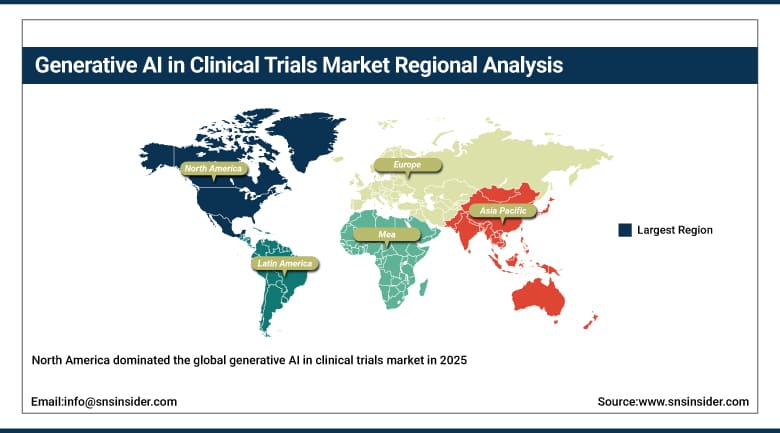
North America dominated the global generative AI in clinical trials market in 2025, accounting for approximately 31.29% of global revenues. The region remAIns a leader through strong pharmaceutical R&D investment, extensive healthcare digitalization and increasing adoption of AI-powered clinical research technologies. Generative AI solutions are being increasingly leveraged by pharmaceutical companies and research organizations to improve trial design, patient recruitment, documentation and operational efficiency in complex clinical studies.
The region’s healthcare technology ecosystem is mature and there is increasing collaboration between life science organizations and AI developers. Growing investments in advanced analytics, machine learning infrastructure and clinical trial modernization initiatives support market growth. The accelerated adoption of generative AI platforms is also driven by increased focus on shortening drug development timelines and improving trial success rates.
Get Customized Report as Per Your Business Requirement - Enquiry Now
Europe Generative AI In Clinical Trials Market Insights
There is evidence of substantial market growth in Europe with increasing investments in the digital infrastructure for clinical research and greater uptake of artificial intelligence systems during the development of pharmaceuticals. Organizations are using generative AI solutions to recruit patients, develop protocols and manage the clinical trials process effectively, minimizing its complexity.
The collaborative efforts of research institutes, healthcare organizations, and technology firms are helping in implementing artificial intelligence in clinical research processes. The increasing focus on improving research efficiency and innovations in therapy is driving the uptake of intelligent clinical research systems.
Asia Pacific Generative AI In Clinical Trials Market Insights
The Asia Pacific region is expected to witness the fastest growth over the forecast period owing to rising pharmaceutical research activities, growing healthcare digitalization and increasing investments in artificial intelligence technologies. Clinical research organizations and pharmaceutical companies are turning to AI-enabled platforms to improve the efficiency of trials and speed up development processes in multiple therapeutic areas.
The rising clinical trial activity and the growing biotechnology ecosystems are helping the market growth in the region. Favorable opportunities are arising for the deployment of generative AI in pharmaceutical and clinical research settings, driven by growing demand for advanced analytics, automation technologies, and intelligent research tools.
Middle East & Africa & Latin America Generative AI In Clinical Trials Market Insights
The Middle East & Latin America together accounted for around 10.86% of the total revenue of the global generative AI in clinical trials market in 2025. The growth in these regions is driven by increased digitization in healthcare, increased investment in clinical research infrastructure and increased adoption of artificial intelligence technologies in pharmaceutical and biotechnology sectors. An increasing number of research organizations are embracing AI-based approaches to improve efficiency and speed up development activities.
There is also more collaboration between healthcare establishments, tech providers and pharma companies in the regions to boost research capabilities. Wider use of generative AI technologies across the clinical trial workflow and research operations are driven by cloud-based research platforms, digital health initiatives and advanced analytics solutions.
Market Dynamics
Growth Driver: Increasing Need to Accelerate Clinical Trial Timelines
In order to accelerate the process of drug development and increase efficiency of the research, the use of generative AI in clinical trials is steadily increasing. Pharmaceutical companies use AI-driven solutions to automate processes like protocol design, patient enrolment, document management and monitoring of clinical trials. This allows reducing operational burden and enhancing productivity and decision-making within the entire clinical development process.
The growing complexity of clinical trials and the increasing costs of research lead to the increased investment in advanced AI systems. The technology can analyze big health care data at high speed, model predictions and allocate resources efficiently. The trend of accelerating innovation in the field of therapeutics drives market demand worldwide.
RestrAInt: Regulatory and Data Privacy Concerns
The use of AI in clinical research brings with it compliance, transparency and governance issues that must be addressed. Organizations need to make sure that the output of the use of AI is compliant with the existing rules and regulations of clinical research and privacy and data security are kept at all stages of the development process.
Additionally, there is a lack of clarity on the validation of AI models and variation in global regulation continues to be a hurdle in wider deployment. Organizations are still struggling with explAInability and compliance.
Opportunities: Expansion of smart factories and AI-enabled forming systems
Significant market growth opportunities are being created by increasing investment in AI-driven healthcare and life sciences ecosystems. Pharma companies are using generative AI technologies in different stages of drug development, from target discovery to post-market analysis, and are increasingly needing advanced clinical research solutions.
When technology providers, research organizations and pharmaceutical companies work more closely together, the innovation is speeding up and commercial opportunities are widening. The growing use of intelligent automation, predictive analytics and synthetic data generation technologies are expected to support long-term expansion of the market in global clinical research settings.
Recent Developments
-
March 2026: Medidata expanded its AI-powered clinical development platform with advanced generative AI capabilities for protocol optimization and patient recruitment.
-
January 2026: Tempus AI enhanced its clinical research platform by integrating large language models to support trial matching and research workflow automation.
-
September 2025: IQVIA expanded AI-enabled clinical trial solutions to improve patient enrollment and trial planning processes.
-
May 2025: Oracle Health strengthened its healthcare AI portfolio with enhanced generative AI capabilities supporting clinical research operations.
Key Players
-
IQVIA Inc.
-
Medidata Solutions
-
Oracle Health
-
Tempus AI
-
Microsoft Corporation
-
Google LLC
-
Amazon Web Services, Inc.
-
NVIDIA Corporation
-
SAS Institute Inc.
-
Cognizant Technology Solutions
-
Veeva Systems Inc.
-
IBM Corporation
-
Saama Technologies
-
Insilico Medicine
-
Exscientia plc
-
Recursion Pharmaceuticals
-
Databricks Inc.
-
Palantir Technologies Inc.
-
SymphonyAI
-
Accenture plc
Generative AI in Clinical Trials Market Report Scope:
| Report Attributes | Details |
|---|---|
| Market Size in 2025 | USD 245.82 Billion |
| Market Size by 2035 | USD 1,986.53 Billion |
| CAGR | CAGR of 23.27% from 2026 to 2035 |
| Base Year | 2025 |
| Forecast Period | 2026-2035 |
| Historical Data | 2022-2024 |
| Report Scope & Coverage | Market Size, Segments Analysis, Competitive Landscape, Regional Analysis, DROC & SWOT Analysis, Forecast Outlook |
| Key Segments | • By Application (Patient Recruitment & Matching, Clinical Trial Design & Protocol Optimization, Clinical Data Management & Analysis, Clinical Documentation & Reporting, and Trial Monitoring & Risk Assessment) • By Deployment Mode (Cloud-Based, On-Premises, and Hybrid) • By End User (Pharmaceutical & Biotechnology Companies, Contract Research Organizations (CROs), Academic & Research Institutes, and Healthcare Providers) • By Trial Phase (Phase I, Phase II, Phase III, and Phase IV) |
| Regional Analysis/Coverage | North America (US, Canada, Mexico), Europe (Eastern Europe [Poland, Romania, Hungary, Turkey, Rest of Eastern Europe] Western Europe] Germany, France, UK, Italy, Spain, Netherlands, Switzerland, Austria, Rest of Western Europe]), Asia Pacific (China, India, Japan, South Korea, Vietnam, Singapore, Australia, Rest of Asia Pacific), Middle East & Africa (Middle East [UAE, Egypt, Saudi Arabia, Qatar, Rest of Middle East], Africa [Nigeria, South Africa, Rest of Africa], Latin America (Brazil, Argentina, Colombia, Rest of Latin America) |
| Company Profiles | IQVIA Inc., Medidata Solutions, Oracle Health, Tempus AI, Microsoft Corporation, Google LLC, Amazon Web Services, Inc., NVIDIA Corporation, SAS Institute Inc., Cognizant Technology Solutions, Veeva Systems Inc., IBM Corporation, Saama Technologies, Insilico Medicine, Exscientia plc, Recursion Pharmaceuticals, Databricks Inc., Palantir Technologies Inc., SymphonyAI, Accenture plc. |
Frequently Asked Questions
The market is expected to grow at a CAGR of 23.27% during the forecast period.
North America dominated the market and accounted for 31.29% of global revenues in 2025.
Asia Pacific is expected to register the fastest growth during the forecast period due to expanding pharmaceutical research activities and increasing adoption of artificial intelligence technologies.
Increasing demand for faster clinical trial execution, improved patient recruitment, and AI-powered research automation is driving market growth.
The market was valued at USD 245.82 Billion in 2025.
