
AI in Patient Engagement Market Report Scope & Overview:
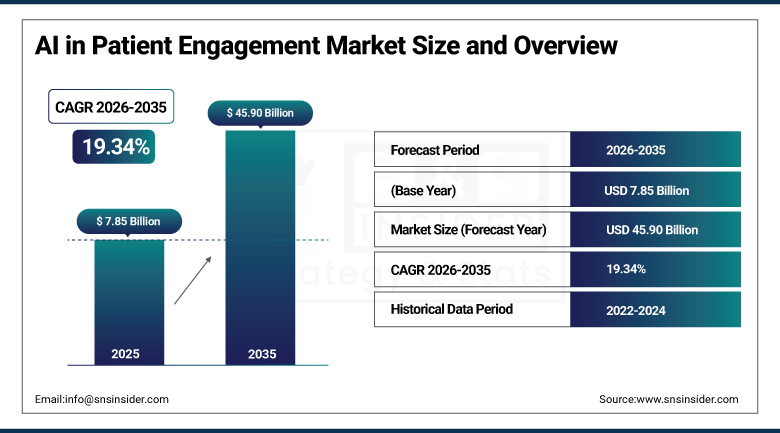
The AI in Patient Engagement Market was valued at USD 7.85 Billion in 2025 and is expected to reach USD 45.90 Billion by 2035, growing at a CAGR of 19.34% from 2026 to 2035.
The AI in Patient Engagement Market is growing very rapidly because of the increasing adoption of conversational AI and virtual health assistants, increased expectations from patients for personal and consistent digital communication, and increased need for hospitals and health organizations to cut down their administrative burden and improve coordination of care. AI-powered patient engagement solutions are used more and more in various processes, such as appointment scheduling, medication adherence, remote monitoring, and billing. Also, increased integration of artificial intelligence solutions with EHRs, increased investments in NLP and predictive analysis, and the growing trend towards value-based care model that requires constant patient engagement are contributing to the accelerated growth of the market.
Both Innovaccer and Microsoft improved their AI-driven patient engagement and automation capabilities in 2026 to support health organizations in reducing their administrative burden while enhancing their proactive patient outreach initiatives considering the growing scarcity of skilled workforce and the need for value-based care across the US and Europe.
To Get more information On AI in Patient Engagement Market - Request Free Sample Report
AI in Patient Engagement Market Trends:
-
Rising adoption of AI-powered chatbots and virtual health assistants is transforming routine patient communication across hospitals and outpatient clinics.
-
Growing use of predictive analytics to identify high-risk patients is expanding demand for proactive, AI-driven outreach and care coordination tools.
-
Increasing integration of AI patient engagement platforms with electronic health record and telehealth systems is improving care continuity and data-driven personalization.
-
Expanding deployment of AI-enabled remote patient monitoring is strengthening chronic disease management and reducing avoidable hospital readmissions.
-
Strategic partnerships between AI technology vendors, EHR providers, and health systems are accelerating rollout of enterprise-scale patient engagement solutions.
U.S. AI in Patient Engagement Market Outlook:
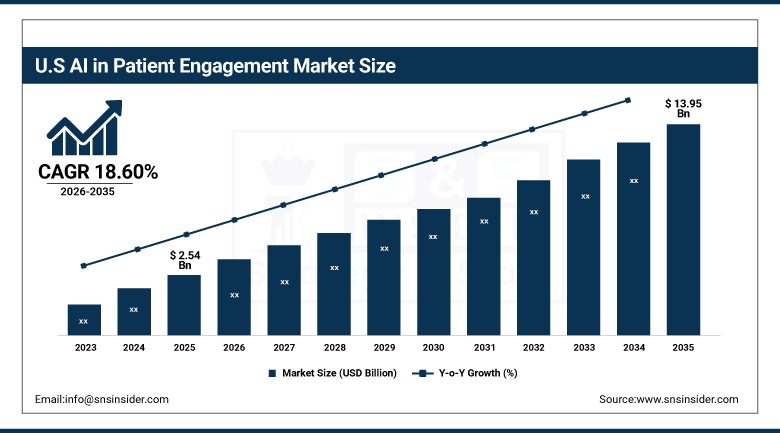
The U.S. AI in Patient Engagement Market was valued at USD 2.54 Billion in 2025 and is projected to reach USD 13.95 Billion by 2035, growing at a CAGR of 18.60% during 2026–2035.
In the United States, with consistent clinical workforce shortages and greater consumer preference for digitally oriented patient experiences, some of the largest hospital chains, integrated delivery systems, and insurance payers have continued to increase adoption of AI-driven patient engagement systems. With more implementation of AI-driven virtual assistants for appointment scheduling, medication management, and post-discharge follow-up along with growing investments in cloud-based patient communication platforms in the biggest health systems in the country, the demand for more powerful AI patient engagement solutions is expected to keep growing.
For instance, in 2026, Oracle Health introduced more AI-driven patient engagement tools in its EHR platform including generative AI-based care summaries and outreach tools to help U.S. hospitals and clinics cut down administrative tasks while ensuring better patient communication and follow-through.
AI in Patient Engagement Market Segment Analysis:
-
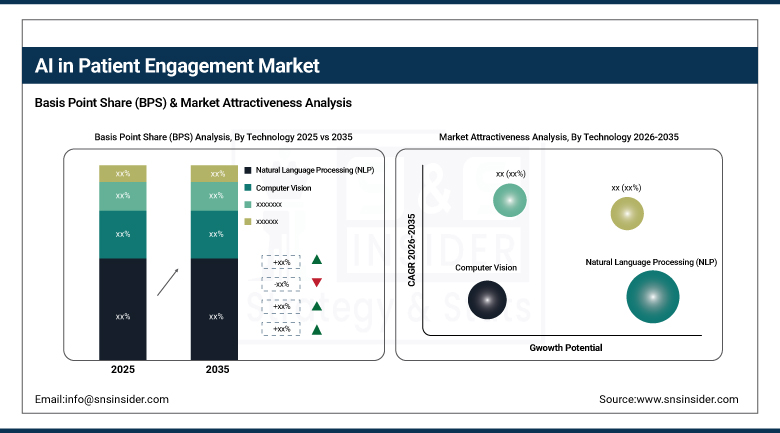
By Technology, Natural Language Processing (NLP) dominated the AI in Patient Engagement Market with a 39.80% share in 2025, while Machine Learning & Predictive Analytics is the fastest-growing technology segment with a CAGR of 22.60% from 2026–2035.
-
By Deployment Mode, Cloud dominated the AI in Patient Engagement Market with a 64.20% share in 2025, while Hybrid is the fastest-growing deployment segment with a CAGR of 23.10% from 2026–2035.
-
By Application, Communication & Messaging dominated the AI in Patient Engagement Market with a 34.60% share in 2025, while Billing, Payments & Claims Management is the fastest-growing application segment with a CAGR of 22.90% from 2026–2035.
-
By End Use, Healthcare Providers dominated the AI in Patient Engagement Market with a 55.40% share in 2025, while Healthcare Payers is the fastest-growing end-use segment with a CAGR of 21.80% from 2026–2035.
By Technology, NLP Leads Adoption While Machine Learning Grows Fastest.
The Natural Language Processing segment was the leading contributor in the AI in Patient Engagement Market in 2025. NLP solutions have become dominant in their type due to their involvement in the operation of conversational bots, voice bots, and messaging automation, which constitutes the major part of most patient communication solutions, allowing healthcare institutions to process patient requests and provide them with relevant replies. The maturity, high degree of integration with current call center and messaging services, and successful experience in decreasing administrative calls have strengthened the dominant position of NLP solutions in hospital settings, ambulatory facilities, and payers.
The Machine Learning & Predictive Analytics segment is expected to witness the highest CAGR during the forecast period 2026-2035. An increasing deployment of predictive risk stratification, personalized care recommendations, and readmission prevention technologies is stimulating the growth of the segment, as healthcare organizations try to transition from reactive patient outreach strategies to proactive approaches based on data analytics. Increased investments in clinical data infrastructure and increased access to longitudinal patient data are boosting the implementation of machine learning solutions for patient engagement purposes even further.
By Deployment Mode, Cloud Dominates While Hybrid Models Grows Fastest.
The Cloud segment accounted for highest market share by deployment mode in the AI in Patient Engagement Market in 2025. The Cloud-based deployment will continue to dominate because it enables health care organizations to quickly deploy patient engagement solutions in several locations with very little investment in infrastructure, while facilitating quick updates to the software as well as third-party integrations. The ability of cloud infrastructure to support omnichannel communication and ingestion of remote monitoring data, alongside elastic computing requirements during times of high patient engagement, makes it the deployment of choice.
The Hybrid segment is anticipated to grow at the fastest rate during the forecast period 2026-2035. Increasing need for large health systems and payers to blend scalability of cloud with control over private and sensitive information of patients with the help of on-premise deployment is boosting the adoption of hybrid deployment models.
By Application, Communication & Messaging Leads While Billing, Payments & Claims Management Grows Fastest.
The Communication & Messaging segment dominated the AI in Patient Engagement Market in 2025. Communication and messaging continue to hold the top spot in terms of application as the use of AI-powered chatbots and automated appointment reminders and personal outreach campaigns is the most widespread use case for artificial intelligence in healthcare. With the help of such solutions, it is possible to ensure reduced no-shows and decrease in the number of calls, improve patient experience, and provide constant availability, from scheduling reminders to notification about prescription refills and general patient questions with no direct participation of staff required.
The Billing, Payments & Claims Management segment is expected to register the fastest CAGR during the forecast period 2026-2035. Increasing attention being paid by the healthcare industry to minimizing claim denials, speeding up collections, and simplifying billing communications is contributing to high demand for AI solutions that will be able to provide explanations of charges, flexible payment terms, and resolve billing disputes proactively.
By End Use, Healthcare Providers Dominate While Healthcare Payers Grows Fastest.
The Healthcare Providers segment dominated the AI in Patient Engagement Market in 2025. Healthcare providers continue to lead the end-use category because it is the responsibility of the healthcare providers to facilitate the communication and engagement between the patients. Since there is a constant requirement to cut down on administrative tasks and improve on patient satisfaction and outcome, the demand for artificial intelligence-based engagement solutions is high among healthcare providers.
The Healthcare Payers segment is projected to record the fastest CAGR during the forecast period 2026-2035. Health insurance companies are increasingly adopting AI-powered member engagement tools to support proactive outreach, medication adherence, personalized wellness communication, and preventive care initiatives. Growing adoption is driven by payer efforts to improve member satisfaction, reduce avoidable claims costs, enhance care management, and strengthen competitive positioning in increasingly consumer-focused health insurance markets.
Regional Analysis:
|
Region |
Major Country |
Share within Region, 2025 (%) |
|---|---|---|
|
North America |
United States |
84.00% |
|
Europe |
Germany |
24.50% |
|
Asia Pacific |
China |
38.60% |
|
Middle East & Africa |
UAE |
24.80% |
|
Latin America |
Brazil |
35.40% |
North America AI in Patient Engagement Market Insights
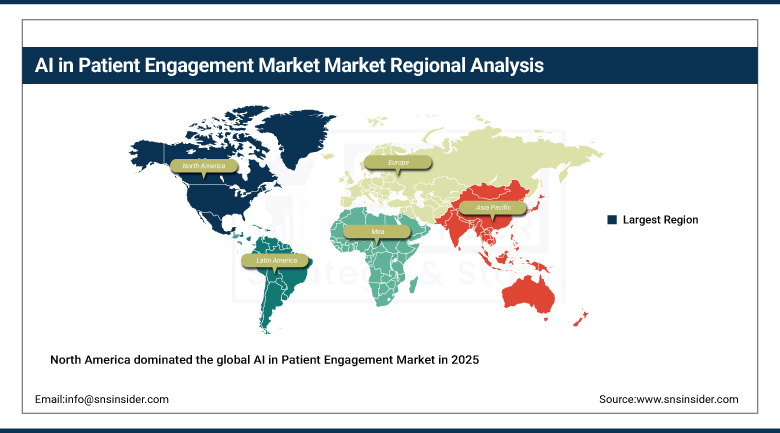
North America dominated the global AI in Patient Engagement Market in 2025 with the highest market share of 38.50%. Factors such as sophisticated healthcare IT infrastructure, widespread use of electronic health records, prevalence of AI and health technology players, along with continuous shortages of clinicians are favoring the growth of the region. Comprehensive digital health policies, coupled with investments from well-established players and AI startups in the healthcare industry, are making North America the dominant regional market for AI in Patient Engagement solutions.
The US led the North America AI in Patient Engagement Market in 2025, representing 84.00% of the regional market. This is due to advanced infrastructure for healthcare IT, the existence of leading AI and cloud technologies vendors, and the quick adoption of AI-based virtual assistants in integrated delivery networks and academic medical centers. Also, Canada has facilitated regional growth via the increasing digital health projects and government funding for AI-assisted primary care and patient monitoring.
Get Customized Report as per Your Business Requirement - Enquiry Now
Europe AI in Patient Engagement Market Insights
Europe was a significant contributor to the AI in Patient Engagement Market in 2025 and is expected to experience comparatively strong growth in AI-driven multilingual patient communication solutions through the forecast period. Regional expansion is enabled by the high importance attached to privacy regulations and interoperability efforts such as the European Health Data Space, as well as the presence of national healthcare digitization programs. The rise in patients’ needs for convenient healthcare communication channels is spurring healthcare institutions in Europe to push forward their digital health transformation agenda.
Germany represents one of the major European markets, supported by substantial investment in digital healthcare infrastructure and the presence of leading electronic health record and health-tech vendors serving domestic and international customers. The nation is making improvements to its digital health system, which has created an environment that favors patient engagement solutions through the use of AI. Other nations such as the United Kingdom, France, and the Netherlands have contributed to the growth of the regional market by developing their own digital healthcare systems.
Asia Pacific AI in Patient Engagement Market Insights
The Asia Pacific AI in Patient Engagement Market is projected to record the fastest growth during the forecast period 2026-2035, registering a CAGR of 23.80%. Market growth will be fueled by the rapid development of digitalization initiatives in the healthcare sector, higher government spending on the construction of AI-driven public health systems, and the rising popularity of smartphones and the Internet within the region. This trend will facilitate wide-scale implementation of AI-based solutions for patient communications and engagement in healthcare markets undergoing digital transformation.
China is among the leading growth drivers in the Asia Pacific AI in Patient Engagement Market, supported by its large patient population, expanding domestic health-tech ecosystem, and strong government backing for AI-enabled healthcare innovation. The country’s rising healthcare digital infrastructure is offering immense growth prospects in the form of AI-enabled patient communication and engagement solutions. Other than that, India and Japan are contributing largely to the regional growth due to the rising use of digital healthcare and deployment of AI-based engagement solutions.
Middle East & Africa and Latin America AI in Patient Engagement Market Insights
The Middle East & Africa and Latin American regions are gradually increasing their adoption of AI-powered patient engagement solutions as healthcare digitalization investments continue to expand. With regard to government efforts toward the modernization of healthcare infrastructure, this is setting up positive conditions for digital health innovations within both geographies. In addition, growing investments within private healthcare in patient communication, collaboration, and administrative tasks using AI technologies are contributing to market growth.
Brazil is forecasted to continue being a key player in Latin America thanks to its well-developed private sector of healthcare together with the increasing investments into digital health solutions equipped with AI-based patient engagement technology. The increasing digitalization of the healthcare market in Brazil creates openings for the development of such solutions that will facilitate communication and scheduling and will help patients. When it comes to the Middle East & Africa segment, such countries as the UAE and Saudi Arabia are making significant investments in their national healthcare digital transformation initiatives.
Market Dynamics:
Growth Drivers: Rising demand for automated, personalized patient communication driving market growth
The rising demand for scalable and personal patient communication within hospitals, clinics, and payers is driving the AI in Patient Engagement Market. Staffing shortages have been a long-time challenge in the healthcare industry and are also contributing to the adoption of AI-enabled technology that allows managing large-scale patient communications on an ongoing basis. Such solutions help patients keep their appointments and communicate proactively at different stages of engagement, including scheduling, reminders, post-discharge follow-ups, and chronic condition.
Advancements in natural language processing and generative AI have substantially improved the accuracy, responsiveness, and conversational quality of AI-powered patient communication platforms. New capabilities are enabling more sophisticated interactions through chatbots, virtual health assistants, and other digital engagement channels. In addition, the adoption of value-based care models, greater integration with electronic health records and telehealth systems, and continued venture and enterprise investment in digital health infrastructure are supporting demand as AI increasingly replaces manual, staff-dependent communication processes.
Restraints: Data privacy concerns and integration complexity limiting market expansion
Data Privacy and security issues continue to be some of the biggest challenges in the adoption of AI-based patient engagement programs.
There is growing reluctance on the part of healthcare institutions and patients to adopt AI solutions which would use sensitive personal health information, especially with the growing amount of data available in digital healthcare records. The need for compliance with regulations like the HIPAA in the U.S. and GDPR in Europe, makes the process much more complicated.
Integration difficulties faced by legacy EHR and HIE systems also pose barriers to implementation and make the process more expensive. This is especially the case with community hospitals and solo practitioner offices that frequently struggle with tight IT budgets and capabilities. Moreover, ongoing training of models, clinical validation, monitoring, and human supervision are required to ensure accuracy and appropriateness of communications generated by AI technology, thus resulting in ongoing expenses and limiting the adoption of the technology among financially challenged institutions.
Opportunities: Expansion of generative AI capabilities and value-based care adoption creating new growth avenues
The growing sophistication of generative AI for personalized health education, care summaries, and patient support is creating significant opportunities in the AI in Patient Engagement Market. The rise of multimodal systems incorporating voice, text, remote monitoring information, and other digital input sources is enabling healthcare organizations to gain access to new opportunities in terms of engaging with patients. In addition, growing demand from healthcare payers for AI-enabled patient engagement solutions, along with the ongoing trend towards value-based healthcare and population health management, is likely to fuel this demand further.
AI-driven engagement platforms customized for marginalized and rural communities also offer considerable potential in terms of market expansion. The adoption of digital-based communication would help overcome the shortage of providers, provide greater access to health information, and increase engagement among individuals who are constrained by geography or lack of resources to access traditional healthcare services.
Additionally, increased investment in AI-enabled health infrastructure in emerging economies of Asia Pacific and Latin America, coupled with government initiatives to adopt digital health transformation, would drive demand in mature as well as developing health markets.
Recent Developments:
-
2025: Innovaccer launched its Care Engagement Copilot, a generative AI-powered assistant embedded within its Health Cloud platform, enabling automated care gap outreach and personalized patient messaging for hospital and ambulatory customers.
-
2025: mPulse Mobile introduced an expanded version of its Impact conversational AI platform, adding multilingual voice-based outreach capabilities designed to improve medication adherence and appointment attendance among Medicaid and underserved patient populations.
-
2026: Microsoft expanded its Dragon Copilot ambient AI assistant with new patient engagement features, enabling automated after-visit summaries and personalized follow-up messaging for clinicians using Microsoft Cloud for Healthcare.
AI in Patient Engagement Market Key Players are:
-
Innovaccer Inc.
-
IBM Corporation
-
Microsoft Corporation
-
Oracle Health
-
Huma Therapeutics Ltd.
-
mPulse Mobile, Inc.
-
Omnicell, Inc.
-
EmpiRx Health, LLC
-
Health Catalyst, Inc.
-
Ada Health GmbH
-
Notable Health, Inc.
-
Teladoc Health, Inc.
-
ZS Associates
-
IQVIA Inc.
-
UST Global Inc.
-
Brand Engagement Network, Inc.
-
GetWellNetwork, Inc.
-
Qure.ai
-
Orbita, Inc.
-
Salesforce, Inc.
AI in Patient Engagement Market Report Scope:
| Report Attributes | Details |
|---|---|
| Market Size in 2025 | USD 7.85 Billion |
| Market Size by 2035 | USD 45.90 Billion |
| CAGR | CAGR of 19.34% From 2026 to 2035 |
| Base Year | 2025 |
| Forecast Period | 2026-2035 |
| Historical Data | 2022-2024 |
| Report Scope & Coverage | Market Size, Segments Analysis, Competitive Landscape, Regional Analysis, DROC & SWOT Analysis, Forecast Outlook |
| Key Segments | • By Technology (Natural Language Processing, Machine Learning & Predictive Analytics, Computer Vision, Robotic Process Automation) • By Deployment Mode (Cloud, On-Premise, Hybrid), Application (Communication & Messaging, Appointment Management & Scheduling, Remote Patient Monitoring, Billing, Payments & Claims Management) • By End Use (Healthcare Providers, Healthcare Payers, Patients & Individual Users) |
| Regional Analysis/Coverage | North America (US, Canada), Europe (Germany, UK, France, Italy, Spain, Russia, Poland, Rest of Europe), Asia Pacific (China, India, Japan, South Korea, Australia, ASEAN Countries, Rest of Asia Pacific), Middle East & Africa (UAE, Saudi Arabia, Qatar, South Africa, Rest of Middle East & Africa), Latin America (Brazil, Argentina, Mexico, Colombia, Rest of Latin America). |
| Company Profiles | Innovaccer Inc., IBM Corporation, Microsoft Corporation, Oracle Health, Huma Therapeutics Ltd., mPulse Mobile, Inc., Omnicell, Inc., EmpiRx Health, LLC, Health Catalyst, Inc., Ada Health GmbH, Notable Health, Inc., Teladoc Health, Inc., ZS Associates, IQVIA Inc., UST Global Inc., Brand Engagement Network, Inc., GetWellNetwork, Inc., Qure.ai, Orbita, Inc., Salesforce, Inc. |
Frequently Asked Questions
Key Players include Innovaccer Inc., IBM Corporation, Microsoft Corporation, Oracle Health, and Huma Therapeutics Ltd., among others.
Key opportunities include personalized patient experiences, AI-powered virtual assistants, predictive engagement, cloud-based platforms, and chronic disease management.
The market is driven by rising adoption of AI-powered chatbots and virtual assistants, persistent clinical staffing shortages, and continued advancement in natural language processing and generative AI technology.
The Communication & Messaging segment dominated the AI in Patient Engagement Market in 2025, accounting for approximately 34.60% market share.
The North America region dominated the AI in Patient Engagement Market in 2025 with a market share of 38.50%, driven by advanced healthcare IT infrastructure and strong adoption of AI-powered patient communication tools.
