
AI In Revenue Cycle Management Market Report Scope & Overview:
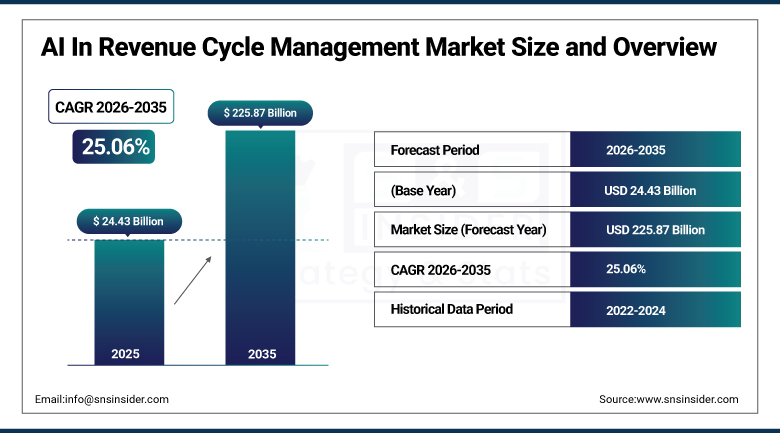
The AI In Revenue Cycle Management Market was valued at USD 24.43 Billion in 2025 and is expected to reach USD 225.87 Billion by 2035, growing at a CAGR of 25.06% from 2026 to 2035.
The growth of the AI in Revenue Cycle Management (AI-RCM) market is mainly determined by growing administrative challenges and complexities associated with healthcare billing and reimbursement processes. In this context, AI- and machine learning-based solutions have been used more and more frequently to streamline the revenue cycle management and decrease the rate of denials and claim submissions. Besides, the requirement to increase efficiency and optimize financial performance of health care organizations has also contributed to the demand for AI-powered solutions.
The implementation of AI in the area of revenue cycle management is increasingly being driven by the administrative challenges that are emerging within healthcare organizations. As noted by the American Medical Association, physicians and their staff dedicate about 16.4 hours each week in prior authorizations, physicians carry out roughly 43 prior authorizations each week, and 95% report burnout from the administration.
To Get more information On AI In Revenue Cycle Management Market - Request Free Sample Report
AI In Revenue Cycle Management Market Trends
-
AI-powered autonomous coding solutions are increasingly automating medical coding and reducing claim processing errors.
-
Generative AI adoption is accelerating for documentation, prior authorization, and patient communication workflows.
-
Cloud-based RCM platforms are gaining traction due to scalability, interoperability, and lower infrastructure costs.
-
Predictive analytics tools are increasingly used to identify denials and optimize reimbursement outcomes.
-
Healthcare providers are integrating AI-driven financial analytics to improve revenue forecasting and performance monitoring.
U.S. AI In Revenue Cycle Management Market Outlook
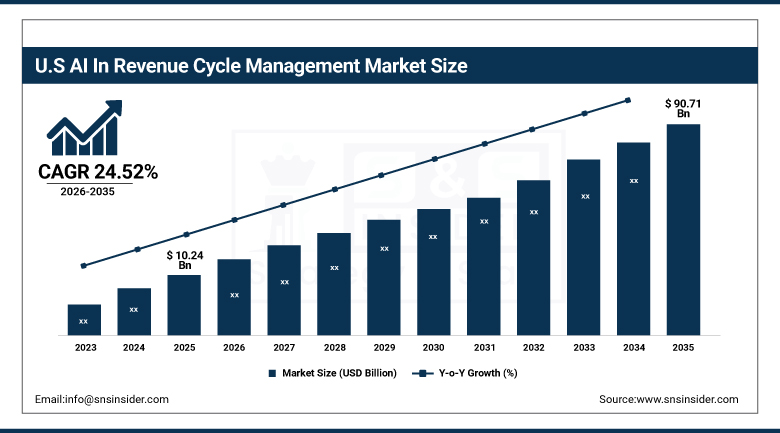
The U.S. AI In Revenue Cycle Management Market was valued at approximately USD 10.24 Billion in 2025 and is expected to reach approximately USD 90.71 Billion by 2035, growing at a CAGR of approximately 24.52%.
The U.S. AI in Revenue Cycle Management (AI-RCM) market can be attributed to the growing number of claim denials and the growing requirement for enhancing the first pass claim acceptance and reimbursement processes. Healthcare organizations have been increasingly turning towards AI-based tools to detect billing discrepancies and enhance the efficiency of claims processings. Furthermore, the presence of prominent healthcare IT companies and AI-RCM players in the U.S. is driving technological advancement, thereby propelling the adoption of automation solutions.
AI In Revenue Cycle Management Market Segment Analysis
-
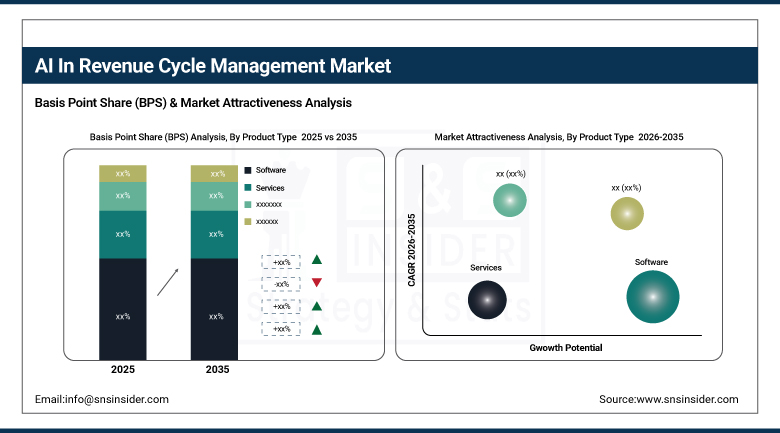
By Product Type, the Software segment dominated the AI in Revenue Cycle Management (AI-RCM) market in 2025 with 70.21% share; while the Services segment is the fastest-growing segment with a CAGR of approximately 24.80%.
-
By Type, the Integrated segment dominated the AI in Revenue Cycle Management (AI-RCM) market in 2025 with 67.00% share and is also the fastest-growing segment with a CAGR of 25.65%.
-
By Application, the Claims Management segment dominated the AI in Revenue Cycle Management (AI-RCM) market in 2025 with 24.00%; the Financial Analytics & KPI Monitoring segment is the fastest-growing segment with a CAGR of approximately 27.51%.
-
By Delivery Mode, the Cloud Based segment dominated the AI in Revenue Cycle Management (AI-RCM) market in 2025 with 47.57% share and it is also the fastest-growing segment with a CAGR of approximately 26.35%.
-
By End Use, the Hospitals segment dominated the AI in Revenue Cycle Management (AI-RCM) market in 2025 with 48.12% share, while the Physician Back Offices segment is the fastest-growing segment with CAGR of 26.24%.
By Product Type, the Software segment dominates the market, Services segment is expected to show fastest growth
The Software segment dominates the AI in Revenue Cycle Management (AI-RCM) market due to the increasing adoption of AI-powered platforms for medical coding, claims management, billing automation, and revenue analytics. Providers have been increasingly relying on software-based applications to simplify their administrative processes, reduce claim denials, and enhance efficiency. The escalating demand for real-time financial information and electronic health record integration is contributing to the rising popularity of AI-enabled revenue cycle software.
The Services segment is expected to witness the fastest growth owing to the rising demand for implementation, consulting, training, and managed services associated with AI-enabled revenue cycle solutions. Most healthcare organizations do not possess the know-how as well as the required capabilities to implement and integrate sophisticated AI technology, hence the need for service providers. Moreover, growing complexities of systems, changing regulations, and custom AI integration are boosting demand for revenue cycle management services.
By Type, the Integrated segment leads the market and is also expected to grow fastest
The Integrated segment dominates the AI in Revenue Cycle Management (AI-RCM) market due to the growing preference for unified platforms that seamlessly connect billing, coding, claims management, payment processing, and financial analytics within a single system. The rising inclination towards integration in healthcare providers has fueled the demand for integrated AI-RCM software because of the better interoperability and increased operational efficiency associated with them. The capability to offer end-to-end visibility in revenue cycle management processes has boosted their adoption rate.
The Integrated segment is also expected to register the fastest growth, driven by increasing demand for comprehensive automation and centralized revenue cycle management. The healthcare organizations are showing a preference for integrated AI systems to facilitate better workflow and coordination among different departments, besides real-time information sharing. Moreover, the growing use of cloud computing technology, electronic health records, and analytics has compelled the providers to go in for more efficient integrated systems.
By Application, the Claims Management segment dominates the market, Financial Analytics & KPI Monitoring segment shows fastest growth
The Claims Management segment dominates the AI in Revenue Cycle Management (AI-RCM) market due to the rising number and complexity of claims in the healthcare industry and the rising need to lower claim denial and delayed payments. Healthcare companies are implementing AI-based claims management solutions in large numbers to submit claims, detect coding mistakes, and increase the first pass success rate of claims. The effectiveness of these solutions in terms of reducing revenue leakage and improving efficiency has boosted their popularity.
The Financial Analytics & KPI Monitoring segment is expected to witness the fastest growth due to the rising demand for data-driven financial decision-making and predictive insights. The healthcare organizations are relying more on artificial intelligence-driven analytics solutions to track financial performance, detect inefficiencies, and predict the trends in reimbursement. The increasing pressure for profit maximization and better financial transparency is further fueling the adoption of such analytics and KPI monitoring solutions in revenue cycle management processes.
By Delivery Mode, the Cloud Based segment dominates the market and is also expected to show fastest growth
The Cloud Based segment dominates the AI in Revenue Cycle Management (AI-RCM) market owing to the increasing preference for scalable, cost-effective, and easily deployable solutions. Cloud-based systems are being deployed by health care organizations for streamlining revenue cycle management tasks, data accessibility, and interoperability within the health care ecosystem. The ability of such platforms to facilitate real-time analysis, cut down on infrastructure expenses, and offer remote collaboration capabilities have contributed greatly to their adoption.
The Cloud Based segment is also expected to witness the fastest growth due to accelerating healthcare digital transformation and rising demand for flexible, subscription-based deployment models. The shift to cloud computing from traditional on-premises solutions is being made to take advantage of sophisticated AI algorithms, quicker deployment, and regular software updates. Moreover, increased investment in cloud infrastructure, telehealth technology adoption, and need for scalable data management solutions have contributed to the fast-paced growth of the segment.
By End Use, the Hospitals segment dominates the market, the Physician Back Offices segment is expected to grow fastest
The hospitals segment dominates the AI in Revenue Cycle Management (AI-RCM) market due to the high volume of patient transactions, complex billing procedures, and extensive claims processing requirements within hospital settings. Hospitals have started using AI-based revenue cycle systems to streamline their operations, lower claim denials, and increase the efficiency of the entire process of reimbursement. Furthermore, increasing spending on the digitization of healthcare and improving financial and operational performance of hospitals have also fueled the adoption of AI-RCM systems among hospitals.
The physician back-offices segment is expected to witness the fastest growth owing to the increasing adoption of affordable, cloud-based AI solutions among independent practices and outpatient clinics. Physicians are adopting revenue cycle management systems that use artificial intelligence technology in order to ease billing processes, coding and eliminate other administrative tasks due to understaffing and increased operational costs. Also, the emphasis on maximizing cash flow, reducing revenue leakage and improving practice efficiency is promoting the use of AI-RVM solutions in physicians’ back offices.
Regional Insights
|
Region |
Major Country |
Share within Region, 2025 (%) |
|---|---|---|
|
North America |
United States |
88.34% |
|
Europe |
Germany |
23.04% |
|
Asia Pacific |
China |
36.12% |
|
Middle East & Africa |
United Arab Emirates |
28.76% |
|
Latin America |
Brazil |
49.12% |
North America AI in Revenue Cycle Management (AI-RCM) Market Insights
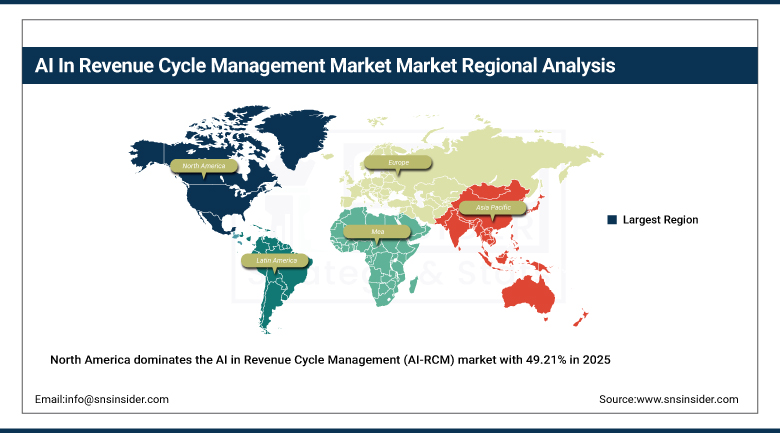
North America dominates the AI in Revenue Cycle Management (AI-RCM) market with 49.21% in 2025 due to its highly advanced healthcare infrastructure, complex reimbursement landscape, and widespread adoption of healthcare information technologies. Healthcare institutions in this region are facing an increase in administrative workload and high claim denial ratios, which has resulted in considerable investments in AI-based revenue cycle management systems. Furthermore, the presence of healthcare IT firms along with favorable digital health programs has further boosted the use of AI in the sector.
The North America AI-RCM market is also being driven by growing demand for automation and data-driven financial management across healthcare organizations. The healthcare facilities and physicians’ groups have been implementing the use of AI in order to increase efficiency of claims processing, minimize costs, and improve cash flow management. Also, the increased focus on value-based care, along with increased investments in cloud computing, predictive analytics, and machine learning technologies is creating ample growth opportunities for AI-enabled RCM solutions.
Get Customized Report as per Your Business Requirement - Enquiry Now
Europe AI in Revenue Cycle Management (AI-RCM) Market Insights
The Europe AI in Revenue Cycle Management (AI-RCM) market is experiencing steady growth owing to increasing healthcare digitalization and rising investments in artificial intelligence technologies across the region. Healthcare providers have started to embrace revenue cycle management solutions that use AI in order to improve administrative inefficiencies, billing errors, and the claims process. Increasing efforts to reduce healthcare costs and improving operational efficiency have led to the adoption of automation solutions for revenue cycles.
The market is further driven by supportive government initiatives promoting digital health transformation and the increasing adoption of cloud-based healthcare IT platforms. Nations like Germany, United Kingdom, and France are putting significant resources into the modernization of the healthcare system and technologies for data-driven decision making. In addition, the growing emphasis on transparency and efficiency in patient experiences is boosting the uptake of AI-driven revenue cycle management systems.
Asia Pacific AI in Revenue Cycle Management (AI-RCM) Market Insights
The Asia-Pacific AI in Revenue Cycle Management (AI-RCM) market is witnessing rapid growth with a 16.54% share in 2025 due to accelerating healthcare digitalization and increasing investments in artificial intelligence technologies across the region. The adoption of AI-enabled revenue cycle technology solutions is being witnessed by healthcare providers due to the improved billing precision and efficiency in claims processing. The growing healthcare infrastructure and need for affordable healthcare management solutions are also leading to intelligent automation technology adoption.
The market is further supported by favourable government initiatives promoting digital health transformation and growing adoption of cloud-based healthcare IT platforms in countries such as China, India, and Japan. Furthermore, rising spending on healthcare, increasing patients, and awareness about the advantages of automating administrative operations using AI technologies are prompting healthcare organizations to adopt revenue cycle management solutions, making APAC the fastest-growing regional market.
MEA & Latin America Asia-Pacific AI in Revenue Cycle Management (AI-RCM) Market Insights
The Middle East & Africa AI in Revenue Cycle Management (AI-RCM) market is growing steadily due to increasing investments in healthcare modernization and digital transformation initiatives across the region. Various healthcare organizations are making use of artificial intelligence-based solutions to streamline the billing process, eliminate administrative hassles, and automate claims management processes. Moreover, the growing requirement for new-age healthcare technologies and development of private healthcare facilities is boosting the adoption of intelligent revenue cycle management solutions.
The market is further driven by government-led digital health programs and increasing adoption of cloud-based healthcare IT infrastructure in countries such as the United Arab Emirates and Saudi Arabia. In addition, increasing healthcare spending, insurance coverage, and need for improving the bottom line and patient experience are leading to increased deployments of AI-powered revenue cycle management systems in hospitals and other healthcare institutions in MEA region.
Growth Drivers: Rising Need to Reduce Administrative Burden and Improve Revenue Cycle Efficiency
The rising complexity of administrative processes involved in health care billing, coding, claim processing, and reimbursement is one of the main reasons for the growth of the AI in Revenue Cycle Management (AI-RCM) market. Health care companies find themselves under increasing pressure to process a huge amount of data efficiently and without any unnecessary overheads. AI-based systems can automate many processes and make the work much more efficient.
Additionally, rising claim denial rates and increasing complexity of reimbursement procedures are encouraging healthcare providers to adopt AI-driven revenue cycle solutions. Modern technologies such as predictive analytics can be used to identify any errors in the billing process, thereby ensuring that the claims process is as efficient as possible. In light of this, with healthcare institutions looking to reduce revenue leaks, cut costs, and optimize their cash flow, AI-based revenue cycle automation technology is becoming increasingly common.
Restraint: Data Privacy and Security Concerns Associated with AI-Based Revenue Cycle Solutions
The threat of data privacy and security becomes one of the major constraints for the growth of AI in RCM market. The AI-based revenue cycle system involves collecting a huge amount of extremely confidential information, which poses a threat to data theft and hacking for the health care providers. Confidentiality issues and strict adherence to the regulations of the health care industry hinder adoption of AI-based revenue cycles.
Moreover, implementation of AI solutions in the existing healthcare infrastructure often demands a large amount of data exchange among various systems, making issues of interoperability and data security more serious. Healthcare institutions require considerable financial resources to implement measures related to cybersecurity and risk management that would ensure the security of sensitive data. All these additional costs contribute to the slow adoption of AI solutions, especially by smaller health institutions.
Opportunity: Growing Adoption of Cloud-Based and Predictive Analytics Solutions in Healthcare
The increasing adoption of cloud-based healthcare platforms and predictive analytics technologies presents a significant opportunity for the AI in Revenue Cycle Management (AI-RCM) market. There is an increasing number of health care organizations looking for flexible and economical ways to help them optimize their revenue cycle management processes, increase interoperability, and gain access to their financial data in real time. The cloud technology offers improved flexibility and faster implementation, which motivates the companies to update their revenue cycle process management.
Additionally, the growing demand for predictive analytics is creating new opportunities for AI-RCM vendors to deliver advanced solutions that identify reimbursement trends, predict claim denials, and optimize revenue collection strategies. Providers are more inclined to make decisions based on the data-driven insights that help them to avoid inefficiencies in operations. In view of the fast pace of the digital transformation processes across the globe, the potential for development in the AI-RCM market is quite high.
Recent Developments
-
2026: Athenahealth had rolled out more than 80 new artificial intelligence features for revenue cycle management (RCM) operations on its AI-native athenaOne platform. Athenahealth provided electronic health records (EHR) software, RCM, and patient engagement solutions to small and independent provider practices. The new RCM roadmap aimed to reduce manual administrative work across ambulatory revenue cycles and improve outcomes.
-
2026: Veradigm, a leading provider of clinical and revenue cycle solutions for independent practices, had announced the launch of a new AI-enabled application for its Revenue Cycle Services (RCS) clients to deliver faster and deeper revenue cycle insights. The company stated that independent practices had been facing increasing administrative complexity and financial pressures due to denials, payment variability, staffing constraints, and limited analytical visibility. Veradigm RCS had addressed these challenges through technology, expertise, and operational support.
-
2025: Optum had introduced Optum Integrity One, an integrated revenue cycle platform powered by Optum Clinical Language Intelligence, to reduce administrative burdens for health systems. The platform enhanced clinical documentation and coding accuracy, enabling timely and accurate billing. Building on its leadership in revenue cycle management, Optum Integrity One had consolidated multiple RCM functions into a single interface and leveraged AI to automate documentation review, coding and billing processes, thereby improving reimbursement accuracy and claims efficiency.
AI in Revenue Cycle Management (AI-RCM) Market Key Players
-
Experian Information Solutions, Inc.
-
R1 RCM, Inc.
-
McKesson Corporation
-
CareCloud Corporation
-
Oracle (Cerner Corporation)
-
eClinicalWorks
-
Infinx
-
Care.fi
-
VisiQuate
-
IntelligentDX
-
Thoughtful AI
-
Adonis
-
Zentist
-
Maverick Medical AI Ltd.
-
Olive AI
-
FinThrive
-
Epic Systems
-
Conifer Health Solutions
AI In Revenue Cycle Management Market Report Scope:
| Report Attributes | Details |
|---|---|
| Market Size in 2025 | USD 24.43 Billion |
| Market Size by 2035 | USD 225.87 Billion |
| CAGR | CAGR of 25.06% From 2026 to 2035 |
| Base Year | 2025 |
| Forecast Period | 2026-2035 |
| Historical Data | 2022-2024 |
| Report Scope & Coverage | Market Size, Segments Analysis, Competitive Landscape, Regional Analysis, DROC & SWOT Analysis, Forecast Outlook |
| Key Segments | By Product Type (Software, Services) By Type (Integrated, Standalone) By Application (Medical Coding and Charge Capture, Claims Management, Payment Posting & Remittance, Financial Analytics & KPI Monitoring, Others) By Delivery Mode (On-Premise, Web-Based, Cloud Based) By End Use (Physician Back Offices, Hospitals, Diagnostic Laboratories, Others) |
| Regional Analysis/Coverage | North America (US, Canada), Europe (Germany, UK, France, Italy, Spain, Russia, Poland, Rest of Europe), Asia Pacific (China, India, Japan, South Korea, Australia, ASEAN Countries, Rest of Asia Pacific), Middle East & Africa (UAE, Saudi Arabia, Qatar, South Africa, Rest of Middle East & Africa), Latin America (Brazil, Argentina, Mexico, Colombia, Rest of Latin America). |
| Company Profiles | athenahealth Inc., Experian Information Solutions, Inc., R1 RCM Inc., McKesson Corporation, CareCloud Corporation, Oracle (Cerner Corporation), eClinicalWorks, Infinx, Care.fi, VisiQuate, IntelligentDX, Thoughtful AI, Adonis, Zentist, Maverick Medical AI Ltd, Innovaccer, Olive AI, FinThrive, Epic Systems, Conifer Health Solutions. |

Frequently Asked Questions
The AI in Revenue Cycle Management (AI-RCM) Market is expected to grow at a CAGR of 25.06% from 2026 to 2035.
The AI in Revenue Cycle Management (AI-RCM) Market was valued at USD 24.43 Billion in 2025.
The cloud based delivery mode segment dominated the AI in Revenue Cycle Management (AI-RCM) Market.
