
AI Inference Infrastructure Market Report Scope & Overview:
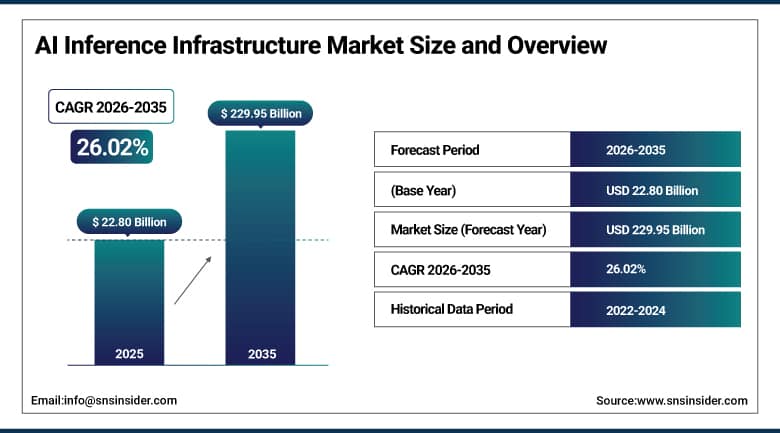
The AI Inference Infrastructure Market size was valued at USD 22.80 billion in 2025 and is expected to reach USD 229.95 billion by 2035, growing at a CAGR of 26.02% from 2026–2035.
The factors contributing to the growth of the global AI inference infrastructure market include the rapid adoption of generative AI, large language models (LLMs), and AI-powered applications across enterprises, increasing demand for high-performance AI inference, and growing investments in scalable AI computing infrastructure. Organizations are increasingly deploying advanced GPUs, AI accelerators, high-speed networking, and optimized software platforms in the AI inference infrastructure market to enable low-latency inference, improve computational efficiency, reduce operational costs, and support real-time AI workloads across cloud, edge, and on-premises environments.
AMD announced an expanded strategic partnership with Microsoft to deploy the Helios AI infrastructure platform across Microsoft Azure. The collaboration integrates next-generation AMD Instinct GPUs, EPYC processors, advanced networking, and open AI software to accelerate large-scale AI inference workloads, improve inference performance and energy efficiency, reduce latency, and support enterprise generative AI applications in cloud environments.
Market size and forecast
-
Market Size 2026E: USD 28.69 billion
-
Market Size 2035: USD 229.95 billion
-
CAGR: 26.02% from 2026 to 2035
-
Fastest Growing Region: Asia-Pacific
-
Largest Region: North America
To Get More Information On AI Inference Infrastructure Market - Request Free Sample Report
AI Inference Infrastructure Market Trends
-
Increasing adoption of generative AI, large language models (LLMs), and enterprise AI applications is driving demand for high-performance AI inference infrastructure.
-
Increasing investments in GPUs, AI accelerators, and high-bandwidth networking are improving AI inference performance and scalability.
-
Increasing deployment of cloud-native and edge AI infrastructure is enabling low-latency, real-time AI inference across industries.
-
Expanding adoption of energy-efficient AI hardware and optimized inference software is reducing operational costs and power consumption.
-
Rising demand for scalable AI computing infrastructure is accelerating investments in advanced data centers and AI inference platforms.
U.S. AI Inference Infrastructure Market Outlook
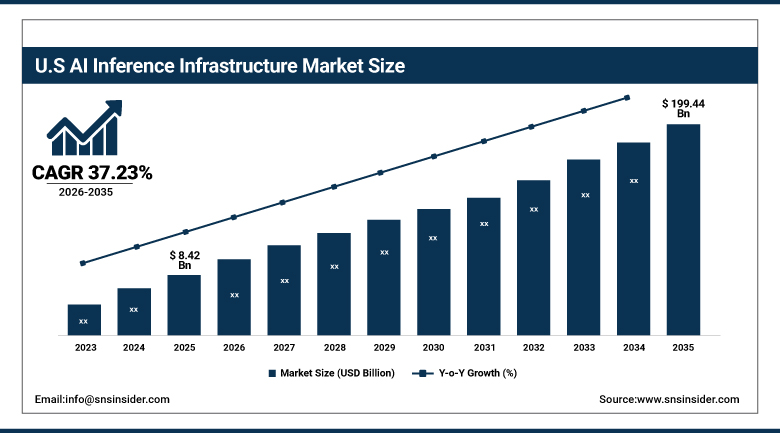
The U.S. AI Inference Infrastructure Market was valued at USD 8.42 billion in 2025 and is expected to reach around USD 199.44 billion by 2035, growing at a CAGR of 37.23% from 2026–2035.
The AI inference infrastructure market in the US is experiencing steady growth owing to the growing adoption of generative AI, large language models (LLMs), and AI-driven enterprise applications, coupled with rising investments in hyperscale data centers and HPC infrastructure. Enterprises are making use of sophisticated GPUs, AI accelerators, high-speed networking, and optimized AI inference software to perform real-time AI inferencing for faster processing and lower latency. Furthermore, innovations in AI chips, energy-efficient computing solutions, liquid cooling systems, and distributed AI infrastructure solutions have resulted in the rapid growth of the AI inference infrastructure market in the US.
Microsoft expanded its Azure AI infrastructure in the United States through a strategic partnership with AMD, introducing next-generation AMD Instinct MI455X GPUs, EPYC Venice processors, and high-performance networking to power production-scale AI inference workloads. The new infrastructure enables enterprises to accelerate large language model (LLM) inference, reduce latency, improve energy efficiency, and support large-scale generative AI applications across Azure cloud environments.
AI Inference Infrastructure Market Segment Analysis
-
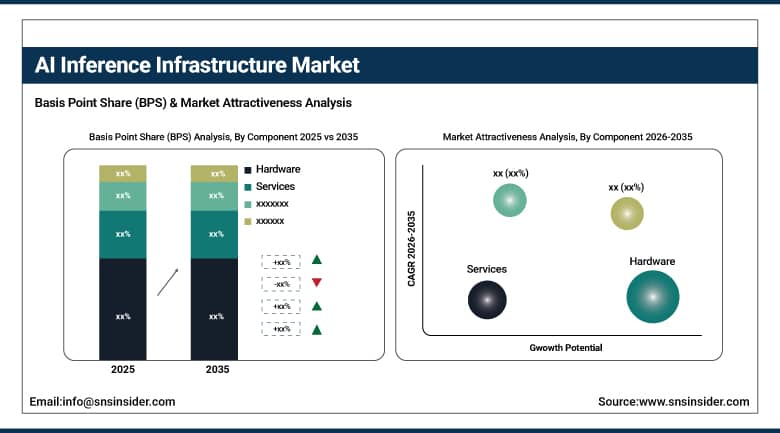
By Component, hardware dominated the AI inference infrastructure market with a 67.80% share in 2025; while services are the fastest-growing segment with a 33.63% CAGR during 2026–2035.
-
By Infrastructure, compute dominated the AI inference infrastructure market with a 43.80% share in 2025; while networking is the fastest-growing segment with a 31.23% CAGR during 2026–2035.
-
By Deployment, cloud dominated the AI inference infrastructure market with a 63.40% share in 2025; while hybrid is the fastest-growing segment with a 36.98% CAGR during 2026–2035.
-
By Processor Type, GPU dominated the AI inference infrastructure market with a 61.90% share in 2025; while ASIC is the fastest-growing segment with a 37.68% CAGR during 2026–2035.
-
By End User, cloud service providers dominated the AI inference infrastructure market with a 52.80% share in 2025; while enterprises are the fastest-growing segment during 2026–2035.
By Component, hardware dominated the AI Inference Infrastructure Market, while services are expected to grow fastest
The dominance of the hardware segment was recorded in 2025 due to the growing deployment of GPUs, AI accelerators, high-bandwidth memory, and high-performance servers required to support large-scale AI inference workloads. Hyperscale cloud providers, enterprises, and AI infrastructure vendors significantly invested in advanced computing hardware to improve inference speed, scalability, and energy efficiency, making hardware the largest market segment.
The services segment is anticipated to register the fastest growth during the forecast period due to the increasing demand for AI infrastructure deployment, integration, consulting, managed services, and ongoing optimization. As organizations expand generative AI and large language model (LLM) deployments, they are increasingly relying on specialized service providers to design, implement, manage, and optimize AI inference infrastructure across cloud, on-premises, and hybrid environments.
By Infrastructure, compute dominated the AI Inference Infrastructure Market, while networking is expected to grow fastest.
The compute segment dominated the market in 2025 owing to the widespread deployment of high-performance GPUs, AI accelerators, and advanced processors required to execute large language models (LLMs), generative AI applications, and real-time AI inference workloads. Increasing investments by hyperscale cloud providers and enterprises in AI computing infrastructure to improve processing performance, scalability, and efficiency further strengthened the dominance of the compute segment.
On the other hand, the networking segment is projected to record the highest growth during the forecast period. This is attributed to the increasing demand for high-speed interconnects, low-latency data transfer, and high-bandwidth networking technologies that support distributed AI inference, multi-node GPU clusters, and large-scale AI data centers. The rapid expansion of cloud AI infrastructure and edge AI deployments is expected to further accelerate the growth of the networking segment.
By Deployment, cloud dominated the AI Inference Infrastructure Market, while hybrid is expected to grow fastest.
Cloud dominated the market share in 2025 owing to the widespread adoption of cloud-based AI platforms, hyperscale data centers, and scalable computing infrastructure for generative AI and large language model (LLM) inference. Organizations increasingly preferred cloud deployments because they provide on-demand access to GPUs, AI accelerators, high-performance networking, and elastic compute resources while reducing infrastructure costs and simplifying AI workload management. The flexibility, scalability, and rapid deployment capabilities of cloud environments further strengthened the dominance of this segment.
The hybrid segment is expected to grow at the fastest rate during the forecast period due to the increasing need to balance performance, security, compliance, and cost across AI workloads. Organizations are adopting hybrid infrastructure to combine on-premises AI resources with cloud computing, enabling low-latency inference, improved data sovereignty, optimized resource utilization, and seamless scalability for enterprise AI applications.
Regional Insights
|
Region |
Major Country |
Share within Region, 2025(%) |
|---|---|---|
|
North America |
United States |
88.30% |
|
Europe |
Germany |
25.60% |
|
Asia Pacific |
China |
45.80% |
|
Middle East & Africa |
Saudi Arabia |
32.40% |
|
Latin America |
Brazil |
49.60% |
North America AI Inference Infrastructure Market Insights
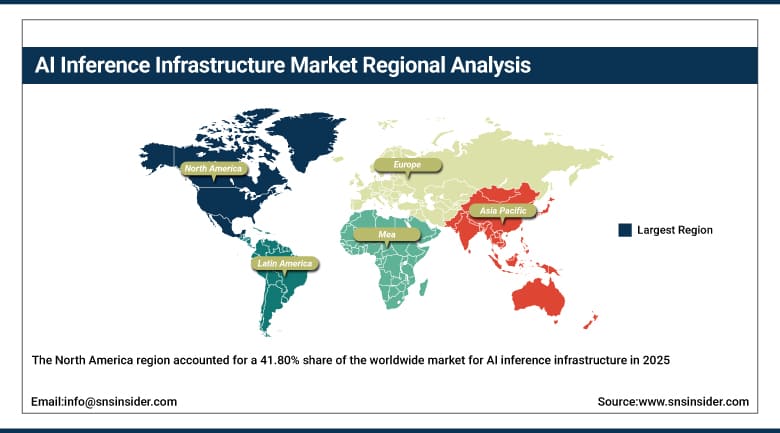
The North America region accounted for a 41.80% share of the worldwide market for AI inference infrastructure in 2025 due to the fast growth of hyperscale data centers, robust investments in AI compute infrastructure, extensive use of GPUs and AI accelerators, and the availability of prominent cloud service providers. Companies in the region are making massive investments in high-performance computing, networking, memory, and energy-efficient infrastructure to facilitate generative AI, large language models, and enterprise AI inference workloads. In 2025, the United States dominated the North America AI inference infrastructure market and captured an 88.30% share of the North America AI inference infrastructure market.
Get Customized Report as Per Your Business Requirement - Enquiry Now
Europe AI Inference Infrastructure Market Insights
Europe continues to be a significant market for the AI inference infrastructure market owing to its strong industrial base, expanding AI data center investments, and growing adoption of high-performance computing infrastructure for enterprise AI applications. Germany leads the region, accounting for 25.60% of the European AI inference infrastructure market in 2025 due to its advanced manufacturing sector, robust cloud infrastructure, and increasing deployment of AI inference platforms across automotive, industrial automation, and enterprise workloads. The growing investments in GPU clusters, AI accelerators, energy-efficient data centers, high-speed networking, and sovereign AI infrastructure are further supporting the modernization and long-term growth of the AI inference infrastructure market across Europe.
Asia Pacific AI Inference Infrastructure Market Insights
The Asia-Pacific region is expected to grow at the highest CAGR of 28.16% during the forecast period due to rapid AI adoption, expanding hyperscale data center investments, increasing deployment of generative AI applications, and rising demand for high-performance AI computing infrastructure across enterprises. China accounted for the largest share of the Asia-Pacific AI inference infrastructure market at 45.80% in 2025, supported by its large AI ecosystem, strong government initiatives, expanding cloud infrastructure, and significant investments in AI chips, GPU clusters, and intelligent computing centres.
The increasing adoption of AI inference workloads, large language models (LLMs), AI accelerators, high-speed networking, and energy-efficient data center infrastructure, along with growing investments in cloud computing and enterprise AI deployment, is expected to create significant growth opportunities for the AI inference infrastructure market across the Asia-Pacific region throughout the forecast period.
Middle East & Africa and Latin America AI Inference Infrastructure Market Insights
The Middle East & Africa AI inference infrastructure market is witnessing steady growth owing to increasing investments in AI-ready data centers, expanding cloud infrastructure, growing adoption of artificial intelligence across enterprises, and government-led digital transformation initiatives. Saudi Arabia dominated the regional market, accounting for 32.40% of the Middle East & Africa AI inference infrastructure market in 2025, supported by significant investments in AI infrastructure, hyperscale data centers, high-performance computing, and national AI development programs.
The AI inference infrastructure market in Latin America is experiencing consistent growth due to expanding cloud computing infrastructure, increasing enterprise AI adoption, and rising investments in AI data centers and high-performance computing resources. Brazil accounted for the largest share of the Latin American AI inference infrastructure market at 49.60% in 2025, driven by its large digital economy, growing deployment of AI inference platforms, expanding hyperscale cloud facilities, and increasing investments in GPU-powered infrastructure across key industries.
Growth Driver: Rising adoption of generative AI and increasing demand for high-performance AI inference infrastructure
Among the key factors driving the growth of the AI inference infrastructure market is the rapid adoption of generative AI, large language models (LLMs), and enterprise AI applications across industries such as healthcare, BFSI, retail, manufacturing, and telecommunications. As organizations deploy AI models for real-time inference, they require high-performance computing infrastructure equipped with GPUs, AI accelerators, high-speed networking, and scalable storage to deliver low-latency and efficient AI processing.
Organizations are investing heavily in AI-optimized data centers, hyperscale cloud infrastructure, advanced processors, and energy-efficient computing systems to support growing AI inference workloads. Moreover, increasing investments in cloud computing, edge AI deployment, AI chip innovation, and high-bandwidth networking are accelerating the adoption of advanced AI inference infrastructure across industries.
Restraint: High infrastructure costs and power consumption associated with AI deployments
The high cost of deploying and maintaining AI inference infrastructure continues to restrain the growth of the AI inference infrastructure market. Building AI-ready data centers requires substantial investments in GPUs, AI accelerators, high-performance processors, networking equipment, storage systems, and advanced cooling technologies, making large-scale deployments challenging for small and medium-sized enterprises. In addition, rising electricity costs, hardware shortages, and the increasing complexity of integrating AI infrastructure across cloud, on-premises, and hybrid environments further increase operational expenses.
Moreover, AI inference workloads consume significant computing power and energy, creating challenges related to power availability, thermal management, and infrastructure scalability. Organizations must continuously upgrade hardware, improve energy efficiency, and optimize resource utilization to support increasingly complex AI models, which increases implementation costs and can slow the adoption of advanced AI inference infrastructure.
Opportunity: Growing investments in hyperscale AI infrastructure and edge AI deployment
The increasing adoption of generative AI, large language models (LLMs), and enterprise AI applications is creating significant growth opportunities for the AI inference infrastructure market. Organizations are investing in AI-optimized data centers, GPU clusters, AI accelerators, high-speed networking, and scalable storage infrastructure to support real-time inference workloads, improve model performance, and reduce latency. These investments enable faster AI processing, higher computing efficiency, and seamless deployment of AI applications across cloud, edge, and hybrid environments.
Growing investments in hyperscale cloud infrastructure, sovereign AI initiatives, edge AI computing, and next-generation AI chips are expected to create substantial opportunities for infrastructure providers, semiconductor manufacturers, and cloud service providers over the coming years. Furthermore, increasing demand for energy-efficient AI infrastructure, liquid cooling technologies, advanced interconnects, and high-bandwidth memory, along with the rapid expansion of enterprise AI deployments, is accelerating the adoption of advanced AI inference infrastructure and supporting the long-term growth of the AI inference infrastructure market.
Recent Developments
-
May 2026: Microsoft expanded its Azure AI infrastructure with new AI-optimized virtual machines and accelerated networking capabilities, enabling enterprises to deploy large-scale AI inference workloads with improved performance, scalability, and energy efficiency.
-
April 2026: Google Cloud introduced next-generation AI infrastructure enhancements for Gemini workloads, featuring advanced TPU infrastructure, high-speed networking, and optimized inference capabilities for enterprise AI applications.
-
March 2026: NVIDIA expanded its Blackwell AI infrastructure platform with next-generation GPU systems and networking technologies designed to accelerate generative AI inference, large language models (LLMs), and enterprise AI deployments.
-
February 2026: Amazon Web Services (AWS) introduced new Amazon EC2 AI infrastructure instances powered by custom AI chips and NVIDIA GPUs, enabling organizations to scale AI inference workloads with lower latency, higher throughput, and improved cost efficiency.
AI Inference Infrastructure Market Key Players
-
NVIDIA Corporation
-
Advanced Micro Devices, Inc. (AMD)
-
Intel Corporation
-
Microsoft Corporation
-
Google LLC
-
Amazon Web Services, Inc.
-
Oracle Corporation
-
Dell Technologies Inc.
-
Hewlett Packard Enterprise Development LP (HPE)
-
Super Micro Computer, Inc.
-
Cisco Systems, Inc.
-
Broadcom Inc.
-
Arista Networks, Inc.
-
Micron Technology, Inc.
-
Samsung Electronics Co., Ltd.
-
SK hynix Inc.
-
Lenovo Group Limited
-
Equinix, Inc.
-
Vertiv Holdings Co.
-
Schneider Electric SE.
AI Inference Infrastructure Market Report Scope:
| Report Attributes | Details |
|---|---|
| Market Size in 2025 | USD 22.80 Billion |
| Market Size by 2035 | USD 229.95 Billion |
| CAGR | CAGR of 26.02% From 2026 to 2035 |
| Base Year | 2025 |
| Forecast Period | 2026-2035 |
| Historical Data | 2022-2024 |
| Report Scope & Coverage | Market Size, Segments Analysis, Competitive Landscape, Regional Analysis, DROC & SWOT Analysis, Forecast Outlook |
| Key Segments | • By Component (Hardware, Software, Services) • By Infrastructure (Compute, Networking, Storage, Memory, Power & Cooling) • By Deployment (Cloud, On-premises, Hybrid) • By Processor Type (GPU, CPU, ASIC, FPGA, Others) • By End User (Cloud Service Providers, Enterprises, Government Organizations) |
| Regional Analysis/Coverage | North America (US, Canada), Europe (Germany, UK, France, Italy, Spain, Russia, Poland, Rest of Europe), Asia Pacific (China, India, Japan, South Korea, Australia, ASEAN Countries, Rest of Asia Pacific), Middle East & Africa (UAE, Saudi Arabia, Qatar, South Africa, Rest of Middle East & Africa), Latin America (Brazil, Argentina, Mexico, Colombia, Rest of Latin America). |
| Company Profiles | NVIDIA Corporation, Advanced Micro Devices, Inc. (AMD), Intel Corporation, Microsoft Corporation, Google LLC, Amazon Web Services, Inc., Oracle Corporation, Dell Technologies Inc., Hewlett Packard Enterprise Development LP (HPE), Super Micro Computer, Inc., Cisco Systems, Inc., Broadcom Inc., Arista Networks, Inc., Micron Technology, Inc., Samsung Electronics Co., Ltd., SK hynix Inc., Lenovo Group Limited, Equinix, Inc., Vertiv Holdings Co., Schneider Electric SE. |

Frequently Asked Questions
The AI inference Infrastructure Market is expected to grow at a CAGR of 26.02% from 2026 to 2035.
The AI inference Infrastructure Market was valued at USD 22.80 billion in 2025.
Growth is driven by increasing adoption of generative AI, large language models (LLMs), and AI inference infrastructure investments.
Hardware dominated the market in 2025 with a 67.80% share.
North America dominated the AI inference Infrastructure Market in 2025 with a 41.80% share.
