
AI-Native Open RAN Market Report Scope & Overview:
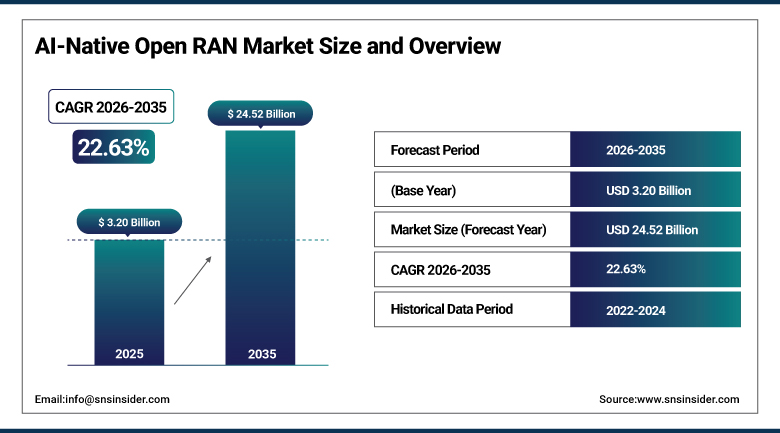
The AI-Native Open RAN Market was valued at USD 3.20 billion in 2025 and is expected to reach USD 24.52 billion by 2035, growing at a CAGR of 22.63% from 2026-2035.
The AI-Native Open RAN Market is witnessing rapid growth As a result of the high demand for intelligent, flexible, and cost-effective radio access network infrastructure. Mobile network operators have begun to increasingly use the Open RAN architecture to facilitate network flexibility, interoperation among vendors, automation of processes, and minimizing the dependency on proprietary network equipment. Artificial intelligence and machine learning have added another layer of improvement in network optimization, traffic management, resource management, and predictive maintenance. Moreover, the rollout of 5G all over the world, increase in the amount of data traffic, and increased demand for low latency connections have led to the deployment of advanced RAN infrastructure. Innovations in AI-powered RAN intelligent controllers, cloud-native network functions, network virtualization, and open interfaces have aided in the deployment of these technologies.
The FCC describes Open RAN as an architecture in which components use standards that enable interoperability among vendors, reducing vendor lock-in and increasing flexibility in network design and maintenance.
To Get more information AI-Native Open RAN Market - Request Free Sample Report
AI-Native Open RAN Market Trends
-
Rising adoption of 5G networks is driving demand for AI-native Open RAN solutions that improve flexibility and network performance.
-
Increasing use of AI and machine learning is enabling automated network optimization, resource allocation, and predictive maintenance.
-
Growing demand for vendor interoperability is accelerating adoption of Open RAN architectures across telecommunications networks worldwide.
-
Advancements in AI-powered RAN automation are improving network efficiency, traffic management, energy optimization, and operational performance.
-
Increasing deployment of cloud-native network technologies is supporting flexible, scalable, and software-driven Open RAN infrastructure.
U.S. AI-Native Open RAN Market Outlook
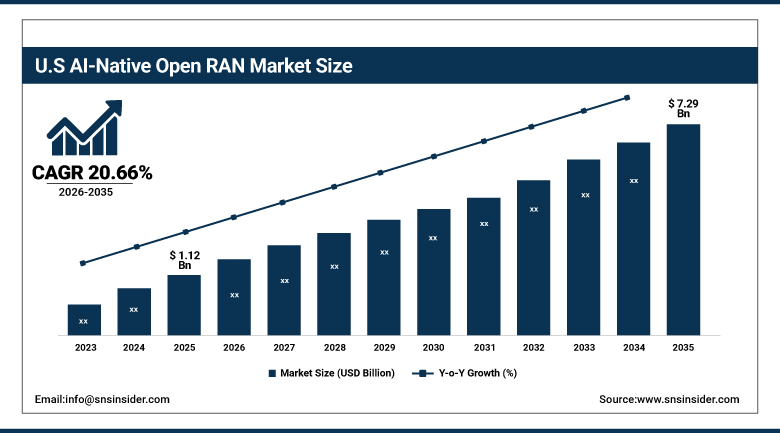
U.S. AI-Native Open RAN Market was valued at USD 1.12 billion in 2025 and is expected to reach USD 7.29 billion by 2035, growing at a CAGR of 20.66% from 2026-2035.
The U.S. AI-Native Open RAN Market is witnessing rapid growth due to growing needs for a flexible, intelligent, and efficient infrastructure of radio access network. An Open RAN is gaining popularity among mobile network operators because of the need to provide compatibility, flexibility, and automation of the network, as well as reducing the dependence on the proprietary systems. Thanks to artificial intelligence and machine learning technologies, optimization, traffic management, resource management, and predictive maintenance become more efficient. In addition, the growth of 5G networks implementation, mobile data traffic, and the need for high-quality connection stimulate investment in next-generation RAN infrastructure. Improvements in RAN Intelligent Controller, cloud native network functions, virtualization, and open interfaces will be driving market growth. The need for performance enhancement, cost reduction, energy efficiency, and autonomy of the network operation drives the market growth in the United States.
NTIA announced a new direction for its Innovation Fund focused specifically on U.S.-based AI-native network architecture and the integration of AI into Radio Access Networks.
AI-Native Open RAN Market Segment Analysis
-
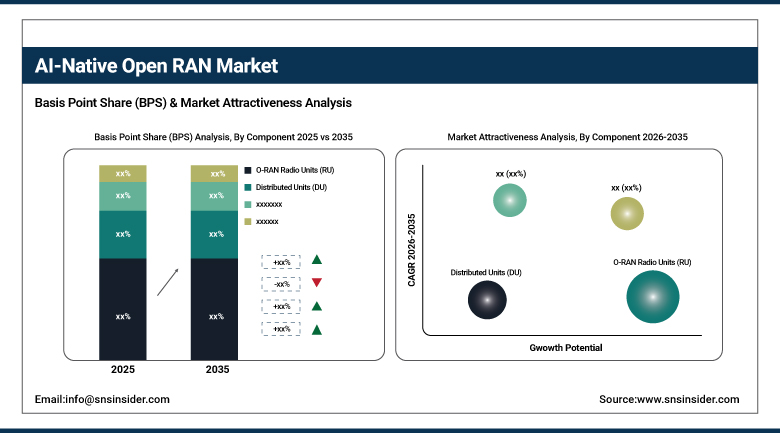
By Component, O-RAN Radio Units (RU) dominate the AI-Native Open RAN Market with 35% share in 2025; Near-RT RIC Applications are expected to grow at the fastest CAGR of 29.77% from 2026–2035.
-
By Application, Network Automation & Optimization dominates the Network Orchestration Market with 31% share in 2025; Edge AI Deployment is expected to grow at the fastest CAGR of 25.24% from 2026–2035.
-
By End User, Mobile Network Operators dominate the AI-Native Open RAN Market with 55% share in 2025; Private 5G Enterprises are expected to grow at the fastest CAGR of 30.34% from 2026–2035.
By Component, O-RAN Radio Units (RU) dominate the AI-Native Open RAN Market, Near-RT RIC Applications grow fastest.
The O-RAN Radio Units (RU) segment dominated the AI-Native Open RAN Market with the highest revenue share of about 35% in 2025, This growth is spurred on by the installation of radio infrastructure, expansion of 5G networks, and usage of open RAN architecture. Open RAN RUs are flexible and vendor-neutral, thus allowing the use of disaggregated networking architecture, which makes them very relevant to radio access networks modernization.
The Near-RT RIC Applications segment is expected to grow at the fastest CAGR of 29.77% from 2026–2035, The motivation behind such efforts is driven by the growing requirement for AI-based network optimization and intelligent real-time control. Near-RT RIC use cases allow the operator to optimize the traffic, interference, and resources by leveraging artificial intelligence and machine learning.
By Application, Network Automation & Optimization dominates the AI-Native Open RAN Market, Edge AI Deployment grows fastest.
The Network Automation & Optimization segment dominated the AI-Native Open RAN Market with the highest revenue share of about 31% in 2025, Motivated by increasing complexity of the network and the rising need for automated operations. The use of automation allows operators to utilize their network resources efficiently, improve their performance, minimize human intervention, and ensure increased efficiency in operation.
The Edge AI Deployment segment is expected to grow at the fastest CAGR of 25.24% from 2026–2035, driven by the rise in demand for low-latency computation and distributed intelligence. Deployment of AI functions at network edges helps make decisions in real time and optimize without transferring too much data. Increased use of 5G, edge computing, autonomous systems, and IIoT helps in expanding this segment.
By End User, Mobile Network Operators dominate the AI-Native Open RAN Market, Private 5G Enterprises grow fastest.
The Mobile Network Operators segment dominated the AI-Native Open RAN Market with the highest revenue share of about 55% in 2025, because of massive 5G deployments, substantial network infrastructure, and rising demands for automation and efficiency of networks. Operators are using AI-native Open RAN for cost optimization, network performance, vendor independence, and flexibility in increasingly complicated telecommunication networks.
The Private 5G Enterprises segment is expected to grow at the fastest CAGR of 30.34% from 2026–2035, driven by increasing need for dedicated, secure, and high performance connectivity in various industrial scenarios. Companies are increasingly using private 5G networks combined with artificial intelligence enabled Open RAN. Digitalization in various industries like manufacturing, logistics, healthcare, and energy is making the adoption faster.
Regional Analysis
|
Region |
Major Country |
Share within Region, 2025 (%) |
|---|---|---|
|
North America |
United States |
91.0% |
|
Europe |
Germany |
24.0% |
|
Asia Pacific |
China |
41.5% |
|
Middle East & Africa |
UAE |
18.0% |
|
Latin America |
Brazil |
35.0% |
North America AI-Native Open RAN Market Insights
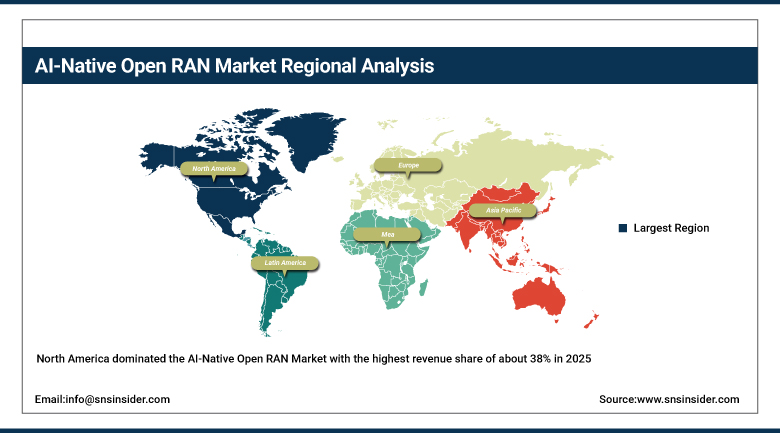
North America dominated the AI-Native Open RAN Market with the highest revenue share of about 38% in 2025, Backed up with advanced telecommunications infrastructure, the deployment of 5G, and investment in Open RAN. With the increasing demand for flexible, virtualized, and automated networks, Open RAN adoption will increase. Initiatives by the government, R&D strength, and the existence of leading telecom/technology companies in the region contribute to dominance of the regional market.
The U.S. AI-Native Open RAN Market accounted for a market share of 91.0%, backed by robust telecommunication infrastructure, wide adoption of 5G networks, and heavy investment in Open RAN technology. High demand for flexible, automated networks and vendor diversification has been pushing their adoption. Government incentives, huge R&D spendings, and presence of major telecommunication and tech giants make the American market even stronger.
Get Customized Report as per Your Business Requirement - Enquiry Now
Europe AI-Native Open RAN Market Insights
Europe’s AI-Native Open RAN Market This is driven by greater 5G network deployments, telecom modernization, and increased investments in open and disaggregated networks. The need for vendor diversification and flexibility coupled with automation is driving the adoption. Regulatory actions aimed at securing competitive telecommunications infrastructures, along with AI networking investments and collaboration between operators and tech vendors, further drive market growth in the region.
The Germany AI-Native Open RAN Market accounted for a market share of 24.0%, motivated by sophisticated telecommunication infrastructure, expanding 5G coverage, and enhanced investments in open networks. Demand for flexibility and compatibility is driving the trend. Government policies, advances in telecommunication technology, research, and cooperation between operators and technology companies give Germany an edge over other players in Europe.
Asia Pacific AI-Native Open RAN Market Insights
Asia Pacific is expected to grow at the fastest CAGR of about 25.03% from 2026–2035, fuelled by fast-paced 5G deployment, increased mobile traffic, and higher investments in the Open RAN network infrastructure. The need for effective, flexible, and scalable networks is driving the adoption rate. The government’s digitalization plans, telecom modernization, AI implementation, and deployments in China, Japan, India, and South Korea are fuelling growth.
The China AI-Native Open RAN Market accounted for a market share of 41.5%, backed by the fast development of 5G networks, growing telecommunications infrastructure, and investment in networking improvements. The rising usage of mobile data services and flexible network needs are among the factors encouraging this trend. Digital transformation efforts in government, local technological development, the inclusion of artificial intelligence, and investments in the new generation of telecommunications infrastructure support China’s market development.
Middle East & Africa and Latin America AI-Native Open RAN Market Insights
The Middle East & Africa and Latin America AI-Native Open RAN Markets These are driven by the expansion of 5G networks, increased digital transformation and higher demand for flexible telecommunication infrastructure. Telco providers are looking at open architecture models to enhance network efficiency and vendor independence. Government connectivity programs, increased investments in network upgrading and the adoption of cloud-native and AI-powered technologies add up to regional opportunities.
The UAE AI-Native Open RAN Market accounted for a market share of 18.0%, powered by fast digitalization, 5G connectivity growth, and investment in sophisticated telecommunication systems. The high demand for flexible architecture is fueling its implementation. Government policies for digitalization, Smart City projects, telecom upgrades, and cooperation with foreign companies contribute to the successful implementation of AI-Native Open RAN in the UAE.
Market Dynamics
Growth Drivers: Growing demand for intelligent network automation and autonomous RAN is accelerating AI-native Open RAN adoption
The increasing complexity of 5G networks is driving operators toward AI-native Open RAN architectures capable of automating network operations and optimizing performance in real time. These capabilities include traffic optimization, resource management, anomaly detection, predictive maintenance, energy management, and closed-loop network control. In the case of the recently issued specifications by the O-RAN Alliance, AI and machine learning have seen an enhancement of their capabilities in the area of workflow in the Non-Real-Time and Near-Real-Time RAN Intelligent Controllers. This is also happening as AI-driven RAN intelligence is increasingly finding its way into commercial implementations.
Restraints: High deployment complexity and multi-vendor interoperability challenges can limit AI-native Open RAN adoption
AI-native Open RAN environments involve multiple components, vendors, software layers, cloud platforms, and standardized interfaces, making deployment and integration significantly more complex than conventional RAN architectures. Operators need to ensure interoperability among the components of O-RU, O-DU, O-CU, RIC, SMO, and O-Cloud while ensuring that performance and reliability of the network are not compromised. The AI models would also need reliable data pipelines as well as consistent interfaces among various network domains. While O-RAN PlugFests and test centers have significantly improved the multi-vendor validation process, the massive rollout of commercial products would require a significant amount of testing and integration.
Opportunities: Expansion of AI-powered RAN optimization and closed-loop automation is creating significant growth opportunities
The growing integration of AI into RAN controllers provides substantial opportunities for vendors offering intelligent optimization and automation solutions. AI implementations have the potential to make dynamic decisions on how to optimize spectrum usage, beamforming, traffic, energy, mobility, and resource optimization based on live conditions. Specifically, O-RAN Release 5 focuses on improving the AI RAN architecture and making machine learning applications available to optimize massive MIMO beamforming. Closed-loop AI systems can help networks identify problems and apply optimization policies to fix these issues. With operators striving to make their networks efficient and minimize operating costs, there will be more demand for AI-based RIC applications, orchestration solutions, optimization software, and AI infrastructure for RAN.
Recent Developments:
-
2026 : Ericsson advanced its AI-native RAN portfolio by introducing AI-powered RAN software features including AI-native scheduling, AI-managed beamforming, and multi-layer coordination, supporting more intelligent and autonomous network performance.
-
2026 : Nokia Corporation strengthened its AI-RAN strategy through its partnership with NVIDIA, including functional testing of telecom and AI workloads on a shared GPU-accelerated platform and preparation for commercial AI-RAN deployments.
-
2026 : Samsung Electronics Co., Ltd. demonstrated AI-RAN capabilities with NVIDIA AI infrastructure, including an AI-based MIMO beamformer designed to improve downlink performance and throughput, advancing AI-native software-driven networks.
-
2025 : NVIDIA Corporation expanded its AI-RAN ecosystem by collaborating with telecom industry leaders to develop AI-native 6G networks, combining AI and RAN workloads on accelerated computing infrastructure and supporting O-RAN-based network evolution.
AI-Native Open RAN Market key players are:
-
Ericsson
-
Nokia
-
Huawei
-
Samsung
-
ZTE
-
NEC
-
Fujitsu
-
Mavenir
-
Rakuten Symphony
-
Parallel Wireless
-
Radisys
-
Airspan Networks
-
Intel
-
NVIDIA
-
Qualcomm
-
AMD
-
Dell Technologies
-
HPE
-
Cisco
-
Keysight Technologies
AI-Native Open RAN Market Report Scope:
| Report Attributes | Details |
|---|---|
| Market Size in 2025 | USD 3.20 Billion |
| Market Size by 2035 | USD 24.52 Billion |
| CAGR | CAGR of 22.63% From 2026 to 2035 |
| Base Year | 2025 |
| Forecast Period | 2026-2035 |
| Historical Data | 2022-2024 |
| Report Scope & Coverage | Market Size, Segments Analysis, Competitive Landscape, Regional Analysis, DROC & SWOT Analysis, Forecast Outlook |
| Key Segments | • By Component (O-RAN Radio Units (RU), Distributed Units (DU), Centralized Units (CU), RAN Intelligent Controller (RIC), Near-RT RIC Applications) • By Application (Network Automation & Optimization, AI-Driven Traffic Management, Edge AI Deployment, Network Slicing, Security & Anomaly Detection) • By End User (Mobile Network Operators, Telecom Equipment Vendors, Government & Defense, Private 5G Enterprises) |
| Regional Analysis/Coverage | North America (US, Canada), Europe (Germany, UK, France, Italy, Spain, Russia, Poland, Rest of Europe), Asia Pacific (China, India, Japan, South Korea, Australia, ASEAN Countries, Rest of Asia Pacific), Middle East & Africa (UAE, Saudi Arabia, Qatar, South Africa, Rest of Middle East & Africa), Latin America (Brazil, Argentina, Mexico, Colombia, Rest of Latin America). |
| Company Profiles | Ericsson, Nokia, Huawei, Samsung, ZTE, NEC, Fujitsu, Mavenir, Rakuten Symphony, Parallel Wireless, Radisys, Airspan Networks, Intel, NVIDIA, Qualcomm, AMD, Dell Technologies, HPE, Cisco, and Keysight Technologies. |

Frequently Asked Questions
Key players in the AI-Native Open RAN Market include Ericsson, Nokia Corporation, Huawei Technologies Co., Ltd., Samsung Electronics Co., Ltd., and ZTE Corporation, among others.
Key opportunities in the AI-Native Open RAN Market include expansion of 5G networks, increasing deployment of AI-driven RAN optimization, and growing demand for open, interoperable, and automated network infrastructure.
The market is driven by increasing demand for intelligent network automation, along with growing adoption of 5G, Open RAN architectures, AI-powered optimization, and cloud-native technologies.
The O-RAN Radio Units (RU) segment dominated the AI-Native Open RAN Market, accounting for approximately 34.60% market share.
