
Optical Network Automation Market Report Scope & Overview:
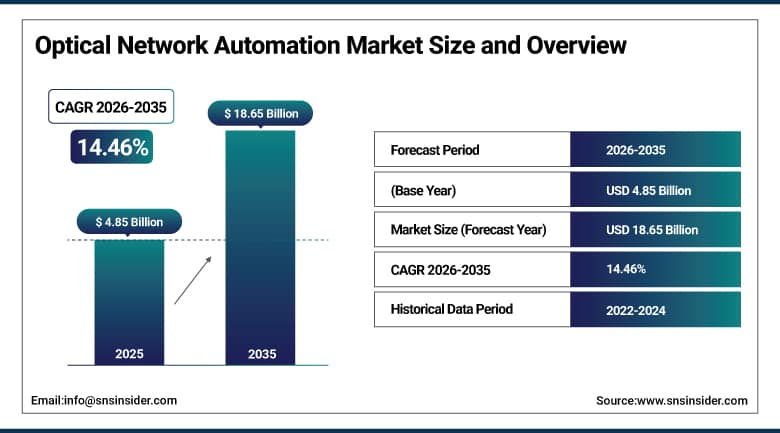
The Optical Network Automation Market was valued at USD 4.85 billion in 2025 and is expected to reach USD 18.65 billion by 2035, growing at a CAGR of 14.46% from 2026-2035.
The Optical Network Automation Market is witnessing strong growth Due to the increasing complexity of network architecture, increasing data traffic, and the increasing demands for more efficient and reliable management of networks. There has been an increase in the adoption of automation among telecommunications providers to ease provisioning, network fault management, network performance management, and network orchestration. The growth of 5G technology, fiber optics, cloud computing, and edge computing has been fueling the demand for automation of optical networks. Furthermore, automation reduces cost, avoids human error, and increases scalability of the network. Growth in artificial intelligence, machine learning, software-defined networks, and intent-based networks is helping with this.
In 2025–2026, Cisco expanded AI-powered networking capabilities focused on automation, predictive operations, network visibility, and simplified management across increasingly complex networks.
To Get More Information On Optical Network Automation Market - Request Free Sample Report
Optical Network Automation Market Trends:
-
Rising network traffic from 5G, cloud computing, and data centers is driving demand for automated optical network management and orchestration solutions.
-
Increasing network complexity is encouraging telecommunications operators to adopt automation for faster provisioning, fault management, performance monitoring, and service optimization.
-
Growing deployment of fiber-optic networks and high-capacity connectivity is expanding demand for intelligent automation solutions that improve network scalability and reliability.
-
Advancements in artificial intelligence and machine learning are enhancing predictive maintenance, network optimization, anomaly detection, and automated operational decision-making.
-
Increasing adoption of software-defined networking is supporting integration of optical network automation with centralized orchestration and programmable network architectures.
U.S. Optical Network Automation Market Outlook:
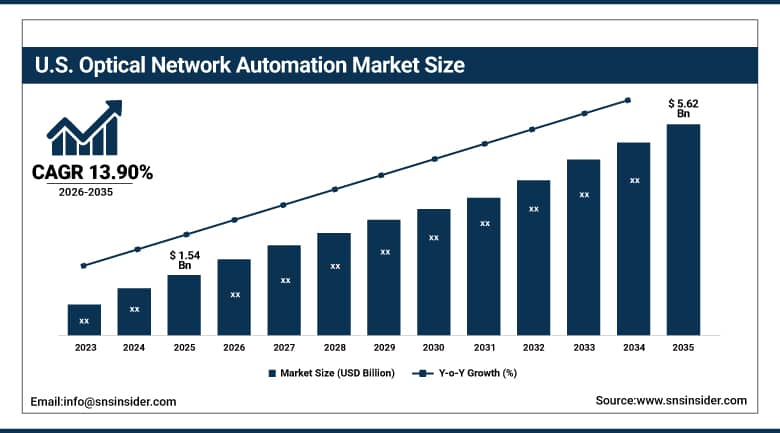
The U.S. Optical Network Automation Market was valued at USD 1.54 billion in 2025 and is expected to reach USD 5.62 billion by 2035, growing at a CAGR of 13.90% from 2026-2035.
The U.S. Optical Network Automation Market is witnessing strong growth because of the growth of data traffic, development of the fiber optic network, and the increasing demand for an efficient network management system. The telecommunications companies are opting for automation to simplify network provisioning, optimize fault management, optimize performance monitoring, and eliminate operational complexities. The growth of 5G networks, cloud computing, edge networks, and the fast broadband network is boosting the adoption of such systems. Moreover, the need to cut down the operational costs, reduce the chances of human error, and increase the reliability of the network is pushing firms towards the automation of the optical network systems.
In January 2025, Microsoft announced approximately US$80 billion in planned U.S. investment in AI-enabled data centers for FY2025, increasing demand for high-capacity data-center connectivity.
Optical Network Automation Market Segment Analysis:
-
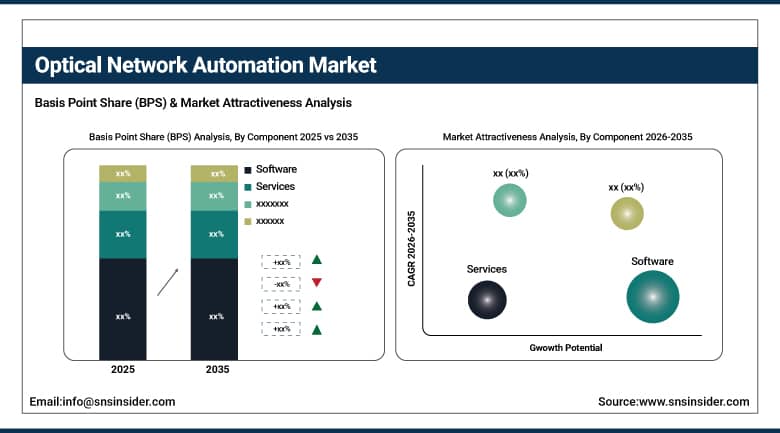
By Component, Software dominated the Optical Network Automation Market with 53% share in 2025; Services is expected to grow at the fastest CAGR of 15.60% from 2026–2035.
-
By Network Type, Wavelength Division Multiplexing (WDM) dominated the Optical Network Automation Market with 47% share in 2025; Wavelength Division Multiplexing (WDM) is expected to grow at the fastest CAGR of 15.01% from 2026–2035.
-
By Application, Network Provisioning dominated the Optical Network Automation Market with 22% share in 2025; Network Orchestration is expected to grow at the fastest CAGR of 17.00% from 2026–2035.
-
By End-User, Telecommunications dominated the Optical Network Automation Market with 40% share in 2025; IT & Data Centers are expected to grow at the fastest CAGR of 16.13% from 2026–2035.
By Component, Software dominates the optical network automation market, Services grow fastest.
Software segment dominated the Optical Network Automation Market with the highest revenue share of about 53% in 2025 owing to increased demand for automated management and control of networking, network provisioning, monitoring, orchestration, and fault detection. Software provides centralized control, visibility, and efficient resource usage in optical networks. Increased network complexity, 5G, cloud computing, and increased data traffic make the case for software even more compelling.
Services segment is expected to grow at the fastest CAGR of 15.60% from 2026-2035 as a result of rising requirements for network implementation, integration, consulting, maintenance, optimization, and management services. Telecom operators need more and more qualified specialists to implement and control sophisticated automated optical networks. The trend towards network modernization, increasing complexity and the necessity of constant technical support should lead to rapid growth of services usage worldwide.
By Network Type, Wavelength Division Multiplexing (WDM) dominates the optical network automation market and grows fastest.
Wavelength Division Multiplexing (WDM) segment dominated the Optical Network Automation Market with the highest revenue share of about 47% in 2025 due to the capability of using more than one wavelength on a single optical fiber at once. The need for increased bandwidths, the growth of fiber networks, cloud connections, and high traffic have been bolstering the use of WDM worldwide.
Wavelength Division Multiplexing (WDM) segment is expected to grow at the fastest CAGR of 15.01% from 2026-2035 due to the rising demand for greater fiber bandwidth capacity, effective spectrum usage, and scalable optical interconnect. The expansion of 5G, data centers, cloud computing, and broadband networks is driving more needs for WDM solutions. Data traffic growth and network upgrades will fuel further implementation of WDM worldwide.
By Application, Network Provisioning dominates the optical network automation market, Network Orchestration grows fastest.
Network Provisioning segment dominated the Optical Network Automation Market with the highest revenue share of about 22% in 2025 because of the increased demand for rapid and automated service delivery, configuration, and resource allocation. Provisioning helps eliminate manual work, saves time, and minimizes mistakes while increasing network efficiency. Increased fiber optic growth and 5G deployments and the complexity of optical infrastructure add to the adoption worldwide.
Network Orchestration segment is expected to grow at the fastest CAGR of 17.00% from 2026-2035 due to growing requirements for efficient automation and coordination of multi-vendor and multi-domain optical networks. With orchestration, it is possible to perform automatic resource allocation and service management and optimize network operations. The deployment of 5G technology, cloud technologies, and edge computing is expected to increase orchestration adoption.
By End-User, Telecommunications dominates the optical network automation market, IT & Data Centers grow fastest.
Telecommunications segment dominated the Optical Network Automation Market with the highest revenue share of about 40% in 2025 as a result of increasing data traffic, 5G rollouts, fiber deployments, and requirements for reliable, high-capacity connectivity. The telecommunication providers need to automate their processes of network provisioning, management, troubleshooting, and optimization. Increased broadband connectivity and upgrades make the case even stronger.
IT & Data Centers segment is expected to grow at the fastest CAGR of 16.13% from 2026-2035 due to increased data center expansion, cloud loads, artificial intelligence usage, and increased interconnection needs. Data centers need fast, scalable, and reliable optical networking with automatic management capabilities. Increased east-west traffic, large scale infrastructures, and operational efficiency needs are predicted to increase the adoption of automation worldwide.
Regional Insights:
|
Region |
Major Country |
Share within Region, 2025 (%) |
|---|---|---|
|
North America |
United States |
91.0% |
|
Europe |
Germany |
25.5% |
|
Asia Pacific |
China |
35.0% |
|
Middle East & Africa |
UAE |
22.0% |
|
Latin America |
Brazil |
39.0% |
North America Optical Network Automation Market Insights
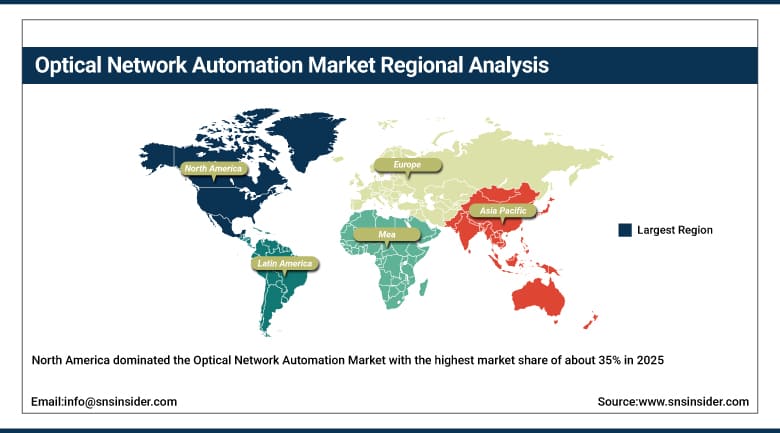
North America dominated the Optical Network Automation Market with the highest market share of about 35% in 2025, motivated by the advanced telecom infrastructure, 5G penetration, and high requirement for network management automation. The increasing spending on cloud computing services, data center, fiber, and AI-powered networking, together with the availability of technology vendors, is fueling the growth of the regional market.
The U.S. Optical Network Automation Market accounted for a market share of 91.0%, Backed by highly advanced telecoms infrastructure, fiber-optic networks, 5G implementation, and investments in the cloud and data centers. The increasing demand for automatic provisioning, monitoring, orchestration, and network optimization is fueling the growth. There are more investments in AI-based networking, network transformation, and connectivity.
Get Customized Report as Per Your Business Requirement - Enquiry Now
Europe Optical Network Automation Market Insights
Europe Optical Network Automation Market is witnessing steady growth, These trends are backed by the increase in fiber optic networks, 5G networks, cloud computing, and high volume data transmission. Telecom companies are employing automation in order to achieve better network configuration, monitoring, and fault management. Investments in network infrastructure, data center operations, and digital transformations are further driving regional market growth.
The Germany Optical Network Automation Market accounted for a market share of 25.5%, Driven by the development of the fiber-optic network infrastructure, the 5G network roll-out and the need for reliable and fast connection services. Telecommunication companies have turned to automation to facilitate their service provisioning, monitoring, and fault management. The rise in investment in cloud-based services and data center operations, digitalization efforts, and data traffic is aiding this trend in Germany.
Asia Pacific Optical Network Automation Market Insights
Asia Pacific is expected to grow at the fastest CAGR of about 15.88% from 2026–2035, backed by fast-growing 5G, data traffic, cloud, and fiber networks. Growing capital spending on communications infrastructure, data centers, and network modernization, in addition to increased need for automation in provisioning, monitoring, orchestration, and fault management, is driving regional market growth even faster.
The China Optical Network Automation Market accounted for a market share of 35.0%, backed by fast 5G rollouts, expansion of fiber network infrastructure, growing traffic volumes, and investments in clouds and data centers. Growing need for automation of network operations, provisioning, monitoring, and orchestration is fueling the adoption. Digital infrastructure development programs, telecoms modernization projects, and high-bandwidth connectivity investments by the government are reinforcing the optical network automation market in China.
Middle East & Africa and Latin America Optical Network Automation Market Insights
The Middle East & Africa and Latin America Optical Network Automation Market is steadily increasing due to factors such as increased fiber network deployments, growth in 5G, cloud services, and the need for more connectivity. Telecommunication companies are automating their networks in order to be efficient, scalable, and reliable. The digital transformations, data center growth, network upgrades, and increase in data traffic are other reasons for optical network automation in these countries.
The UAE Optical Network Automation Market accounted for a market share of 22.0%, backed by a high-level telecommunication infrastructure, quick 5G rollout, growing fiber optic networks, and increased cloud utilization. High data flow and requirement of reliability are driving the adoption of automation in networks. The digital transformation drive of governments, smart cities and data center investments, and AI-based network management are other drivers for the growth of the market in UAE.
Growth Drivers: Growing network complexity and rising data traffic are accelerating demand for automated optical network management solutions globally
Rapid growth in data traffic and increasing optical network complexity are significantly driving demand for optical network automation. With the advent of 5G technology, cloud computing, data center deployments, and high bandwidth applications, telecom companies, cloud providers, and enterprises need to manage more advanced and large-scale fiber optic networks. It becomes progressively harder to manage the network with respect to provisioning, monitoring, fault management, and configuration as the size of the network grows. Optical network automation allows centralizing the management, provisioning, monitoring, and fault management process, thus increasing efficiency and reducing the role of human intervention in the process. With increasing demands on scalability, reliability, and quick deployment of services, software-based automation systems have been encouraged by operators.
Restraints: Cybersecurity risks and concerns surrounding automated network control can restrain wider adoption among telecom operators
Increasing automation and centralized network control can create cybersecurity concerns for telecom operators and infrastructure providers. The optical network automation platform involves interconnections between various network elements, management tools, applications, and data sources, possibly increasing the attack surface. Unauthorized access to the network, malicious configuration of the network elements, software flaws, or API attacks can disable the vital network functionality and harm many users. The operators need to ensure sufficient levels of authentication, encryption, access control, and other security measures prior to introducing the automatic management systems. Inclusion of cybersecurity mechanisms into the automation process can lead to additional expenses and complications. Telecom providers can be hesitant in providing extensive authority over the vital infrastructure to the automated system.
Opportunities: Integration of artificial intelligence and machine learning creates significant opportunities for intelligent optical network automation solutions
Integration of artificial intelligence and machine learning is creating substantial opportunities for the Optical Network Automation Market. AI-driven systems can be used to perform analysis of performance data for the network, detect abnormalities, make predictions regarding future breakdowns, optimize traffic routing, and provide recommendations for improvements. Using predictive analytics will enable network operators to detect deterioration of equipment and prevent possible failure of the network. Also, the use of machine learning technologies will facilitate the automatic management of resources and optimization of the network, depending on traffic dynamics. With increasing complexity of optical networks, the implementation of AI solutions will minimize human interaction and increase efficiency and reliability of operations. The combination of AI solutions with such technologies as SDN, IBN, and autonomous networks will enhance the level of automation even further.
Recent Developments:
-
2026 –Ciena introduced Automated Deployment Optimizer within Navigator Network Control Suite, automating commissioning, calibration, and optimization to accelerate optical-network deployments and reduce operational effort.
-
2026 –Nokia upgraded its Autonomous Networks portfolio with agentic AI capabilities and new AI-driven frameworks for optical networks, supporting more autonomous, efficient, and intelligent network operations.
-
2026 –Huawei launched next-generation optical-network solutions incorporating AI-powered operations, automated fault identification, and optimization to accelerate the evolution toward AI-centric all-optical networks.
-
2026 –Cisco published an Optical Automation Solution workflow covering network planning, device onboarding, network control, automated service provisioning, live-network import, and network analysis.
Optical Network Automation Market Key Players are:
-
Ciena Corporation
-
Nokia Corporation
-
Cisco Systems, Inc.
-
Juniper Networks, Inc.
-
Infinera Corporation
-
Fujitsu Limited
-
NEC Corporation
-
ADTRAN Holdings, Inc.
-
Ribbon Communications Inc.
-
Lumentum Holdings Inc.
-
Corning Incorporated
-
ZTE Corporation
-
Ericsson
-
Ekinops S.A.
-
NEC Corporation
-
Spirent Communications plc
-
Coherent Corp.
-
Keysight Technologies, Inc.
Optical Network Automation Market Report Scope:
| Report Attributes | Details |
|---|---|
| Market Size in 2025 | USD 4.85 Billion |
| Market Size by 2035 | USD 18.65 Billion |
| CAGR | CAGR of 14.46% From 2026 to 2035 |
| Base Year | 2025 |
| Forecast Period | 2026-2035 |
| Historical Data | 2022-2024 |
| Report Scope & Coverage | Market Size, Segments Analysis, Competitive Landscape, Regional Analysis, DROC & SWOT Analysis, Forecast Outlook |
| Key Segments | • By Component (Software, Hardware, Services) • By Network Type (Wavelength Division Multiplexing (WDM), Synchronous Optical Networking (SONET), Fiber Channel, Others) • By Application (Network Provisioning, Network Optimization, Fault Management, Performance Monitoring, Network Orchestration, Others) • By End-User (Telecommunications, IT & Data Centers, BFSI, Healthcare, Government, Others) |
| Regional Analysis/Coverage | North America (US, Canada), Europe (Germany, UK, France, Italy, Spain, Russia, Poland, Rest of Europe), Asia Pacific (China, India, Japan, South Korea, Australia, ASEAN Countries, Rest of Asia Pacific), Middle East & Africa (UAE, Saudi Arabia, Qatar, South Africa, Rest of Middle East & Africa), Latin America (Brazil, Argentina, Mexico, Colombia, Rest of Latin America). |
| Company Profiles | Ciena Corporation, Nokia Corporation, Huawei Technologies Co., Ltd., Cisco Systems, Inc., Juniper Networks, Inc., Infinera Corporation, Fujitsu Limited, NEC Corporation, ADTRAN Holdings, Inc., Ribbon Communications Inc., Lumentum Holdings Inc., Corning Incorporated, ZTE Corporation, Ericsson, Mavenir Systems, Inc., Ekinops S.A., Spirent Communications plc, Coherent Corp., and Keysight Technologies, Inc. |

Frequently Asked Questions
The Optical Network Automation Market is expected to grow at a CAGR of 14.46% from 2026 to 2035.
The Optical Network Automation Market was valued at USD 4.85 billion in 2025.
The major growth factor is rising data traffic from 5G, cloud computing, and AI workloads, increasing demand for automated optical networks that provide scalable bandwidth, low latency, and efficient network management.
The Software segment dominated the Optical Network Automation Market in 2025.
North America dominated the Optical Network Automation Market in 2025.
