
AI-Native Development Platforms Market Report Scope & Overview:
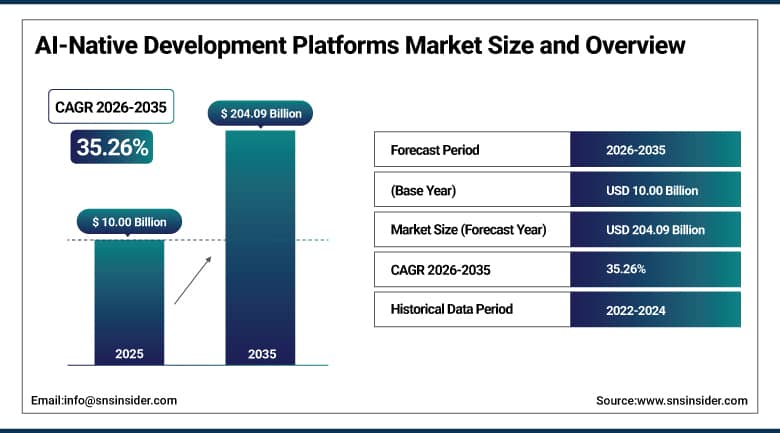
AI-Native Development Platforms Market was valued at USD 10.00 billion in 2025 and is expected to reach USD 204.09 billion by 2035, growing at a CAGR of 35.26% from 2026-2035.
The AI-Native Development Platforms Market is witnessing rapid growth owing to the rising requirement for speed in software development and automation with the help of AI. Businesses are increasingly using AI native platforms for automating code creation, designing of applications, testing and debugging as well as deployment of the application, allowing the developers to increase their efficiency in software development. The increased use of generative AI and large language models is further helping to enhance the functionality of these platforms. Furthermore, the rising need for skilled developers and customization in software development has led to businesses adopting AI enabled tools.
GitHub's controlled experiment found that developers using GitHub Copilot completed a coding task 55% faster than developers who did not use the AI assistant, highlighting the productivity benefits of AI-assisted development.
To Get More Information On AI-Native Development Platforms Market - Request Free Sample Report
AI-Native Development Platforms Market Trends
-
Rising adoption of generative AI and AI-assisted software development is driving demand for platforms that automate coding, testing, debugging, and application development.
-
Increasing developer demand for productivity-enhancing tools is accelerating adoption of AI-native platforms capable of generating code, documentation, workflows, and technical solutions.
-
Growing integration of AI agents into software development is enabling automated architectural planning, code optimization, testing, deployment, and continuous application maintenance.
-
Advancements in large language models and multimodal AI are improving code generation accuracy, contextual understanding, debugging capabilities, and developer collaboration.
-
Increasing adoption among enterprises is expanding demand for AI-native development platforms that accelerate application modernization, cloud migration, and digital transformation initiatives.
U.S. AI-Native Development Platforms Market Outlook
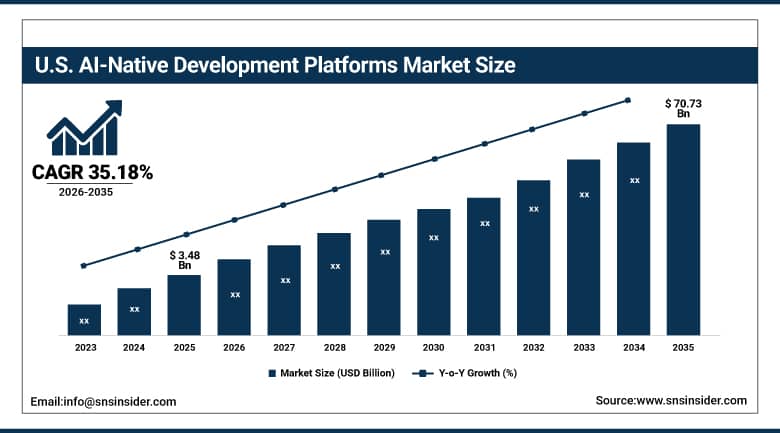
U.S. AI-Native Development Platforms Market was valued at USD 3.48 billion in 2025 and is expected to reach USD 70.73 billion by 2035, growing at a CAGR of 35.18% from 2026-2035.
The U.S. AI-Native Development Platforms Market is witnessing rapid growth due to the rising use of AI native platforms for automation and development in organizations because of generative AI. Organizations are utilizing these platforms for accelerating code creation, application development, testing, debugging, and deployment along with enhanced productivity of developers. The shortage of skilled software professionals and rising demands for customized digital applications are further pushing for increased use. Furthermore, high investment in cloud computing, large language models, AI infrastructure, and digital transformation of enterprises are adding to market growth. Advances in autonomous development agents, multi-model orchestration, and low-code AI are further contributing to platform capability and market growth across the United States.
GitHub reported that 92% of U.S.-based developers were already using AI coding tools at work, demonstrating strong adoption of AI-assisted programming within software-development workflows.
AI-Native Development Platforms Market Segment Analysis
-
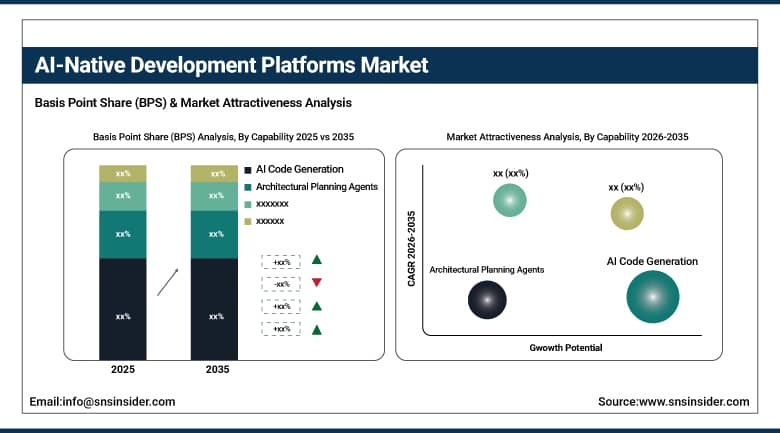
By Capability, AI Code Generation dominated the AI-Native Development Platforms Market with 44% share in 2025; Architectural Planning Agents are expected to grow at the fastest CAGR of 37.29% from 2026–2035.
-
By Target Developer, Professional Engineers dominated the AI-Native Development Platforms Market with 54% share in 2025; Citizen Developers are expected to grow at the fastest CAGR of 37.22% from 2026–2035.
-
By End-User, Large Enterprises dominated the AI-Native Development Platforms Market with 52% share in 2025; Small & Medium Enterprises are expected to grow at the fastest CAGR of 37.17% from 2026–2035.
By Capability, AI Code Generation dominates the AI-Native Development Platforms Market, Architectural Planning Agents grow fastest.
AI Code Generation segment dominated the AI-Native Development Platforms Market with the highest revenue share of about 44% in 2025 Because of rising demands for quick development of software, automated coding, debugging, and increased productivity, AI coding systems assist programmers in saving time on development and repetitive coding. The rising workload of software, shortage of developers, and the use of generative AI drive the segment’s demand.
Architectural Planning Agents segment is expected to grow at the fastest CAGR of 37.29% from 2026-2035 as a result of the rising need for automation in system design, architecture optimization, scalability planning, and intelligent suggestions for technologies. Such agents will be capable of analyzing the needs and coming up with the most efficient architecture designs, making it easier for the planners.
By Target Developer, Professional Engineers dominate the AI-Native Development Platforms Market, Citizen Developers grow fastest.
Professional Engineers segment dominated the AI-Native Development Platforms Market with the highest revenue share of about 54% in 2025 as a result of the general use of AI software to code, test, debug, document, and develop programs. Engineers are well-versed in managing complex development projects and would be able to successfully incorporate AI functions into their workflow. Increasing demands of software development add impetus to this process.
Citizen Developers segment is expected to grow at the fastest CAGR of 37.22% from 2026-2035 This is due to the increasing need for low-code and AI-powered development platforms that will enable non-technical people to develop applications. Corporations are becoming more and more interested in rapid application development at a time when there are not enough developers. Better interfaces, automation, and adoption by business people will lead to more citizen developers.
By End-User, Large Enterprises dominate the AI-Native Development Platforms Market, Small & Medium Enterprises grow fastest.
Large Enterprises segment dominated the AI-Native Development Platforms Market with the highest revenue share of about 52% in 2025 This is as a result of high software development needs, larger tech budget, and increased investment in AI-powered digital transformation. Large organizations utilize AI native platform for enhanced productivity, automation, and fast deployment of applications. Increasing adoption of enterprise AI and IT complexity reinforce this global demand.
Small & Medium Enterprises segment is expected to grow at the fastest CAGR of 37.17% from 2026-2035 Due to the increased availability of cost-effective AI development tools, cloud-based solutions, and low-code options. SMEs want their applications to be developed quickly without any large team of tech experts. Increased digital transformation, competition, and better access to AI tools will fuel this adoption trend.
Regional Analysis
|
Region |
Major Country |
Share within Region, 2025 (%) |
|---|---|---|
|
North America |
United States |
92.0% |
|
Europe |
Germany |
22.5% |
|
Asia Pacific |
China |
43.0% |
|
Middle East & Africa |
UAE |
18.0% |
|
Latin America |
Brazil |
35.0% |
North America AI-Native Development Platforms Market Insights
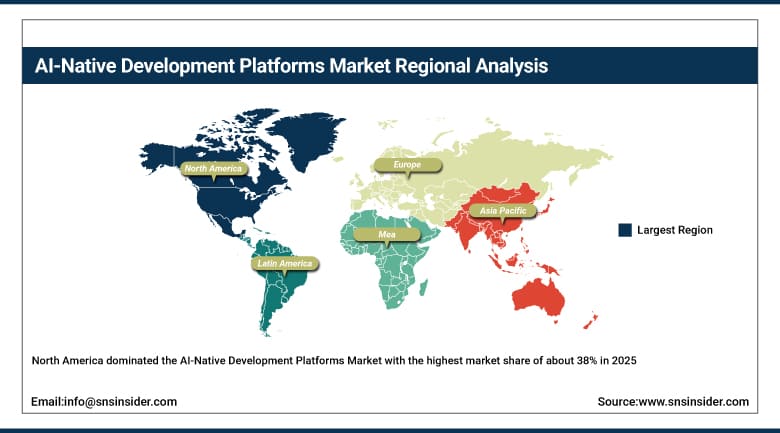
North America dominated the AI-Native Development Platforms Market with the highest market share of about 38% in 2025, Driven by high rates of AI enterprise adoption, sophisticated software ecosystems, and the presence of prominent AI technology vendors. The increasing requirement for AI-enabled code writing, automation, developer productivity, and cloud-based applications development, backed by significant technology spending, is adding to regional market dominance.
The U.S. AI-Native Development Platforms Market accounted for a market share of 92.0%, backed by robust enterprise AI adoption, sophisticated software development ecosystems, and the presence of key technology firms. Increased spending on generative AI, AI-driven code generation, cloud-native development, automation, and developer productivity is fueling adoption rates, whereas robust venture investments and innovations help reinforce the market in the United States.
Get Customized Report as Per Your Business Requirement - Enquiry Now
Europe AI-Native Development Platforms Market Insights
Europe AI-Native Development Platforms Market is growing at a constant rate, backed by rising adoption of AI by enterprises, cloud migration, and AI-enabled software development. Enterprises are implementing AI-enabled platforms that will help speed up coding, testing, automation, and modernization of applications. Increased investment in generative AI, developer productivity, cybersecurity, and digital transformation, together with AI initiatives and technology ecosystem, is aiding in regional market development.
The Germany AI-Native Development Platforms Market accounted for a market share of 22.5%, Propelled by the digitalization of enterprises, industrial automation, and AI-driven software development. The requirement of application modernization, developer efficiency, and cloud-based technologies is helping the market to grow. Generative AI, Industry 4.0, cybersecurity, and digital transformation efforts are some of the factors that are driving AI-native development platform adoption in Germany.
Asia Pacific AI-Native Development Platforms Market Insights
Asia Pacific is expected to grow at the fastest CAGR of about 36.80% from 2026–2035, These factors have been fueled by fast-paced digital transformation, increased use of AI by enterprises, and growing software development operations. The increase in investments in generative AI, cloud computing, automation, developer tools, along with the growth of startup ecosystems and AI-related government initiatives in China, Japan, India, and South Korea is also boosting market growth in the region.
The China AI-Native Development Platforms Market accounted for a market share of 43.0%, backed up by the quick integration of AI, increased software development efforts, and substantial investments in generative AI solutions. The increasing demand for code automation, app modernization, and increased developer efficiency is fueling the adoption rate. AI initiatives in the government, growing technology ecosystems, development of cloud infrastructure, and digital transformation of enterprises are adding more impetus to the market in China.
Middle East & Africa and Latin America AI-Native Development Platforms Market Insights
The Middle East & Africa and Latin America AI-Native Development Platforms Market These markets are growing in size, owing to the increased adoption of digital transformation, cloud computing, and interest in generative AI. Companies need an AI-native platform that makes software development more efficient, automation easier, and modernizes applications. Increased tech spending, growth in the ecosystem of startups, governmental AI programs, and demand for developer productivity tools are also aiding market growth.
The UAE AI-Native Development Platforms Market accounted for a market share of 18.0%, backed up by fast-paced digital transformation, increased investment in AI technologies, and more cloud usage. Companies use AI-native development tools to speed up application development and automation. Government-driven AI efforts, development of smart cities, growth of technology ecosystem, and investment in generative AI and digital infrastructure are also driving the adoption of AI-native development tools in the UAE.
Market Dynamics
Growth Drivers: Growing enterprise adoption of generative AI is accelerating demand for AI-native software development platforms globally
Rapid adoption of generative AI across enterprises is significantly driving demand for AI-native development platforms. Artificial Intelligence is being leveraged by organizations in the automation of programming, testing, debugging, documentation, application design, and software maintenance activities. The AI-native platforms have such functionalities embedded in the development process, helping developers develop applications rapidly while minimizing mundane tasks. The mounting need for shortening the development time and reacting fast to shifting customer requirements is also pushing enterprises to invest in AI-based development environments. The availability of large language models, coding helpers, autonomous agents, and multi-model orchestration features is increasing the capabilities of such platforms even further. Enterprises are also looking for those solutions which can help developers through the entire software development lifecycle.
Restraints: Concerns regarding AI-generated code accuracy and reliability can limit enterprise adoption of AI-native development platforms
Concerns regarding the accuracy, reliability, and security of AI-generated code can restrain adoption of AI-native development platforms. AI algorithms could produce erroneous, inefficient, obsolete, or insecure code, especially when dealing with intricate demands and/or technical environments unknown to them. This means that developers will need to examine and approve AI-generated recommendations prior to their application, which negates some of the productivity gains expected. Erroneous recommendations could also result in software bugs, inefficiencies, or incompatibilities, which would need further troubleshooting. Corporations running mission-critical systems could be very hesitant about permitting AI systems to take autonomous decisions in software development. Keeping code quality and compliance with corporate software development standards would necessitate comprehensive testing and monitoring procedures.
Opportunities: Expansion of autonomous coding agents creates significant opportunities for next-generation AI-native development platform providers globally
The rapid development of autonomous coding agents is creating substantial opportunities for AI-native development platform providers. Unlike traditional coding assistants, autonomous agents have the capability to undertake multiple development operations such as requirement analysis, code generation, testing, error detection, file modification, and deployment process preparation with minimal human intervention. With increasing advancement in the domain of reasoning capabilities and tools integration, AI systems can be used more intensively within the software development process. These can be leveraged by organizations to speed up application development, automate engineering processes, and increase the productivity of developers. Multiple specialists’ agents can be integrated for architecture, coding, testing, debugging, and security operations to leverage the platform even further. Vendors that develop robust agentic workflows with good human supervision and security controls stand a great chance of winning a large market share.
Recent Developments:
-
2026 –GitHub expanded Copilot into a multi-agent development platform, integrating Claude and Codex alongside Copilot to support autonomous coding across GitHub and development environments.
-
2026 –Google introduced Managed Agents through the Gemini API, enabling secure cloud-based agents capable of reasoning, tool use, and code execution for advanced agentic development workflows.
-
2026 –AWS expanded Amazon Q Developer’s agentic capabilities to autonomously implement features, conduct testing, perform code reviews, refactor software, and execute complex development tasks.
-
2026 –Cursor launched Origin, extending its AI-native coding platform into code hosting with agent-focused repository management, pull requests, code browsing, and collaborative development capabilities.
AI-Native Development Platforms Market key players are:
-
Microsoft Corporation (GitHub Copilot)
-
Anysphere, Inc. (Cursor)
-
Anthropic PBC (Claude Code)
-
OpenAI (Codex)
-
Cognition AI (Devin / Windsurf)
-
Google LLC (Gemini Code Assist)
-
Amazon Web Services, Inc. (Amazon Q Developer)
-
Replit, Inc.
-
Tabnine
-
Poolside
-
Continue.dev
-
Sourcegraph, Inc.
-
JetBrains s.r.o.
-
Cline
-
Augment Code
-
Lovable
-
Vercel (v0)
-
CodeRabbit
-
StackBlitz (Bolt.new)
-
GitLab Inc.
AI-Native Development Platforms Market Report Scope:
| Report Attributes | Details |
|---|---|
| Market Size in 2025 | USD 10.00 Billion |
| Market Size by 2035 | USD 204.09 Billion |
| CAGR | CAGR of 35.26% From 2026 to 2035 |
| Base Year | 2025 |
| Forecast Period | 2026-2035 |
| Historical Data | 2022-2024 |
| Report Scope & Coverage | Market Size, Segments Analysis, Competitive Landscape, Regional Analysis, DROC & SWOT Analysis, Forecast Outlook |
| Key Segments | • By Capability (AI Code Generation, Architectural Planning Agents, Automated Testing & Debugging, Multi-Model Orchestration) • By Target Developer (Professional Engineers, Citizen Developers, DevOps Teams, Legacy System Modernization) • By End-User (Large Enterprises, Small & Medium Enterprises, Startups, Government & Public Sector) |
| Regional Analysis/Coverage | North America (US, Canada), Europe (Germany, UK, France, Italy, Spain, Russia, Poland, Rest of Europe), Asia Pacific (China, India, Japan, South Korea, Australia, ASEAN Countries, Rest of Asia Pacific), Middle East & Africa (UAE, Saudi Arabia, Qatar, South Africa, Rest of Middle East & Africa), Latin America (Brazil, Argentina, Mexico, Colombia, Rest of Latin America). |
| Company Profiles | Microsoft Corporation, Anysphere, Inc., Anthropic PBC, OpenAI, Cognition AI, Google LLC, Amazon Web Services, Inc., Replit, Inc., Tabnine, Poolside, Continue.dev, Sourcegraph, Inc., JetBrains s.r.o., Cline, Augment Code, Lovable, Vercel, CodeRabbit, StackBlitz, and GitLab Inc. |

Frequently Asked Questions
The AI-Native Development Platforms Market is expected to grow at a CAGR of 35.26% from 2026 to 2035.
The AI-Native Development Platforms Market was valued at USD 10.00 billion in 2025.
The major growth factor is rising adoption of generative AI and agentic software development, as enterprises seek to accelerate coding, automate development workflows, improve developer productivity, and reduce software development time and costs.
The AI Code Generation segment dominated the AI-Native Development Platforms Market in 2025.
North America dominated the AI-Native Development Platforms Market in 2025.
