
AI Protein Design Market Report Scope & Overview:
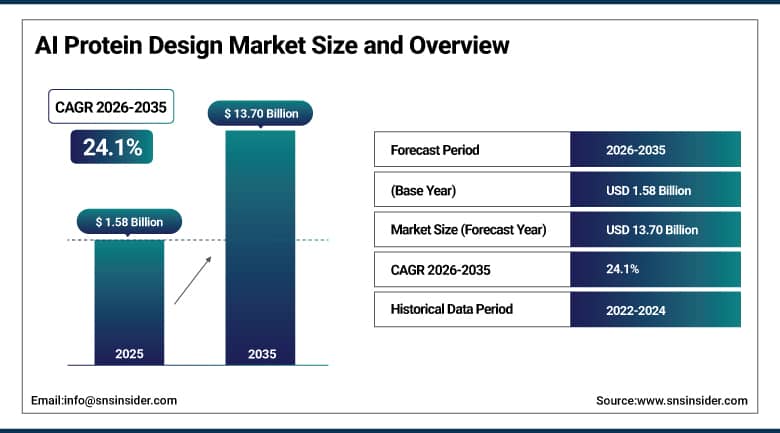
The AI Protein Design Market was valued at USD 1.58 Billion in 2025 and is expected to reach USD 13.70 Billion by 2035, growing at a CAGR of 24.1% from 2026 to 2035.
The AI Protein Design market is experiencing rapid growth as pharmaceutical, biotech, and industrial biotech firms are adopting AI technologies along with structural bioinformatics to design new protein molecules for therapeutic, catalytic, and agronomic applications. AI protein design platforms use deep learning techniques, including diffusion models, protein language models, and transformers to predict the structure of novel proteins and predict binding affinity and developability. Such an innovation in early drug discovery is reducing the time from target identification to a candidate from several years to just a few months at significantly reduced screening costs. Also, proteins can be designed with functions that are entirely non-existent in nature.
In 2026, Isomorphic Labs closed a USD 2.1 Billion Series B financing round led by Thrive Capital to extend its AlphaFold-derived protein structure prediction platform beyond biologics into small-molecule and multi-modality drug design, reflecting intensifying investor confidence in AI-native protein engineering platforms.
To Get More Information On AI Protein Design Market - Request Free Sample Report
AI Protein Design Market Trends:
-
Rapid adoption of generative diffusion and protein language models for de novo antibody and biologics design.
-
Surging multi-billion-dollar pharma-AI biotech licensing and structure-prediction co-development deals.
-
Expanding integration of AI design with automated wet-lab validation for faster iterative design cycles.
-
Increasing use of foundation protein language models to accelerate industrial enzyme and biocatalyst engineering.
-
Rising venture and strategic capital inflows into AI-native biotech platforms building proprietary structural datasets.
U.S. AI Protein Design Market Outlook:
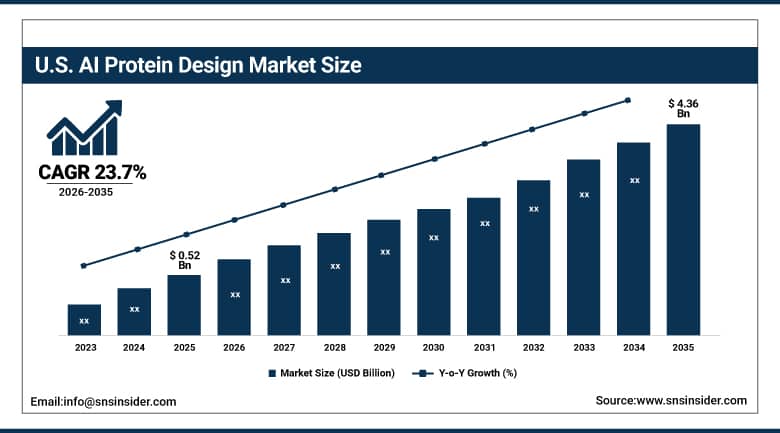
The U.S. AI Protein Design Market was valued at USD 0.52 Billion in 2025 and is projected to reach USD 4.36 Billion by 2035, growing at a CAGR of 23.7% during 2026–2035.
The United States continues to anchor global AI protein design activity, supported by a dense concentration of AI-native biotech startups, deep venture and strategic pharma capital, and close proximity to leading academic structural biology programs including the Institute for Protein Design. Domestic pharmaceutical majors are increasingly signing multi-billion-dollar milestone-based partnerships with AI protein design platforms to access proprietary generative models for antibody, enzyme, and small-molecule target discovery, while cloud infrastructure providers are expanding GPU compute capacity specifically tailored to large-scale biological foundation model training. The country's regulatory environment, growing acceptance of computationally designed biologics in early-stage clinical evaluation, and expanding contract research and manufacturing capacity supporting AI-designed candidate validation continue to reinforce sustained U.S. market leadership.
In 2026, Chai Discovery entered a licensing agreement with Pfizer granting the company early access to Chai-3, its generative model for de novo antibody design, alongside a custom biology model trained on Pfizer's proprietary discovery data.
AI Protein Design Market Segment Analysis:
-
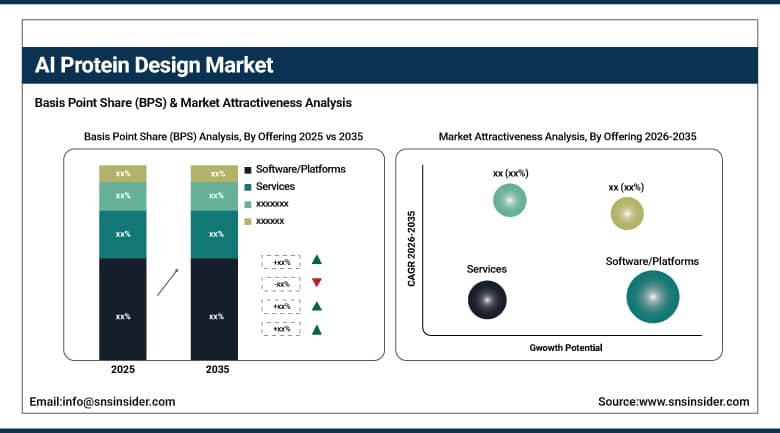
By Offering, Software/Platforms dominated the AI Protein Design Market with a 72.40% share in 2025, while Services is the fastest-growing offering segment with a CAGR of 27.90% from 2026–2035.
-
By Technology, Structure Prediction & Modeling dominated the AI Protein Design Market with a 36.80% share in 2025, while De Novo Protein Generation is the fastest-growing technology segment with a CAGR of 30.60% from 2026–2035.
-
By Application, Drug Discovery & Therapeutics dominated the AI Protein Design Market with a 59.30% share in 2025, while Industrial Enzymes & Biomanufacturing is the fastest-growing application segment with a CAGR of 29.40% from 2026–2035.
-
By End User, Pharmaceutical & Biotechnology Companies dominated the AI Protein Design Market with a 63.70% share in 2025, while CROs & CDMOs is the fastest-growing end-user segment with a CAGR of 27.60% from 2026–2035.
Software/Platforms leads By Offering, while Services grows fastest.
Software/Platforms held the largest revenue share of the AI Protein Design Market in 2025 at 72.40%. This was a result of pharmaceutical and biotech companies using their own licenses of proprietary software platforms and computational biology packages for protein design, instead of relying completely on third party services. These platforms integrate structure prediction, sequence generation, and developability scoring into end-to-end pipelines that in-house R&D teams can execute consistently across multiple drug discovery initiatives. In doing so, software-based solutions ensure an enduring advantage over single-shot service offerings from an economic and governance perspective. Investment by key players in AI protein design in software platforms, subscription and milestones-based licensing, and increased use of in-house computational biology platforms have driven the software market segment to dominance.
The Services segment is expected to register the fastest CAGR of 27.90% during the forecast period 2026-2035, as smaller biotechnology firms and academic research groups increasingly outsource end-to-end AI-driven protein design campaigns rather than build internal computational capability. Rising demand for closed-loop design-build-test-validate services that combine generative modeling with wet-lab synthesis and screening is expanding the addressable market for specialized AI protein design service providers, particularly among mid-sized biotechs pursuing novel therapeutic modalities without dedicated in-house machine learning teams.
Structure Prediction & Modeling leads By Technology, while De Novo Protein Generation grows fastest.
The Structure Prediction & Modeling segment took a pioneering position in the AI Protein Design Market in 2025, having captured 36.80% of the revenue share. It highlights the key significance of structural prediction in almost all the downstream stages of protein engineering. The prediction models based on the AlphaFold architecture are currently the standard choice in target validation, binding site determination, and candidate triage within the entire pipeline of pharmaceutical research and development. Continuous improvements in predictive accuracy are expanding the list of targets that can be predicted, ranging from multi-chain to membrane proteins. The extensive use of open and proprietary databases of structure prediction and the incorporation of these tools into the overall drug discovery software suite have cemented the leadership of this segment among conventional pharmaceutical R&D companies as well as novel AI-based biotech startups.
The De Novo Protein Generation market is projected to have the highest growth rate of 30.60% CAGR during the period of 2026-2035. This is driven by the increased trust in generative diffusion and language-based models, which are capable of designing brand new binders, enzymes, and antibody frameworks independently of any existing templates. Successful pharmaceutical partnerships that prove the value of de novo-designed proteins during preclinical and early clinical development stages are encouraging companies to apply the benefits of generative design methods.
Drug Discovery & Therapeutics leads By Application, while Industrial Enzymes & Biomanufacturing grows fastest.
AI Protein Design Market is dominated by Drug Discovery & Therapeutics segment, accounting for 59.30% market share in terms of revenues in 2025 due to growing adoption of AI-based protein design solutions by pharma and biotech companies for rapid development of antibodies, peptides, and biologics for various disease indications such as oncology, immunology, and rare diseases. Large milestone-based partnerships between native AI-based technology platforms and key pharmaceutical partners are further affirming the business potential of computationally-designed therapies, thus driving R&D activities in the area. Additionally, growing knowledge about AI-assisted discovery documentation by regulators and increasing pipeline assets based on AI-driven protein design among leading biopharma companies worldwide is further fueling segment growth.
The forecast period between 2026 and 2035 is expected to experience the highest CAGR of 29.40% by the Industrial Enzymes & Biomanufacturing segment due to the rising trend of use of enzymes designed through AI technology to improve catalysis, thermodynamic stability, and substrate specificity in biofuel production, food processing, and specialty chemicals manufacturing. The rising trend towards the sustainable use of bio-based industrial processes rather than using conventional chemical catalysts is spurring companies into using computational enzyme designs for bioprocesses.
Pharmaceutical & Biotechnology Companies lead By End User, while CROs & CDMOs grow fastest.
In the AI Protein Design Market in 2025, the Pharmaceutical & Biotechnology Companies category held a majority revenue market share of 63.70%. Large pharmaceutical companies and high-budget biotech organizations still invest heavily in research and development into AI protein design both in-house and via partnerships. In the process, they secure ownership of all proprietary training data, target identification, and IP generated by AI protein design programs in therapeutic areas of oncology, immunology, and metabolism. With growing belief from executives about the progress made in preclinical validation of AI-created drug candidates, the budgets allocated to protein design programs have further increased.
The CROs & CDMOs segment is projected to grow at the fastest CAGR of 27.60% during the forecast period 2026-2035, as contract research and development organizations expand AI protein design service offerings to support biotechnology clients lacking internal computational biology infrastructure. Rising demand for integrated design-to-manufacturing service packages that combine generative candidate design with downstream expression, purification, and analytical characterization is accelerating capability expansion among leading global contract service providers.
Regional Analysis:
|
Region |
Major Country |
Share within Region, 2025 (%) |
|---|---|---|
|
North America |
United States |
87.40% |
|
Europe |
United Kingdom |
24.80% |
|
Asia Pacific |
China |
33.20% |
|
Middle East & Africa |
UAE |
27.90% |
|
Latin America |
Brazil |
35.60% |
North America AI Protein Design Market Insights
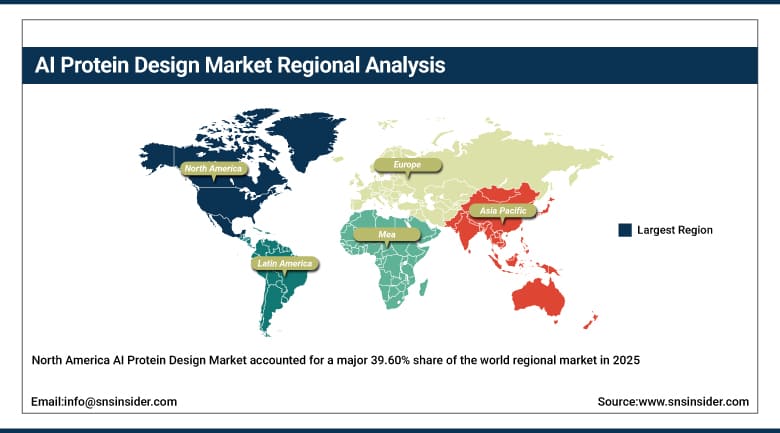
North America AI Protein Design Market accounted for a major 39.60% share of the world regional market in 2025 owing to the presence of clusters of native AI biotech companies, plentiful venture and pharmaceutical investment funds, and proximity to top structural biology academic institutions which are constantly striving to innovate the algorithms. High levels of local pharmaceutical R&D funding, early and multiple adoptions of AI-based platforms by leading biopharmaceutical companies, and advanced cloud and GPU computing infrastructure to train large biological foundation models add to the region’s dominance in the space. Favorable intellectual property framework, as well as increased knowledge of how to document discoveries with the use of AI at regulatory agencies, helps build company confidence in moving forward computational designs into clinical trials phase.
The US was the leading country within the North America AI Protein Design Market in 2025 with a market share of 87.40% of the regional market, driven by concentrated presence of leading AI protein design platform companies, sustained multi-billion-dollar pharma partnership activity, and extensive domestic computational infrastructure supporting foundation model development. Canada is contributing to regional growth through its expanding artificial intelligence research ecosystem and growing academic-industry collaboration in computational structural biology and synthetic biology applications.
Get Customized Report as Per Your Business Requirement - Enquiry Now
Europe AI Protein Design Market Insights
The Europe region was a significant contributor to the AI Protein Design Market in 2025, expected to register comparatively higher growth for customized enzyme and antibody design platforms during the forecast period. This is attributed to the region's strong academic structural biology heritage, well-established pharmaceutical manufacturing base, and growing government funding directed toward artificial intelligence applications in life sciences and computational drug discovery across member states pursuing broader biotechnology competitiveness objectives.
The United Kingdom is one of the major markets in Europe owing to its strong academic AI research base, including leading contributions from DeepMind's structural biology research heritage, alongside a growing concentration of AI-native biotechnology startups serving both domestic and international pharmaceutical customers. Other countries such as Germany, Switzerland, and France, home to established pharmaceutical manufacturers and growing computational biology research clusters, are also contributing to market growth through expanding enzyme engineering and biologics design research investment.
Asia Pacific AI Protein Design Market Insights
The Asia Pacific AI Protein Design Market is expected to witness the fastest growth rate during the forecast period 2026-2035, at a CAGR of 28.30%. The market growth is driven by rapidly expanding biotechnology investment, growing government-backed artificial intelligence and life sciences funding programs, and increasing pharmaceutical outsourcing activity across the region's major and emerging manufacturing economies pursuing accelerated computational drug discovery capability.
China is one of the main growth drivers in the Asia Pacific AI Protein Design Market, owing to its rapidly expanding domestic AI-driven drug discovery ecosystem and growing government investment supporting computational biology research infrastructure serving both local and export-oriented pharmaceutical customers. Japan and South Korea, both home to established pharmaceutical manufacturing bases and growing academic-industry AI research partnerships, are also contributing to regional growth through expanding structural biology research capacity and increasing adoption of generative protein design platforms across domestic biotechnology programs.
Middle East & Africa and Latin America AI Protein Design Market Insights
Middle East & Africa and Latin American regions are gradually expanding AI protein design adoption as biotechnology and life sciences investment grows across both regions, supported by increasing government focus on building domestic computational biology and precision medicine research capability.
Brazil is set to be a prominent Latin American market fueled by its expanding domestic biotechnology and agricultural biosciences sectors requiring efficient enzyme and crop-trait protein engineering capability. The Middle East & Africa region has the UAE and Saudi Arabia investing in national artificial intelligence and life sciences research initiatives that are gradually increasing demand for AI protein design platforms across their expanding biotechnology and pharmaceutical research sectors.
Market Dynamics:
Growth Drivers: Accelerating generative AI adoption and pharma partnership activity driving market growth
The rising integration of generative artificial intelligence into pharmaceutical discovery, industrial enzyme engineering, and synthetic biology programs, combined with growing pharma-biotech partnership activity validating computationally designed candidates, are among the primary drivers of the AI Protein Design Market. AI protein design platforms provide a dramatically faster and more cost-effective alternative to traditional directed-evolution and crystallography-based protein engineering approaches, compressing discovery timelines from years to months while expanding access to previously undruggable target classes across virtually every major biologics and industrial biocatalysis application.
Technological advancements in generative diffusion models and protein language models have significantly increased design accuracy, with recent foundation models demonstrating improved capability to generate functional, developable proteins under complex structural and functional constraints. Rising multi-billion-dollar pharmaceutical partnership and licensing activity, growing venture capital investment into AI-native biotechnology platforms, and continued expansion of large-scale structural and sequence datasets are further supporting demand across the forecast period, as generative protein design tools continue displacing conventional experimental screening approaches across an increasingly broad range of therapeutic and industrial applications.
Restraints: High computational costs and limited clinical validation constraining market expansion
One of the most critical obstacles to market growth is the substantial computational infrastructure investment required to train and operate large-scale generative protein design models, which limits full-scale platform adoption among smaller biotechnology companies and academic research institutions lacking access to dedicated GPU compute resources. This capital intensity creates a competitive divide between well-funded AI-native platform companies and resource-constrained research organizations seeking to leverage similar generative design capability.
Moreover, the relatively limited number of AI-designed biologics that have progressed through late-stage clinical validation continues to create uncertainty among some pharmaceutical decision-makers regarding the translational reliability of computationally generated candidates. Besides, the high technical complexity involved in validating developability, immunogenicity, and manufacturability of AI-designed proteins requires considerable downstream wet-lab investment, extending the practical timeline before generative design fully displaces established experimental discovery workflows.
Opportunities: Expansion into industrial biotechnology and foundation model innovation creating new growth avenues
AI Protein Design Market is expected to experience considerable growth due to growing demand for improved efficiency of enzyme engineering in biofuels, food processing, and specialty chemicals. Growth will be supported by emergence of multimodal foundation models capable of reasoning about sequences, structures, and functions simultaneously, as well as by growing pharmaceutical industry spending on generative biology research. The need to speed up development of innovative modalities such as multispecific antibodies and protein degraders will drive the growth of the market as pharmaceutical companies aim to differentiate their intellectual property using computational designs of proteins.
Great opportunities lie in closed-loop design-build-test-validate platforms combining the power of generative AI design with automated laboratory synthesis and screening tools. In addition, expanding AI protein design services into emerging markets of Asia Pacific and Latin America, driven by growing government spending on biotechnology and increasing collaboration between universities and industries, will increase demand for affordable cloud-based generative protein design platforms.
Recent Developments:
-
2026: Isomorphic Labs closed a USD 2.1 Billion Series B round led by Thrive Capital to extend its AlphaFold-derived platform into small-molecule and multi-modality drug design beyond biologics structure prediction.
-
2026: Chai Discovery launched Chai-3, its de novo antibody design model, through a licensing agreement giving Pfizer early access alongside a custom model trained on Pfizer's proprietary discovery data.
-
2026: Genesis Molecular AI expanded its GEMS platform collaboration with Incyte in a deal valued at over USD 1 Billion, applying protein-ligand structure prediction to difficult oncology and inflammation targets.
-
2026: Dyno Therapeutics entered a partnership with Roche worth up to USD 1.05 Billion to apply its AI-designed AAV capsid engineering platform, CapsidMap, to next-generation gene therapy programs.
AI Protein Design Market Key Players Are:
-
Isomorphic Labs
-
Xaira Therapeutics, Inc.
-
Chai Discovery, Inc.
-
Generate:Biomedicines, Inc.
-
Absci Corporation
-
Recursion Pharmaceuticals, Inc.
-
Insilico Medicine, Inc.
-
EvolutionaryScale PBC
-
Profluent Bio, Inc.
-
Cradle (Calventora B.V.)
-
NVIDIA Corporation
-
Schrödinger, Inc.
-
XtalPi Inc.
-
Genesis Molecular AI, Inc.
-
insitro, Inc.
-
Dyno Therapeutics, Inc.
-
Nabla Bio, Inc.
-
Latent Labs, Inc.
-
Terray Therapeutics, Inc.
-
Basecamp Research Ltd.
AI Protein Design Market Report Scope:
| Report Attributes | Details |
|---|---|
| Market Size in 2025 | USD 1.58 Billion |
| Market Size by 2035 | USD 13.70 Billion |
| CAGR | CAGR of 24.1% From 2026 to 2035 |
| Base Year | 2025 |
| Forecast Period | 2026-2035 |
| Historical Data | 2022-2024 |
| Report Scope & Coverage | Market Size, Segments Analysis, Competitive Landscape, Regional Analysis, DROC & SWOT Analysis, Forecast Outlook |
| Key Segments | • By Offering (Software/Platforms, Services) • By Technology (Structure Prediction & Modeling, De Novo Protein Generation, Directed Evolution & Sequence Optimization, Protein-Protein Interaction Modeling) • By Application (Drug Discovery & Therapeutics, Industrial Enzymes & Biomanufacturing, Agriculture & Agritech, Vaccine & Diagnostics Development) • By End User (Pharmaceutical & Biotechnology Companies, Academic & Research Institutes, CROs & CDMOs) |
| Regional Analysis/Coverage | North America (US, Canada, Mexico), Europe (Eastern Europe [Poland, Romania, Hungary, Turkey, Rest of Eastern Europe] Western Europe] Germany, France, UK, Italy, Spain, Netherlands, Switzerland, Austria, Rest of Western Europe]), Asia Pacific (China, India, Japan, South Korea, Vietnam, Singapore, Australia, Rest of Asia Pacific), Middle East & Africa (Middle East [UAE, Egypt, Saudi Arabia, Qatar, Rest of Middle East], Africa [Nigeria, South Africa, Rest of Africa], Latin America (Brazil, Argentina, Colombia, Rest of Latin America) |
| Company Profiles | Isomorphic Labs, Xaira Therapeutics, Inc., Chai Discovery, Inc., Generate:Biomedicines, Inc., Absci Corporation, Recursion Pharmaceuticals, Inc., Insilico Medicine, Inc., EvolutionaryScale PBC, Profluent Bio, Inc., Cradle (Calventora B.V.), NVIDIA Corporation, Schrödinger, Inc., XtalPi Inc., Genesis Molecular AI, Inc., insitro, Inc., Dyno Therapeutics, Inc., Nabla Bio, Inc., Latent Labs, Inc., Terray Therapeutics, Inc., Basecamp Research Ltd. |

Frequently Asked Questions
Key players in the AI Protein Design Market include Isomorphic Labs, Xaira Therapeutics, Inc., Chai Discovery, Inc., Generate:Biomedicines, Inc., Absci Corporation, Recursion Pharmaceuticals, Inc., Insilico Medicine, Inc., EvolutionaryScale PBC, Profluent Bio, Inc., and others.
Key opportunities include expansion into industrial biotechnology, AI-designed enzyme engineering, multimodal foundation models, closed-loop design-build-test-validate platforms, and growing pharmaceutical investment in generative biology.
The market is driven by rapid integration of generative AI into pharmaceutical discovery and industrial enzyme engineering, rising pharma-biotech partnership activity, and continued advancement in structure prediction and de novo generation model accuracy.
The Drug Discovery & Therapeutics segment dominated the AI Protein Design Market in 2025, accounting for approximately 59.30% market share.
The North America region dominated the AI Protein Design Market in 2025 with a 39.60% share, driven by dense concentration of AI-native biotechnology platforms and deep pharmaceutical R&D investment.
Asia Pacific is expected to register the fastest CAGR of 28.30% during the forecast period 2026-2035.
