
Physical AI Infrastructure Market Report Scope & Overview:
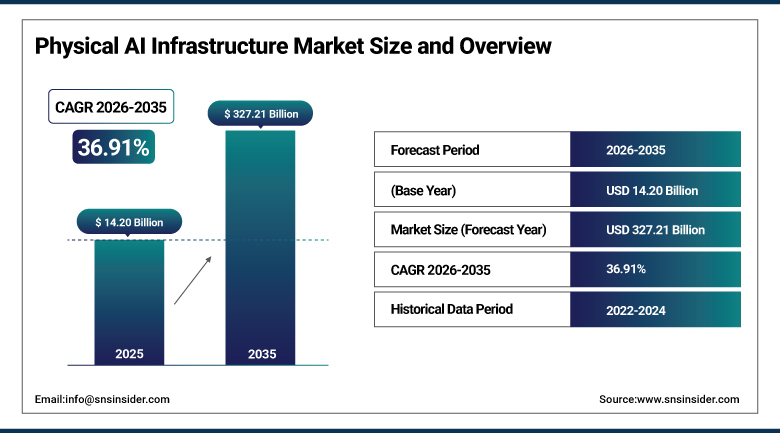
The Physical AI Infrastructure Market was valued at USD 14.20 billion in 2025 and is expected to reach USD 327.21 billion by 2035, growing at a CAGR of 36.91% from 2026-2035.
The Physical AI Infrastructure Market is witnessing rapid growth because of growing implementation of AI solutions which function and interact in physical environment. Development of robotics, autonomous vehicles, automation, smart factories, and edge AI devices is fueling requirements for computing, sensors, networking, and AI infrastructure. Growing investment in embodied AI solutions and autonomous systems is also fueling market growth. Moreover, developments in GPU, AI accelerator, edge computing, computer vision, and real-time data processing are enhancing capabilities of physical AI solutions. Requirements for low-latency and efficient infrastructure are helping market expansion in industrial, automotive, logistics, healthcare, and other markets.
The International Federation of Robotics reported that global industrial robot installations reached 542,000 units in 2024, demonstrating continued expansion of automated physical systems.
To Get more information Physical AI Infrastructure Market - Request Free Sample Report
Physical AI Infrastructure Market Trends
-
Rising adoption of robotics and autonomous systems is driving demand for specialized infrastructure supporting real-time perception, decision-making, and physical interactions.
-
Increasing deployment of embodied AI across manufacturing, logistics, healthcare, and transportation is expanding demand for advanced computing and sensing infrastructure.
-
Growing investments in AI accelerators, GPUs, edge computing, and high-performance processors are improving computational capabilities for physical AI applications.
-
Increasing demand for real-time data processing is accelerating adoption of edge infrastructure that enables low-latency AI inference closer to physical devices.
U.S. Physical AI Infrastructure Market Outlook
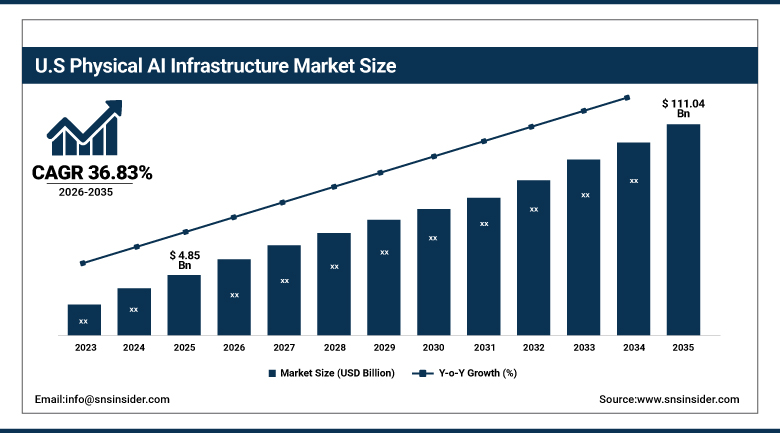
The U.S. Physical AI Infrastructure Market was valued at USD 4.85 billion in 2025 and is expected to reach USD 111.04 billion by 2035, growing at a CAGR of 36.83% from 2026-2035.
The U.S. Physical AI Infrastructure Market is witnessing rapid growth because of increased usage of AI systems that can interact and function in the physical world. Investments made in robotics, autonomous vehicles, smart manufacturing, industrial automation, and intelligent edge devices are driving the demand for computing, networking, sensing, and AI infrastructure. Besides, significant investment in embodied AI, AI accelerators, GPUs, computer vision, and real-time data processing capabilities is aiding the growth of the market. Increased usage of autonomous and intelligent machines is increasing the demand for low-latency and high-performing infrastructure. Increased usage in automotive, manufacturing, logistics, healthcare, and defense sectors is fueling market growth in the United States.
NIST's Manufacturing Extension Partnership supports U.S. manufacturers in adopting advanced technologies including automation, robotics, AI, and digital manufacturing systems.
Physical AI Infrastructure Market Segment Analysis
-
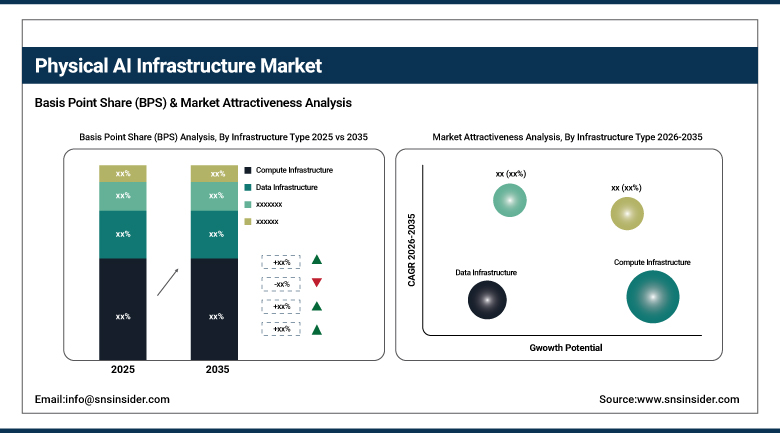
By Infrastructure Type, Compute Infrastructure dominates the Physical AI Infrastructure Market with 35% share in 2025; Simulation Infrastructure is expected to grow at the fastest CAGR of 38.68% from 2026–2035.
-
By Deployment Model, Cloud dominates the Physical AI Infrastructure Market with 48% share in 2025; Cloud is expected to grow at the fastest CAGR of 37.43% from 2026–2035.
-
By Application, Industrial Automation dominates the Physical AI Infrastructure Market with 19% share in 2025; Humanoid Robotics is expected to grow at the fastest CAGR of 40.63% from 2026–2035.
-
By End User, Technology Companies dominate the Physical AI Infrastructure Market with 24% share in 2025; Robotics Companies are expected to grow at the fastest CAGR of 39.24% from 2026–2035.
By Infrastructure Type, Compute Infrastructure dominates the Physical AI Infrastructure Market, Simulation Infrastructure grows fastest.
Compute Infrastructure segment dominated the Physical AI Infrastructure Market with the highest revenue share of about 35% in 2025 because of its critical importance in aiding training, inferencing, robotics control, sensing, and decision-making by AI models. High-performance GPUs, CPUs, accelerators, and storage enable the computing necessary for physical AI applications. More AI workloads and infrastructure spending increase demand even further.
Simulation Infrastructure is expected to grow at the fastest CAGR of 38.68% from 2026-2035 due to increasing demand for virtual testing and development of physical AI-enabled devices prior to actual deployment. Through simulations, development becomes cheaper, safer, and faster for robots and autonomous machines. Increasing use of digital twin technology, synthetic data, and robotics development platforms will boost the demand for simulation infrastructure going forward.
By Deployment Model, Cloud dominates the Physical AI Infrastructure Market and grows fastest.
Cloud segment dominated the Physical AI Infrastructure Market with the highest revenue share of about 48% in 2025 owing to the features of scalability and flexible computing capabilities, along with being able to handle huge AI computations without having to invest heavily in the infrastructure initially. Cloud computing allows the use of advanced GPUs, simulation systems, and development of AI. The increase in development of robotics and distributed AI further helps in the growth of cloud computing.
Cloud segment is expected to grow at the fastest CAGR of 37.43% from 2026-2035 due to the rising need for scalable computing, remote development of artificial intelligence, simulations, and centralization of management of physical artificial intelligence systems. Cloud computing technology provides companies with dynamic scaling based on computational needs. The rise in robotics use cases, digital twin technology, AI model development, and the need for efficient infrastructure will boost cloud adoption.
By Application, Industrial Automation dominates the Physical AI Infrastructure Market, Humanoid Robotics grows fastest.
Industrial Automation segment dominated the Physical AI Infrastructure Market with the highest revenue share of about 19% in 2025 due to increasing application of AI enabled robots, autonomous machines, machine vision, and intelligent control systems in manufacturing facilities. Physical AI increases efficiency, accuracy, and efficiency in operations. Increasing efforts in Industry 4.0, factory automation, and intelligent manufacturing systems increase the adoption further.
Humanoid Robotics segment is expected to grow at the fastest CAGR of 40.63% from 2026-2035 due to the fast progress made in AI, robotics, computer vision, sensors, and autonomous decision-making technology. Humanoid robots are becoming more prevalent in industries such as manufacturing, logistics, health care, and service. Increased investment in robotics companies, automation requirements in the workforce, and advances in robot intelligence will fuel the infrastructure demand.
By End User, Technology Companies dominate the Physical AI Infrastructure Market, Robotics Companies grow fastest.
Technology Companies segment dominated the Physical AI Infrastructure Market with the highest revenue share of about 24% in 2025 due to major investments in computing for artificial intelligence, robots, simulations, and software development. Companies that are into technology have major research capabilities to build physical artificial intelligence systems. Increased investments in AI technology, autonomous technologies, and intelligent machines only add to their strength in the market.
Robotics Companies segment is expected to grow at the fastest CAGR of 39.24% from 2026-2035 This is due to the increased growth and commercialization of autonomous robots, humanoid robots, warehouse robotics, and industrial robots. Robotics firms need high-performance computing capabilities, simulation capabilities, sensor processing capabilities, and infrastructure to support the development of artificial intelligence. Increased automation needs, investment funding, and advancements in the robotic mind are expected to drive infrastructure adoption worldwide.
Regional Insights
|
Region |
Major Country |
Share within Region, 2025 (%) |
|---|---|---|
|
North America |
United States |
91.5% |
|
Europe |
Germany |
22.5% |
|
Asia Pacific |
China |
42.0% |
|
Middle East & Africa |
UAE |
16.0% |
|
Latin America |
Brazil |
34.5% |
North America Physical AI Infrastructure Market Insights
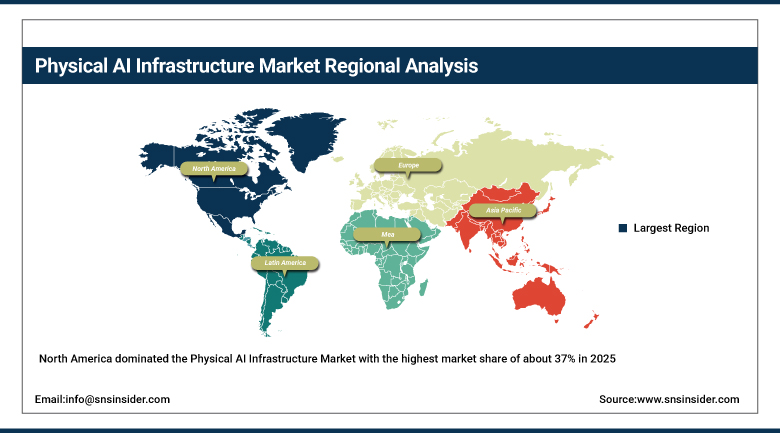
North America dominated the Physical AI Infrastructure Market with the highest market share of about 37% in 2025, Backed up by robust investments in robotics, autonomous technologies, AI computing, and manufacturing infrastructure. The presence of leading companies in AI and robotics technology, robust research & development facilities, high levels of industrial automation, and robust investments in GPUs and edge computing and intelligent systems add to regional dominance.
The U.S. Physical AI Infrastructure Market accounted for a market share of 91.5%, backed up with significant investments in AI computing, robotics, autonomous technology, and intelligent automation. Increase in use in manufacturing, logistics, healthcare, and automobile industry is increasing the need. The availability of top-notch AI and robotics firms, high-level R&D skills, and significant investments in edge computing are also aiding the growth of the market.
Get Customized Report as per Your Business Requirement - Enquiry Now
Europe Physical AI Infrastructure Market Insights
Europe Physical AI Infrastructure Market is experiencing continuous growth due to rising application of robotics, autonomous vehicles, intelligent manufacturing, and artificial intelligence. Investments in intelligent machines, edge computing, and manufacturing are encouraging the deployment of artificial intelligence. The strong automotive and industrial industries, government AI projects, robotics development, and need for efficiency in automated manufacturing are contributing to market growth.
The Germany Physical AI Infrastructure Market accounted for a market share of 22.5%, Powered by industrial automation, advanced manufacturing, and robotics adoption. The increasing demand for intelligent manufacturing, autonomous systems, and industrial applications of AI is fueling the market growth. Spending on Industry 4.0, smart factories, edge computing, and automotive automation are bolstering the growth of the regional market.
Asia Pacific Physical AI Infrastructure Market Insights
Asia Pacific is expected to grow at the fastest CAGR of about 38.56% from 2026–2035, backed up by the speed of automation and robotic technology along with infrastructure development through the use of artificial intelligence technologies. Improvements in manufacturing capacity, developments in smart factory, autonomous operations, and governmental programs implemented in China, Japan, South Korea, and India are propelling the adoption process forward.
The China Physical AI Infrastructure Market accounted for a market share of 42.0%, backed by robust manufacturing prowess, high adoption rate of robotics, and heavy investments in artificial intelligence. Increasing usage of autonomous systems, smart factories, and intelligent industrial machinery is creating demand. Government policies, sophisticated automation solutions, growing AI infrastructure, and investments in embodied AI and edge computing are among the factors supporting the growth of China’s market.
Middle East & Africa and Latin America Physical AI Infrastructure Market Insights
The Middle East & Africa and Latin America Physical AI Infrastructure Market and is continuously growing due to increased levels of automation and digitization, and the use of intelligent infrastructures. Opportunities are being generated through robotics, autonomous systems, and advanced applications of artificial intelligence in industries. Technology programs of governments, development of smart cities, manufacturing upgrades, and data centers are some factors driving the regional market.
The UAE Physical AI Infrastructure Market accounted for a market share of 16.0%, backed by growing investments in artificial intelligence, robotics, smart infrastructure, and digital transformation. An increasing number of applications for autonomous systems and intelligent automation in logistics, manufacturing, and smart cities is propelling the demand. Technology initiatives backed by the government, infrastructure advancements, and AI-based system investments are contributing to market growth in the UAE.
Growth Drivers: Rapid adoption of robotics and autonomous systems is accelerating demand for physical AI infrastructure across industrial and commercial environments
The rapid expansion of robotics, autonomous vehicles, drones, intelligent machines, and smart manufacturing systems is significantly driving demand for physical AI infrastructure. Physical AI needs a combination of compute, sensors, edge compute, connectivity, simulation, data pipelines, and cyber-physical security to allow machines to sense, think, and do things in the real world. IDC notes that infrastructure refers to the compute and connectivity fabric of physical AI and includes silicon on board, edge compute hardware, connectivity, cloud and data center compute, and cyber-physical security. The growing adoption in manufacturing, logistics, healthcare, transport, and automation is therefore generating significant demand for infrastructure that can support physical intelligence.
Restraints: High infrastructure costs and complex deployment requirements can limit adoption of physical AI infrastructure among smaller organizations
High capital requirements remain a significant restraint for the Physical AI Infrastructure Market. Physical deployment of AI requires AI accelerators, edge servers, sensors, networking equipment, simulation tools, storage devices, robotics hardware, and software. Organizations have to incur expenses on facility upgrade, connectivity, cybersecurity, integration, and maintenance. Large initial investment and long time required for return on investment are key challenges in the way of automation, especially for small organizations. Combining AI infrastructure with existing OT (operational technology) and equipment used in manufacturing increases the level of deployment difficulty. These factors may contribute to delayed implementation and encourage starting from pilot deployment of AI infrastructure instead of wide-scale one.
Opportunities: Expansion of AI-powered manufacturing and industrial automation creates significant opportunities for physical AI infrastructure providers globally
The growing integration of physical AI into manufacturing and industrial operations is creating substantial opportunities for infrastructure providers. AI in Physical Forms is being widely adopted to enhance productivity, perform complex functions, minimize errors in operations, and overcome shortages of skilled labor. Infrastructure needs are not limited to robots but also cover AI computing, edge servers, sensors, industrial networking, simulation platforms, digital twins, and fleet management systems. According to IDC, AI in Physical Forms is one of the top AI investment areas for the coming two years. This makes enterprises highly interested in adopting AI in Physical Forms. Consequently, companies that provide integrated infrastructure solutions tailored for robots and intelligent production processes get huge opportunities in the manufacturing sector.
Recent Developments
-
2026 : NVIDIA expanded its physical AI infrastructure portfolio with new Cosmos, Isaac, GR00T, and OSMO technologies, enabling large-scale robot training, simulation, reasoning, and deployment across industrial and humanoid robotics.
-
2026 : Amazon Web Services and NVIDIA announced plans to deploy 2 million additional NVIDIA GPUs across AWS infrastructure, expanding AI factories, networking, and computing capacity for agentic and physical AI workloads.
-
2026 : Microsoft advanced physical AI through its Rho-alpha robotics model, designed to enable robots to perceive, reason, and act in less structured physical environments with greater autonomy.
-
2026 : Figure AI introduced Index, a large-scale physical AI data platform designed to collect and process real-world training data for humanoid robots, with the company planning more than $1 billion in data and compute investment over the following year.
Physical AI Infrastructure Market Key Players
-
NVIDIA Corporation
-
Microsoft Corporation
-
Amazon Web Services, Inc.
-
Google LLC
-
IBM Corporation
-
Dell Technologies Inc.
-
Hewlett Packard Enterprise Company
-
Figure AI, Inc.
-
Tesla, Inc.
-
Agility Robotics
-
Apptronik Inc.
-
Sanctuary AI
-
Siemens AG
-
ABB Ltd.
-
Schneider Electric SE
-
Dassault Systèmes SE
-
FANUC Corporation
-
KUKA AG
Physical AI Infrastructure Market Report Scope:
| Report Attributes | Details |
|---|---|
| Market Size in 2025 | USD 14.20 Billion |
| Market Size by 2035 | USD 327.21 Billion |
| CAGR | CAGR of 36.91% From 2026 to 2035 |
| Base Year | 2025 |
| Forecast Period | 2026-2035 |
| Historical Data | 2022-2024 |
| Report Scope & Coverage | Market Size, Segments Analysis, Competitive Landscape, Regional Analysis, DROC & SWOT Analysis, Forecast Outlook |
| Key Segments | • By Infrastructure Type (Compute Infrastructure, Data Infrastructure, Simulation Infrastructure, Networking Infrastructure, Deployment Infrastructure) • By Deployment Model (Cloud, On-Premises, Hybrid) • By Application (Humanoid Robotics, Industrial Automation, Autonomous Vehicles, Warehouse Automation, Smart Manufacturing, Defence Systems, Drones and UAVs, Healthcare Robotics) • By End User (Technology Companies, Robotics Companies, Automotive OEMs, Manufacturing Enterprises, Logistics Providers, Defence Organizations, Cloud Service Providers) |
| Regional Analysis/Coverage | North America (US, Canada), Europe (Germany, UK, France, Italy, Spain, Russia, Poland, Rest of Europe), Asia Pacific (China, India, Japan, South Korea, Australia, ASEAN Countries, Rest of Asia Pacific), Middle East & Africa (UAE, Saudi Arabia, Qatar, South Africa, Rest of Middle East & Africa), Latin America (Brazil, Argentina, Mexico, Colombia, Rest of Latin America). |
| Company Profiles | NVIDIA Corporation, Microsoft Corporation, Amazon Web Services, Inc., Google LLC, Oracle Corporation, IBM Corporation, Dell Technologies Inc., Hewlett Packard Enterprise Company, Figure AI, Inc., Tesla, Inc., Agility Robotics, Apptronik Inc., Sanctuary AI, Siemens AG, ABB Ltd., Rockwell Automation, Inc., Schneider Electric SE, Dassault Systèmes SE, FANUC Corporation, and KUKA AG. |

Frequently Asked Questions
Key players in the Physical AI Infrastructure Market include NVIDIA Corporation, Microsoft Corporation, Amazon Web Services, Inc., Google LLC, and Oracle Corporation, among others.
Key opportunities in the Physical AI Infrastructure Market include expansion of embodied AI applications, increasing industrial automation, and growing investment in autonomous robotics and intelligent manufacturing.
The market is driven by rising adoption of AI-powered robots, autonomous systems, and smart manufacturing, along with increasing demand for real-time computing and advanced AI infrastructure.
The Compute Infrastructure segment dominated the Physical AI Infrastructure Market, accounting for approximately 34.50% market share.
