
Incident Categorization AI Market Report Scope & Overview:
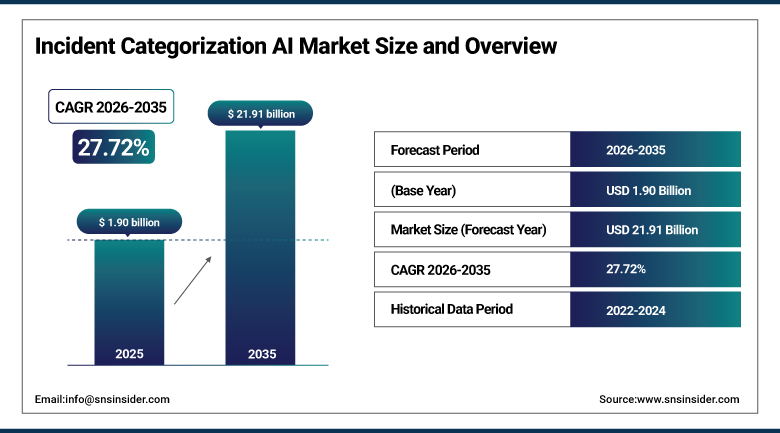
The Incident Categorization AI Market was valued at USD 1.90 Billion in 2025 and is expected to reach USD 21.91 Billion by 2035, growing at a CAGR of 27.72% from 2026–2035.
The growth of the global incident categorization artificial intelligence (AI) market are the increasing number of IT and security incidents, increased adoption of AI-enabled IT service management (ITSM) and AIOps platforms, and increased demand for rapid and accurate incident categorization. As organizations adopt cloud platforms, enterprise applications, connected devices, and digital services, the number of alerts, service tickets, and incidents increases. Manual incident categorization and prioritization may not be efficient and consistent; hence, the demand for AI-enabled solutions that automatically classify, categorize, prioritize, and route incidents arises.
In addition, developments in natural language processing (NLP), machine learning, generative AI, predictive analytics, and automation of workflows are contributing to the growth of the market. With the use of the above technologies, organizations are able to analyze incident descriptions, logs, alerts, and historical incident resolution data in order to classify, define the level of severity, suggest the actions to be taken, and route incidents to the concerned teams. Increased complexity of hybrid and multi-cloud IT environments coupled with increased demand for faster resolution of incidents and reducing MTTRs (mean time to resolution) is fueling the adoption of incident categorization AI solutions.
In March 2026, PagerDuty introduced its Spring 2026 release with AI-powered autonomous operations capabilities, including an SRE Agent designed to detect, triage, and diagnose incidents before escalating them to human responders, while learning from historical incidents to improve future response.
To Get more information Incident Categorization AI Market - Request Free Sample Report
Incident Categorization AI Market Trends
-
Increasing volumes of IT and security incidents are driving AI adoption.
-
Growing demand for faster incident triage and automated prioritization supports market growth.
-
Expanding use of AI across IT operations and cybersecurity strengthens market demand.
-
Rising investments in AIOps, ITSM automation, and intelligent workflow platforms support innovation.
-
Increasing development of generative AI, NLP, and predictive analytics enhances categorization accuracy.
U.S. Incident Categorization AI Market Outlook
The U.S. Incident Categorization AI Market was valued at USD 0.65 Billion in 2025 and is expected to reach around USD 8.57 Billion by 2035, growing at a CAGR of 29.42% from 2026–2035.
Growing utilization of AI-enabled incident management systems is expected to propel the growth of the U.S. incident categorization AI market during the forecast period. As the number and complexity of incidents keep on rising, more and more organizations are resorting to the use of AI-driven solutions for automating the processes of incident categorization, prioritization, routing, and resolution. These solutions find application in various departments like IT operations, cybersecurity, customer support, and enterprise service management in order to speed up incident response and ensure greater efficiency.
Furthermore, the increasing adoption of cloud computing, hybrid IT infrastructure, AIOps, and IT service management software is helping in market expansion in the U.S. Enterprises are increasingly looking for smart tools that can help them understand the nature of incidents based on incident descriptions, logs, alerts, and other relevant data by analyzing the process of resolution. Innovations like natural language processing, machine learning, generative AI, predictive analytics, and automation of workflows are adding to such developments.
In March 2026, ServiceNow expanded its AI capabilities for IT service management by introducing an agentic workflow that automatically categorizes IT incidents, assigns categories, subcategories, services, and configuration items, and links incidents to related major incidents or known problems, supporting faster and more consistent incident triage for U.S. enterprises.
Incident Categorization AI Market Segment Analysis
-
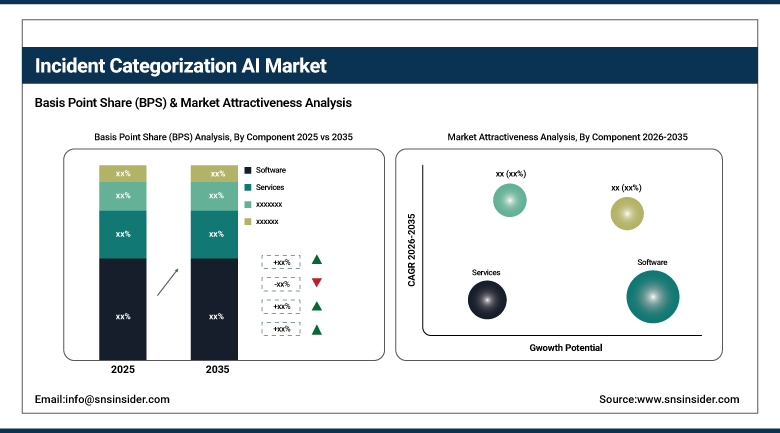
By Component, software dominated the incident categorization AI market with a 68.43% share in 2025, while services are projected to be the fastest-growing segment, registering a 29.25% CAGR during 2026–2035.
-
By Organization Size, large enterprises dominated the incident categorization AI market with a 72.64% share in 2025, while small and medium enterprises are projected to be the fastest-growing segment, registering a 31.25% CAGR during 2026–2035.
-
By Deployment Mode, cloud-based solutions dominated the incident categorization AI market with a 61.28% share in 2025, while cloud-based deployment is projected to be the fastest-growing segment, registering a 29.37% CAGR during 2026–2035.
-
By Application, IT operations dominated the incident categorization AI market with a 34.26% share in 2025, while security operations are projected to be the fastest-growing segment, registering a 30.88% CAGR during 2026–2035.
-
By End User, BFSI dominated the incident categorization AI market with a 28.16% share in 2025, while IT and telecom is projected to be the fastest-growing segment, registering a 33.43% CAGR during 2026–2035.
By Component, software dominated the incident categorization AI market, while services are expected to grow fastest
In 2025, the software segment held the largest market share of 64.50% in the incident categorization AI market, supported by growing demand for automated incident classification, ticket routing, natural language processing, predictive analytics, and workflow automation. Organizations increasingly use AI-based software to process large volumes of incidents, identify recurring patterns, prioritize critical issues, and improve response efficiency. Software solutions can integrate with IT service management, monitoring, security information and event management, and enterprise workflow platforms, allowing organizations to centralize incident data and automate classification processes.
The services segment is expected to witness the fastest growth during the forecast period, driven by increasing demand for implementation, consulting, system integration, training, customization, and managed AI services. Enterprises are increasingly seeking specialized support to integrate AI models with existing operational systems and improve model accuracy.
By Application, IT operations dominated the incident categorization AI market, while security operations are expected to grow fastest
In 2025, IT operations accounted for the largest market share of 32.10% in the incident categorization AI market because IT teams manage high volumes of alerts, service tickets, infrastructure failures, and operational incidents. AI-based incident categorization helps organizations prioritize issues, automate ticket routing, identify recurring problems, and improve response efficiency. The technology also assists IT teams in analyzing historical incident records, recognizing relationships between events, and directing issues to appropriate technical teams.
Security operations are expected to be the fastest-growing application segment during the forecast period, supported by increasing cyberattacks, expanding security alert volumes, growing adoption of security operations centers, and rising demand for automated threat detection and incident prioritization. AI-based categorization can help security teams reduce alert fatigue and focus resources on high-priority incidents.
By End User, BFSI dominated the incident categorization AI market, while IT and telecom are expected to grow fastest
BFSI held the largest share of the incident categorization AI market in 2025, accounting for 27.30%, driven by the sector's reliance on secure digital services, high transaction volumes, strict regulatory requirements, and continuous operations. Financial institutions increasingly use AI-based incident categorization to manage service disruptions, cybersecurity events, fraud-related alerts, and technology incidents more efficiently. The technology enables financial organizations to classify incidents according to severity, business impact, and operational risk, helping reduce response delays and maintain service continuity.
IT and telecom are expected to be the fastest-growing end-user segment during the forecast period, supported by rapid digitalization, expanding cloud infrastructure, increasing network complexity, and rising volumes of IT and telecommunications incidents. Telecom operators and technology companies are increasingly adopting automated incident management to improve network reliability, reduce service interruptions, and support increasingly complex digital environments.
Regional Insights
|
Region |
Major Country |
Share within Region, 2025(%) |
|---|---|---|
|
North America |
United States |
82.64% |
|
Europe |
Germany |
27.63% |
|
Asia Pacific |
China |
45.18% |
|
Middle East & Africa |
Saudi Arabia |
31.42% |
|
Latin America |
Brazil |
44.76% |
North America Incident Categorization AI Market Insights
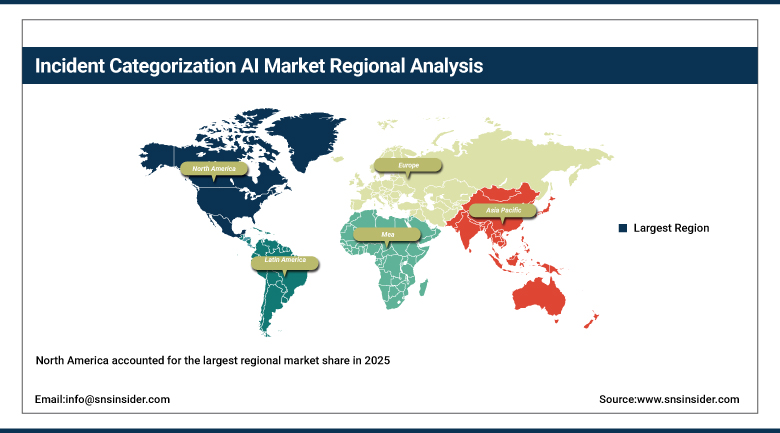
North America accounted for the largest regional market share of around 41.45% in 2025, owing to the increasing implementation of AI in IT operations, cybersecurity, customer support, and enterprise service management. Enterprises in the region are relying on AI-based solutions for automated categorization of incidents, prioritization of alerts, improved ticketing and reduced response time.
In 2025, the United States accounted for the largest market share within North America. This is attributed to the advanced digital infrastructure of the US, presence of several tech companies, high cloud adoption rate, and increased investments in AIOps and cybersecurity automation. Increasing number of incidents and alerts in the hybrid cloud, connected system, and digital services environments is creating further growth opportunities for the incident categorization AI market in North America.
Get Customized Report as per Your Business Requirement - Enquiry Now
Europe Incident Categorization AI Market Insights
The incident classification AI for Europe market is predicted to grow at a consistent pace due to the increasing use of automation in IT services, cybersecurity, and customer care using AI solutions. Enterprises are becoming more interested in efficient incident response, eliminating manual ticket classifications, and operational resilience as the digital landscape grows more complicated.
Increased adoption of cloud computing platforms, strict data protection regulations, and a rising number of cybersecurity incidents are some of the factors driving businesses to deploy smart incident classification and prioritization solutions. Germany led the Europe market in 2025 owing to its technological and industrial advancements and strong enterprise IT infrastructure and increased usage of automation and AI.
Asia Pacific Incident Categorization AI Market Insights
According to projections, the Asia Pacific region would witness the highest growth rate in the incident categorization AI market over the forecasted period owing to fast digital transformation, cloud computing infrastructure, cyber threats, and the growing use of AI-based IT operations. Countries such as China, Japan, South Korea, and India have invested heavily in artificial intelligence, cloud computing, enterprise software, and digital infrastructure.
As a result, there has been an increasing need for automation of classification, prioritization, and routing of alerts, security events, and other IT service requests. China had the biggest market share within the Asia Pacific region in 2025 because of its rich digital ecosystem, large technology sector, cloud infrastructure expansion, and investments in AI and enterprise automation.
Middle East & Africa and Latin America Incident Categorization AI Market Insights
There is consistent growth within the market for AI-based categorization of incidents in the Middle East & Africa due to increasing investments in areas such as digital transformation, cloud computing, cybersecurity, and IT services management. There has been an increase in the use of digital services in the government, finance technology, telecom, and enterprise segments, thereby causing an increase in the number of incidents and alerts that need classification and prioritization. The largest market share for incident categorization in AI in the Middle East & Africa in 2025 was attributed to Saudi Arabia due to investments made in digital transformation, cloud computing, cybersecurity, and technology in general.
The AI market of incident classification in Latin America is also experiencing a rising demand owing to increased spending on digital infrastructure, cloud computing, cybersecurity, and enterprise automation. Organizations in Latin America are leveraging the benefits of artificial intelligence tools to improve IT service management processes, automate the process of incident routing, and increase their operational efficiencies. The growth in digital banking, telecommunication, e-commerce, and cloud-enabled business application processes is creating more incidents and security alerts. Brazil was the leading market share holder of the AI market of incident classification in Latin America in 2025, owing to its large ecosystem of technology and its rapidly growing digital economy.
Growth Driver: Rising adoption of sodium-ion batteries for energy storage driving the incident categorization AI market growth
The other prominent growth drivers for the market include the rising adoption of AI technologies for incident categorization through IT operations, cybersecurity, customer support, and risk management. Enterprises have started producing huge numbers of incidents including service tickets, system alerts, security incidents, and operation incidents due to the growth in cloud platforms, enterprise software, internet of things, and digital services. The incident categorization AI solutions allow organizations to automatically categorize, prioritize, and route incidents based on their type, severity, and business impacts. The rise in AIOps, IT service management automation, and AI-powered cybersecurity is helping drive market growth. Moreover, the emphasis on mean time to resolution, operational efficiency, and availability of services has been increasing among enterprises.
Restraints: Data quality and integration challenges may restrict incident categorization AI market growth
However, due to the poor quality of data and its fragmented nature, the application of artificial intelligence in categorizing incidents may have certain limitations and issues. Indeed, the records of incidents are often created on different IT service management, monitoring, cybersecurity, and customer support systems, which makes the integration of data difficult and sometimes even impossible. Besides, the poor quality of training data, inconsistency in the labeling of incidents, and the lack of historical data may influence the performance of models and their efficiency in classifying incidents. Moreover, integration with an existing infrastructure and enterprise workflow requires many resources and adjustments. Another factor that is worth considering is the privacy of data that may be necessary for AI model training.
Opportunities: Growing deployment of generative AI and AIOps creating new growth opportunities
There are considerable prospects arising in the incident categorization AI market owing to the rising incorporation of generative AI, machine learning, NLP, and AIOps in the process of incident management. Through generative AI, unstructured incident descriptions can be analyzed, the events can be summarized, possible causes of the problem can be identified, and proper responses can be suggested, providing the grounds for creating better categorization algorithms. In addition to that, the growing number of incidents related to cloud-native applications, hybrid IT infrastructure, cybersecurity operations, and digital customer service lines is opening more prospects for the implementation of automatic classification and prioritization. Moreover, the creation of multi-platform incident intelligence, real-time incident correlation, predictive incident management, and AI-driven workflow automation may broaden the adoption of incident categorization AI.
Recent Developments
-
2026: ServiceNow expanded AI-driven incident management capabilities, strengthening automated incident classification, prioritization, routing, and resolution workflows across enterprise IT service environments.
-
2026: IBM advanced AI-powered IT operations solutions, supporting automated incident analysis, classification, correlation, and response across complex enterprise technology environments.
-
2026: Atlassian enhanced AI capabilities across Jira Service Management, enabling more intelligent incident triage, categorization, summarization, and workflow automation.
-
2026: PagerDuty advanced AI-powered operations capabilities, helping organizations automate incident detection, prioritization, response, and resolution across critical digital services.
-
2026: Freshworks continued expanding AI-powered service management capabilities, supporting automated ticket classification, routing, prioritization, and resolution for enterprise support teams.
Incident Categorization AI Market Key Players are:
-
ServiceNow
-
IBM Corporation
-
Atlassian Corporation Plc
-
PagerDuty Inc.
-
Freshworks Inc.
-
BMC Software, Inc.
-
Ivanti Inc.
-
HCL Technologies Limited
-
Broadcom Inc.
-
Splunk Inc.
-
Datadog Inc.
-
Dynatrace Inc.
-
Elastic N.V.
-
New Relic, Inc.
-
BigPanda, Inc.
-
Aisera Inc.
-
Moveworks Inc.
-
Resolve AI
Incident Categorization AI Market Report Scope:
| Report Attributes | Details |
|---|---|
| Market Size in 2025 | USD 1.90 Billion |
| Market Size by 2035 | USD 21.91 Billion |
| CAGR | CAGR of 27.72% From 2026 to 2035 |
| Base Year | 2025 |
| Forecast Period | 2026-2035 |
| Historical Data | 2022-2024 |
| Report Scope & Coverage | Market Size, Segments Analysis, Competitive Landscape, Regional Analysis, DROC & SWOT Analysis, Forecast Outlook |
| Key Segments | • By Component (Software, Services) • By Organization Size (Large Enterprises, Small and Medium Enterprises) • By Deployment Mode (Cloud-based, On-Premises) • By Application (IT Operations, Security Operations, Customer Support, Risk Management, Other Applications) • By End User (BFSI, Healthcare, IT and Telecom, Government, Retail, Manufacturing, Other End Users) |
| Regional Analysis/Coverage | North America (US, Canada), Europe (Germany, UK, France, Italy, Spain, Russia, Poland, Rest of Europe), Asia Pacific (China, India, Japan, South Korea, Australia, ASEAN Countries, Rest of Asia Pacific), Middle East & Africa (UAE, Saudi Arabia, Qatar, South Africa, Rest of Middle East & Africa), Latin America (Brazil, Argentina, Mexico, Colombia, Rest of Latin America) |
| Company Profiles | ServiceNow, IBM Corporation, Atlassian Corporation Plc, PagerDuty Inc., Freshworks Inc., BMC Software, Inc., Ivanti Inc., HCL Technologies Limited, SolarWinds Corporation, Broadcom Inc., Splunk Inc., Datadog Inc., Dynatrace Inc., Elastic N.V., New Relic, Inc., ScienceLogic, Inc., BigPanda, Inc., Aisera Inc., Moveworks Inc., Resolve AI |
Frequently Asked Questions
The incident categorization AI market was valued at USD 1.90 billion in 2025.
The market is driven by the increasing adoption of AI-powered incident classification across IT operations, cybersecurity, customer support, and enterprise service management, along with rising incident volumes and growing demand for faster automated incident prioritization.
Software dominated the incident categorization AI market in 2025 with a 68.42% share.
North America dominated the incident categorization AI market in 2025 with a 45.92% share.
