
AI Voice Rights Management Market Report Scope & Overview:
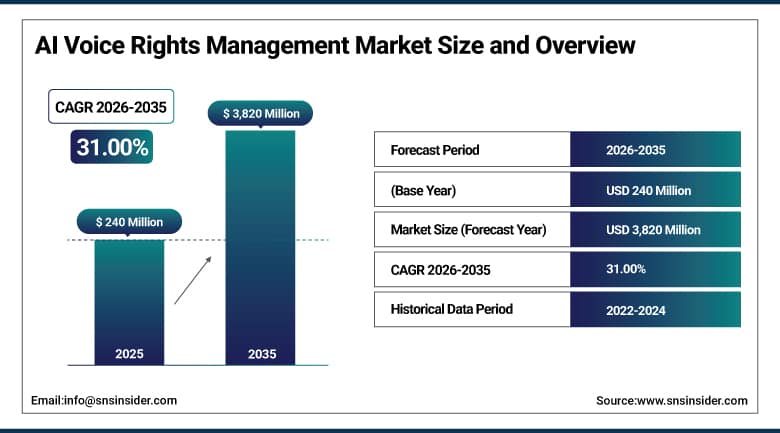
The AI Voice Rights Management Market was valued at USD 240 Million in 2025 and is expected to reach USD 3,820 Million by 2035, growing at a CAGR of 31.00% from 2026 to 2035.
The AI Voice Rights Management Market Growth will be driven by the increasing commercial deployment of voice generation technologies in industries like entertainment, advertising, gaming, online education, and customer service applications, along with increasing regulation that mandates proof of consent, usage tracking, and royalties where a person’s voice has been digitally synthesized. Studios, broadcasters, talent agencies, and enterprise brands are shifting from multiple individual voice licensing agreements to a platform that can gather consent, issue usage-based license, distribute royalties, and identify any use of the voice clone through streaming, social media, and broadcast media channels.
ElevenLabs launched its Iconic Voices marketplace in 2026, enabling verified voice actors, celebrities, and public figures to license revocable, royalty-tracked AI voice clones directly to enterprise customers, reflecting accelerating industry demand for consent-based synthetic voice licensing infrastructure across the media and advertising sectors.
To Get More Information On AI Voice Rights Management Market - Request Free Sample Report
AI Voice Rights Management Market Trends:
-
Rising deployment of consent-based voice-licensing marketplaces is enabling talent to monetize AI-cloned voices directly.
-
Growing enterprise adoption of real-time deepfake voice detection is expanding demand for authentication-integrated rights platforms.
-
Increasing state and federal right-of-publicity legislation is accelerating mandatory consent and provenance tracking for synthetic voices.
-
Expanding use of blockchain-based usage ledgers is improving transparency in royalty distribution for licensed voice models.
-
Growing integration of voice-rights APIs into gaming and localization workflows is broadening enterprise-wide adoption.
U.S. AI Voice Rights Management Market Outlook:
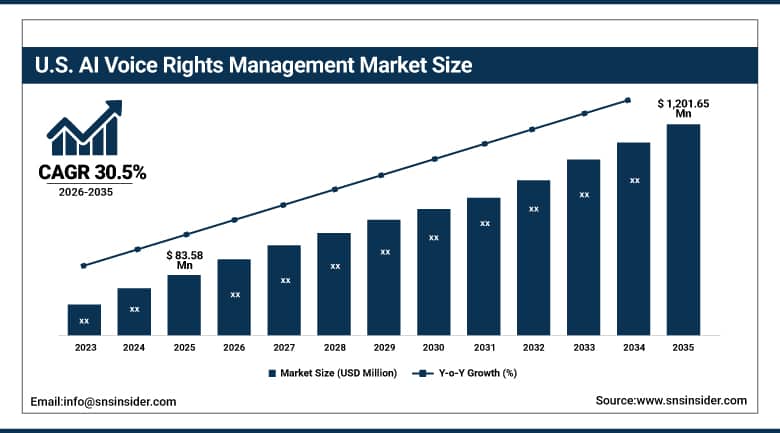
The U.S. AI Voice Rights Management Market was valued at approximately USD 83.58 Million in 2025 and is projected to reach approximately USD 1,201.65 Million by 2035, registering a CAGR of approximately 30.5% from 2026 to 2035.
Domestic adoption is being driven by Hollywood studios, national broadcasters, and advertising networks that require legally defensible consent trails before deploying an actor's or narrator's cloned voice across dubbing, marketing and interactive-media projects. The presence of SAG-AFTRA's AI-use provisions, growing state-level right-of-publicity statutes, and a concentration of leading voice-AI vendors headquartered domestically is reinforcing demand for integrated licensing, royalty and authentication tooling. Rising instances of voice-based fraud targeting call centers and financial institutions are further pushing enterprises toward platforms combining rights management with deepfake detection capability.
Pindrop expanded its Pindrop Pulse deepfake-detection engine across major U.S. call-center networks in 2026, enabling real-time voice authentication for banks and insurers seeking to curb synthetic-voice fraud while maintaining auditable consent records for legitimate voice-AI deployments.
AI Voice Rights Management Market Segment Analysis:
-
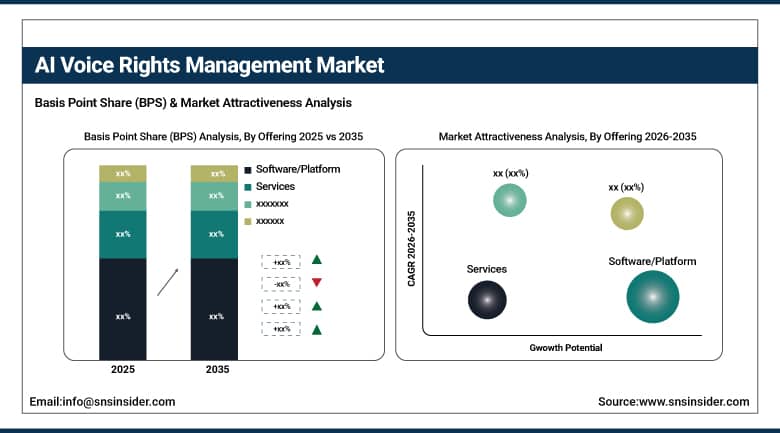
By Offering, Software/Platform dominated the AI Voice Rights Management Market with a 64.50% share in 2025, while Services is the fastest-growing offering segment with a CAGR of 27.80% from 2026–2035.
-
By Deployment Mode, Cloud dominated the AI Voice Rights Management Market with a 71.20% share in 2025, while On-Premise is the fastest-growing deployment segment with a CAGR of 26.40% from 2026–2035.
-
By Application, Voice Licensing & Rights Clearance dominated the AI Voice Rights Management Market with a 36.80% share in 2025, while Deepfake Detection & Content Authentication is the fastest-growing application segment with a CAGR of 29.60% from 2026–2035.
-
By End User, Media & Entertainment dominated the AI Voice Rights Management Market with a 41.50% share in 2025, while BFSI & Enterprise Call Centers is the fastest-growing end-user segment with a CAGR of 29.20% from 2026–2035.
By Offering, Software/Platform leads while Services grows fastest.
The Software/Platform segment held the leading 64.50% revenue share in 2025, driven by end-to-end solutions that provide for consent capturing, license management process, royalty tracking, and unauthorized-use detection in one system of record. End-to-end solutions are especially popular among media groups, talent agencies, and major advertisers because they allow bypassing the process of reconciliation of voice usage data from various contract-management, payments, and content monitoring systems, as well as providing right owners with a single interface for monitoring every license usage of a cloned voice by partners and through different channels of distribution to significantly lower their risk of legal issues related to the unauthorized or expired voice licenses.
The Services segment is projected to expand at the fastest CAGR of 27.80% during 2026–2035, as increasing number of studios, brands, and mid-market players in the voice-AI technology space turn to outsourcing consent verification, contract management, and compliance audit to specialized companies. The increase in complexity of regulatory landscape both within U.S. states and globally is pushing businesses with limited legal or technical capabilities to engage in advisory and managed-service engagements to implement a compliant voice cloning and licensing program.
By Deployment Mode, Cloud dominates while On-Premise expands fastest.
Cloud deployment accounted for the largest 71.20% share of the AI Voice Rights Management Market in 2025, supported by the scalability, lower upfront cost and rapid integration cloud platforms offer to advertising agencies, gaming studios, and broadcasters managing large and geographically distributed voice-licensing portfolios. Cloud-hosted rights platforms also allow real-time synchronization of consent status and royalty calculations across multiple production teams and external partners, which is increasingly essential as voice-cloning projects span multiple territories, languages and distribution channels simultaneously.
On-Premise deployment is expected to register the fastest CAGR of 26.40% during the forecast period as major studios, financial institutions and government-linked broadcasters that handle highly sensitive biometric voice data increasingly prefer infrastructure under direct organizational control. Concerns over cross-border data-residency rules, biometric-privacy statutes such as Illinois' BIPA and the reputational risk associated with a breach of proprietary voice models are pushing select high-value rights holders toward hybrid or fully on-premise architectures despite the added implementation and maintenance overhead.
By Application, Voice Licensing & Rights Clearance leads while Deepfake Detection grows fastest.
Voice Licensing & Rights Clearance represented the leading application category with a 36.80% share in 2025, reflecting the foundational role this function plays across virtually every organization deploying synthetic voice commercially. Talent agencies, dubbing studios, and voice-AI vendors rely on rights-clearance tooling to formalize usage-scoped, time-bound and revenue-share licenses before a cloned voice can be legally deployed in advertising, gaming, or audiobook production, making this application category the entry point through which most enterprises first adopt AI voice rights infrastructure.
Deepfake Detection & Content Authentication is projected to grow at the fastest CAGR of 29.60% through 2035, driven by escalating incidents of unauthorized voice cloning used in financial fraud, political disinformation, and celebrity impersonation scams. Enterprises across banking, media and public-sector communications are rapidly integrating real-time authentication capability alongside licensing tools to verify whether an audio clip originates from a consented, registered voice model or an unauthorized clone, positioning this application as the fastest-scaling component of the broader voice-rights technology stack.
By End User, Media & Entertainment leads while BFSI & Call Centers grow fastest.
Media & Entertainment was the leading end-user category, contributing a 41.50% revenue share in 2025, owing to the usage of AI-cloned voices for dubbing, archiving, voice characterizations, and posthumous/de-aged voice performance in film studios, streaming services and broadcasting networks. The extensive use of unionized voice talent and high-value intellectual properties by this industry makes licensing and rights management almost mandatory instead of an additional compliance tool.
BFSI & Enterprise Call Centers are expected to post the fastest CAGR of 29.20% between 2026 and 2035, financial companies and enterprises operating customer service call centers will face a steep increase in fraud attempts using voice cloning technology to attack telephone-based authentication systems. The rapid expansion of voice biometrics solutions for account verification purposes is increasing their vulnerability to synthetic voices, prompting financial and telecom companies to implement integrated licensing and authentication platforms.
Regional Insights:
|
Region |
Major Country |
Share within Region, 2025 (%) |
|---|---|---|
|
North America |
United States |
87.50% |
|
Europe |
United Kingdom |
24.50% |
|
Asia Pacific |
China |
33.20% |
|
Middle East & Africa |
UAE |
26.40% |
|
Latin America |
Brazil |
35.60% |
North America AI Voice Rights Management Market Insights
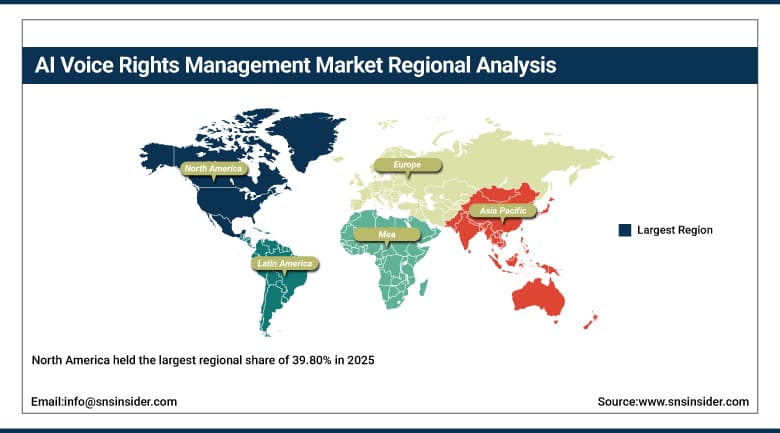
North America held the largest regional share of 39.80% in 2025, underpinned by the region's dense concentration of major studios, streaming platforms, voice-AI vendors and talent unions actively negotiating AI-voice-use terms. A rapidly evolving legal landscape, including the ELVIS Act in Tennessee, proposed federal NO FAKES Act protections, and state-level biometric-privacy statutes, is compelling both technology providers and rights holders to formalize consent, licensing and audit trails well ahead of most other regions. The region's mature advertising and gaming industries are further reinforcing sustained demand for royalty-tracking and authentication infrastructure across commercial voice-AI deployments.
The United States led the North America AI Voice Rights Management Market in 2025 with an 87.50% share of the regional market, driven by the presence of prominent voice AI solution providers, media entertainment companies, and financial institutions that are fighting against voice synthesis attacks. The expansion of Canada’s visual effects and dubbing production ecosystem, along with the increased use of voice authentication technologies by local banks and telecommunication companies, is aiding the region’s growth.
Get Customized Report as Per Your Business Requirement - Enquiry Now
Europe AI Voice Rights Management Market Insights
Europe represented a significant share of the AI Voice Rights Management Market in 2025 and is expected to register steady growth through the forecast period, propelled by the EU AI Act's transparency and labeling obligations for synthetic media, which require organizations deploying AI-generated voice content to maintain documented provenance and consent records. The region's strong public-broadcasting sector and well-established collective-rights-management tradition in music and audio content are translating into rapid institutional adoption of comparable frameworks for AI-cloned voice assets across member states.
The United Kingdom is one of the leading markets in Europe, supported by its large dubbing, gaming, and advertising production base alongside a concentration of voice-AI and rights-technology start-ups. Germany, France, and the Nordic countries are also contributing to regional growth through active enforcement of performer-consent requirements and growing investment in domestic content-authentication and provenance-verification infrastructure among public broadcasters and streaming platforms.
Asia Pacific AI Voice Rights Management Market Insights
Asia Pacific is projected to register the fastest regional CAGR of 27.60% during 2026–2035, driven by the region's massive gaming, anime dubbing, and e-learning content industries that increasingly rely on AI-cloned voices for multilingual localization at scale. Rapidly growing voice-AI investment across China, Japan, South Korea, and India, combined with rising government attention to deepfake-related fraud and disinformation, is accelerating enterprise adoption of consent-tracking and authentication platforms across both public and private sector applications.
China is a primary growth driver within the Asia Pacific AI Voice Rights Management Market, supported by its large domestic streaming, gaming and advertising industries alongside expanding regulatory requirements around synthetic-content labeling. Japan's deeply established voice-actor (seiyuu) culture is fueling strong demand for consent-based licensing tools, while India is emerging as a key growth market on the back of its large dubbing and outsourced content-localization industry serving global media clients.
Middle East & Africa and Latin America AI Voice Rights Management Market Insights
Middle East & Africa and Latin America are gradually scaling adoption of AI voice rights management solutions as regional media production, advertising, and banking sectors increase investment in synthetic-voice technology and fraud-prevention infrastructure. Growing government interest in AI governance frameworks across both regions is beginning to translate into early-stage compliance requirements for organizations deploying AI-generated voice content commercially.
As an influential market within the Middle East region, the UAE is being shaped by the government-sponsored AI initiatives and media and advertising production center in Dubai. Brazil is set to lead Latin America, driven by its large telenovela and dubbing industry alongside rising deployment of voice-biometric authentication among domestic banks seeking to counter synthetic-voice fraud targeting call-center and mobile-banking channels.
Growth Drivers: Regulatory pressure and rising deepfake fraud accelerating adoption of consent-based voice rights infrastructure
The single largest driver of the AI Voice Rights Management Market is the rapid tightening of legal frameworks governing the use of a person's voice in AI-generated content. Legislation such as Tennessee's ELVIS Act, the proposed federal NO FAKES Act, and the EU AI Act's synthetic-media transparency provisions is compelling studios, advertisers and voice-AI vendors to formalize consent capture, licensing terms, and royalty distribution rather than relying on informal or verbal agreements with voice talent. Rising commercial adoption of voice cloning across dubbing, gaming, advertising and customer-service applications is simultaneously expanding the volume of licensed voice assets that organizations must track, creating sustained demand for centralized management platforms.
Escalating incidents of voice-cloning-enabled fraud, including impersonation scams targeting bank call centers and high-profile disinformation campaigns using cloned political and celebrity voices, are further pushing enterprises to pair rights-management tooling with real-time authentication capability. Growing collaboration between voice-AI vendors, talent unions such as SAG-AFTRA and collective-licensing organizations is also standardizing consent and royalty frameworks, lowering the operational barrier for smaller studios and content platforms to adopt compliant voice-cloning workflows and further broadening the addressable market.
Restraints: Fragmented global regulation and integration complexity limiting near-term adoption
One major constraint faced by the AI Voice Rights Management Market is the fragmented and emerging landscape of voice-likeness regulations around the world that necessitates vendors to create jurisdiction-based compliance mechanisms instead of a universal solution. Regulatory inconsistency complicates the process and costs of implementing a rights-management system for international media production houses and advertising platforms that need to cater to tens of countries with varying consent and royalty requirements.
Moreover, rights management solutions need to be integrated with the existing content creation and payment processes of large production and broadcasting houses and often require extensive customization efforts, thus delaying their implementation. Small voice-AI vendors and independent content creators do not have the financial and legal means to implement a complete consent and royalty-tracking system and hence, restrict the market’s reach among them in the near future.
Opportunities: Expansion into gaming localization and blockchain-based royalty verification creating new growth avenues
Significant growth opportunity exists in extending voice-rights infrastructure into gaming localization, where studios increasingly deploy AI-cloned voices across dozens of languages for non-player characters and require scalable systems to manage consent and royalties for large voice-actor rosters. The rapid growth of interactive and immersive media, including virtual reality and AI-driven digital companions, is expected to further expand demand for platforms capable of managing high-volume, multi-language voice-licensing portfolios.
The advent of blockchain-based usage ledgers offers yet another avenue of increasing trust and transparency in the allocation of royalties to voice talent by helping them independently track where and how often their cloned voice has been used and ensuring that they have been paid fairly. The increased interest in licensing and authentication solutions for enterprises, especially within banking and governmental communications channels, should offer plenty of cross-selling prospects for companies that can provide both.
Recent Developments:
-
2025: Respeecher partnered with a major Hollywood studio to deploy consent-verified voice conversion for dubbing and archival restoration projects, embedding usage logs into each licensed voice model to support post-production rights audits.
-
2025: Pindrop introduced Pindrop Pulse, a real-time deepfake voice detection engine designed to flag AI-cloned audio during live call-center interactions, targeting fraud-prevention use cases across banking and insurance.
-
2026: ElevenLabs launched its Iconic Voices marketplace, enabling verified voice actors and public figures to license revocable, royalty-tracked AI voice clones directly to enterprise customers.
-
2026: Veritone expanded its MARVEL.ai platform with an automated royalty-distribution ledger that settles payments to voice talent within 48 hours of licensed usage, reducing settlement delays for media and advertising clients.
-
2026: Reality Defender rolled out its Voice Provenance API, allowing broadcasters and digital publishers to authenticate the origin of an audio clip in real time prior to distribution.
-
2026: Vermillio launched TraceID for Voice, a rights-registration and detection tool that scans streaming platforms and social media for unauthorized use of a talent's cloned voice.
AI Voice Rights Management Market Key Players:
-
ElevenLabs, Inc.
-
Veritone, Inc.
-
Resemble AI, Inc.
-
Respeecher, Inc.
-
Modulate, Inc.
-
Pindrop Security, Inc.
-
Nuance Communications, Inc. (Microsoft)
-
SoundHound AI, Inc.
-
Voices.com Inc.
-
Speechify, Inc.
-
Synthesia Ltd.
-
Descript, Inc.
-
LOVO Inc.
-
PlayAI, Inc.
-
Vermillio, Inc.
-
Loti AI, Inc.
-
Reality Defender, Inc.
-
Audible Magic Corporation
-
Podcastle, Inc.
-
Voice-Swap Ltd.
AI Voice Rights Management Market Report Scope:
| Report Attributes | Details |
|---|---|
| Market Size in 2025 | USD 240 Million |
| Market Size by 2035 | USD 3,820 Million |
| CAGR | CAGR of 31.00% From 2026 to 2035 |
| Base Year | 2025 |
| Forecast Period | 2026-2035 |
| Historical Data | 2022-2024 |
| Report Scope & Coverage | Market Size, Segments Analysis, Competitive Landscape, Regional Analysis, DROC & SWOT Analysis, Forecast Outlook |
| Key Segments | • By Offering (Software/Platform, Services) • By Deployment Mode (Cloud, On-Premise) • By Application (Voice Licensing & Rights Clearance, Royalty & Revenue Management, Consent & Identity Verification, Deepfake Detection & Content Authentication) • By End User (Media & Entertainment, Advertising & Marketing, Gaming, BFSI & Enterprise Call Centers, Others) |
| Regional Analysis/Coverage | North America (US, Canada), Europe (Germany, UK, France, Italy, Spain, Russia, Poland, Rest of Europe), Asia Pacific (China, India, Japan, South Korea, Australia, ASEAN Countries, Rest of Asia Pacific), Middle East & Africa (UAE, Saudi Arabia, Qatar, South Africa, Rest of Middle East & Africa), Latin America (Brazil, Argentina, Mexico, Colombia, Rest of Latin America). |
| Company Profiles | ElevenLabs, Inc., Veritone, Inc., Resemble AI, Inc., Respeecher, Inc., Modulate, Inc., Pindrop Security, Inc., Nuance Communications, Inc. (Microsoft), SoundHound AI, Inc., Voices.com Inc., Speechify, Inc., Synthesia Ltd., Descript, Inc., LOVO Inc., PlayAI, Inc., Vermillio, Inc., Loti AI, Inc., Reality Defender, Inc., Audible Magic Corporation, Podcastle, Inc., Voice-Swap Ltd. |

Frequently Asked Questions
Key players in the AI Voice Rights Management Market include ElevenLabs, Inc., Veritone, Inc., Resemble AI, Inc., Respeecher, Inc., Modulate, Inc., Pindrop Security, Inc., Nuance Communications, Inc. (Microsoft), SoundHound AI, Inc., among others.
Key opportunities in the AI voice rights management market include expansion into gaming localization and interactive/immersive media, blockchain-based royalty verification for transparent compensation, and growing demand for combined licensing-plus-authentication platforms across banking and public-sector communications.
The market is driven by tightening legal frameworks (ELVIS Act, NO FAKES Act, EU AI Act) mandating documented consent and royalty tracking, alongside escalating deepfake fraud and rising commercial adoption of voice cloning across dubbing, gaming, advertising, and customer-service applications.
The Voice Licensing & Rights Clearance segment dominated the AI Voice Rights Management Market, accounting for approximately 36.80% market share in 2025.
The North America region dominated the AI Voice Rights Management Market in 2025 with a 39.80% share, driven by a dense concentration of major studios, streaming platforms, voice-AI vendors, talent unions, and a rapidly evolving legal landscape including the ELVIS Act and proposed federal NO FAKES Act protections.
