
Aluminum Foil Packaging Market Report Scope & Overview:
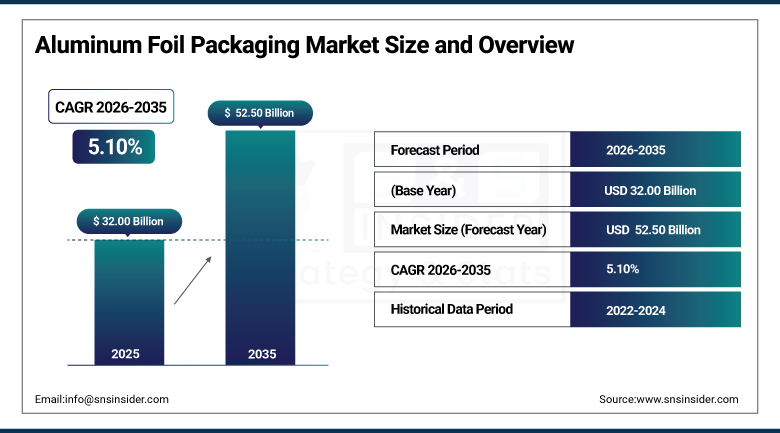
The Aluminum Foil Packaging Market was valued at USD 32.00 Billion in 2025 and is expected to reach USD 52.50 Billion by 2035, growing at a CAGR of 5.10% from 2026–2035.
Aluminum foil packaging covers everything from the roll of household foil in a kitchen drawer to the blister pack a pharmacist pops a tablet out of, all built around the same fundamental property: aluminum forms a complete barrier against moisture, light, oxygen, and bacteria that few other materials can match at comparable cost and weight. That protection is why food, beverage, and pharmaceutical manufacturers keep specifying foil even as sustainability pressure pushes other packaging categories toward alternative materials, since foil's near-total barrier performance directly translates into longer shelf life and fewer product recalls. The industry's real tension right now is stretching that protective performance across ever-thinner gauges to cut material cost and weight without opening any gaps a contaminant could slip through.
Amcor introduced a new high-barrier, ultra-lightweight aluminum foil solution in May 2025 specifically targeting the dairy and baby food sectors, categories where product safety margins leave essentially no room for a packaging failure. Getting foil thinner without sacrificing barrier performance is a genuinely difficult materials-science problem, since aluminum foil's whole reason for existing is blocking moisture, light, and oxygen completely, and every micron removed to cut cost or weight is a micron less protection standing between a product and spoilage.
To Get more information On Aluminum Foil Packaging Market - Request Free Sample Report
Aluminum Foil Packaging Market Trends
-
Recyclable, mono-material aluminum foil laminates continue displacing multi-layer plastic-foil composites, as manufacturers respond to tightening packaging waste regulation without sacrificing barrier performance.
-
Recycled aluminum content continues expanding across food and beverage packaging, with major rolling mills partnering directly with brand owners to deliver foil made from up to 100% post-consumer recycled material.
-
Ultra-thin gauge foil development continues advancing for household, food wrap, and pharmaceutical blister applications, balancing material cost reduction against the barrier performance these categories require.
-
Rising retail-ready meal offerings in supermarkets and hypermarkets continue driving demand for aluminum container foils that can move directly from freezer to oven or microwave without repackaging.
-
Pharmaceutical-grade foil capacity continues expanding across multiple regions, as manufacturers invest in dedicated production lines meeting the stricter purity and traceability standards drug packaging requires.
U.S. Aluminum Foil Packaging Market Outlook
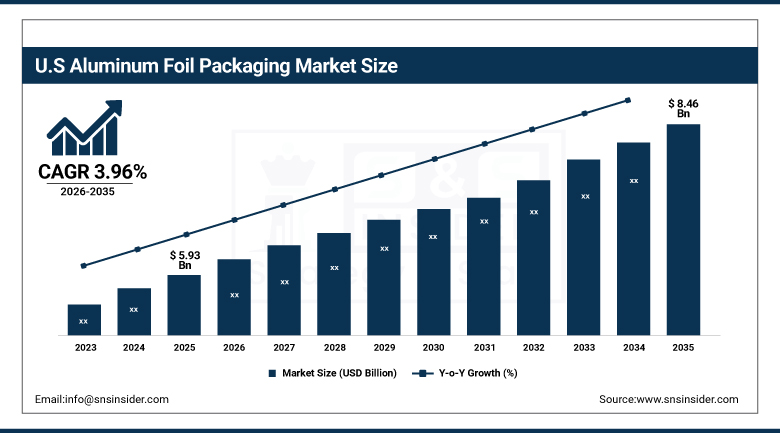
The U.S. Aluminum Foil Packaging Market was valued at approximately USD 5.93 Billion in 2025 and is expected to reach approximately USD 8.46 Billion by 2035, growing at a CAGR of approximately 3.96%.
Demand in the United States is anchored by a large, mature food and beverage industry alongside a substantial pharmaceutical manufacturing base that both depend heavily on foil's superior barrier properties against moisture, light, and oxygen. Deep-rooted consumer familiarity with household aluminum foil, reinforced by decades of brand recognition, continues supporting steady retail demand even as packaging-grade foil producers face growing competition from European and Asian rolling mills on cost and lead time. Domestic manufacturers continue investing in recycled-content capacity to meet both regulatory pressure and brand owner sustainability commitments across food, beverage, and pharmaceutical packaging categories.
Reynolds Consumer Products, the Lake Forest, Illinois-based company behind the Reynolds Wrap household aluminum foil brand familiar in American kitchens for generations, remains one of the few U.S.-headquartered names competing in a market otherwise dominated by European producers like Amcor and Constantia Flexibles and Asian rolling mills serving cost-focused regional buyers. That domestic brand recognition gives Reynolds genuine retail shelf advantages in the U.S. consumer segment that newer or purely industrial-focused competitors can't easily replicate, even as the broader packaging-grade foil market remains more globally fragmented.
Aluminum Foil Packaging Market Segment Analysis
-
By Product Type, the Rigid Aluminum Foil Containers segment dominated the Aluminum Foil Packaging Market with approximately 54.00% share in 2025, while the Blister Packs segment is the fastest growing with a CAGR of approximately 7.40%.
-
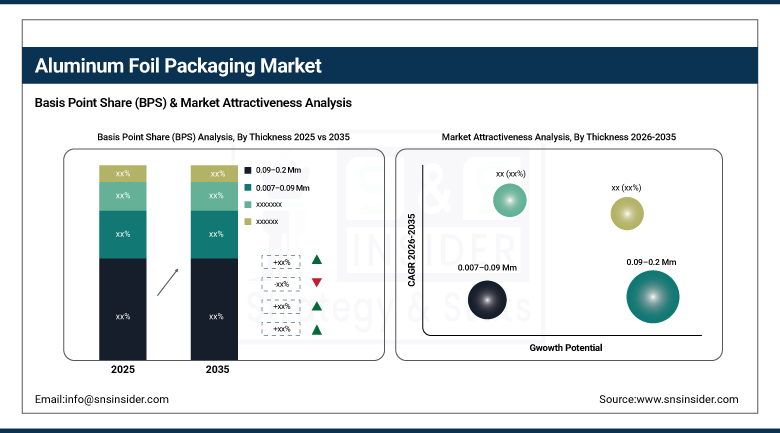
By Thickness, the 0.09–0.2 mm segment dominated the Aluminum Foil Packaging Market with approximately 58.00% share in 2025, while the 0.007–0.09 mm segment is the fastest growing with a CAGR of approximately 7.20%.
-
By End-Use Industry, the Food & Beverage segment dominated the Aluminum Foil Packaging Market with approximately 64.00% share in 2025, while the Personal Care & Cosmetics segment is the fastest growing with a CAGR of approximately 7.60%.
-
By Distribution Channel, the Direct Sales segment dominated the Aluminum Foil Packaging Market with approximately 70.40% share in 2025, while the Distributors/Retail segment is the fastest growing with a CAGR of approximately 6.20%.
By Product Type, rigid aluminum foil containers dominates, blister packs grows fastest
Rigid containers accounted for the largest portion in the product type segment in 2025 due to the fact that they were extensively preferred in the ready-to-eat/pre-cooked meals packaging application as a result of their ability to be heated directly from the freezer to an oven or microwave without suffering deformation or leakage as a result of extreme temperatures. The above characteristics have made rigid containers the predominant form of containers in the retail-ready meals packaging applications as lifestyles of consumers become more hectic.
The blister pack is growing at the fastest rate due to the continuous growth of the pharmaceuticals industry which is fueling the demand for tamper-proof and moisture resistant unit dose containers that offer protection to drugs in terms of distribution and storage. Increasing demand for the traceability of drugs and safety of patients coupled with increased capacity of the pharmaceutical industry is making the blister pack grow above average.
By Thickness, 0.09–0.2 mm dominates, 0.007–0.09 mm grows fastest
Foil in the 0.09 to 0.2 millimeter thickness range held the largest share of the thickness segment in 2025, striking the balance between adequate barrier protection and material efficiency that most standard food container and pharmaceutical packaging applications require. That middle-thickness range remains the practical default across the majority of aluminum foil packaging production, since it delivers reliable protection without the added material cost thicker gauges carry unnecessarily for most standard packaging needs.
Thinner foil in the 0.007 to 0.09 millimeter range is growing fastest as it provides the ideal ratio of strength to flexibility for household foil applications, food wraps, and pharmaceutical blister packs manufactured at large scale. This thinner range maintains cost effectiveness while still guaranteeing effective barrier qualities, and growing food and healthcare industry demand for packaging materials that are both strong and lightweight continues reinforcing this above-average growth trajectory.
By End-Use Industry, food & beverage dominates, personal care & cosmetics grows fastest
The food and beverages segment held the highest end-use market share in 2025, owing to increasing demand for food packaging foils that increase the use of packaging foils in packaged foods and food service industries, as aluminum foils provide excellent protection against moisture, light, oxygen, and bacteria. The demand from the end-user segment will increase due to the increased population of urban areas, as urban consumers will be busy and would require packaged foods and snacks; thus, food and beverage is expected to be the largest end-use industry in the global aluminum foil packaging market.
The personal care and cosmetics end-user segment is the fastest growing segment, as demand is increasing for sustainable packaging solutions within the beauty and personal care industry. Aluminum foils can provide protection against light, oxygen, and moisture in order to preserve the formulation of cosmetics, while increasing sustainability of packaging is also contributing to the fast growth of the segment.
By Distribution Channel, direct sales dominates, distributors/retail grows fastest
Direct sales accounted for the largest share of the distribution-channel segment in 2025, reflecting how major food, beverage, and pharmaceutical brand owners typically negotiate supply agreements directly with foil manufacturers rather than purchasing through intermediary distributors. These direct relationships typically involve standardized ordering tied to broader supply chain and long-term procurement agreements, giving manufacturers more predictable production planning than distributor-mediated sales channels generally allow.
Distributors and retail channels are growing fastest as smaller food processors, independent bakeries, and specialty consumer goods brands increasingly source aluminum foil packaging through wholesale distribution networks rather than negotiating direct manufacturer relationships. That channel shift is particularly pronounced among smaller businesses that don't have the purchasing volume to command favorable direct-supply contract terms from the largest foil manufacturers.
Regional Analysis
|
Region |
Major Country |
Share within Region, 2025 (%) |
|
Asia Pacific |
China |
40.20% |
|
North America |
United States |
80.60% |
|
Europe |
Germany |
24.90% |
|
Latin America |
Brazil |
35.40% |
|
Middle East & Africa |
UAE |
29.70% |
Asia Pacific Aluminum Foil Packaging Market Insights
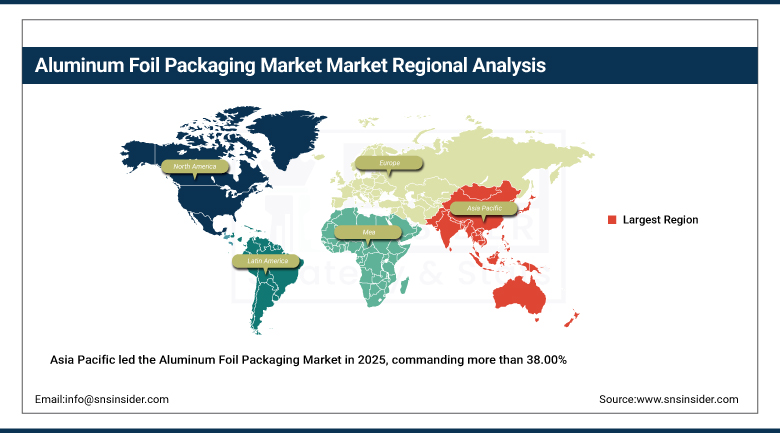
Asia Pacific led the Aluminum Foil Packaging Market in 2025, commanding more than 38.00% of overall global market revenue, and is also expected to register the fastest regional growth through 2035. Rising urbanization and busy lifestyles across China, India, Indonesia, and Japan continue increasing demand for ready-to-eat meals, snacks, and convenience foods, while these same countries are experiencing rapid growth in online grocery shopping and meal kit delivery services that require reliable, protective foil packaging. Government-supported manufacturing capacity expansion across multiple Asian economies keeps regional foil production growing in step with rising domestic packaged food demand.
China's massive food processing and consumer goods manufacturing base gives the region substantial baseline demand, while India's expanding organized retail and pharmaceutical sectors are drawing significant new investment in foil production capacity. Japan and South Korea represent more mature, technology-forward markets with established pharmaceutical-grade foil manufacturing standards, while Southeast Asian markets continue following a similar urbanization-driven growth trajectory as regional manufacturing infrastructure expands.
Get Customized Report as per Your Business Requirement - Enquiry Now
North America Aluminum Foil Packaging Market Insights
North America represents a substantial aluminum foil packaging market, with the United States accounting for the large majority of regional demand through its mature food and beverage, pharmaceutical, and consumer goods manufacturing base. Deep consumer familiarity with household foil products, reinforced by decades of established brand recognition, continues supporting steady retail demand even as packaging-grade foil manufacturers navigate growing competitive pressure from lower-cost overseas rolling mills on standard commodity foil grades.
Canada contributes additional demand through its own food processing and consumer goods manufacturing sectors, while Mexico's market continues expanding alongside growing nearshoring-driven manufacturing investment tied to broader North American supply chain integration. Cross-border supply relationships tie much of North American demand together, with major manufacturers typically serving all three markets through shared production and distribution networks.
Europe Aluminum Foil Packaging Market Insights
Europe represents a mature, sustainability-focused aluminum foil packaging market, home to major aluminum packaging companies including Amcor, Constantia Flexibles, Aluflexpack, and Eurofoil, each investing heavily in recyclable and mono-material laminate technology. Germany anchors regional demand, home to a large food processing and pharmaceutical manufacturing base and several major foil producers with deep engineering expertise in barrier coating technology.
France, Italy, and the United Kingdom contribute meaningful volume as well, each with substantial food, beverage, and pharmaceutical manufacturing sectors adapting to tightening EU packaging waste regulation. Comprehensive European recycling infrastructure investment continues reinforcing genuine circularity across the region's aluminum foil packaging supply chain more directly than in most other global markets.
MEA & Latin America Aluminum Foil Packaging Market Insights
The Middle East and Africa represent a smaller but developing aluminum foil packaging market, with the UAE driving demand through growing food processing and pharmaceutical retail investment tied to broader economic diversification goals. Growth elsewhere in the region remains tied closely to the pace of broader consumer goods manufacturing and organized retail infrastructure development across neighboring markets.
Latin America is a growing market led by Brazil, where expanding food processing and pharmaceutical manufacturing continue driving demand for protective, barrier-grade aluminum foil packaging. Mexico and Argentina contribute meaningful secondary demand, tied to their own growing manufacturing sectors serving both domestic consumption and export-oriented consumer goods markets.
Market Dynamics
Growth Drivers: Packaged food consumption growth and pharmaceutical shelf-life requirements fueling adoption
Rising consumption of packaged and processed foods worldwide is one of the clearest forces behind rising aluminum foil packaging demand, as expanding urbanization and busy lifestyles continue driving demand for ready-to-eat meals, snacks, and convenience foods that depend on foil's superior barrier protection. That consistent, high-frequency purchase pattern gives the aluminum foil packaging market a demand base that holds up reliably across broader economic cycles and consumer spending fluctuations.
Growing pharmaceutical packaging requirements add a second major driver, as extended product shelf life and product safety needs continue expanding demand for foil-based blister packs and unit-dose packaging that protect tablets and capsules through global distribution. Rising global healthcare spending and expanding pharmaceutical manufacturing capacity, particularly across emerging markets building domestic production capability, continue reinforcing this demand base.
Restraints: Raw material price volatility and recycling infrastructure gaps limiting margin stability
Fluctuating primary aluminum prices add real cost unpredictability for manufacturers, since foil producers remain exposed to broader commodity market swings tied to global aluminum smelting capacity and energy costs that directly affect production costs across every product category. Manufacturers without long-term metal supply contracts are particularly exposed to these swings, which can compress margins even when finished-foil demand remains steady across the broader market.
Uneven recycling infrastructure across different markets adds a further restraint, since multi-layer foil laminates combining aluminum with plastic or paper require specialized processing that many regions haven't yet built at meaningful scale. That infrastructure gap limits how quickly genuine circularity can improve even as producers invest heavily in mono-material redesigns as an alternative pathway toward better end-of-life recovery.
Opportunities: Recycled content expansion and pharmaceutical-grade capacity investment opening new growth avenues
Expanding recycled aluminum content offers manufacturers a genuine path to capturing premium business from brand owners chasing credible sustainability commitments ahead of tightening packaging waste regulation across major markets. Companies that build strong recycled-content sourcing and processing capability, backed by direct partnerships with brand owners seeking closed-loop supply chains, are positioned to capture a growing share of business from environmentally conscious food and beverage customers.
Dedicated pharmaceutical-grade foil capacity investment represents a second significant opportunity, as expanding global pharmaceutical manufacturing continues requiring stricter purity, traceability, and barrier performance standards that commodity-grade foil production wasn't originally designed to meet. Manufacturers that build genuine pharmaceutical-grade production capability are positioned to capture premium pricing from drug manufacturers prioritizing supply reliability and regulatory compliance over pure cost considerations.
Recent Developments:
-
April 2025: Constantia Flexibles expanded its eco-friendly foil portfolio by launching a recyclable mono-material aluminum laminate.
-
March 2025: Ess Dee Aluminium reopened its Jhagadia plant in India to increase pharmaceutical-grade foil production capacity.
-
February 2025: Novelis partnered with beverage brands in Europe to deliver aluminum foil made from 100% recycled content.
-
October 2025: Constantia Flexibles increased investment in aluminum foil packaging innovation targeting pharmaceutical and food protection applications with improved barrier performance.
Aluminum Foil Packaging Market Key Players
-
United Company RUSAL
-
Hulamin Ltd.
-
Hindalco Industries Ltd.
-
China Hongqiao Group Limited
-
Amcor plc
-
D&W Fine Pack, LLC
-
LSKB Aluminium Foils Pvt. Ltd.
-
Constellium SE
-
Novelis Inc.
-
Reynolds Consumer Products Inc.
-
Constantia Flexibles Group GmbH
-
Alcoa Corporation
-
Norsk Hydro ASA
-
UACJ Corporation
-
Toyo Aluminium K.K.
-
JW Aluminum Company
-
Emirates Global Aluminium PJSC
-
Eurofoil Luxembourg S.A.
-
Assan Alüminyum Sanayi ve Ticaret A.Ş.
-
Zhengzhou Eming Aluminium Industry Co., Ltd.
Aluminum Foil Packaging Market Report Scope:
| Report Attributes | Details |
|---|---|
| Market Size in 2025 | USD 32.00 Billion |
| Market Size by 2035 | USD 52.50 Billion |
| CAGR | CAGR of 5.10% From 2026 to 2035 |
| Base Year | 2025 |
| Forecast Period | 2026-2035 |
| Historical Data | 2022-2024 |
| Report Scope & Coverage | Market Size, Segments Analysis, Competitive Landscape, Regional Analysis, DROC & SWOT Analysis, Forecast Outlook |
| Key Segments | • by Product Type (Rigid Aluminum Foil Containers, Flexible Aluminum Foil Packaging, Aluminum Foil Lids, Blister Packs, Specialty Products) • by Thickness (0.007–0.09 mm, 0.09–0.2 mm, Above 0.2 mm) • by End-Use Industry (Food & Beverage, Pharmaceutical, Personal Care & Cosmetics, Others) • by Distribution Channel (Direct Sales, Distributors/Retail) |
| Regional Analysis/Coverage | North America (US, Canada), Europe (Germany, UK, France, Italy, Spain, Russia, Poland, Rest of Europe), Asia Pacific (China, India, Japan, South Korea, Australia, ASEAN Countries, Rest of Asia Pacific), Middle East & Africa (UAE, Saudi Arabia, Qatar, South Africa, Rest of Middle East & Africa), Latin America (Brazil, Argentina, Mexico, Colombia, Rest of Latin America). |
| Company Profiles | United Company RUSAL, Hulamin Ltd., Hindalco Industries Ltd., China Hongqiao Group Limited, Amcor plc, D&W Fine Pack, LLC, LSKB Aluminium Foils Pvt. Ltd., Constellium SE, Novelis Inc., Reynolds Consumer Products Inc., Constantia Flexibles Group GmbH, Alcoa Corporation, Norsk Hydro ASA, UACJ Corporation, Toyo Aluminium K.K., JW Aluminum Company, Emirates Global Aluminium PJSC, Eurofoil Luxembourg S.A., Assan Alüminyum Sanayi ve Ticaret A.Ş., Zhengzhou Eming Aluminium Industry Co., Ltd. |
Frequently Asked Questions
Key players in the Aluminum Foil Packaging Market include Amcor plc, Novelis Inc., Hindalco Industries Ltd., Constantia Flexibles Group GmbH, and Reynolds Consumer Products Inc., among others.
Key opportunities in the Aluminum Foil Packaging Market include expanding recycled aluminum content for credible brand-owner sustainability commitments and dedicated pharmaceutical-grade foil capacity investment meeting stricter purity standards.
The market is driven by rising consumption of packaged and processed foods worldwide, combined with growing pharmaceutical packaging requirements for extended shelf life and product safety.
The Rigid Aluminum Foil Containers segment dominated the Aluminum Foil Packaging Market, accounting for approximately 54.00% market share.
The Asia Pacific region dominated the Aluminum Foil Packaging Market in 2025 with more than 38.00% share, driven by rising urbanization and increasing demand for ready-to-eat meals and convenience foods.
