
API Security Market Report Scope & Overview:
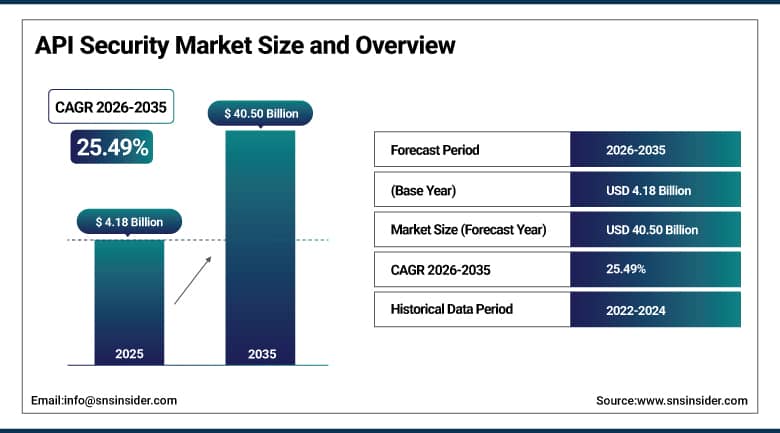
The API Security Market was valued at USD 4.18 Billion in 2025 and is expected to reach USD 40.50 Billion by 2035, growing at a CAGR of 25.49% from 2026 to 2035.
The API Security Market is witnessing rapid growth due to the rapid transition to cloud-native technology stacks, microservices, and machine-to-machine connectivity where APIs are used extensively for data communication inside the enterprises and between partners and customers. The increased use of APIs has expanded the attack surface of most enterprises to a very large extent; thus, security solutions are transitioning from web application firewalls that could not provide sufficient protection to APIs to new platforms specifically designed to identify shadow APIs, enforce authentication and authorization checks, and detect behavioral anomalies that indicate abuse. The increasing use of applications and autonomous agents powered by AI that communicate via APIs is adding another layer of complexity to the issue.
In March 2026, Cloudflare launched the beta of its Web and API Vulnerability Scanner, using AI-generated API call graphs to proactively identify Broken Object Level Authorization flaws, the highest-ranked risk category on the OWASP API Security Top 10.
To Get More Information On API Security Market - Request Free Sample Report
API Security Market Trends:
-
Enterprises are prioritizing automated discovery of shadow and undocumented APIs across hybrid IT environments.
-
AI-powered runtime detection is becoming standard for identifying business logic abuse and behavioral anomalies.
-
Vendors are consolidating API discovery, testing, and runtime protection into unified platform offerings.
-
Growing use of GraphQL and gRPC APIs is driving demand for protocol-aware security tooling.
-
Rising API-driven exposure from AI agents and LLM integrations is expanding enterprise security requirements.
U.S. API Security Market Outlook:
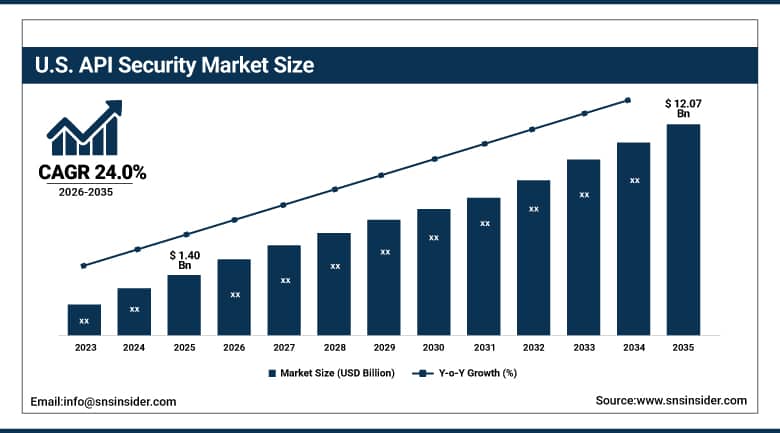
The U.S. API Security Market was valued at approximately USD 1.40 Billion in 2025 and is projected to reach approximately USD 12.07 Billion by 2035, registering a CAGR of approximately 24.0% from 2026 to 2035.
With consistent enterprise demands for such technologies, the U.S. top cloud, content delivery, and cybersecurity companies keep developing dedicated API protection solutions, enabled by a well-developed regulatory environment covering various compliance frameworks, including HIPAA, CCPA, as well as financial industry regulations, which increasingly call for API-level controls. Enterprises in sectors such as banking, healthcare, and technology have been stepping up investment in APIs discovery and runtime protection platforms due to increasing numbers of integration points made public due to digital transformation initiatives, whereas the government organizations also mandate API governance due to zero-trust requirements for modernization.
In 2025, Akamai Technologies was named a Leader across four categories in the KuppingerCole API Security Leadership Compass, with its Akamai API Security platform, built on the integrated Noname Security engine, running more than 150 dynamic tests across customer CI/CD pipelines.
API Security Market Segment Analysis:
-
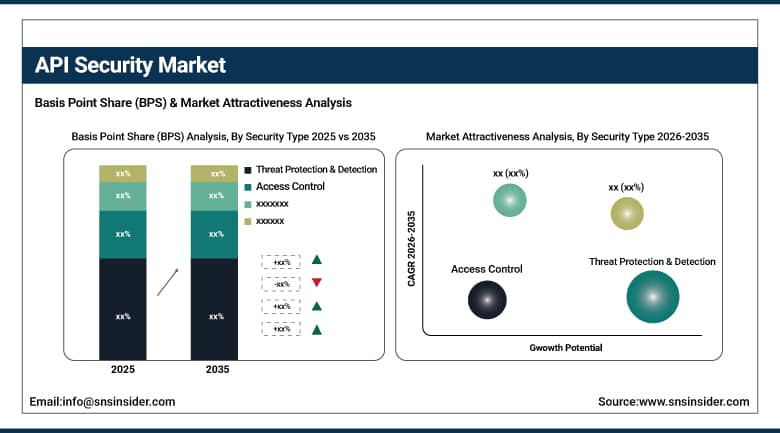
By Security Type, Threat Protection & Detection dominated the API Security Market with a 32.40% share in 2025, while Access Control is the fastest-growing security type segment with a CAGR of 19.80% from 2026–2035.
-
By Deployment Mode, Cloud dominated the API Security Market with a 71.50% share in 2025, while Hybrid is the fastest-growing deployment segment with a CAGR of 20.60% from 2026–2035.
-
By Organization Size, Large Enterprises dominated the API Security Market with a 58.90% share in 2025, while Small & Medium Enterprises is the fastest-growing segment with a CAGR of 19.40% from 2026–2035.
-
By Industry Vertical, BFSI dominated the API Security Market with a 24.80% share in 2025, while Healthcare is the fastest-growing vertical segment with a CAGR of 20.90% from 2026–2035.
By Security Type, Threat Protection leads while Access Control grows fastest.
The Threat Protection & Detection segment held the leading position in the API Security Market in 2025. Enterprises are increasingly looking to invest in real-time behavior analysis and anomaly detection which would help to detect credential stuffing, data scraping, and exploitation of business logic flaws in production-level API traffic because these kinds of security threats often cannot be detected using conventional security software which uses signatures for detecting malicious activity. The dominant share of this segment can be attributed to the increasing sophistication of automated attacks designed to bypass rate limiting and static rules-based protection mechanisms.
The Access Control segment is expected to register the highest CAGR during 2026-2035. The rising adoption of advanced authorization techniques such as attribute-based and policy-based access control is gaining momentum because of the need to prevent Broken Object Level Authorization and Broken Function Level Authorization exploits in APIs. Increasing regulatory pressure towards least-privilege access governance in the financial services and healthcare industries is adding momentum to the above average growth of this segment in comparison to other security type segments.
By Deployment Mode, Cloud leads while Hybrid grows fastest.
The Cloud segment accounted for dominant share of the API Security Market in 2025. The preference of enterprises to use cloud-based API security stems from the scalability that comes with fluctuating volume of APIs, the ease of implementation as compared to the on-premise inspection appliances, and low operational burden.
The Hybrid segment is projected to grow at the fastest CAGR during the forecast period. The increasing adoption of enterprises having workloads which need to be executed on-premises due to regulatory reasons is combining cloud-based threat intelligence and detection engines with on-premises enforcement points for centralized visibility of distributed API traffic.
By Organization Size, Large Enterprises lead while SMEs grow fastest.
Large Enterprises held a major share of the API Security Market in 2025. Organizations that have large numbers of APIs running on internally used, partner, and publicly available endpoints need all-rounded discovery, testing, and runtime security features and have the budget required to buy enterprise-grade solutions in globally dispersed infrastructures.
Small & Medium Enterprises are expected to witness the fastest CAGR through 2026-2035. The declining costs of cloud-based API security solutions, increasing prevalence of self-deployment options, and increasing knowledge about the vulnerabilities of APIs among small companies are increasing adoption amongst enterprises that did not earlier have any application security expertise.
By Industry Vertical, BFSI leads while Healthcare grows fastest.
The BFSI segment led the API Security Market in 2025. The BFSI Sector consists of organizations that utilize vast API infrastructure used to process and manage high-volume transaction data which makes it vulnerable to attacks and also a top priority for regulation, driving further investments in specific API Discovery & Protection Solutions.
The Healthcare segment is projected to expand at the fastest CAGR during 2026-2035. The rapid growth in telemedicine systems, EHR Interoperability Mandates and patient facing apps has increased the volume of APIs managing sensitive personal information, driving the need for healthcare providers and payers to implement API Security controls.
Regional Analysis:
|
Region |
Major Country |
Share within Region, 2025 (%) |
|
North America |
United States |
83.40% |
|
Europe |
Germany |
23.80% |
|
Asia Pacific |
China |
36.90% |
|
Middle East & Africa |
UAE |
26.40% |
|
Latin America |
Brazil |
34.20% |
North America API Security Market Insights
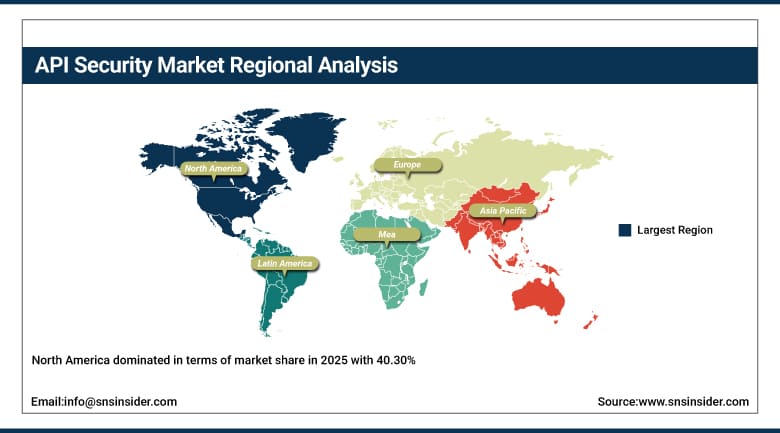
North America dominated in terms of market share in 2025 with 40.30%, backed by the presence of top-tier cloud infrastructures and cybersecurity vendors in the region, huge enterprise investment on digital transformation initiatives, and strict regulatory environment around data privacy, health, and financial services which mandates enterprises to manage API-level access controls. Enterprises in North America have some of the most complicated APIs in the world, which include internal microservices, third-party partnerships, and external developer APIs, thus ensuring the need for discovery, testing, and protection capabilities in the region. In addition, the presence of top-tier hyperscale cloud providers and vendors specializing in API security further drives product innovations in the region.
The United States was the leading country within the North America API Security Market in 2025 of the regional market, due to the presence of key players in the field of cybersecurity and cloud computing, enterprise IT modernization spend, and rapid deployment of APIs security solutions for zero trust modernization in sectors such as banks, healthcare, and the federal government. Canada is supporting the growth of the region in terms of increasing use of cloud-based API security solutions by mid-market enterprises and investments by the finance industry.
Get Customized Report as Per Your Business Requirement - Enquiry Now
Europe API Security Market Insights
The Europe region remained a significant contributor to the API Security Market in 2025 and is expected to register steady growth throughout the forecast period, supported by the region's stringent data-protection regime under GDPR, growing enforcement of PSD2 open-banking API standards, and rising enterprise investment in compliance-oriented API governance tooling capable of demonstrating auditable access controls across cross-border data flows.
Germany is one of the major markets in Europe owing to its large manufacturing, automotive, and financial-services enterprise base actively formalizing API security programs to support Industry 4.0 connectivity initiatives, along with the presence of strong regional systems-integration partners. Other countries such as the United Kingdom, France, and the Netherlands, home to sizable financial and professional-services sectors, are also contributing to market growth through expanding open-banking API adoption and growing investment in application-security modernization programs.
Asia Pacific API Security Market Insights
The Asia Pacific API Security Market is expected to register the fastest growth rate of around 27.8% during the forecast period 2026-2035, owing to the growing pace of digital transformation in developed as well as developing countries, increasing ecosystem of fintech and e-commerce that relies a lot on API integrations, and government-backed programs that encourage the adoption of secure digital infrastructure among public as well as private organizations.
China is one of the main growth drivers in the Asia Pacific API Security Market, owing to its expansive digital-payments and e-commerce ecosystem and rapidly growing domestic development of cybersecurity platforms serving both large state-owned enterprises and a fast-expanding private technology sector. India and Japan, both major global technology and financial-services hubs, are also contributing to regional growth through expanding IT services exports that increasingly embed API security requirements and rising domestic enterprise demand for protection against API-targeted fraud and data-exfiltration attempts.
Middle East & Africa and Latin America API Security Market Insights
Middle East & Africa and Latin American regions are gradually expanding API security adoption as enterprise digital-transformation investment grows across both regions, supported by increasing government-led smart-economy and open-banking initiatives that require standardized, auditable API access controls across regional financial and public-sector systems.
Brazil is set to be a prominent Latin American market fueled by its large open-banking ecosystem and expanding fintech sector requiring robust API protection, alongside growing domestic enterprise cloud adoption. The Middle East & Africa region has the UAE and Saudi Arabia investing heavily in national digital-economy strategies and smart-government programs that are gradually increasing enterprise demand for API security platforms across banking, energy, and public-sector organizations.
Market Dynamics
Growth Drivers: Expanding API attack surface and regulatory mandates driving market growth
The exponential growth in enterprise API traffic, owing to the popularity of microservices-based architecture, mobile applications, and integration with third parties, is one of the main factors fueling the API Security Market. Each new API endpoint represents a potential entry point for attackers, and traditional web application firewalls and network security tools are increasingly unable to detect API-specific threats such as broken object-level authorization, excessive data exposure, and business logic abuse, compelling organizations to adopt purpose-built API security platforms capable of continuous discovery, behavioral analysis, and automated remediation across dynamic API inventories.
Regulatory pressure has played its part in increasing the need for API security, as the frameworks related to financial services, healthcare, and general data protection often mention access governance and auditing of APIs. The growing frequency of API breach incidents and their subsequent exposure has increased awareness about API risks among boards, leading to greater budget allocation for API security and not just application security as a whole. In addition, there is another dimension that will be exposed to enterprises in the forecast period in the form of artificial intelligence agents and large language models communicating via APIs.
Restraints: Shadow API sprawl and integration complexity limiting market expansion
One of the most significant obstacles to market growth is the persistent challenge of shadow and undocumented API sprawl within large, decentralized engineering organizations. Many enterprises lack complete visibility into the full inventory of APIs operating across their environments, particularly those created by individual development teams outside formal governance processes, making comprehensive protection difficult to achieve even with advanced discovery tooling, and leaving significant blind spots that limit the effectiveness of otherwise capable security platforms.
Moreover, the technical complexity of integrating API security platforms with existing API gateways, service meshes, and legacy identity-management infrastructure continues to slow enterprise-wide rollout timelines, particularly within organizations operating multi-cloud or hybrid environments with inconsistent API architecture standards. Budget constraints among small and mid-sized organizations, combined with a persistent shortage of specialized application security talent capable of operationalizing and tuning these platforms effectively, add further friction to broader market penetration across the forecast period.
Opportunities: AI-driven detection and open-banking expansion creating new growth avenues
The growing application of artificial intelligence and machine learning to automate API discovery, classify sensitive data exposure, and detect subtle behavioral anomalies indicative of business logic abuse presents substantial opportunity for vendors capable of differentiating through detection accuracy and reduced false-positive rates. The expansion of open-banking and open-finance mandates across an increasing number of countries is also creating structural, regulation-driven demand for standardized API security controls across the financial services sector globally.
There is considerable potential for growth in securing the rapidly expanding category of AI agent and large language model API traffic, an entirely new attack surface that existing platforms are only beginning to address through dedicated capabilities. The continued expansion of enterprise cloud and digital-payments infrastructure across emerging economies in Asia Pacific and Latin America, combined with rising government support for secure digital-economy initiatives, will further drive demand for API security platforms across organizations of all sizes.
Recent Developments:
-
2025: Akamai Technologies released its 2025 API Security Impact Study for Asia Pacific, evaluating hidden vulnerabilities, operational risks, and financial impacts of API security incidents across the region's largest economies.
-
2026: Cloudflare expanded API Shield with JSON Web Token validation support for HS256, HS384, and HS512 symmetric keys, strengthening token-based authentication controls for enterprise API traffic.
API Security Market Key Players are:
-
Akamai Technologies, Inc.
-
Cloudflare, Inc.
-
Salt Security, Inc.
-
Imperva, Inc.
-
F5, Inc.
-
Amazon Web Services, Inc.
-
Google LLC
-
Microsoft Corporation
-
Broadcom Inc.
-
Cisco Systems, Inc.
-
International Business Machines Corporation (IBM)
-
Palo Alto Networks, Inc.
-
Fortinet, Inc.
-
Wallarm, Inc.
-
Cequence Security, Inc.
-
42Crunch Ltd.
-
APIsec, Inc.
-
Data Theorem, Inc.
-
Harness Inc. (Traceable)
-
SAP SE
API Security Market Report Scope:
| Report Attributes | Details |
|---|---|
| Market Size in 2025 | USD 4.18 Billion |
| Market Size by 2035 | USD 40.50 Billion |
| CAGR | CAGR of 25.49% From 2026 to 2035 |
| Base Year | 2025 |
| Forecast Period | 2026-2035 |
| Historical Data | 2022-2024 |
| Report Scope & Coverage | Market Size, Segments Analysis, Competitive Landscape, Regional Analysis, DROC & SWOT Analysis, Forecast Outlook |
| Key Segments | • By Security Type (Authentication Security, Data Security, Access Control, Threat Protection & Detection) • By Deployment Mode (Cloud, On-Premises, Hybrid) • By Organization Size (Large Enterprises, Small & Medium Enterprises) • By Industry Vertical (BFSI, IT & Telecom, Healthcare, Retail & E-commerce, Government) |
| Regional Analysis/Coverage | North America (US, Canada), Europe (Germany, UK, France, Italy, Spain, Russia, Poland, Rest of Europe), Asia Pacific (China, India, Japan, South Korea, Australia, ASEAN Countries, Rest of Asia Pacific), Middle East & Africa (UAE, Saudi Arabia, Qatar, South Africa, Rest of Middle East & Africa), Latin America (Brazil, Argentina, Mexico, Colombia, Rest of Latin America). |
| Company Profiles | Akamai Technologies, Inc., Cloudflare, Inc., Salt Security, Inc., Imperva, Inc., F5, Inc., Amazon Web Services, Inc., Google LLC, Microsoft Corporation, Broadcom Inc., Cisco Systems, Inc., International Business Machines Corporation (IBM), Palo Alto Networks, Inc., Fortinet, Inc., Wallarm, Inc., Cequence Security, Inc., 42Crunch Ltd., APIsec, Inc., Data Theorem, Inc., Harness Inc. (Traceable), SAP SE |

Frequently Asked Questions
Key players in the API Security Market include Akamai Technologies, Inc., Cloudflare, Inc., Salt Security, Inc., Imperva, Inc., F5, Inc., Amazon Web Services, Inc., Google LLC, Microsoft Corporation, Broadcom Inc., Cisco Systems, Inc., IBM Corporation, among others.
Key opportunities in the API security market include AI/ML-driven automated detection of business logic abuse, expansion of open-banking and open-finance mandates, and securing the rapidly growing category of AI agent and large language model (LLM) API traffic.
The market is driven by the exponential growth in enterprise API traffic from microservices and mobile apps, combined with stringent regulatory mandates (HIPAA, CCPA, PSD2) and rising board-level awareness following high-profile API-related data breaches.
The Threat Protection & Detection segment dominated the API Security Market, accounting for approximately 32.40% market share in 2025.
The North America region dominated the API Security Market in 2025 with a 40.30% share, driven by a dense concentration of cloud/cybersecurity vendors, extensive enterprise digital-transformation spending, and stringent regulatory frameworks.
