
API Security Testing Tools Market Report Scope & Overview:
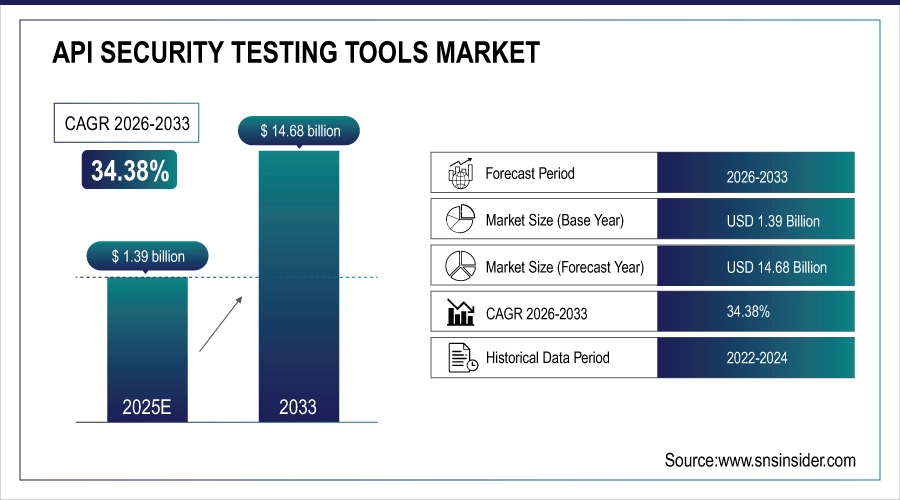
The API Security Testing Tools Market is valued at USD 1.39 billion in 2025E and is expected to reach USD 14.68 billion by 2033, growing at a CAGR of 34.38% from 2026-2033.
The API security testing tools market is growing rapidly due to the rising adoption of cloud services, increased API-based integrations, and growing cyber threats targeting APIs. Organizations are focusing on securing data exchanges, ensuring regulatory compliance, and preventing breaches. The need for automated, continuous testing solutions, combined with the rise of digital transformation initiatives and increased demand for secure software development practices, is driving significant growth in API security testing tools across enterprises globally.
80% of global enterprises adopted automated API security testing driven by cloud adoption, rising cyber threats, and compliance needs to secure integrations and enable resilient digital transformation.
API Security Testing Tools Market Size and Forecast
-
Market Size in 2025E: USD 1.39 Billion
-
Market Size by 2033: USD 14.68 Billion
-
CAGR: 34.38% from 2026 to 2033
-
Base Year: 2025E
-
Forecast Period: 2026–2033
-
Historical Data: 2022–2024
To Get more information on API Security Testing Tools Market - Request Free Sample Report
API Security Testing Tools Market Trends
-
Rising adoption of automated API security testing tools to detect vulnerabilities across modern cloud-native applications
-
Increasing focus on compliance-driven security testing as enterprises address evolving regulatory and data protection requirements
-
Growing integration of API security testing within DevSecOps pipelines to enable continuous and shift-left security practices
-
Expansion of AI-powered testing capabilities to identify complex attack patterns and zero-day API vulnerabilities
-
Rising demand for real-time monitoring and runtime API protection to secure exposed endpoints and microservices architectures
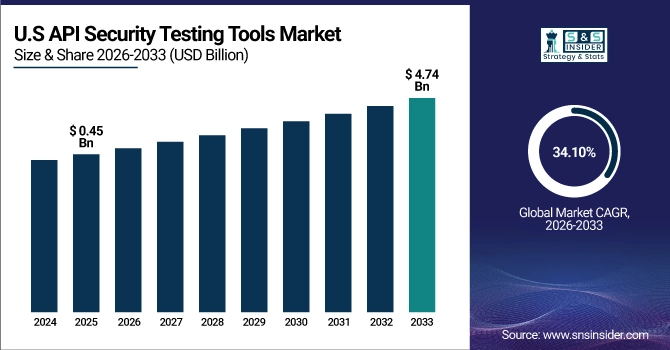
U.S. API Security Testing Tools Market is valued at USD 0.45 billion in 2025E and is expected to reach USD 4.74 billion by 2033, growing at a CAGR of 34.10% from 2026-2033. The U.S. API security testing tools market is growing rapidly due to increasing adoption of cloud services, rising API-based integrations, and heightened cyber threats. Organizations are investing in automated testing solutions to ensure secure data exchanges, maintain compliance, and protect sensitive information, driving strong market growth.
API Security Testing Tools Market Growth Drivers:
-
Rising adoption of APIs across cloud, mobile, and microservices architectures is increasing demand for automated security testing tools to detect vulnerabilities and ensure compliance
The rapid growth of APIs in modern software ecosystems, including cloud computing, mobile applications, and microservices architectures, has significantly increased the attack surface for enterprises. Organizations require robust API security testing tools to identify vulnerabilities, prevent unauthorized access, and maintain compliance with industry standards. Automated testing ensures continuous monitoring and faster detection of potential risks, reducing security incidents. As APIs become critical for business operations and digital transformation initiatives, demand for comprehensive API security testing tools is rising globally, supporting investments in advanced solutions to safeguard sensitive data.
76% of enterprises deployed automated API security testing driven by widespread API use in cloud, mobile, and microservices to detect vulnerabilities and meet compliance demands at scale.
-
Growing frequency of API-based cyberattacks and data breaches is pushing enterprises to invest in proactive API security testing and continuous vulnerability assessment solutions
The increasing prevalence of cyberattacks targeting APIs, such as injection attacks, broken authentication, and data leaks, has heightened awareness of security risks. Enterprises are prioritizing proactive API security measures, including automated testing, vulnerability scanning, and threat analysis. Continuous assessment helps detect flaws before exploitation, mitigating potential financial losses and reputational damage. Organizations are integrating API security testing into their software development lifecycle to maintain secure and resilient systems. Rising regulatory requirements for data protection further drive investments, compelling companies across industries to adopt advanced API security testing solutions to protect sensitive information.
78% of enterprises increased investment in API security testing driven by a 60% rise in API-targeted breaches enabling proactive vulnerability detection and continuous threat mitigation.
API Security Testing Tools Market Restraints:
-
High implementation costs and complexity of integrating API security testing tools into existing DevOps pipelines limit adoption among small and medium-sized enterprises
Implementing advanced API security testing tools requires significant financial and technical investment, making it challenging for small and medium-sized enterprises (SMEs) with limited budgets. Integration into existing DevOps pipelines can be complex, requiring skilled personnel and process adjustments to ensure seamless testing without disrupting development workflows. Additionally, the need for continuous updates, monitoring, and tool management increases operational overhead. These factors can hinder adoption, especially among resource-constrained organizations. As a result, SMEs often rely on manual security practices or basic testing methods, limiting their exposure to comprehensive API security solutions.
64% of SMEs refrained from adopting API security testing tools due to high costs and complex DevOps integration, leaving critical API endpoints vulnerable amid rising cyber threats.
-
Lack of skilled cybersecurity professionals capable of managing advanced API security tools restricts effective deployment and reduces testing efficiency across organizations
Effective deployment of API security testing tools requires specialized knowledge in cybersecurity, DevSecOps practices, and API protocols. Many organizations face a shortage of skilled professionals capable of configuring, monitoring, and analyzing test results accurately. Insufficient expertise can lead to misconfigurations, false positives, or undetected vulnerabilities, reducing the effectiveness of security measures. This talent gap constrains widespread adoption, particularly among SMEs and emerging enterprises. Companies may face challenges in training staff or hiring qualified personnel, which increases operational costs and limits the efficiency and reliability of API security testing initiatives across business-critical applications.
67% of organizations faced API security gaps due to a shortage of skilled cybersecurity professionals, reducing testing efficiency by 30% and delaying secure deployments.
API Security Testing Tools Market Opportunities:
-
Increasing shift toward DevSecOps practices creates opportunities for API security testing tools to integrate seamlessly into CI/CD pipelines and software development lifecycles
The adoption of DevSecOps, which integrates security into the development process, is creating significant opportunities for API security testing tools. Tools that can be embedded directly into CI/CD pipelines allow continuous testing of APIs during development and deployment, ensuring vulnerabilities are detected early. Automated integration reduces delays, minimizes human error, and accelerates secure software releases. As organizations increasingly prioritize security-first development methodologies, vendors providing API security testing solutions compatible with DevSecOps practices can capture a growing market, offer enhanced protection while support agile and efficient software delivery processes.
In 2025, 75% of organizations embedded API security testing into CI/CD pipelines accelerating secure releases by 40% and aligning with DevSecOps-driven development workflows.
-
Rising regulatory requirements for data protection and API governance open opportunities for vendors to offer compliance-focused, automated API security testing solutions globally
Stringent regulations like GDPR, CCPA, and industry-specific standards require organizations to ensure the security and privacy of sensitive data transmitted through APIs. Non-compliance can result in substantial fines and reputational damage. This regulatory pressure is driving demand for API security testing tools that provide automated compliance checks, risk assessment, and reporting capabilities. Vendors can capitalize on this trend by offering solutions that help organizations adhere to legal requirements while maintaining operational efficiency. Growing global emphasis on data privacy presents significant growth opportunities for innovative, compliance-oriented API security testing providers.
In 2025, 70% of API security vendors launched compliance-driven, automated testing tools helping organizations meet global data protection regulations and reduce API-related breach risks by 45%.
API Security Testing Tools Market Segment Analysis
-
By Tool Type: Static Application Security Testing led with 34.6% share, while Runtime Application Self-Protection is the fastest-growing segment with CAGR of 38.9%.
-
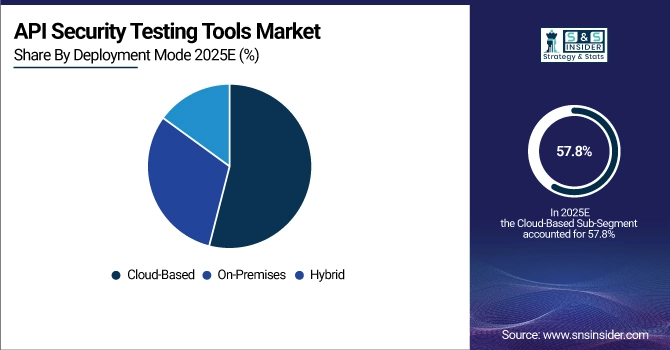
By Deployment Mode: Cloud-Based led with 57.8% share, while Hybrid is the fastest-growing segment with CAGR of 37.6%.
-
By Application: API Vulnerability Assessment led with 31.9% share, while DevSecOps Integration is the fastest-growing segment with CAGR of 40.2%.
-
By End User: BFSI led with 28.7% share, while IT & Telecom is the fastest-growing segment with CAGR of 37.4%.
By Deployment Mode: Cloud-Based led, while Hybrid is the fastest-growing segment.
Cloud-based deployment leads the market due to low upfront investment, easy scalability, and centralized management capabilities. Enterprises benefit from automatic updates, real-time monitoring, and global accessibility. It is widely preferred by BFSI, IT, and large corporate organizations requiring distributed security management. Integration with DevSecOps practices, multi-tenant architecture, and reduced maintenance requirements strengthen its dominance over traditional on-premises solutions.
Hybrid deployment is growing fastest as organizations combine on-premises and cloud solutions to meet compliance, security, and scalability needs. It offers flexibility for sensitive data storage while leveraging cloud agility. Enterprises deploying hybrid models can balance security, performance, and cost-effectiveness, accelerating adoption in sectors like IT, telecom, and healthcare. The hybrid model’s adaptability to existing infrastructure and ability to support continuous API security monitoring drives its rapid CAGR.
By Tool Type: Static Application Security Testing led, while Runtime Application Self-Protection is the fastest-growing segment.
Static Application Security Testing (SAST) dominates due to its ability to identify vulnerabilities early in the development lifecycle. Widely adopted across enterprises, it integrates seamlessly with CI/CD pipelines and supports multiple programming languages. High demand in large organizations for pre-production security, regulatory compliance, and risk mitigation ensures steady adoption. Its cost-effectiveness, accuracy in identifying coding flaws, and compatibility with DevSecOps practices contribute to its market-leading position in API security testing.
Runtime Application Self-Protection is growing rapidly due to real-time threat detection and automated protection capabilities during application runtime. It enables proactive monitoring of API behavior, blocking attacks instantly without human intervention. Organizations adopting cloud-native and microservices architectures increasingly prefer RASP to complement existing security tools. Its scalability, reduced false positives, and integration with DevOps pipelines are driving adoption, especially among enterprises seeking continuous protection in dynamic API environments.
By Application: API Vulnerability Assessment led, while DevSecOps Integration is the fastest-growing segment.
API Vulnerability Assessment dominates due to its critical role in identifying flaws and misconfigurations in APIs before exploitation. Enterprises rely on vulnerability scanning tools to ensure compliance with industry regulations and prevent data breaches. High adoption across BFSI, healthcare, and telecom sectors for proactive risk mitigation maintains its leading market share. The integration of automated scanning with DevSecOps pipelines enhances efficiency and reliability, reinforcing dominance in the API security space.
DevSecOps Integration is the fastest-growing segment as organizations embed security into development pipelines. By integrating API security testing directly into CI/CD workflows, teams can detect and remediate vulnerabilities in real-time. The rise of agile and cloud-native development, combined with regulatory requirements for secure software delivery, accelerates adoption. Continuous security feedback, automated compliance checks, and faster release cycles drive DevSecOps Integration to become a key focus area for enterprises globally.
By End User: BFSI led, while IT & Telecom is the fastest-growing segment.
BFSI dominates due to its high sensitivity to data breaches and regulatory compliance requirements. Banks and financial institutions implement comprehensive API security testing across internal and external APIs to protect customer information and ensure operational continuity. The demand for advanced threat detection, secure integrations, and regulatory adherence supports the BFSI segment’s leadership. Continuous investment in security infrastructure and integration with digital banking platforms reinforces its dominant share in the market.
IT & Telecom is the fastest-growing end-user segment, driven by rapid digital transformation and API-centric architectures. These sectors increasingly adopt automated API security solutions to handle high volumes of data exchange, protect cloud services, and secure customer-facing applications. Integration with DevOps and cloud-native environments accelerates adoption, while regulatory compliance and cyberthreat mitigation further fuel growth. The focus on scalability, real-time monitoring, and efficient risk management supports its strong CAGR globally.
API Security Testing Tools Market Regional Analysis
North America API Security Testing Tools Market Insights:
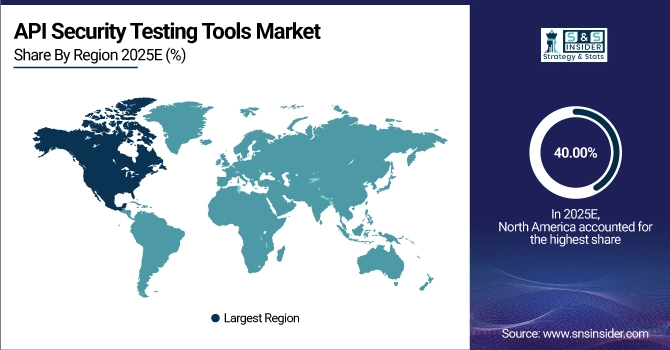
North America dominated the API Security Testing Tools Market with a 40.00% share in 2025 due to early adoption of advanced cybersecurity solutions, high concentration of cloud-native enterprises, and strong presence of leading API security vendors. Stringent data protection regulations, widespread DevSecOps adoption, and increasing frequency of API-based cyberattacks further reinforced regional market leadership.
Get Customized Report as per Your Business Requirement - Enquiry Now
Asia Pacific API Security Testing Tools Market Insights
Asia Pacific is expected to grow at the fastest CAGR of about 36.81% from 2026–2033, driven by rapid digital transformation, expanding cloud and microservices adoption, and rising API usage across fintech, e-commerce, and telecom sectors. Growing cybersecurity awareness, increasing regulatory focus, and investments in modern application security tools are accelerating market growth across the region.
Europe API Security Testing Tools Market Insights
Europe held a significant share in the API Security Testing Tools Market in 2025, supported by strong data protection regulations such as GDPR, increasing adoption of API-driven digital services, and growing emphasis on application security. Rising cloud migration, widespread DevSecOps implementation, and presence of established cybersecurity vendors further strengthened Europe’s market position.
Middle East & Africa and Latin America API Security Testing Tools Market Insights
The Middle East & Africa and Latin America together showed steady growth in the API Security Testing Tools Market in 2025, driven by expanding digital economies, increasing API adoption across banking, telecom, and government services, and rising awareness of cybersecurity risks. Growing cloud deployment, regulatory modernization, and investments in IT security infrastructure supported gradual market expansion.
API Security Testing Tools Market Competitive Landscape:
Salt Security
Salt Security is a leading provider of API security solutions, focusing on protecting enterprise APIs from data breaches, attacks, and misuse. The company leverages AI and machine learning to detect anomalies, vulnerabilities, and malicious activity in real time. Its platform offers continuous monitoring, threat intelligence, and risk analytics, helping organizations secure APIs across development and production environments. Salt Security is recognized globally for its innovative approach, scalability, and strong focus on proactive API protection.
-
June 2024, Salt Security introduced AI-powered red teaming as part of its API Security Testing module, enabling organizations to proactively simulate advanced API attacks based on real-world behavioral baselines.
Noname Security
Noname Security specializes in comprehensive API security, providing enterprises with visibility, threat detection, and automated protection. The platform identifies API vulnerabilities, misconfigurations, and anomalies while integrating seamlessly with existing development and security workflows. With features such as runtime protection, discovery, and analytics, Noname Security helps organizations secure their APIs throughout the software development lifecycle. It has gained recognition for simplifying API security management and supporting both on-premises and cloud environments worldwide.
-
October 2023, Noname Security launched Active Testing, a continuous, non-disruptive API penetration testing capability that safely validates vulnerabilities in production and pre-production environments.
Imperva
Imperva is a global cybersecurity company offering solutions for application, data, and API security. Its API security tools focus on protecting APIs from threats, preventing data leaks, and ensuring compliance. Leveraging AI-driven threat detection and real-time monitoring, Imperva identifies suspicious behavior and mitigates attacks effectively. The company provides scalable solutions suitable for enterprises of all sizes, integrating security into API development and runtime processes. Imperva is recognized for reliability, innovation, and a strong global customer base.
-
February 2025, Imperva integrated automated API security testing directly into its Cloud WAF and Runtime Protection platform, creating a unified pre- and post-deployment API security solution.
API Security Testing Tools Market Key Players
-
Salt Security
-
Noname Security
-
Imperva
-
Akamai Technologies
-
Fortinet
-
Check Point Software Technologies
-
Rapid7
-
Synopsys
-
SmartBear Software
-
Postman
-
42Crunch
-
Cequence Security
-
Neosec
-
Traceable AI
-
Wallarm
-
Akto
-
Veracode
-
Snyk
| Report Attributes | Details |
|---|---|
| Market Size in 2025E | USD 1.39 Billion |
| Market Size by 2033 | USD 14.68 Billion |
| CAGR | CAGR of 34.38% From 2026 to 2033 |
| Base Year | 2025 |
| Forecast Period | 2026-2033 |
| Historical Data | 2022-2024 |
| Report Scope & Coverage | Market Size, Segments Analysis, Competitive Landscape, Regional Analysis, DROC & SWOT Analysis, Forecast Outlook |
| Key Segments | • By Tool Type (Static Application Security Testing, Dynamic Application Security Testing, Interactive Application Security Testing, Runtime Application Self-Protection, Fuzz Testing Tools) • By Deployment Mode (Cloud-Based, On-Premises, Hybrid) • By Application (API Vulnerability Assessment, API Penetration Testing, Threat Detection & Monitoring, Compliance & Regulatory Testing, DevSecOps Integration) • By End User (BFSI, IT & Telecom, Healthcare, Retail & E-commerce, Government & Public Sector) |
| Regional Analysis/Coverage | North America (US, Canada), Europe (Germany, UK, France, Italy, Spain, Russia, Poland, Rest of Europe), Asia Pacific (China, India, Japan, South Korea, Australia, ASEAN Countries, Rest of Asia Pacific), Middle East & Africa (UAE, Saudi Arabia, Qatar, South Africa, Rest of Middle East & Africa), Latin America (Brazil, Argentina, Mexico, Colombia, Rest of Latin America). |
| Company Profiles | Salt Security, Noname Security, Imperva, Akamai Technologies, Palo Alto Networks, Fortinet, Check Point Software Technologies, Rapid7, Synopsys, SmartBear Software, Postman, 42Crunch, Cequence Security, Neosec, Traceable AI, Wallarm, Akto, Data Theorem, Veracode, Snyk |

Frequently Asked Questions
The API Security Testing Tools Market is projected to grow at a CAGR of 34.38% from 2026 to 2033 due to rising cyber threats and API adoption.
In 2025, the API Security Testing Tools Market is valued at USD 1.39 billion, driven by automated testing adoption, cloud integration, and compliance-focused security measures.
Rising API adoption across cloud, mobile, and microservices environments, coupled with increasing cyberattacks and regulatory compliance requirements, are driving the market’s rapid growth globally.
Static Application Security Testing (Tool Type), Cloud-Based (Deployment Mode), API Vulnerability Assessment (Application), and BFSI (End-User) dominated the market throughout the forecast period.
North America dominated the market in 2025 with a 40.00% share, owing to early adoption of advanced API security solutions and strong presence of leading vendors.
