
Aquaponics Market Report Scope & Overview:
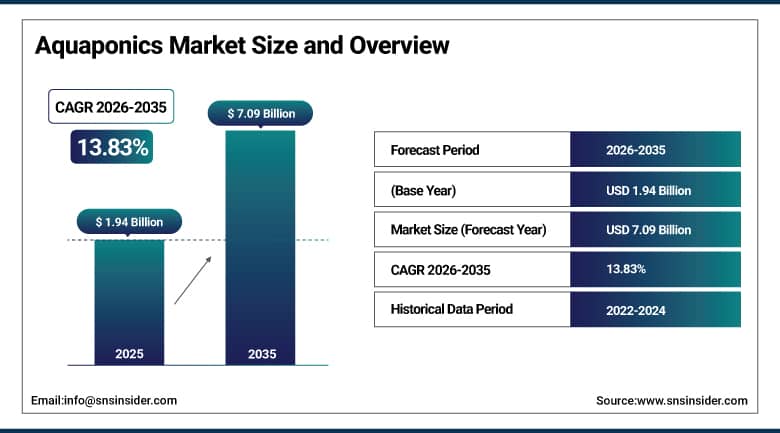
Aquaponics Market was valued at USD 1.94 billion in 2025 and is expected to reach USD 7.09 billion by 2035, growing at a CAGR of 13.83% from 2026-2035.
The aquaponics industry is expanding owing to increasing demand for sustainable agriculture, better water management, and organic products. Increased popularity of urban farming, technology improvements, and governmental backing also fuel growth. The combination of fish and crop farming increases efficiency, while environmental pressures and scarcity of agricultural lands encourage the use of efficient farming practices.
The U.S. Department of Agriculture's Alternative Agriculture Research Program has documented aquaponics systems achieving crop yields 3-5x higher per square foot than conventional soil farming while using 90% less water. The FAO's 2023 report on sustainable food systems specifically highlights aquaponics as a priority technology for addressing food security in water-scarce and land-constrained environments globally.
To Get More Information On Aquaponics Market - Request Free Sample Report
Aquaponics Market Trends
-
IoT-enabled sensor networks monitoring water pH, dissolved oxygen, ammonia, and temperature in real time are enabling remote management of commercial aquaponics facilities with minimal on-site staffing requirements.
-
Solar-powered aquaponics systems are gaining adoption in off-grid and developing market contexts where energy cost reduction directly improves system economics and enables deployment in regions without reliable grid power.
-
Vertical aquaponics stacking growing trays in a column fed by a single fish tank below is expanding the yield per square meter achievable in urban indoor farming applications where real estate cost is the primary economic constraint.
-
Restaurant and hospitality aquaponics installations where fish and greens grown on-site supply kitchen operations are building consumer brand narratives around freshness and sustainability that generate premium pricing.
-
Tilapia remains the dominant fish species in commercial aquaponics globally due to its tolerance of high-density rearing, omnivorous diet, rapid growth rate, and consumer familiarity across global food cultures.
-
Aquaponics certification programs and organic food label compatibility are expanding as regulatory frameworks in the U.S., EU, and Australia clarify organic status for aquaponically grown produce.
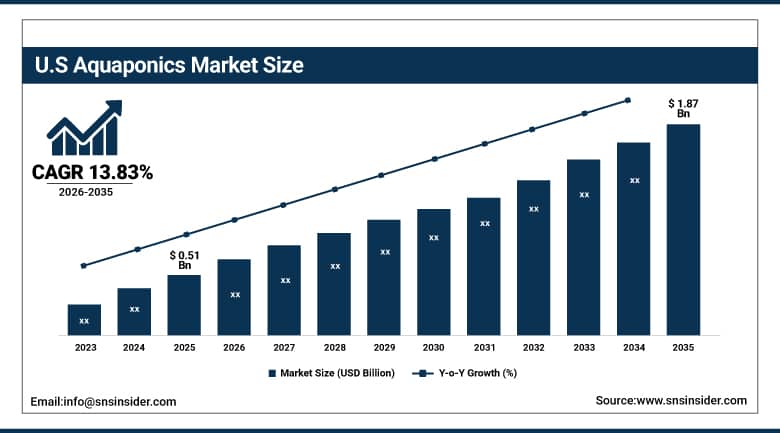
U.S. Aquaponics Market was valued at USD 0.51 billion in 2025 and is expected to reach USD 1.87 billion by 2035, growing at a CAGR of 13.83% from 2026-2035.
The United States leads in the global Aquaponics Market, holding dominant position in North-America, drive by concentration of commercial aquaponics operators, increasing consumer demand for local and organic food, active university research programs, and USDA grant programs supporting technology development for sustainable agriculture. However, there are companies such as Nelson and Pade Inc., Pentair Aquatic Eco-Systems, and Growing Power which all have set up their own commercial-scale aquaponic operations but are geared to direct-to-consumer as well as for the restaurant supply market.
The USDA's Economic Research Service documents that U.S. consumers pay a 20-30% premium for locally grown produce, creating the pricing environment that supports aquaponics economics in urban markets. The National Organic Program has clarified that aquaponics-grown crops can qualify for organic certification when systems meet specific soil biology requirements, expanding the addressable premium market for aquaponics produce.
Aquaponics Market Segment Analysis
-
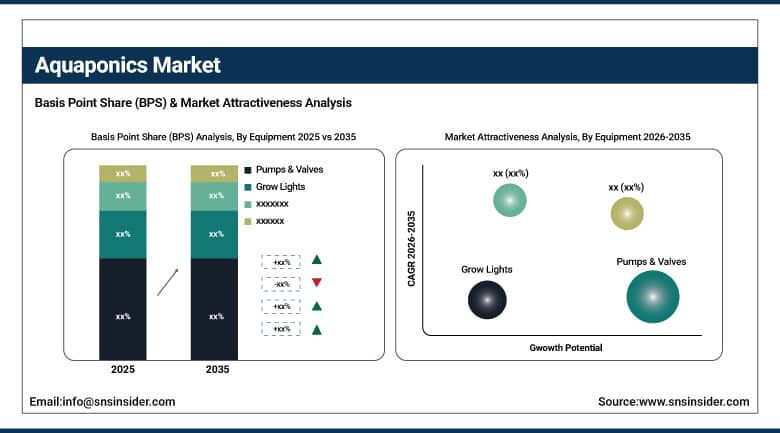
By Equipment, Pumps & Valves segment dominated the Aquaponics Market in 2025; Grow Lights fastest growing (CAGR).
-
By Component, Rearing Tank segment dominated the Aquaponics Market in 2025; Bio-filters fastest growing (CAGR ~14.2%).
-
By Facility Type, Greenhouse segment dominated the Aquaponics Market in 2025; Indoor Farm/Building fastest growing (CAGR).
-
By Growing Mechanism, Media Filled Grow Beds segment dominated the Aquaponics Market in 2025; Nutrient Film Technique growing steadily.
By Equipment, Pumps & Valves segment dominates the Aquaponics Market, Grow Lights expected to grow fastest
Pumps and Valves held the dominant equipment revenue share in 2025, reflecting the fundamental role that water circulation plays in aquaponics system operation. Without reliable, continuous water movement through the system from fish tank through mechanical and biological filtration to plant beds and back the closed-loop symbiosis that makes aquaponics function breaks down within hours. Aquaponics farms use submersible pumps and inline pumps to move water throughout the system at flow rates matched to fish biomass and plant bed volume. Valves regulate and control water flow between system zones, enabling operators to isolate sections for maintenance without disrupting the entire system.
Grow Lights are expected to register the fastest equipment CAGR through 2035, driven by the expansion of indoor aquaponics farming where natural light is unavailable or insufficient for year-round crop production. Modern LED grow lights specifically designed for aquaponics applications deliver targeted light spectra optimized for plant photosynthesis while minimizing heat generation that would destabilize the temperature-sensitive aquatic environment. The continuing decline in LED component costs has made grow light economics for indoor aquaponics increasingly competitive, while the performance improvement of modern horticultural LED arrays delivering higher photosynthetically active radiation (PAR) per watt than previous generations is improving crop yield per energy consumed.
By Component, Rearing Tank segment dominates the Aquaponics Market, Bio-filters expected to grow fastest
Rearing Tanks dominated the component market revenue in 2025, reflecting their status as the foundational physical infrastructure of every aquaponics installation. From small home-based glass aquarium setups to large-scale commercial operations using 50,000+ liter fiberglass or high-density polyethylene circular tanks, the fish rearing tank is where the system's biological productivity originates. Commercial operators use circular tanks with radial flow water entry that creates a rotational current helping to concentrate fish waste at the center drain a design that both cleans the tank continuously and maximizes stocking density relative to tank volume.
Bio-filters are anticipated to grow at the fastest component CAGR of approximately 14.2%, driven by the recognition that biological filtration is the rate-limiting subsystem in aquaponics scaling. Bio-filters convert ammonia toxic to fish at elevated concentrations to nitrite and then to nitrate through the action of nitrifying bacteria colonizing the bio-filter media. Without adequate bio-filtration capacity, increasing fish stocking density rapidly degrades water quality and limits system productivity. As commercial operators seek to maximize fish yield per system volume, bio-filter capacity must scale proportionally, driving both replacement purchasing and new installation procurement.
By Facility Type, Greenhouse segment dominates the Aquaponics Market, Indoor Farm/Building expected to grow fastest
Greenhouse facilities held the dominant facility type share in 2025. Greenhouses offer aquaponics operators the optimal balance of natural light availability, climate control capability, and capital cost efficiency. Passive solar greenhouse designs are particularly well-suited to aquaponics because the thermal mass of the fish tanks and water volume provides free temperature buffering that reduces heating and cooling loads. Growing methods compatible with greenhouse aquaponics span the full range deep water culture, nutrient film technique, media-filled grow beds, and vertical growing systems all work effectively in greenhouse environments.
Indoor farms based in buildings warehouses, repurposed commercial spaces, and purpose-built vertical farming facilities are anticipated to grow at the fastest facility type CAGR through 2035. The urban farming imperative driving this growth is geographical rather than technical: the highest-value markets for locally grown aquaponics produce are in dense urban cores where greenhouse land is unavailable, but warehouse space can be repurposed for vertical food production. Indoor aquaponics eliminates weather dependence entirely, enabling 365-day production with precise climate control that optimizes both fish and plant growth rates.
Aquaponics Market Regional Analysis
|
Region |
Major Country |
Share within Region (%) |
|---|---|---|
|
North America |
United States |
85% |
|
Europe |
Netherlands |
28% |
|
Asia Pacific |
China |
45% |
|
Middle East & Africa |
UAE |
40% |
|
Latin America |
Brazil |
48% |
North America Aquaponics Market Insights
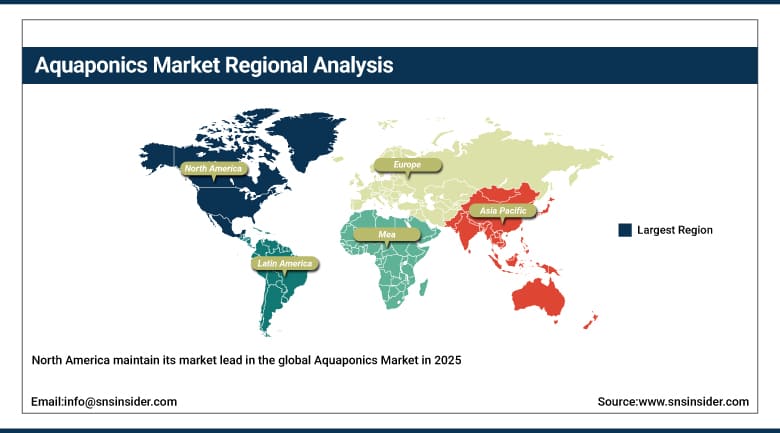
North America maintain its market lead in the global Aquaponics Market in 2025 due to growing consumer preference for locally grown organic food, grants supporting sustainable agriculture innovation, and the presence of the developed commercial aquaponics ecosystem since 1990s. The sustainable U.S. market is enhanced by the USDA's active support of alternative agricultural systems, the availability of university extension programs to train new commercial aquaponics entrepreneurs, and a market driven by restaurants and the food service sector actively marketing local and sustainably produced food to price-tolerant consumers. The urban farming sector in Canada, specifically Ontario and British Columbia, is a rising player in establishing regional markets, with climate-controlled indoor aquaponics systems providing year-round local food to cold-climate cities.
The USDA's Sustainable Agriculture Research & Education program has funded over 100 aquaponics research and demonstration projects since 2010. Wisconsin Department of Agriculture data documents that aquaponics operations in the state collectively employ over 500 full-time equivalent workers and generate annual revenue exceeding USD 25 million illustrating the commercial maturity of the sector in a leading U.S. state market.
Get Customized Report as Per Your Business Requirement - Enquiry Now
Asia Pacific Aquaponics Market Insights
Asia Pacific is set to be the fastest-growing regional Aquaponics Market owing to the rapidly dwindling freshwater supplies in the densely populated nations, the burgeoning demand for premium quality fresh food from the growing middle-class consumers, and through government food security initiatives which directly endorse aquaponics as a sustainable food technology. China strategy of food security and environmental protection is opening up great opportunities for commercial aquaponics. Aquaponics are getting a boost in policy interest due India's increasing urban population and simultaneous water stress crises affecting agricultural regions. Japan, with its land-constrained food production system and established tradition of precision agriculture, is a sophisticated early adopter of advanced aquaponics technology.
China's Ministry of Agriculture and Rural Affairs has incorporated aquaponics into its 14th Five-Year Plan for smart agriculture development, with pilot demonstration projects underway in 15 provinces. India's National Innovation Foundation has identified aquaponics as a priority food technology innovation for water-scarce regions, with development grants available through the Department of Biotechnology's agricultural biotechnology programs.
Europe Aquaponics Market Insights
Europe holds an important position in the global Aquaponics Market, with the Netherlands, Germany, France, and Belgium as the leading national markets. The Netherlands' world-class expertise in greenhouse agriculture and controlled environment food production makes it the most technologically sophisticated national aquaponics market in Europe, with several commercial operations operating at scales that serve major retail and food service buyers. European consumer willingness to pay premium prices for locally grown, certified organic, and sustainably produced food directly supports aquaponics economics. EU agricultural innovation funding through Horizon Europe has supported aquaponics research projects including the COST Action Aquaponics Hub, which has developed commercial scale-up frameworks that are being adopted by European operators.
The EU's Farm to Fork Strategy targets a 50% reduction in pesticide use and 20% reduction in fertilizer use by 2030, policy goals that aquaponics inherently addresses through its chemical-free production model. The European Parliament's report on urban food production identified aquaponics as a priority technology for integrating food production into urban planning frameworks across EU member states.
Middle East & Africa and Latin America Aquaponics Market Insights
The Middle East represents a structurally compelling aquaponics market because the region's extreme freshwater scarcity with per-capita freshwater availability among the lowest globally makes the technology's 90%+ water use reduction versus soil farming directly relevant to national food security strategy. UAE and Saudi Arabia are investing in urban vertical farming and aquaponics as components of their food import dependency reduction programs under Vision 2030 and UAE Food Security Strategy 2051. Israel's agricultural technology expertise including world-leading drip irrigation, greenhouse management, and controlled environment agriculture is being applied to aquaponics scale-up with characteristic Israeli innovation efficiency. In Latin America, Brazil's diverse climate, large aquaculture industry, and growing consumer interest in sustainable food production create favorable conditions for aquaponics market development, particularly in the subtropical southern states.
Saudi Arabia's Ministry of Environment, Water and Agriculture's food security programs explicitly include controlled environment agriculture and aquaponics in their import substitution strategy. UAE's Emirates Food Security Council has identified aquaponics as a priority technology in the National Food Security Strategy, with government grants supporting pilot commercial aquaponics installations at multiple locations across the Emirates.
Aquaponics Market Growth Drivers:
-
Rising global food security concerns and sustainable farming demand driving rapid aquaponics market adoption worldwide
Market growth for aquaponics is fundamentally based on the existence of three drivers, all of which are independently exhibiting strictly exponential growth on separate time frames. These include the growth in consumer demand for locally-sourced, natural food without chemical preservatives; the increasingly critical nature of water shortages leading to a situation where irrigating crop farms becomes unsustainable within many major agricultural zones; and worldwide urban population expansion such that there is a consolidation of food demands that cannot be served by conventional farms. Each of these individually drives demand for aquaponics; however, the simultaneous existence of all three drivers leads to an interaction effect that results in much stronger market force than any one of the individual factors could on its own. When someone living in the city desires locally-grown food, with no pesticides used, but the city's water is under threat, and the person's inability to source food from the farm leaves no alternative, then the ability of aquaponics to resolve all three dilemmas simultaneously creates a value proposition that nothing else can replicate.
The UN Food and Agriculture Organization projects that global food demand will increase by 50% by 2050 while freshwater availability per person decreases by 40% under current climate trajectories. The World Resources Institute identifies aquaponics and hydroponic systems as among the highest-priority technologies for closing the projected food production gap sustainably.
Aquaponics Market Restraints:
-
High system sensitivity to environmental changes and operational complexity limiting aquaponics adoption among new market entrants
Aquaponics systems are more operationally demanding than most agricultural alternatives, and that complexity is a genuine adoption barrier for potential commercial operators without biological systems expertise. The interdependence of fish and plant health means that a water quality disruption pH shift, ammonia spike, dissolved oxygen drop simultaneously affects both production streams, creating double the crop loss risk of either standalone aquaculture or hydroponics. Equipment failures such as pump failure or aeration system failure can cause total system loss within hours if not detected and corrected, making continuous monitoring and rapid response capability operationally essential. The steep learning curve of aquaponics system management requiring working knowledge of fish physiology, plant nutrition, water chemistry, and mechanical system operation — limits the available labor pool and raises management cost above comparable-area conventional farming operations. These operational challenges are manageable with adequate training and backup systems, but they add cost and complexity that slow adoption among risk-averse agricultural investors.
Aquaponics Market Opportunities:
-
IoT automation and urban farming integration creating transformative commercial opportunities for global aquaponics market growth
Combining IoT sensor technologies with AI-powered monitoring and automatic control mechanisms is revolutionizing the complexity of operation in aquaponics. Where constant monitoring through intelligent sensors and automated measures that prevent potential risks before the situation reaches the threshold level ensures system failures can be effectively addressed and avoided, the worst-case scenario of the past that prevented operators from undertaking the venture due to high risks becomes less relevant. Being able to remotely monitor system performance and receive notifications on their smartphones, operators who used to have to stay physically present in the facility at all times now have the ability to manage the operation remotely. By reducing the skill level and manual work involved in operating the aquaponics facility, this technological development directly addresses the two major issues associated with adoption and makes the venture accessible to anyone with an interest and agricultural or food business experience.
Recent Developments:
-
2026: Plenty Unlimited expanded its indoor aquaponics vertical farming operations with a new 100,000 square foot facility in Compton, California, combining tilapia aquaculture with vertical leafy green production under a fully automated AI management system that monitors 30,000 sensor data points per second across fish and plant systems, achieving produce unit costs competitive with conventional greenhouse farming.
-
2025: Nelson and Pade Inc. launched its Commercial Aquaponics Pro 3.0 system featuring integrated IoT monitoring with cloud-based AI analytics, automated fish feeding based on real-time biomass estimation, and predictive water quality modeling that anticipates system imbalances 12-24 hours before they become critical, targeting commercial operators seeking to reduce labor intensity while improving production reliability.
-
2025: Bader Farms entered a commercial partnership with FreshBox Farms to deploy containerized aquaponics units across five U.S. cities, each producing 500kg of tilapia and 2,000kg of leafy greens annually from a standard 40-foot shipping container format that can be installed in urban locations without building modification or water utility infrastructure upgrades.
Aquaponics Market Key Players
Some of the Aquaponics Market Companies
-
Nelson and Pade Inc.
-
Aquaponics Association
-
Pentair Aquatic Eco-Systems, Inc.
-
Systeme Aquaponics
-
UrbanKisaan
-
Aqua Farming Technologies
-
Aquaponics UK
-
Backyard Aquaponics Pty Ltd.
-
FishStory Aquaponics
-
Advancing Eco Agriculture
-
AquaSprouts
-
Bright Agrotech (Plenty)
-
Ouroboros Farms
-
aquaponics.co.za
-
Growponics
-
Superior Fresh LLC
-
FreshBox Farms
-
Fish & Greens Co.
-
ECF Farmsystems GmbH
-
Ecolife Aquaponics
Aquaponics Market Report Scope
| Report Attributes | Details |
|---|---|
| Market Size in 2025 | USD 1.94 Billion |
| Market Size by 2035 | USD 7.09 Billion |
| CAGR | CAGR of 13.83% From 2026 to 2035 |
| Base Year | 2025 |
| Forecast Period | 2026-2035 |
| Historical Data | 2022-2024 |
| Report Scope & Coverage | Market Size, Segments Analysis, Competitive Landscape, Regional Analysis, DROC & SWOT Analysis, Forecast Outlook |
| Key Segments | • By Equipment (Pumps & Valves, Grow Lights, Aeration Systems, Water Heaters, Others) • By Component (Rearing Tank, Bio-filters, Mechanical Filters, Others) • By Facility Type (Greenhouse, Indoor Farm/Building, Others) • By Growing Mechanism (Media Filled Grow Beds, Nutrient Film Technique, Deep Water Culture, Others) |
| Regional Analysis/Coverage | North America (US, Canada), Europe (Germany, UK, France, Italy, Spain, Russia, Poland, Rest of Europe), Asia Pacific (China, India, Japan, South Korea, Australia, ASEAN Countries, Rest of Asia Pacific), Middle East & Africa (UAE, Saudi Arabia, Qatar, South Africa, Rest of Middle East & Africa), Latin America (Brazil, Argentina, Mexico, Colombia, Rest of Latin America). |
| Company Profiles | Nelson and Pade Inc., Aquaponics Association, Pentair Aquatic Eco-Systems, Inc., Systeme Aquaponics, UrbanKisaan, Aqua Farming Technologies, Aquaponics UK, Backyard Aquaponics Pty Ltd., FishStory Aquaponics, Advancing Eco Agriculture, AquaSprouts, Bright Agrotech (Plenty), Ouroboros Farms, aquaponics.co.za, Growponics, Superior Fresh LLC, FreshBox Farms, Fish & Greens Co., ECF Farmsystems GmbH, Ecolife Aquaponics |

Frequently Asked Questions
Ans: North America dominated the Aquaponics Market in 2025.
Ans: The Bio-filters segment is expected to register the fastest CAGR of approximately 14.2% through 2035.
Ans: The Pumps & Valves segment dominated the Aquaponics Market in 2025.
Ans: The Aquaponics Market was valued at USD 1.94 billion in 2025.
Ans: The Aquaponics Market is expected to grow at a CAGR of 13.83% from 2026 to 2035.
