
Greenhouse Horticulture Market Report Scope & Overview:
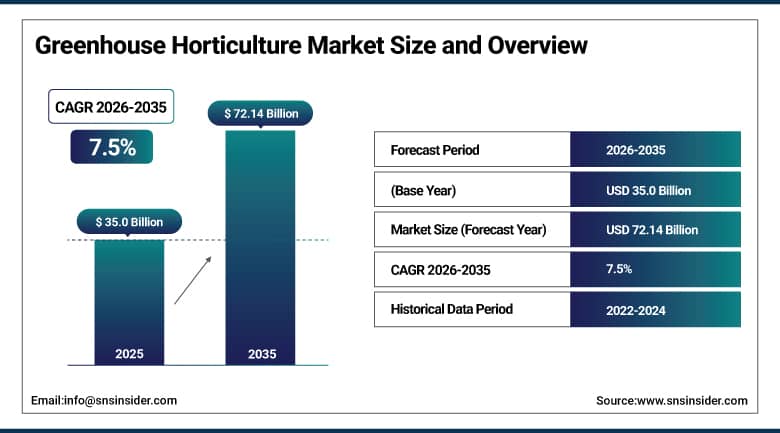
The Greenhouse Horticulture Market was valued at USD 35.0 Billion in 2025 and is expected to reach USD 72.14 Billion by 2035, growing at a CAGR of 7.5% from 2026 to 2035.
The Greenhouse Horticulture Market continues to expand as rising food security concerns, increasing frequency of extreme weather events, and growing water scarcity push growers toward controlled-environment agriculture capable of delivering fresh, high-quality produce year-round regardless of outdoor conditions. Rapid urbanization and land constraints across major population centers continue reinforcing this shift, since greenhouse cultivation can deliver meaningfully higher yield per acre than open-field farming while consuming a fraction of the water. Growers are increasingly replacing single-layer structures with climate-tight facilities powered by on-site renewables, AI-guided fertigation, and high-efficacy LED lighting that together cut both operating costs and carbon footprint compared with earlier-generation greenhouse designs.
Costa Farms integrated Battlefield Farms into its operations in January 2025 to extend its floriculture production capacity, while Netafim launched GrowSphere in September 2024, a cloud platform linking hydraulic and agronomic data to help growers optimize irrigation and fertigation decisions across their greenhouse operations.
To Get More Information On Greenhouse Horticulture Market - Request Free Sample Report
Greenhouse Horticulture Market Trends
-
Growers are replacing single-layer structures with climate-tight facilities powered by on-site renewables and AI-guided fertigation.
-
Greenhouse-as-a-service contracts are converting lump-sum construction costs into predictable fees, widening access for mid-sized farmers.
-
Rising water scarcity concerns are accelerating adoption of precision irrigation and closed-loop nutrient recycling systems.
-
Legalized cannabis cultivation across multiple jurisdictions is driving demand for controlled-environment agriculture facilities.
-
High-efficacy LED lighting adoption is extending growing seasons while reducing per-unit energy consumption.
United States Greenhouse Horticulture Market Outlook
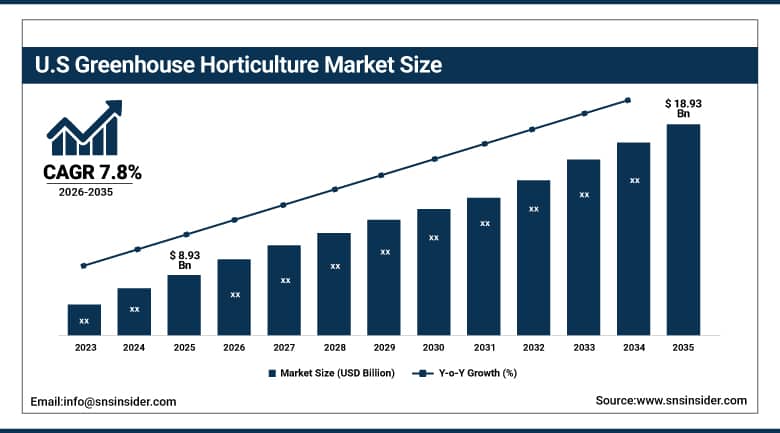
The United States Greenhouse Horticulture Market was valued at USD 8.93 Billion in 2025 and is expected to reach USD 18.93 Billion by 2035, growing at a CAGR of 7.8% from 2026 to 2035.
The United States maintained a leading position in North American greenhouse horticulture demand, driven by growing consumer awareness of food safety and the benefits of fresh, high-nutrient produce available year-round. The legalization of cannabis cultivation in several states continued influencing demand for controlled-environment agriculture facilities optimized for precise growth conditions, and continued investment in domestic pharmaceutical ingredient sourcing kept the country among the more commercially significant national markets for advanced greenhouse infrastructure.
Bright Green, one of the few companies licensed by the Drug Enforcement Administration, announced plans in October 2024 to invest USD 15 million in growing cannabis and opium poppies across seventy acres of high-security greenhouses in New Mexico, aiming to deliver FDA-approved pharmaceutical ingredients sourced from plants for the localized American market.
Greenhouse Horticulture Market Segment Analysis
-
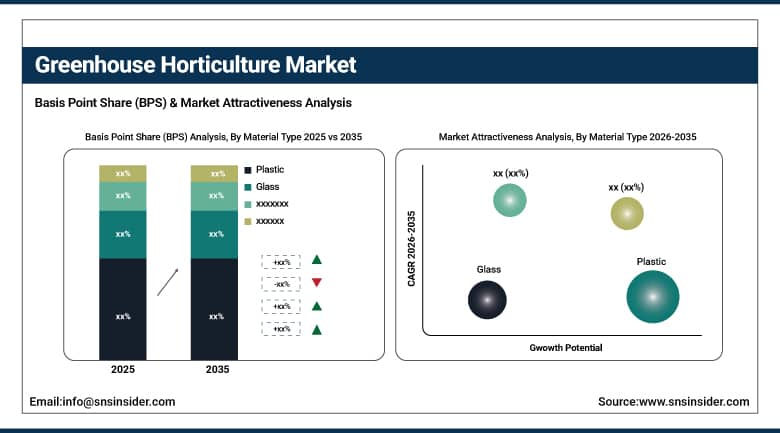
By Material Type, the Plastic segment held approximately 57% share in 2025, while the Glass segment is the fastest growing.
-
By Component, the Hardware segment held approximately 60% share in 2025, while the Services segment is the fastest growing.
-
By Crop Type, the Fruits, Vegetables & Herbs segment held the largest share in 2025, while the Flowers & Ornamentals segment is the fastest growing.
-
By Technology, the Traditional Greenhouses segment held approximately 62% share in 2025, while the Smart/Automated Greenhouses segment is the fastest growing.
-
By Structure Type, the Gutter-Connected/Multi-span segment held approximately 54% share in 2025, while the Freestanding/Hoop House segment is the fastest growing.
-
By Application, the Commercial Cultivation segment held approximately 72% share in 2025, while the Research & Academic segment is the fastest growing.
By Material Type, Plastic led the market, Glass grew fastest
The plastic segment held the highest revenue share of over 57% in terms of material type and will expand further at a significant rate as it is highly versatile with great adaptability to different climate zones, as well as structure sizes. Polyethylene and polyvinyl chloride materials are still very popular choices for greenhouse frame and cover construction, particularly in dry and semi-arid regions of the world where a UV-stabilized film can trap heat (and humidity) to maintain optimum microclimate conditions for plants; that combination of low cost with climate-control capability will keep plastic atop most rankings by a wide margin compared.
The Glass segment is estimated to grow at the highest CAGR over the period of forecast, owing to an increase in high-value horticulture and specialty crop production that requires better environmental control. Glass structures provide better humidity, temperature and light exposure management for growing crops such as tomatoes, cucumbers, peppers, strawberries and ornamental flowers than plastic ones can offer; a performance advantage that still attracts growers targeting premium retail and export markets in which uniformity and shelf life are important.
By Component, Hardware led the market, Services grew fastest
The Hardware segment held the largest component share in 2025, at approximately 60%, anchored by the physical structures, frames, glazing materials, and climate-control equipment that form the foundational capital investment for any greenhouse operation. Growers continue prioritizing durable, weather-resistant hardware capable of withstanding years of continuous operation, and that necessary physical infrastructure layer keeps hardware firmly at the top of the component segmentation across nearly every greenhouse installation worldwide.
The Services segment is projected to grow at the fastest CAGR during the forecast period, as greenhouse-as-a-service contracts increasingly convert lump-sum construction bills into predictable ongoing fees that widen access for mid-sized farmers who previously lacked collateral for large construction loans. Growing demand for installation, maintenance, agronomic consulting, and remote monitoring services continues pushing this segment's growth well ahead of the broader component category as growers increasingly outsource specialized technical expertise rather than building it in-house.
By Crop Type, Fruits, Vegetables & Herbs led the market, Flowers & Ornamentals grew fastest
The Fruits, Vegetables & Herbs segment held the largest crop type share in 2025, reflecting sustained consumer demand for fresh, pesticide-free produce available every week of the year regardless of outdoor growing season. Retailers increasingly seek greenhouse-grown produce specifically to guarantee consistent supply and quality, and that retail-driven demand keeps this crop category firmly at the center of overall greenhouse horticulture investment across nearly every major agricultural region.
The Flowers & Ornamentals segment is projected to grow at the fastest CAGR during the forecast period, driven by expanding floriculture production capacity and rising consumer spending on ornamental plants for both residential and commercial landscaping applications. Growers consolidating floriculture operations through acquisition and capacity expansion continue reinforcing this segment's above-average growth trajectory relative to the broader crop type segmentation.
By Technology, Traditional Greenhouses led the market, Smart/Automated Greenhouses grew fastest
The Traditional Greenhouses segment dominated the technology category in 2025, holding approximately 62% of total revenue, reflecting the sheer scale of existing basic and mid-tier greenhouse infrastructure already in operation across smaller commercial farms and family-run horticultural businesses worldwide. These structures remain the most economically accessible entry point into protected cultivation, and that affordability continues keeping traditional, non-automated greenhouses the dominant technology category across the broader installed base globally.
The Smart/Automated Greenhouses segment is projected to grow at the fastest CAGR during the forecast period, propelled by rising integration of sensor networks, AI-guided fertigation, and remote climate-control systems that let growers optimize yield and resource use with considerably less manual labor. As sensor and automation hardware costs continue falling, smart greenhouse adoption is climbing especially quickly among high-value specialty crop and premium export-oriented growers seeking the yield consistency automated systems deliver.
By Structure Type, Gutter-Connected/Multi-span led the market, Freestanding/Hoop House grew fastest
The Gutter-Connected/Multi-span segment held the largest structure type share in 2025, at approximately 54%, favored by large commercial operators because connecting multiple growing bays under a shared roofline reduces per-square-foot construction and heating costs at scale. That economy-of-scale advantage keeps multi-span structures the preferred choice for large-scale commercial vegetable and floriculture operations investing in significant new growing capacity.
The Freestanding/Hoop House segment is projected to grow at the fastest CAGR during the forecast period, driven by rising adoption among smaller farms, urban agriculture operators, and growers in emerging markets who need lower-cost, faster-to-erect structures that do not require the substantial upfront capital multi-span facilities demand. That lower barrier to entry continues expanding freestanding structure adoption across a meaningfully wider base of smaller-scale growers than multi-span facilities can economically reach.
By Application, Commercial Cultivation led the market, Research & Academic grew fastest
The Commercial Cultivation segment held the largest application share in 2025, at approximately 72%, anchored by large-scale vegetable, fruit, and floriculture operations supplying retail, wholesale, and export markets. The sheer scale of commercial growing operations relative to research or retail nursery applications keeps this application category firmly at the center of overall greenhouse horticulture demand across nearly every major producing region.
The Research & Academic segment is projected to grow at the fastest CAGR during the forecast period, driven by rising university and government investment in controlled-environment agriculture research, plant breeding programs, and climate-resilience crop trials. Growing public and private funding for agricultural technology research continues expanding demand for specialized research greenhouse facilities, pushing this segment's growth rate ahead of the broader application segmentation even though it remains a comparatively small share of total market revenue.
Regional Insights
|
Region |
Major Country |
Share within Region, 2025 (%) |
|---|---|---|
|
Europe |
Netherlands |
26.0% |
|
North America |
United States |
85.0% |
|
Asia Pacific |
China |
36.0% |
|
Middle East & Africa |
UAE |
27.0% |
|
Latin America |
Mexico |
38.0% |
Europe Greenhouse Horticulture Market Insights
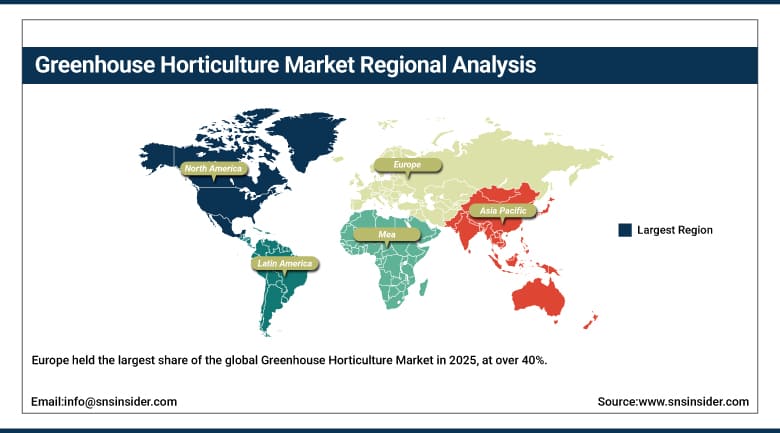
Europe held the largest share of the global Greenhouse Horticulture Market in 2025, at over 40%, supported by the continent's long-established horticulture tradition, dense concentration of advanced growing technology suppliers, and strong consumer demand for locally grown, high-quality produce. Government policy across the region continues favoring sustainable, water-efficient agricultural practices, and that regulatory backdrop keeps Europe firmly ahead of every other region in overall greenhouse horticulture investment and technology adoption.
The Netherlands accounted for roughly 26% of regional revenue, supported by its globally recognized expertise in high-tech greenhouse design, climate control systems, and horticultural research. Germany, France, and Spain contributed significant additional regional demand through their own established greenhouse cultivation industries, reinforcing Europe's position as the clear global leader in both greenhouse horticulture technology and cultivated acreage.
Get Customized Report as Per Your Business Requirement - Enquiry Now
North America Greenhouse Horticulture Market Insights
North America held a substantial share of the global Greenhouse Horticulture Market in 2025, driven by growing consumer awareness of food safety benefits and the expansion of controlled-environment agriculture for both food and pharmaceutical crop production. The United States accounted for roughly 85% of regional revenue, reflecting its concentration of large-scale commercial greenhouse operators and cannabis cultivation facilities.
Canada contributed a smaller but steadily growing share of regional revenue, supported by its own expanding greenhouse vegetable and cannabis cultivation industry. That combination of food security investment and specialty crop cultivation kept North America among the more commercially significant regional markets for greenhouse horticulture throughout the year.
Asia Pacific Greenhouse Horticulture Market Insights
Asia Pacific was the fastest-growing region in the global Greenhouse Horticulture Market, propelled by increasing urbanization, shrinking arable land per capita, and innovative agricultural practices supported by government-backed smart farming initiatives across China, Japan, and South Korea. Rising middle-class food spending and growing demand for pesticide-free, traceable produce continued accelerating greenhouse adoption across the region's largest agricultural economies.
China accounted for roughly 36% of regional revenue, supported by aggressive government investment in smart farming infrastructure and expanding protected cultivation acreage. Japan and South Korea contributed significant additional regional demand through their own advanced greenhouse technology adoption, with South Korea's smart farming land area under greenhouse horticulture continuing to expand steadily year over year, reinforcing Asia Pacific's position as the clear growth leader in this market.
MEA & Latin America Greenhouse Horticulture Market Insights
The Middle East and Africa region recorded steady growth in greenhouse horticulture adoption in 2025, driven by water scarcity concerns and government-backed food security initiatives across the Gulf states in particular. The UAE accounted for roughly 27% of regional revenue, supported by national food security strategy investment and rising demand for domestically grown produce in a region historically dependent on food imports.
Latin America expanded at a comparable pace, led by Mexico at roughly 38% of regional revenue, where growing greenhouse vegetable exports to North America continued to support category growth. Brazil and Colombia followed a similar trajectory as regional floriculture and vegetable export industries expanded further through the remainder of the forecast period.
Growth Drivers: Food security concerns and climate-driven demand for controlled cultivation
Growing food security concerns and rising demand for fresh, high-quality produce available year-round continue to be the central force behind greenhouse horticulture market growth. Increasing frequency of extreme weather events, including droughts, floods, and unseasonable temperature swings, continues undermining open-field crop yield reliability, pushing growers and retailers alike toward controlled-environment agriculture that can maintain consistent output regardless of outdoor conditions.
Growing concern for water scarcity and rapid, parallel urbanization with a limiting land footprint is further bolstering this structural transition as greenhouse cultivation provides substantially greater yield per acre along with much lower opex (operating expense) on precious water when compared to similar open field farming. The growing population and related food security issues have driven the adoption of controlled-environment agriculture, in particular to improve yield but also quality – a demand driver that shows no sign of slowing across almost all major agricultural regions globally.
Restraints: High upfront construction costs and energy-intensive operations
The substantial capital investment required to construct advanced, climate-controlled greenhouse infrastructure continues to restrict adoption among smaller farmers and operators working with constrained budgets. Energy-intensive climate control, lighting, and automation systems contribute to elevated ongoing utility costs, and those operational expenses can meaningfully affect the economics of greenhouse cultivation relative to conventional open-field farming, particularly in regions with high energy prices.
Potential investors, especially smaller-scale farmers or those in emerging regions, may be discouraged from entering the market given the high upfront expense of building advanced infrastructure and equipment within greenhouses. That cost barrier continues to concentrate large-scale, technology-intensive greenhouse investment among well-capitalized commercial operators, even as smaller growers increasingly explore service-based and shared-infrastructure models to reduce their own capital exposure.
Opportunities: Expanding greenhouse-as-a-service models and floriculture demand
Growing adoption of greenhouse-as-a-service contracts presents substantial opportunity for suppliers positioned to serve mid-sized farmers who previously lacked collateral for large construction loans, converting lump-sum capital expenditure into predictable ongoing fees that widen the addressable customer base considerably. Suppliers capable of bundling financing, construction, and ongoing technical support into a single service offering stand to capture a growing share of demand from operators who want greenhouse capability without the full upfront capital commitment.
The increasing demand for floriculture and ornamental horticulture presents a further significant opportunity, as rising consumer spending on ornamental plants for residential and commercial landscaping continues expanding beyond the market's traditional food-crop stronghold. Growers and technology suppliers positioned to serve this expanding floriculture demand, alongside continued specialty pharmaceutical crop cultivation opportunities, stand to capture meaningful new revenue streams through 2035.
Recent Developments:
-
2024: Kubo unveiled the world's first CO2-negative glasshouse, combining renewable heat pumps with solar roofs to deliver a genuinely carbon-negative growing environment for commercial horticulture operations.
-
2024: Cox Farms surpassed 700 acres under cover after acquiring Greenhill Produce and other assets, significantly expanding its commercial greenhouse cultivation footprint.
-
2024: Bright Green announced plans to invest USD 15 million in cannabis and opium poppy cultivation across seventy acres of high-security greenhouses in New Mexico, targeting FDA-approved pharmaceutical ingredient production.
Greenhouse Horticulture Market Key Players
-
Costa Farms
-
Kubo
-
Netafim Limited
-
Cox Farms
-
Bright Green Corporation
-
Certhon
-
Richel Group
-
Van der Hoeven Horticultural Projects
-
Agra Tech, Inc.
-
Prospiant, Inc.
-
Nexus Corporation
-
GGS Structures Inc.
-
Ceres Greenhouse Solutions
-
Harnois Greenhouses
-
Cravo Equipment Ltd.
-
Priva B.V.
-
Hoogendoorn Growth Management
-
Argus Control Systems Ltd.
Greenhouse Horticulture Market Report Scope:
| Report Attributes | Details |
|---|---|
| Market Size in 2025 | USD 35 Billion |
| Market Size by 2035 | USD 72.14 Billion |
| CAGR | CAGR of 7.5% From 2026 to 2035 |
| Base Year | 2025 |
| Forecast Period | 2026-2035 |
| Historical Data | 2022-2024 |
| Report Scope & Coverage | Market Size, Segments Analysis, Competitive Landscape, Regional Analysis, DROC & SWOT Analysis, Forecast Outlook |
| Key Segments | • by Material Type (Plastic and Glass) • by Component (Hardware, Software, and Services) • by Crop Type (Fruits, Vegetables & Herbs, Flowers & Ornamentals, and Others) • by Technology (Traditional Greenhouses and Smart/Automated Greenhouses) • by Structure Type (Gutter-Connected/Multi-span and Freestanding/Hoop House) • by Application (Commercial Cultivation, Research & Academic, and Retail Nursery) |
| Regional Analysis/Coverage | North America (US, Canada, Mexico), Europe (Eastern Europe [Poland, Romania, Hungary, Turkey, Rest of Eastern Europe] Western Europe] Germany, France, UK, Italy, Spain, Netherlands, Switzerland, Austria, Rest of Western Europe]), Asia Pacific (China, India, Japan, South Korea, Vietnam, Singapore, Australia, Rest of Asia Pacific), Middle East & Africa (Middle East [UAE, Egypt, Saudi Arabia, Qatar, Rest of Middle East], Africa [Nigeria, South Africa, Rest of Africa], Latin America (Brazil, Argentina, Colombia, Rest of Latin America) |
| Company Profiles | Costa Farms, Kubo, Netafim Limited, Cox Farms, Bright Green Corporation, Certhon, Dalsem, Richel Group, Van der Hoeven Horticultural Projects, Agra Tech, Inc., Prospiant, Inc., Nexus Corporation, GGS Structures Inc., Stuppy Greenhouse, Ceres Greenhouse Solutions, Harnois Greenhouses, Cravo Equipment Ltd., Priva B.V., Hoogendoorn Growth Management, Argus Control Systems Ltd. |

Frequently Asked Questions
The Plastic segment held approximately 57% share in 2025.
Europe held the largest share of the Greenhouse Horticulture Market in 2025, at over 40%, while Asia Pacific was the fastest-growing region.
The Greenhouse Horticulture Market is expected to grow at a CAGR of 7.5% from 2026 to 2035.
The Greenhouse Horticulture Market was valued at USD 35.0 Billion in 2025.
Rising food security concerns combined with increasing frequency of extreme weather events and water scarcity is the major growth factor.
