
Food and Beverage Processing Facility Construction Market Report Scope & Overview:
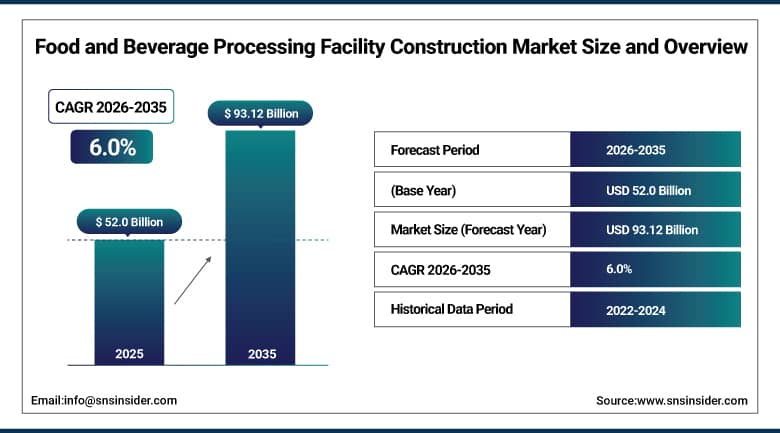
The Food and Beverage Processing Facility Construction Market was valued at USD 52.0 Billion in 2025 and is expected to reach USD 93.12 Billion by 2035, growing at a CAGR of 6.0% from 2026 to 2035.
The Food and Beverage Processing Facility Construction Market continues to expand as processors respond to rising automation requirements, stricter food safety regulation, and sustained consumer demand for processed and packaged food by breaking ground on new greenfield plants and expanding existing facilities. Real-time capital project tracking across North America alone shows dozens of new food and beverage facility construction projects announced every month, with several exceeding one hundred million dollars in individual investment value, spanning dairy processing, meat and poultry, bakery, and beverage bottling categories. Continued modernization of legacy processing infrastructure, combined with growing foreign direct investment in emerging food processing hubs, keeps construction activity elevated across nearly every major food-producing region worldwide.
Chobani broke ground on a USD 1.2 billion dairy processing plant in Rome, New York in March 2025, with capacity to process 12 million pounds of milk daily, representing one of the largest single food processing facility investments announced in recent years, while Nestle USA announced in February 2025 an investment exceeding USD 675 million in a new beverage processing facility in Arizona dedicated to creamer production.
To Get More Information On Food and Beverage Processing Facility Construction Market - Request Free Sample Report
Food and Beverage Processing Facility Construction Market Trends
-
Meat, poultry, and dairy processors continue leading large-scale greenfield construction investment across North America.
-
Design-build delivery models are gaining preference for their ability to compress project timelines and control cost overruns.
-
Sustainability-focused construction, including on-site renewable energy integration, is increasingly standard for new processing facilities.
-
Automation-ready facility design is shaping construction specifications from the earliest planning stages.
-
Foreign direct investment continues flowing into new processing facility construction across emerging food production hubs.
U.S. Food and Beverage Processing Facility Construction Market Outlook
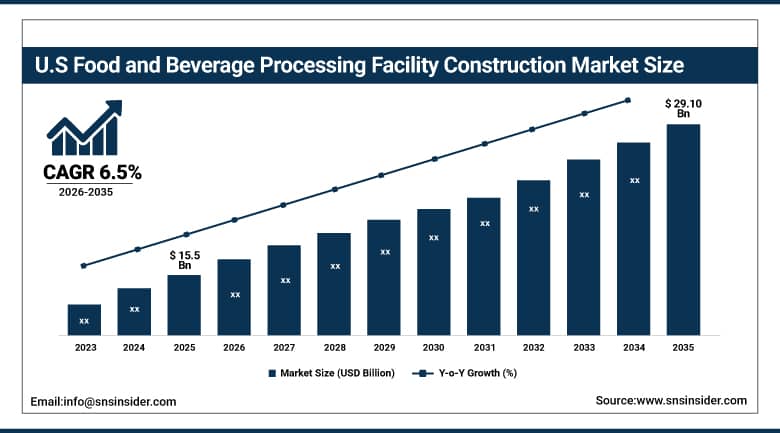
The U.S. Food and Beverage Processing Facility Construction Market was valued at USD 15.5 Billion in 2025 and is expected to reach USD 29.10 Billion by 2035, growing at a CAGR of 6.5% from 2026 to 2035.
The United States maintained a leading position in North American food and beverage processing facility construction demand, supported by sustained capital investment across dairy, meat and poultry, and beverage processing categories. Monthly capital project tracking continues to show dozens of new construction announcements across the country, with meat and poultry processing facilities representing some of the largest individual project values, and that sustained pace of announced investment kept the country among the most commercially significant national markets for processing facility construction services.
Producer Owned Beef announced in July 2024 an investment of USD 670 million for construction of a 750,000 square foot processing complex in Amarillo, Texas, while Agristo announced in February 2025 an investment of USD 450 million for a new processing facility in Grand Forks, North Dakota, reflecting continued large-scale domestic and foreign investment in American food processing infrastructure.
Food and Beverage Processing Facility Construction Market Segment Analysis
-
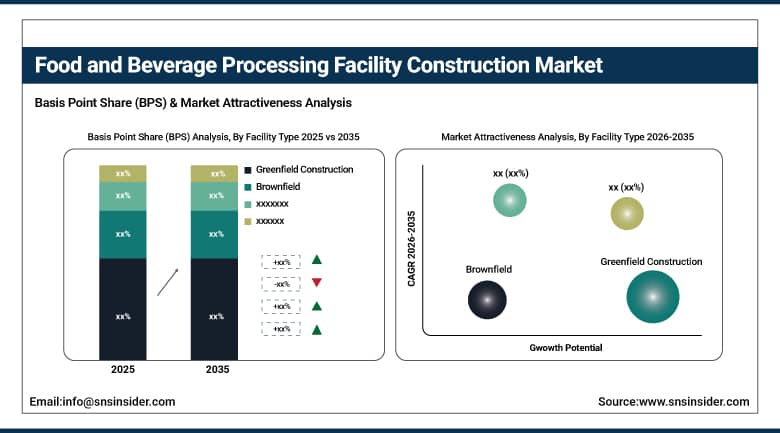
By Facility Type, the Greenfield Construction segment held approximately 55% share in 2025, while the Brownfield/Expansion segment is the fastest growing.
-
By Service Type, the General Construction & Building Envelope segment held approximately 45% share in 2025, while the Mechanical, Electrical & Plumbing/Process Utilities segment is the fastest growing.
-
By End-Use, the Dairy & Beverage Processing segment held the largest share in 2025, while the Meat & Poultry Processing segment is the fastest growing.
-
By Delivery Model, the Design-Build segment held approximately 48% share in 2025, while the Construction Management at Risk segment is the fastest growing.
-
By Facility Size, the Large-Scale/Mega Facilities segment held approximately 58% share in 2025, while the Mid-Scale Facilities segment is the fastest growing.
-
By Contractor Type, the General Contractors segment held approximately 63% share in 2025, while the Specialty/EPC Contractors segment is the fastest growing.
By Facility Type, Greenfield Construction led the market, Brownfield/Expansion grew fastest
In 2025, Greenfield Construction is the leading facility type with around 55% of total revenue share driven by major processors choosing to build brand new, purpose-built facilities over converting existing buildings which can't be retrofitted for modern automation and food safety standards. From the ground up, new-build projects allow processors complete control over facility layout and workflow efficiency as well as future expansion capacity as that flexibility remains optimal and keeps greenfield construction the go to choice for the biggest capital investment projects in all sectors of our industry.
Among the three applications, the Brownfield/Expansion segment is anticipated to be favourable for growth due to processors choosing to install incremental capacity at sites they already own and operate rather than build entirely new facilities, which entails longer timelines as well as higher risk. This enables processors to add into established, already-permitted sites much faster than greenfield or on bare land, and that speed-to-market advantage continues separating brownfield expansion activity in front of the broader facility type segmentation category as processors react to near-term demand growth.
By Service Type, General Construction & Building Envelope led the market, MEP/Process Utilities grew fastest
The General Construction & Building Envelope segment held the largest service type share in 2025, at approximately 45%, anchored by the structural steel, concrete, roofing, and building shell work that represents the foundational construction scope for any processing facility. This category remains the largest single cost component of most processing facility construction projects, and that foundational role keeps general construction firmly at the top of the service type segmentation across nearly every project scale.
The Mechanical, Electrical & Plumbing/Process Utilities segment is projected to grow at the fastest CAGR during the forecast period, as processing facilities require increasingly sophisticated refrigeration, sanitation, wastewater treatment, and process utility systems to meet stricter food safety and environmental regulation. Rising automation integration within new and expanded facilities continues demanding more complex electrical and control system infrastructure, a trend that keeps this service category's growth rate well ahead of the broader service type segmentation.
By End-Use, Dairy & Beverage Processing led the market, Meat & Poultry Processing grew fastest
The Dairy & Beverage Processing segment held the largest end-use share in 2025, reflecting sustained capital investment in large-scale dairy and beverage bottling facilities capable of serving expanding consumer demand for both traditional and specialty beverage products. Recent large-scale dairy plant construction, including facilities capable of processing millions of pounds of milk daily, continues reinforcing this end-use category's leading position within the broader construction market.
The Meat & Poultry Processing segment is projected to grow at the fastest CAGR during the forecast period, driven by sustained protein demand growth and continued large-scale capacity investment across the industry. Several of the largest individual food and beverage facility construction projects tracked in recent years have been meat and poultry processing complexes, and that pattern of outsized capital investment continues pushing this end-use segment's growth rate ahead of the broader end-use segmentation.
By Delivery Model, Design-Build led the market, Construction Management at Risk grew fastest
The Design-Build segment held the largest delivery model share in 2025, at approximately 48%, favored by processors seeking a single point of accountability for both design and construction that compresses overall project timelines relative to traditional sequential delivery approaches. That timeline compression matters considerably to processors racing to bring new capacity online ahead of demand growth, and this preference for integrated delivery keeps design-build firmly at the top of the delivery model segmentation across the largest capital projects tracked in this market.
The Construction Management at Risk segment is projected to grow at the fastest CAGR during the forecast period, as increasingly complex processing facility projects favor a delivery model that gives owners greater cost transparency and risk-sharing structure during the design phase before construction pricing is finalized. Processors managing genuinely complex, multi-phase facility builds increasingly favor this model's collaborative early-stage cost estimation, a preference that continues pushing this delivery approach ahead of the broader delivery model segmentation.
By Facility Size, Large-Scale/Mega Facilities led the market, Mid-Scale Facilities grew fastest
The Large-Scale/Mega Facilities segment, generally representing projects exceeding one hundred million dollars in construction value, held approximately 58% of total market revenue in 2025, driven by major processors continuing to announce nine-figure investments across dairy, meat, and beverage categories. These outsized individual projects continue to represent a disproportionate share of total construction spending even though they account for a comparatively small number of total project announcements tracked each month.
The Mid-Scale Facilities segment is projected to grow at the fastest CAGR during the forecast period, driven by the sheer volume of smaller expansion and modernization projects announced across the industry every month. While individually smaller in value, the consistent monthly cadence of these mid-scale investments continues adding up to meaningful cumulative growth, pushing this segment's overall growth rate ahead of the broader facility size segmentation as more processors pursue incremental capacity additions rather than waiting for a single mega-project.
By Contractor Type, General Contractors led the market, Specialty/EPC Contractors grew fastest
In 2025, the General Contractors contractor type led Segment share accounting for approximately ~63% of total processing facility construction projects, since General contractors manage end-to-end processes across most facilities typically from prepping a site to completing builds. Document processors are still extremely reliant on more established general contracting companies with broader food and beverage knowledge, and that trusted relationship is working especially well to keep the general contractor area further ahead of other specific contract type segmentation.
The Specialty/EPC Contractors segment is expected to register the highest CAGR during the forecast period, owing to demand for specialized engineering and procurement construction expertise in processing facilities needing medium-sized complex process utility, refrigeration & automation systems that are subcontracted out by general contractors. As the plant complexity rises, increasingly more of total project value will migrate to specialist EPC firms that are fully-capable at managing this technical scope directly, a trend which keeps the growth rate for these contractor types ahead of overall broader segmentations.
Regional Insights
|
Region |
Major Country |
Share within Region, 2025 (%) |
|---|---|---|
|
North America |
United States |
83.0% |
|
Europe |
Germany |
27.0% |
|
Asia Pacific |
China |
36.0% |
|
Middle East & Africa |
Saudi Arabia |
28.0% |
|
Latin America |
Brazil |
39.0% |
North America Food and Beverage Processing Facility Construction Market Insights
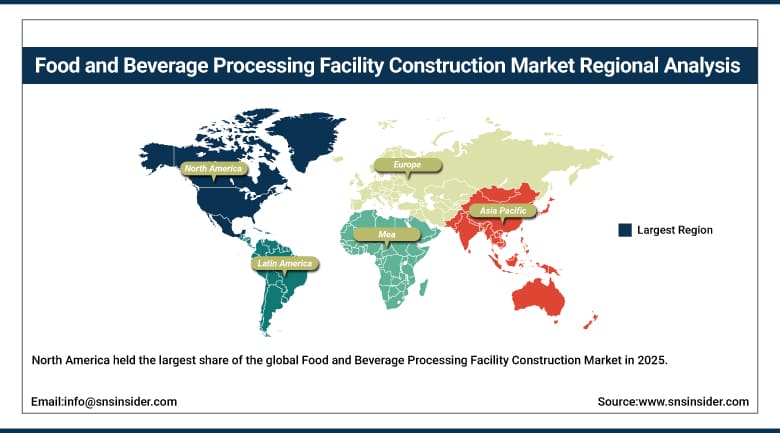
North America held the largest share of the global Food and Beverage Processing Facility Construction Market in 2025, supported by sustained capital project activity across dairy, meat and poultry, and beverage processing categories tracked continuously through industrial capital project intelligence services. The United States accounted for roughly 83% of regional revenue, reflecting its concentration of large-scale food processors and sustained monthly construction announcement volume across nearly every major food-producing state.
Canada contributed a smaller but steadily growing share of regional revenue, supported by its own expanding food processing and export infrastructure investment. That combination of sustained domestic capital investment and steady foreign direct investment inflow kept North America firmly ahead of every other region in overall processing facility construction activity throughout the year.
Get Customized Report as Per Your Business Requirement - Enquiry Now
Europe Food and Beverage Processing Facility Construction Market Insights
Europe held a meaningful share of the global Food and Beverage Processing Facility Construction Market in 2025, supported by continued modernization of legacy processing infrastructure and strong regulatory emphasis on food safety and sustainability across the continent. Germany accounted for roughly 27% of regional revenue, supported by its concentration of large-scale food and beverage manufacturers investing in automated, energy-efficient processing facilities.
France, the United Kingdom, and the Netherlands followed a broadly similar trajectory, as continued European Union food safety and sustainability regulation kept driving facility modernization and expansion investment across the continent's largest food-producing markets. Continued regulatory tightening around energy efficiency and traceability is expected to keep reinforcing steady European construction demand through the remainder of the forecast period.
Asia Pacific Food and Beverage Processing Facility Construction Market Insights
Asia Pacific was the fastest-growing region in the global Food and Beverage Processing Facility Construction Market, driven by rapid industrialization, growing foreign direct investment in domestic food processing capacity, and rising demand for processed and convenience foods across the region's expanding urban populations. China accounted for roughly 36% of regional revenue, supported by continued government initiatives supporting domestic food processing capacity and export-oriented manufacturing investment.
India and Southeast Asian markets contributed significant additional regional demand through their own rapidly growing food processing sectors, supported by government schemes promoting agricultural value addition and export growth. That combination of foreign investment inflow and domestic capacity expansion continued to reinforce Asia Pacific's position as the clear growth leader in processing facility construction activity through the forecast period.
MEA & Latin America Food and Beverage Processing Facility Construction Market Insights
The Middle East and Africa region recorded steady growth in food and beverage processing facility construction activity in 2025, driven by government-backed food security investment and growing domestic food processing capacity across the Gulf states in particular. Saudi Arabia accounted for roughly 28% of regional revenue, supported by national food security strategy investment and rising domestic poultry and dairy processing capacity.
Latin America expanded at a comparable pace, led by Brazil at roughly 39% of regional revenue, where growing food export infrastructure investment continued to support category growth. Mexico and Argentina followed a similar trajectory as regional food processing export capacity expanded further through the remainder of the forecast period.
Growth Drivers: Automation modernization and sustained processed food demand
Sustained global demand for processed and packaged food continues to be the central force behind food and beverage processing facility construction activity, as manual, low-volume operations continue transitioning toward automated, high-volume facilities capable of meeting rising consumption levels efficiently. Dairy processors adopting continuous pasteurization lines and beverage companies constructing inline sterilization units both continue increasing throughput while reducing contamination risk, a shift that keeps driving new construction and facility modernization investment across nearly every processing category.
Stricter food safety and traceability regulation continues reinforcing this construction demand further, as companies failing to comply with modern standards risk product recalls, heavy fines, or facility shutdowns that make continued operation in outdated buildings increasingly untenable. Growing foreign direct investment in emerging food processing hubs, combined with government schemes promoting agricultural value addition and export growth, continues expanding the addressable market for processing facility construction services across both developed and emerging economies.
Restraints: High construction costs and extended project timelines
The substantial capital investment required for large-scale processing facility construction, frequently reaching hundreds of millions of dollars for a single greenfield project, continues to restrict this type of investment to well-capitalized processors and major multinational food and beverage companies. Extended project timelines, often spanning two to three years from groundbreaking to full operational capacity, continue exposing developers to construction cost inflation and changing regulatory requirements over the life of a project.
Rising costs for structural steel, specialized refrigeration equipment, and skilled construction labor continue adding pressure to project budgets, particularly for processors attempting to complete construction on tight timelines to meet growing demand. These combined cost and timeline pressures continue to concentrate the largest processing facility construction projects among the industry's best-capitalized companies capable of absorbing both the upfront investment and the multi-year development risk these projects carry.
Opportunities: Design-build delivery models and sustainable construction demand
Growing adoption of design-build delivery models presents genuine opportunity for construction and engineering firms capable of offering integrated planning, design, and construction services under a single contract. This delivery approach continues appealing to processors seeking to compress project timelines and control cost overruns relative to traditional design-bid-build sequencing, and firms capable of delivering this integrated service model stand to capture a growing share of new processing facility construction contracts.
Rising processor interest in sustainability-focused construction, including on-site renewable energy integration, water recycling systems, and energy-efficient building envelope design, is opening further opportunity for construction firms capable of delivering genuinely green processing facilities. As more food and beverage companies commit to corporate sustainability targets tied to their manufacturing footprint, construction firms positioned to deliver certified sustainable facility design stand to capture meaningful new project volume through 2035.
Recent Developments
-
2025: Atlantic Sapphire announced an investment of USD 350 million for expansion of its processing facility in Miami, Florida, reflecting continued large-scale investment in aquaculture processing infrastructure.
-
2025: Novus Foods announced a 130,000 square foot expansion of its processing and warehouse facility in Delphos, Ohio, with construction expected to begin in late fall 2025.
-
2025: BelGioioso Cheese announced an investment of USD 23 million for expansion of its processing facilities across two New York locations, strengthening its domestic cheese production capacity.
Food and Beverage Processing Facility Construction Market Key Players
-
Fluor Corporation
-
Jacobs Engineering Group Inc.
-
AECOM
-
Burns & McDonnell
-
Gray Construction
-
Stellar
-
Hixson Architecture & Engineering
-
ESI Group USA
-
Faith Technologies, Inc.
-
McHale & Associates, Inc.
-
DPS Group Global
-
IPS-Integrated Project Services, LLC
-
Barry-Wehmiller Design Group
-
Bühler Group
-
GEA Group Aktiengesellschaft
-
Tetra Pak International S.A.
-
Krones AG
-
SPX FLOW, Inc.
Food and Beverage Processing Facility Construction Market Report Scope:
| Report Attributes | Details |
|---|---|
| Market Size in 2025 | USD 52.0 Billion |
| Market Size by 2035 | USD 93.12 Billion |
| CAGR | CAGR of 6.0% From 2026 to 2035 |
| Base Year | 2025 |
| Forecast Period | 2026-2035 |
| Historical Data | 2022-2024 |
| Report Scope & Coverage | Market Size, Segments Analysis, Competitive Landscape, Regional Analysis, DROC & SWOT Analysis, Forecast Outlook |
| Key Segments | • by Facility Type (Greenfield Construction, Brownfield) • by Service Type (General Construction & Building Envelope, Mechanical, Electrical & Plumbing Utilities) • by End-Use (Dairy & Beverage Processing, Meat & Poultry Processing, Bakery & Confectionery, and Others) • by Delivery Model (Design-Build, Design-Bid-Build, and Construction Management at Risk) • by Facility Size (Large-Scale, Mid-Scale Facilities) • by Contractor Type (General Contractors, Specialty Contractors) |
| Regional Analysis/Coverage | North America (US, Canada, Mexico), Europe (Eastern Europe [Poland, Romania, Hungary, Turkey, Rest of Eastern Europe] Western Europe] Germany, France, UK, Italy, Spain, Netherlands, Switzerland, Austria, Rest of Western Europe]), Asia Pacific (China, India, Japan, South Korea, Vietnam, Singapore, Australia, Rest of Asia Pacific), Middle East & Africa (Middle East [UAE, Egypt, Saudi Arabia, Qatar, Rest of Middle East], Africa [Nigeria, South Africa, Rest of Africa], Latin America (Brazil, Argentina, Colombia, Rest of Latin America) |
| Company Profiles | Fluor Corporation, Jacobs Engineering Group Inc., AECOM, Burns & McDonnell, CRB Group, Inc., Gray Construction, Stellar, Hixson Architecture & Engineering, ESI Group USA, Faith Technologies, Inc., McHale & Associates, Inc., DPS Group Global, IPS-Integrated, Project Services, LLC, Barry-Wehmiller Design Group, Bühler Group, GEA Group Aktiengesellschaft, JBT Marel Corporation, Tetra Pak International S.A., Krones AG, SPX FLOW, Inc. |

Frequently Asked Questions
North America held the largest share of the market in 2025, while Asia Pacific was the fastest-growing region.
The Greenfield Construction segment held approximately 55% share in 2025.
Sustained global demand for processed food combined with rising automation and food safety modernization requirements is the major growth factor.
The Food and Beverage Processing Facility Construction Market was valued at USD 52.0 Billion in 2025.
The Food and Beverage Processing Facility Construction Market is expected to grow at a CAGR of 6.0% from 2026 to 2035.
