
Aromatic Hydrocarbon Market Report Scope & Overview:
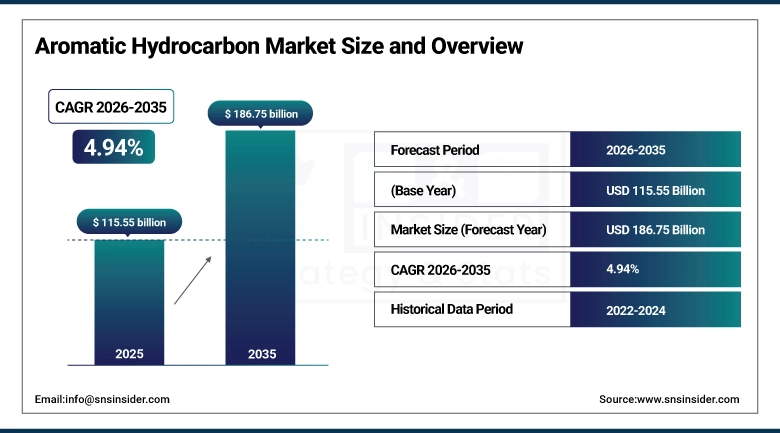
The Aromatic Hydrocarbon Market was valued at USD 115.55 billion in 2025 and is expected to reach USD 186.75 billion by 2035, growing at a CAGR of 4.94% from 2026–2035.
The Aromatic Hydrocarbons Market is exhibiting constant growth around the world because of the increasing demand for aromatic hydrocarbons from various petrochemical applications like plastic, resins, synthetic fibers, and fuel blending applications. Growth in automobile manufacturing, increased packaging industry activity, and growing construction industry activity is leading to an increase in the consumption of BTX derivatives (Benzene, Toluene, and Xylene) in the developed as well as developing countries. Increased refinery capacity additions, refining to chemicals, and demand for high-quality polymers is contributing to market growth.
By 2026, the use of sophisticated petrochemical techniques like artificial intelligence in refining operations, enhanced catalytic reforming, and effective aromatics isolation will be on the rise around the world. The reason behind this is the requirement for purity in chemicals, cost-effectiveness, and sustainability in production.
Market Size and Forecast
-
Market Size in 2025: USD 115.55 Billion
-
Market Size by 2035: USD 186.75 Billion
-
CAGR: 4.94% from 2026 to 2035
-
Base Year: 2025
-
Forecast Period: 2026–2035
-
Historical Data: 2022–2024
To Get more information on Aromatic Hydrocarbon Market - Request Free Sample Report
Aromatic Hydrocarbon Market Trends
-
Strong growth in downstream petrochemical value chains such as styrene, PTA, and cumene production is increasing long-term demand for benzene, toluene, and xylene globally.
-
Expansion of crude-to-chemicals (CTC) projects is reshaping refinery economics by maximizing aromatics output and improving overall conversion efficiency.
-
Rising deployment of energy-efficient and AI-enabled refinery optimization systems is improving yield control, operational efficiency, and process stability in BTX production.
-
Increasing investments in large-scale petrochemical complexes across emerging economies are strengthening global supply capacity and reducing regional dependency.
-
Fluctuations in crude oil pricing and feedstock availability are influencing production costs and creating volatility in aromatics market margins.
-
Growing focus on sustainable chemical manufacturing is driving interest in bio-based aromatics and advanced recycling of plastic waste streams.
-
Tightening environmental and safety regulations related to benzene exposure and emissions are accelerating adoption of cleaner production technologies and compliance systems.
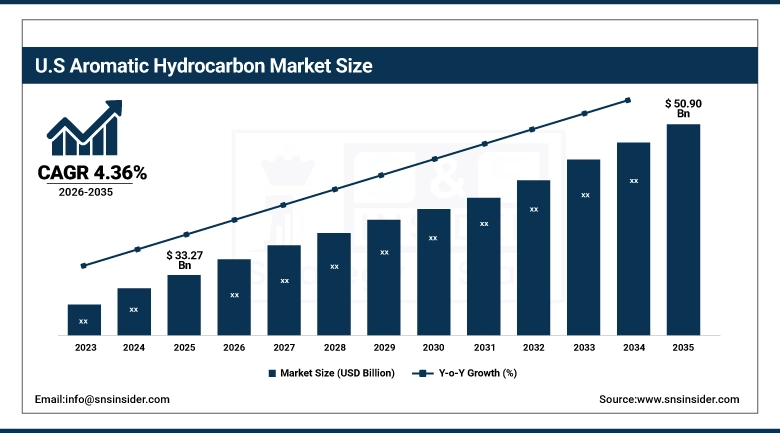
U.S. Aromatic Hydrocarbon Market was valued at around USD 33.27 billion in 2025 and is expected to reach approximately USD 50.90 billion by 2035, growing at a CAGR of 4.36% from 2026–2035.
The United States Aromatics market is amongst the oldest and the most technologically advanced in the world, having a sound infrastructure in terms of refining and petrochemicals on the Gulf coast region. The high usage of aromatics for products such as plastics, automotive, packaging, and artificial fiber industries keeps the demand of benzene, toluene, and xylene (BTX) strong. Companies like ExxonMobil, Chevron Phillips Chemicals, Dow Chemicals, and LyondellBasell are constantly expanding their capacities and optimizing processes.
The U.S. Environmental Protection Agency (EPA) plays a crucial role in regulating emissions of volatile organic compounds (VOCs) and benzene, ensuring strict environmental compliance and safer industrial operations. This regulatory framework is pushing refiners toward cleaner production technologies and energy-efficient processes.
As per the U.S. Energy Information Administration (EIA), increasing shale gas production and refinery integration have significantly strengthened domestic aromatics supply, reducing import dependency and improving feedstock availability for petrochemical manufacturing.
Aromatic Hydrocarbon Market Segment Analysis
-
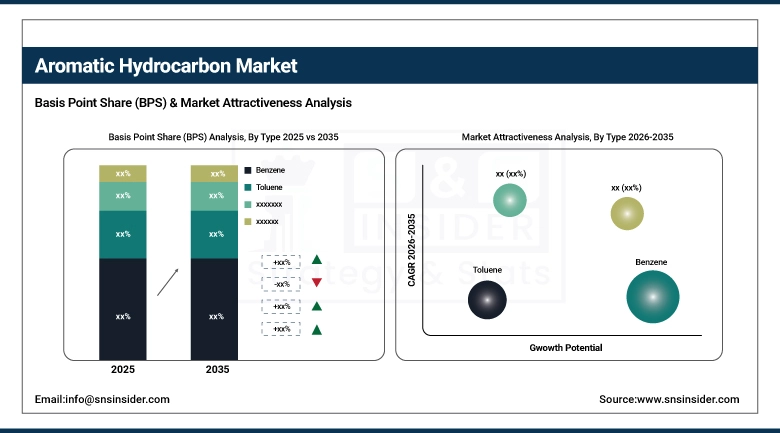
By Type, Benzene dominated the Aromatic Hydrocarbon Market with 38.50% share in 2025; Xylene fastest growing (CAGR).
-
By Application, Chemical Intermediates dominated the Aromatic Hydrocarbon Market with 52.30% share in 2025; Others fastest growing (CAGR).
-
By End-User, Chemicals dominated the Aromatic Hydrocarbon Market with 36.80% share in 2025; Pharmaceuticals fastest growing (CAGR).
By Type, Benzene dominated the Aromatic Hydrocarbon Market, while Xylene is the fastest-growing segment.
Benzene segment dominated the Aromatic Hydrocarbon Market in 2025. This dominance is driven by its extensive use as a primary feedstock for styrene, phenol, cumene, and nylon intermediates. Strong demand from plastics, automotive, and construction industries further supports its large-scale consumption globally.
Xylene market segment is projected to experience the highest CAGR between 2026 and 2035 on account of increased consumption of para-xylene in polyester and PET manufacturing processes. Increased use of packaging, textile, and plastic bottle products will result in higher consumption. Furthermore, increased investment in PX manufacturing process technology is further augmenting xylene production.
By Application, Chemical Intermediates dominated the Aromatic Hydrocarbon Market, while Others is the fastest-growing segment.
Chemical segment emerged as the leading segment of the Aromatic Hydrocarbon market in 2025 owing to its broad application as a fundamental raw material in petrochemicals. The aromatics have found widespread applications in plastic products, resins, synthetic fibers, and various other industrial chemicals. Thus, this segment is considered very important for mass industrial applications around the globe.
Others segment is estimated to witness the highest CAGR over the period 2026-2035 owing to an increase in demand for aromatic hydrocarbons in specialized applications and new areas like specialty chemicals and electronics. Rapid innovation and expanding end-user industry segments are driving growth in this segment.
By End-User, Chemicals dominated the Aromatic Hydrocarbon Market, while Pharmaceuticals is the fastest-growing segment.
Chemicals category held a dominant share of the Aromatic Hydrocarbons market in 2025 because of its high usage as a base ingredient to manufacture plastics, resins, synthetic fibers, and intermediates. High demand for aromatic hydrocarbons in downstream petrochemical sectors and industrial manufacturing ensures high consumption levels.
Pharmaceuticals sector will experience the highest CAGR during the forecast period owing to growing demand for purity-based aromatic compounds in the synthesis of drugs and active pharmaceutical ingredients (APIs). Higher healthcare spending and the rise in the manufacturing of generic drugs is encouraging more use of aromatic hydrocarbons in this field.
Regional Insights
|
Region |
Major Country |
Share (%) |
|---|---|---|
|
North America |
United States |
84.20% |
|
Europe |
Germany |
61.30% |
|
Asia Pacific |
China |
68.90% |
|
Middle East & Africa |
UAE |
42.50% |
|
Latin America |
Brazil |
55.80% |
North America Aromatic Hydrocarbon Market Insights
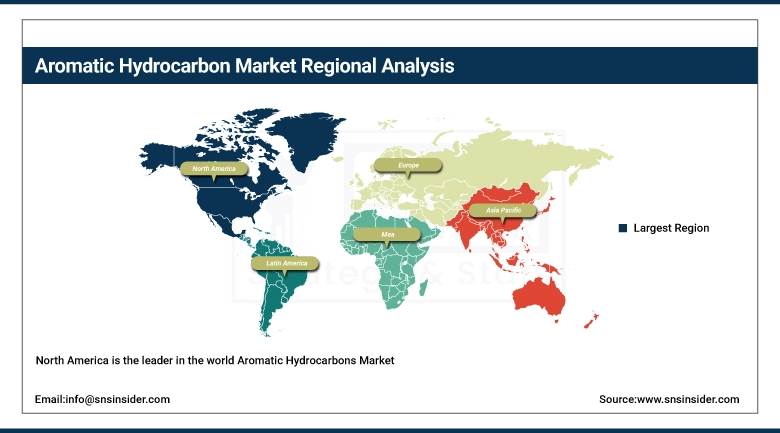
North America is the leader in the world Aromatic Hydrocarbons Market because of the well-developed structure of petrochemical and refining industry, especially in the Gulf Coast of the United States. High demand for aromatic hydrocarbons from various industries like plastics, automotive, packaging, and synthetic fibers results in high BTX consumption. The United States is the most prominent country in North America, holding the largest market share.
Further supporting this dominance, regulatory bodies such as the U.S. Environmental Protection Agency (EPA) enforce strict environmental and VOC emission standards, encouraging cleaner and more efficient production technologies. Major players like ExxonMobil, Dow, Chevron Phillips Chemical, and LyondellBasell are continuously investing in capacity expansion and refinery–petrochemical integration to strengthen aromatics output and supply reliability.
Get Customized Report as per Your Business Requirement - Enquiry Now
Asia Pacific Aromatic Hydrocarbon Market Insights
The Asia Pacific region has emerged as the most rapidly growing market for aromatic hydrocarbons, owing to high levels of industrialization and urbanization, along with increasing demand from the plastics, polyester, and packaging industries. China, India, Japan, and South Korea are the principal countries contributing to the growth of the market, while China leads among them because of its huge petrochemical production and refining capacities.
Government initiatives across several Asia-Pacific economies supporting petrochemical expansion, industrial modernization, and energy security are strengthening production capabilities. Additionally, growing investments in refining infrastructure and increasing participation of private players are accelerating regional supply growth, making Asia-Pacific a global hub for aromatic hydrocarbon production and consumption.
Europe Aromatic Hydrocarbon Market Insights
The Europe in the Aromatic Hydrocarbons Market is attributed to the presence of robust chemical manufacturing operations and high consumer demand from automotive, coating, and specialty chemicals applications. Countries that have been noted to contribute significantly include Germany, France, UK, and Italy, with Germany topping in terms of regional consumption because of its highly developed industries and automobile production.
The European Chemicals Agency (ECHA) and strict EU environmental regulations are driving adoption of cleaner and more sustainable production processes. Manufacturers are increasingly focusing on energy efficiency, emission reduction, and high-purity aromatics production. Growth in specialty chemicals and sustainable packaging solutions is further strengthening market demand across the region.
Middle East & Africa and Latin America Aromatic Hydrocarbon Market Insights
The Middle East & Africa region is witnessing steady growth because of rising refining capacity and downstream petrochemical investment. The Middle East, which includes Saudi Arabia and the UAE, makes significant contributions through large petrochemical plants and exports of BTX derivatives.
In Latin America, Brazil and Mexico serve as significant consumers, owing to the presence of growing industrialization and higher demands from industries such as automobiles and packaging. With higher investments being made for refinery upgrading, along with the implementation of supportive government policies, the potential for market growth is increasing in both regions.
Market Growth Drivers: Expansion of integrated refinery–petrochemical complexes improving efficiency and aromatics yield globally
Integration of refineries with petrochemical facilities has been leading to much improvement in terms of efficient aromatics production and cost reduction. Through crude-to-chemicals (CTC), increased conversion rates of naphtha and reformate to benzene, toluene, and xylene have been achieved. This integration decreases reliance on separate refining facilities and increases supply chain reliability. With enhanced catalytic reforming and steam cracker technologies, efficiency and high yield rates have been attained. Leading companies around the world have been building integrated complex facilities to exploit maximum value from crude oil resources.
In 2026, producers are increasingly adopting integrated refinery–petrochemical (crude-to-chemicals) systems to improve aromatics yield and efficiency. This enables higher conversion of naphtha into benzene, toluene, and xylene while reducing reliance on standalone refineries. Investments in advanced catalytic reforming are further strengthening global supply stability.
Market Restraints: Stringent environmental regulations on benzene emissions and VOC control limiting production flexibility
With the rising regulatory pressures on benzene toxicity and VOC emissions, the manufacturing process will be impacted negatively in many parts of the world. The regulatory authorities are imposing stringent safety measures because of the health and environmental risks that come with the aromatic compounds. Such measures entail huge financial investments for the installation of emission control devices, clean production practices, and process changes, which will ultimately raise costs and lower the production capability of firms. In other cases, expansion projects may not be feasible due to various complications.
Market Opportunities: Development of circular economy solutions and bio-based aromatic hydrocarbons creating long-term growth potential
Increasing attention towards sustainability has resulted in research being conducted into the use of bio-aromatics and the recycling of waste streams of petrochemicals. The concept of circular economy focuses on the recovery and utilization of aromatics from plastic waste and other wastes generated in industries. The development of renewable resources and green chemistry technologies is increasingly attracting interest among developed nations. While such technologies have not yet been commercialized owing to their expensive manufacturing processes, technological improvements will enhance their feasibility.
In 2026, the Aromatic Hydrocarbon Market is gaining momentum due to rising focus on circular economy solutions and bio-based aromatics. Increasing recycling of plastic waste and green chemistry adoption is supporting sustainable production and long-term growth potential globally.
Recent Developments
-
2026: ExxonMobil Corporation expanded its focus on integrated refinery–petrochemical operations to enhance aromatics yield, particularly benzene and xylene. The company prioritized efficiency improvements in Gulf Coast assets and optimization of crude-to-chemicals conversion to support growing global petrochemical demand.
-
2025: Sinopec Corporation accelerated capacity expansion in aromatics and downstream petrochemicals through large integrated refining complexes. Key emphasis was placed on para-xylene and benzene production to strengthen polyester and plastics value chains in high-demand domestic and export markets.
-
2024: Reliance Industries Limited advanced its Jamnagar integrated refining and petrochemical complex to increase BTX production efficiency. The company focused on scaling aromatics output to support rising demand from packaging, polyester, and automotive materials globally.
Aromatic Hydrocarbon Market Key Players
-
ExxonMobil Corporation
-
BASF SE
-
Sinopec Corporation
-
Reliance Industries Limited
-
Shell plc
-
Saudi Aramco
-
LyondellBasell Industries
-
Chevron Phillips Chemical Company
-
TotalEnergies SE
-
INEOS Group Holdings
-
China National Petroleum Corporation (CNPC)
-
China National Offshore Oil Corporation (CNOOC)
-
SABIC
-
Dow Inc.
-
Formosa Chemicals & Fibre Corporation
-
Mitsubishi Chemical Group Corporation
-
LG Chem
-
Lotte Chemical Corporation
-
Indian Oil Corporation (IOCL)
-
Valero Energy Corporation
Aromatic Hydrocarbon Market Report Scope:
| Report Attributes | Details |
|---|---|
| Market Size in 2025 | USD 115.55 Billion |
| Market Size by 2035 | USD 186.75 Billion |
| CAGR | CAGR of 4.94% From 2026 to 2035 |
| Base Year | 2025 |
| Forecast Period | 2026-2035 |
| Historical Data | 2022-2024 |
| Report Scope & Coverage | Market Size, Segments Analysis, Competitive Landscape, Regional Analysis, DROC & SWOT Analysis, Forecast Outlook |
| Key Segments | • By Type (Benzene, Toluene, Xylene, Others) • By Application (Solvents, Chemical Intermediates, Fuels, Others) • By End-User Industry (Automotive, Paints and Coatings, Chemicals, Pharmaceuticals, Others) |
| Regional Analysis/Coverage | North America (US, Canada), Europe (Germany, UK, France, Italy, Spain, Russia, Poland, Rest of Europe), Asia Pacific (China, India, Japan, South Korea, Australia, ASEAN Countries, Rest of Asia Pacific), Middle East & Africa (UAE, Saudi Arabia, Qatar, South Africa, Rest of Middle East & Africa), Latin America (Brazil, Argentina, Mexico, Colombia, Rest of Latin America). |
| Company Profiles | ExxonMobil Corporation, BASF SE, Sinopec Corporation, Reliance Industries Limited, Shell plc, Saudi Aramco, LyondellBasell Industries, Chevron Phillips Chemical Company, TotalEnergies SE, INEOS Group Holdings, China National Petroleum Corporation (CNPC), China National Offshore Oil Corporation (CNOOC), SABIC, Dow Inc., Formosa Chemicals & Fibre Corporation, Mitsubishi Chemical Group Corporation, LG Chem, Lotte Chemical Corporation, Indian Oil Corporation (IOCL), Valero Energy Corporation |
Frequently Asked Questions
North America dominated the Aromatic Hydrocarbon Market in 2025.
The Benzene segment dominated the Aromatic Hydrocarbon Market in 2025.
Rising demand from petrochemical applications such as plastics, resins, synthetic fibers, and fuel blending, along with expansion of integrated refinery–petrochemical complexes and increasing BTX consumption, are the major growth drivers.
The Aromatic Hydrocarbon Market was valued at USD 115.55 billion in 2025.
The Aromatic Hydrocarbon Market is expected to grow at a CAGR of 4.94% from 2026 to 2035.
Get in Touch
