
Thermally Conductive Plastics Market Report Scope & Overview:
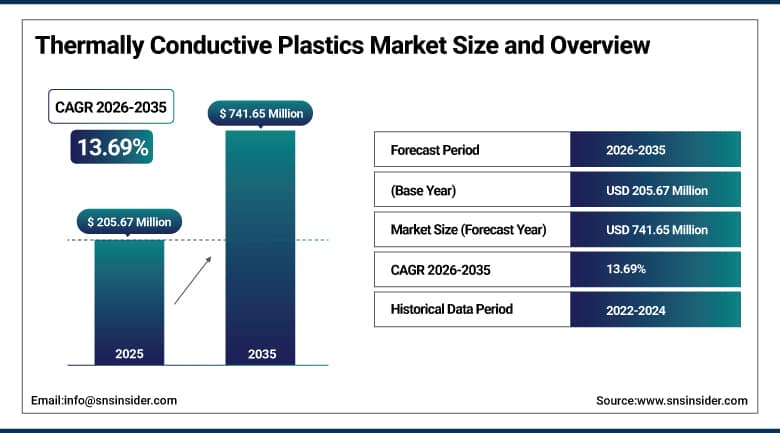
The Thermally Conductive Plastics Market was valued at USD 205.67 Million in 2025 and is expected to reach USD 741.65 Million by 2035, growing at a CAGR of 13.69% from 2026 to 2035.
The Thermally Conductive Plastics Market is experiencing strong growth due to ongoing miniaturization of electronics, increased production of electric vehicles where effective battery thermal management is critical, and increasing need for alternative material solutions that have higher thermal conductivity compared to metals. Thermally conductive plastics are produced by adding thermal fillers into polymers in order to create materials that combine all the benefits of polymers such as lightness, ease of manufacture, good design flexibility and other benefits with the properties of thermal conductivity that were previously available only for metals and ceramics. With the rise of power density in electronic products and increasing need for electric cars, demand for thermally conductive plastics with different types of polymer resins remains strong.
In 2026, Kaneka Corporation launched a new thermally conductive PPS-based compound designed for high-temperature automotive electronics applications, expanding its specialty polymer portfolio for electric vehicle and industrial customers.
To Get More Information On Thermally Conductive Plastics Market - Request Free Sample Report
Thermally Conductive Plastics Market Trends
-
Rising electric vehicle production is accelerating demand for thermally conductive plastics in battery thermal management applications.
-
Growing miniaturization of electronic devices is driving adoption of high-performance thermally conductive polymer compounds for heat dissipation.
-
Expanding 5G infrastructure deployment is increasing demand for thermally conductive plastics in telecommunications equipment housings.
-
Increasing development of bio-based and recyclable thermally conductive plastic formulations is supporting sustainability-focused material substitution.
-
Strategic capacity expansions by compounders are strengthening regional supply chain reliability for electronics and automotive customers.
U.S. Thermally Conductive Plastics Market Outlook
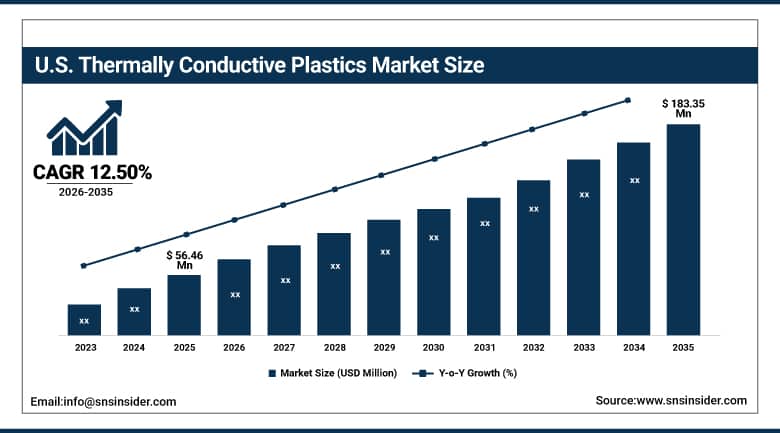
The U.S. Thermally Conductive Plastics Market was valued at approximately USD 56.46 Million in 2025 and is projected to reach approximately USD 183.35 Million by 2035, registering a CAGR of approximately 12.50% from 2026 to 2035.
The U.S. remains the biggest national market for thermally conductive plastics in the world, bolstered by the large electronics manufacturing and design industry in the nation as well as the increasing manufacture of electric vehicles in the US which requires efficient thermal management systems for batteries and power electronics. Compound manufacturers keep ramping up their production of thermally conductive polymer compounds to supply growing demand from consumer electronics, telecoms and auto OEM clients, while rising investment in semiconductors and data centers is keeping demand strong for innovative heat dissipation materials.
In 2025, Celanese Corporation launched a new thermally conductive polyamide compound designed for improved heat dissipation performance in electric vehicle battery components across North American automotive customers.
Thermally Conductive Plastics Market Segment Analysis
-
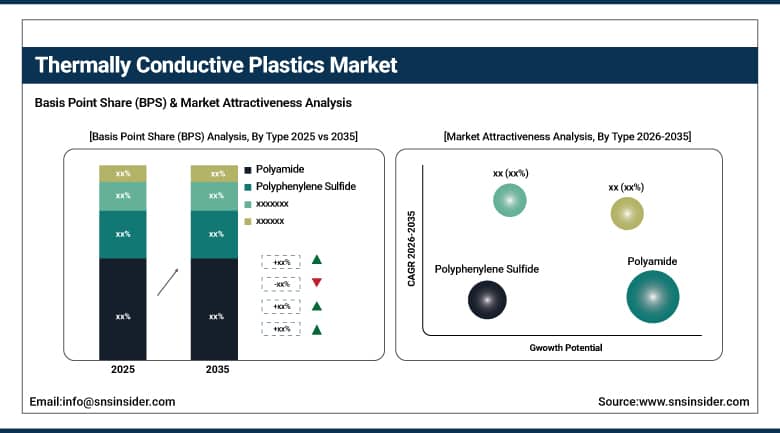
By Type, Polyamide dominated the Thermally Conductive Plastics Market with a 45.60% share in 2025, while Polyphenylene Sulfide is the fastest-growing type segment with a CAGR of 8.30% from 2026–2035.
-
By End-Use Industry, Electronics dominated the Thermally Conductive Plastics Market with a 42.60% share in 2025, while Automotive is the fastest-growing end-use industry segment with a CAGR of 8.60% from 2026–2035.
By Type, Polyamide led while Polyphenylene Sulfide is the fastest-growing segment.
The Polyamide segment was the leading contributor with a 45.60% revenue share in the Thermally Conductive Plastics Market in 2025. Such dominance can be attributed to the combination of high mechanical properties, processability, and economic value of the polyamide in relation to the incorporation of thermal conductive fillers, which has made it the material of choice for numerous applications in electronics housings, LED lights, and automotive parts requiring a certain level of thermal conductivity without the need for the expensive engineering resins, a factor that has helped maintain the supremacy of polyamide in such applications.
The Polyphenylene Sulfide segment is expected to witness the highest CAGR of 8.30% during the forecast period 2026-2035. Increased application of thermally conductive materials based on PPS in high temperature applications in the automotive industry including electronics for vehicles and electric cars due to their improved chemical resistance and dimensional stability at higher temperatures is creating growth opportunities for this market segment. Growing electric vehicle production requiring components capable of withstanding under-hood and battery compartment thermal conditions continues to support above-average growth for this segment relative to the broader market.
By End-Use Industry, Electronics led while Automotive is the fastest-growing segment.
The Electronics segment dominated the Thermally Conductive Plastics Market with a revenue share of 42.60% in 2025. Electronics is still the main application segment owing to continued miniaturization of consumer electronics, lighting (LEDs), and computers requiring lightweight and electrically insulating thermal materials able to conduct heat away from smaller but more powerful electronics components. This makes electronics the basic application segment which creates most of the global consumption of thermally conductive plastics.
The Automotive segment is expected to register the fastest CAGR of 8.60% during the forecast period 2026-2035. Rising global electric vehicle production requiring effective battery pack, power electronics, and motor thermal management is driving accelerated demand for thermally conductive plastics as automakers increasingly favor lightweight polymer-based thermal solutions over traditional metal components to support vehicle weight reduction and range optimization objectives.
Regional Insights
|
Region |
Major Country |
Share within Region, 2025 (%) |
|---|---|---|
|
North America |
United States |
74.60% |
|
Europe |
Germany |
27.80% |
|
Asia Pacific |
China |
43.20% |
|
Middle East & Africa |
UAE |
25.40% |
|
Latin America |
Brazil |
33.60% |
North America Thermally Conductive Plastics Market Insights
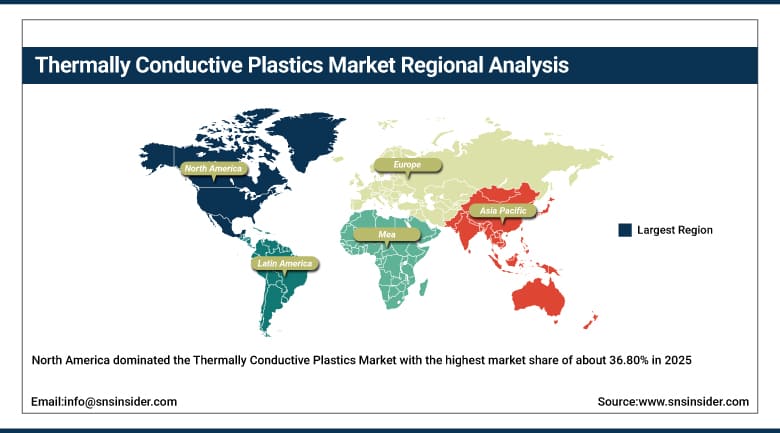
North America dominated the Thermally Conductive Plastics Market with the highest market share of about 36.80% in 2025, Given the significant investments in the semiconductor industry and data centers, and increasing production of electric vehicles in the region which require thermal management solutions. The advanced compounding technologies and strong OEM connections within both the electronics and automotive industries ensure that North America remains the largest market for thermally conductive plastics worldwide.
The US was the leading country within the North America Thermally Conductive Plastics Market in 2025 with a market share of 74.60% of the regional market, supported by the significant electronics industry in Mexico and the increasing production of electric cars. Canada’s contribution to the region’s growth is due to its increasing auto parts industry and electronics assembly.
Get Customized Report as Per Your Business Requirement - Enquiry Now
Europe Thermally Conductive Plastics Market Insights
The Europe region was a meaningful contributor to the Thermally Conductive Plastics Market in 2025, supported by the region's substantial automotive manufacturing base and established specialty polymer compounding infrastructure. The region's continued electric vehicle transition and stringent REACH regulatory framework governing chemical environmental compliance continues to shape product formulation priorities across European thermally conductive plastics manufacturers.
Germany is one of the major markets in Europe, accounting for 27.80% of the regional market in 2025, Due to the significant automotive and electronics manufacturing industries in addition to the availability of top polymer compounders. The other nations like France and Italy with their mature automotive and industrial manufacturing sectors are also participating in the regional demand by the ongoing usage of thermal management materials.
Asia Pacific Thermally Conductive Plastics Market Insights
The Asia Pacific Thermally Conductive Plastics Market is expected to witness the fastest growth rate during the forecast period 2026-2035, registering a CAGR of 8.40%. The market growth is driven by rapid industrialization and technological innovation, expanding electronics manufacturing capacity, and growing electric vehicle production across the region's major and emerging manufacturing economies.
China was the leading country within the Asia Pacific Thermally Conductive Plastics Market in 2025 with a market share of 43.20% of the regional market, driven by its huge electronics and automobile manufacturing industry. Japan and South Korea, who also have significant electronics and automobile manufacturing industries, are also playing their part in the regional growth by increasing the consumption of thermally conductive plastics.
Middle East & Africa and Latin America Thermally Conductive Plastics Market Insights
Middle East & Africa and Latin American regions are gradually expanding thermally conductive plastics adoption as domestic electronics and automotive manufacturing capacity grows, supported by increasing specialty polymer distribution infrastructure investment and rising demand from telecommunications and industrial equipment applications across the regions' major economies.
Brazil is set to be a prominent Latin American market, accounting for 33.60% of the regional market in 2025, fueled by its substantial domestic automotive manufacturing base and growing electronics assembly sector requiring consistent thermal management material supply. The Middle East & Africa region has the UAE investing in telecommunications and electronics distribution infrastructure, accounting for 25.40% of the regional market in 2025, as the country strengthens its position as a regional technology and manufacturing hub.
Growth Drivers: Rising electronics miniaturization and EV adoption driving market growth
The continuous miniaturization of electronic devices, combined with rising power densities in electronic components requiring efficient heat dissipation, is among the primary drivers of the Thermally Conductive Plastics Market. The lightness, ease of design, electrical insulation, and efficient thermal control provided by thermally conductive plastics further ensure that these plastics maintain their status as a superior substitute for metallic and ceramic-based thermal products on the global market.
Rising global electric vehicle production requiring effective battery pack, power electronics, and motor thermal management continues to expand demand for thermally conductive plastics across automotive applications. Growing 5G telecommunications infrastructure deployment requiring compact, thermally efficient equipment housings, combined with continued compounder investment in advanced filler technology improving thermal conductivity performance, is further supporting demand growth across the forecast period.
Restraints: High material costs and processing complexity limiting market expansion
One of the biggest challenges to the development of markets is that the thermally conductive plastics compounds cost much more than common engineering plastics due to the fact that the latter need special fillers to achieve their targeted level of thermal conductivity.
Furthermore, there is the technical difficulty associated with the uniform dispersion of the fillers and the need for an optimum level of thermal conductivity while ensuring mechanical strength, which requires specialized skills and facilities and therefore may be a challenge to new entrants in this field. In addition to that, the absolute level of thermal conductivity in thermally conductive plastics is relatively lower than that of metals.
Opportunities: Bio-based formulation innovation and EV thermal management expansion creating new growth avenues
Thermally Conductive Plastics Market will experience considerable growth due to the increased development of sustainable and recyclable thermally conductive plastics compounds along with increased use of thermally conductive plastic batteries for electric vehicles. Automotive companies as well as electronics firms which aim at minimizing their environmental impact while retaining excellent thermal conductivity performance will prefer using next generation compounds.
There is considerable potential for growth in high-performance thermally conductive composites for advanced electronics cooling solutions as computing power density continues increasing across data center and consumer electronics applications. The expansion of electric vehicle manufacturing capacity across Asia-Pacific and continued 5G infrastructure deployment worldwide will continue to drive incremental demand for thermally conductive plastics across the forecast period.
Recent Developments
-
2025: Celanese Corporation launched a new thermally conductive polyamide compound designed for improved heat dissipation performance in electric vehicle battery components.
-
2025: SABIC introduced an upgraded thermally conductive polycarbonate grade targeting LED lighting and consumer electronics housing applications.
-
2026: RTP Company expanded its thermally conductive compound production capacity to meet rising demand from automotive and electronics customers.
-
2026: Kaneka Corporation launched a new thermally conductive PPS-based compound designed for high-temperature automotive electronics applications.
Thermally Conductive Plastics Companies are:
-
Celanese Corporation
-
SABIC
-
BASF SE
-
Envalior
-
RTP Company
-
Ensinger GmbH
-
Kaneka Corporation
-
Toray Industries, Inc.
-
Mitsubishi Engineering-Plastics Corporation
-
LANXESS AG
-
Imerys S.A.
-
Cool Polymers, Inc.
-
LATI Industria Termoplastici S.p.A.
-
Techmer PM LLC
-
Kingfa Sci. & Tech. Co., Ltd.
-
Asahi Kasei Corporation
-
Covestro AG
-
DuPont de Nemours, Inc.
Thermally Conductive Plastics Market Report Scope:
| Report Attributes | Details |
|---|---|
| Market Size in 2025 | USD 205.67 Million |
| Market Size by 2035 | USD 741.65 Million |
| CAGR | CAGR of 13.69% From 2026 to 2035 |
| Base Year | 2025 |
| Forecast Period | 2026-2035 |
| Historical Data | 2022-2024 |
| Report Scope & Coverage | Market Size, Segments Analysis, Competitive Landscape, Regional Analysis, DROC & SWOT Analysis, Forecast Outlook |
| Key Segments | • By Type (Polyamide, Polycarbonate, Polyphenylene Sulfide, Polyetherimide, Polysulfones & Others) • By End-Use Industry (Electronics, Automotive, Telecommunications, Medical Devices, Industrial Machinery & Others) |
| Regional Analysis/Coverage | North America (US, Canada), Europe (Germany, UK, France, Italy, Spain, Russia, Poland, Rest of Europe), Asia Pacific (China, India, Japan, South Korea, Australia, ASEAN Countries, Rest of Asia Pacific), Middle East & Africa (UAE, Saudi Arabia, Qatar, South Africa, Rest of Middle East & Africa), Latin America (Brazil, Argentina, Mexico, Colombia, Rest of Latin America). |
| Company Profiles | Celanese Corporation, SABIC, BASF SE, Envalior, RTP Company, Dow Inc., Ensinger GmbH, Kaneka Corporation, Toray Industries, Inc., Mitsubishi Engineering-Plastics Corporation, LANXESS AG, Imerys S.A., Cool Polymers, Inc., LATI Industria Termoplastici S.p.A., Avient Corporation, Techmer PM LLC, Kingfa Sci. & Tech. Co., Ltd., Asahi Kasei Corporation, Covestro AG, DuPont de Nemours, Inc. |

Frequently Asked Questions
Key players in the Thermally Conductive Plastics Market include Celanese Corporation, SABIC, BASF SE, RTP Company, and Kaneka Corporation, among others.
Major opportunities include bio-based and recyclable formulations, alongside expanding high-performance electric vehicle battery thermal management applications and innovative material development.
Growth is driven by electronic miniaturization, increasing electric vehicle production, battery thermal management needs, and demand for lightweight metal alternatives.
The Polyamide segment dominated the Thermally Conductive Plastics Market, accounting for approximately 45.60% market share.
North America dominated in 2025 with a 36.80% share, supported by strong electronics manufacturing and increasing electric vehicle production.
