
Highly Reactive Polyisobutylene (HR-PIB) Market Report Scope & Overview:
The Highly Reactive Polyisobutylene (HR-PIB) Market was valued at USD 425.02 Million in 2025 and is expected to reach USD 786.66 Million by 2035, growing at a CAGR of 6.35% from 2026 to 2035.
The HR-PIB Market is witnessing steady growth due to increasing demand for this product in the lubricant additives market for automobiles, rising applications in the adhesive & sealants sector for packaging & construction and development in high performance polymer systems that require high viscosity & reactivity. In contrast to regular PIBs, highly reactive polyisobutylene has high vinylidene content and this varies from 70% to 95%. Such products are suitable for production of PIBSA & PIBSI dispersant compounds that are utilized in advanced lubricants. Hence, highly reactive PIBs play a key role in lubricant additive manufacturing where increasingly stringent standards of fuel efficiency and emissions are considered.
In 2026, Lanxess introduced an upgraded HR-PIB-based dispersant additive targeting fuel efficiency improvement in modern combustion engines, strengthening its position in the advanced lubricant additive segment.
Highly Reactive Polyisobutylene (HR-PIB) Market Trends
-
Rising demand for high molecular weight HR-PIB is supporting advanced lubricant additive and adhesive formulation development.
-
Growing automotive lubricant specification standards are driving consistent HR-PIB consumption across engine oil dispersant applications.
-
Expanding adhesives and sealants applications are accelerating HR-PIB adoption across packaging and construction industries.
-
Increasing feedstock capacity investment in isobutylene production is strengthening HR-PIB supply chain reliability.
-
Strategic capacity expansions across Asia-Pacific are reinforcing the region's position as the leading HR-PIB production and consumption hub.
U.S. Highly Reactive Polyisobutylene (HR-PIB) Market Outlook
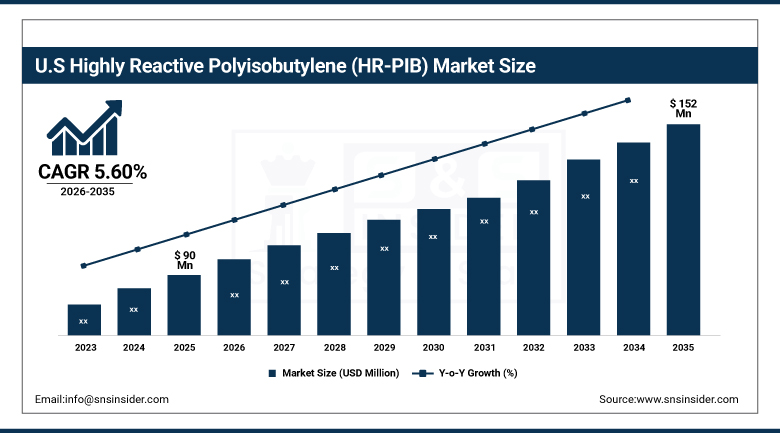
The U.S. HR-PIB Market was valued at USD 90 Million in 2025 and is projected to reach USD 152 Million by 2035, growing at a CAGR of 5.60% during 2026–2035.
The U.S. remains an important component of the global HR-PIB market owing to the presence of a considerable base of automotive lubricant additives manufacturing operations and petrochemical feedstocks infrastructure. The domestic manufacturers of lubricant additives keep using HR-PIB in order to produce PIBSA and PIBSI dispersants amid the increasing stringency of EPA standards concerning fuel efficiency and emissions in the automotive industry, whereas packaging and adhesives industries' needs ensure steady consumption of HR-PIB blends. In combination with recent investments into domestic capacity expansion in isobutylene derivatives production facilities, growing demand for high molecular weight grades of HR-PIB for advanced lubricants keeps ensuring steady growth of HR-PIB consumption in the country.
In 2025, TPC Group expanded its highly reactive polyisobutylene production capacity at its Houston facility to meet rising demand from lubricant additive manufacturers across North America.
Highly Reactive Polyisobutylene (HR-PIB) Market Segment Analysis
-
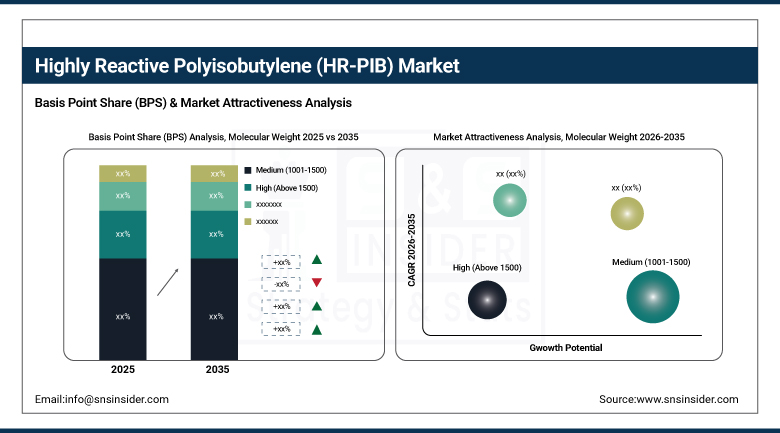
By Molecular Weight, Medium (1001-1500) dominated the HR-PIB Market with a 45.80% share in 2025, while High (Above 1500) is the fastest-growing molecular weight segment with a CAGR of 7.90% from 2026–2035.
-
By Application, Lubricant & Fuel Additives dominated the HR-PIB Market with a 58.30% share in 2025, while Adhesives & Sealants is the fastest-growing application segment with a CAGR of 7.80% from 2026–2035.
-
By End-Use Industry, Automotive dominated the HR-PIB Market with a 53.00% share in 2025, while Industrial is the fastest-growing end-use industry segment with a CAGR of 7.40% from 2026–2035.
By Molecular Weight, Medium (1001-1500) led while High (Above 1500) is the fastest-growing segment.
The Medium (1001-1500) molecular weight segment was the leading contributor in the HR-PIB Market in 2025. This dominance is a result of the balanced performance features of the grade, which allows for achieving the ideal blend of reactivity, viscosity, and processibility, thus making the material especially suited for mainstream manufacturing of lubricant additives in which it demonstrates outstanding dispersant properties without the additional complexity of processing inherent to high molecular weight grades, a feature which has allowed this product segment to maintain its dominant market share position.
The High (Above 1500) molecular weight segment is expected to witness the highest CAGR during the forecast period 2026-2035. Rising demand for high molecular weight HR-PIB in advanced lubricant additive applications requiring enhanced viscosity index improvement and superior thermal stability, particularly across high-performance engine oil and industrial hydraulic fluid formulations, is driving accelerated growth for this segment. Increased usage in the production of high-grade adhesives that demand better bonding and flexibility properties will keep on driving higher-than-market growth rates.
By Application, Lubricant & Fuel Additives led while Adhesives & Sealants is the fastest-growing segment.
The Lubricant & Fuel Additives segment dominated the HR-PIB Market in 2025. Lubricants & Fuel Additives continue to dominate as the top application sector, as HR-PIB acts as the key ingredient in producing PIBSA & PIBSI additives used in motor oils, as its vinylidene content makes it easy to derive into additives that ensure cleanliness of engines and increased fuel efficiency. This is also confirmed by the fact that the use of lubricant manufacturing sector forms the core of the global demand for HR-PIB.
The Adhesives & Sealants segment is expected to register the fastest CAGR during the forecast period 2026-2035. The increase in demand for adhesives and sealants using HR-PIB resin because of its excellent bonding capabilities, flexibility, and water resistance in packaging, building and construction industries, and various industrial sectors is fueling the growth of this category due to the preference for adhesives and sealants produced from HR-PIB resin over traditional ones.
By End-Use Industry, Automotive led while Industrial is the fastest-growing segment.
The Automotive segment dominated the HR-PIB Market in 2025. Applications in the automotive industry continue to dominate the end-user industry for HR-PIB-based lubricant additives due to their large-scale use in engine oils, transmission fluids, and hydraulic fluids that comply with stricter fuel economy and emission standards, thus ensuring a continuous and high volume demand in the manufacturing of automotive lubricants globally.
The Industrial segment is expected to witness the fastest CAGR during the forecast period 2026-2035. Growing demand of HR-PIB in industrial lubricants, hydraulic oils, and specialized adhesives from the increasing number of construction and manufacturing activities that need better performance from their industrial fluids and adhesives has resulted in faster growth in this product type, as industrial equipment manufacturers call for more sophisticated additives.
Regional Insights
|
Region |
Major Country |
Share within Region, 2025 (%) |
|---|---|---|
|
North America |
United States |
81.90% |
|
Europe |
Germany |
27.40% |
|
Asia Pacific |
China |
44.60% |
|
Middle East & Africa |
UAE |
24.80% |
|
Latin America |
Brazil |
32.60% |
North America Highly Reactive Polyisobutylene (HR-PIB) Market Insights
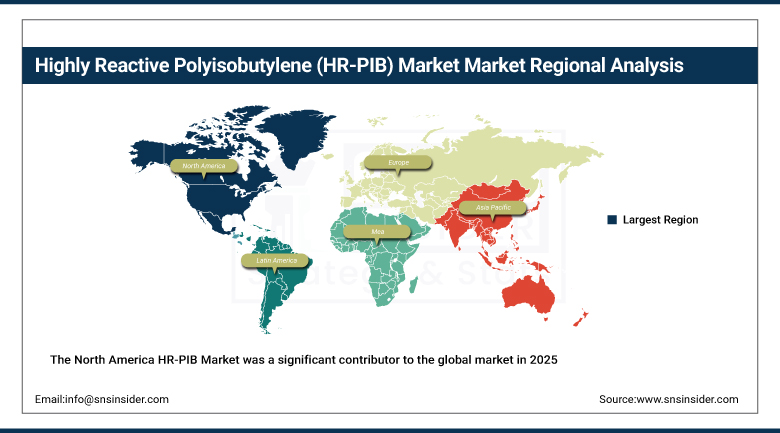
The North America HR-PIB Market was a significant contributor to the global market in 2025, supported by the region's substantial automotive lubricant additive manufacturing base and well-established petrochemical feedstock production infrastructure. The region's continued emphasis on high-performance lubricant additive innovation and growing sustainability-driven formulation development is expected to support steady market growth across the forecast period.
The US was the leading country within the North America HR-PIB Market in 2025, driven by its extensive lubricant additive manufacturing infrastructure and substantial petrochemical feedstock production capacity. Canada is contributing to regional growth through its growing specialty chemical distribution network and expanding industrial lubricant manufacturing sector.
Get Customized Report as per Your Business Requirement - Enquiry Now
Europe Highly Reactive Polyisobutylene (HR-PIB) Market Insights
The Europe region was a meaningful contributor to the HR-PIB Market in 2025, anchored by the region's substantial automotive manufacturing base and established specialty chemical production infrastructure. The stringent REACH regulations for chemical environmental compliance in the region are still affecting the priorities for formulating products among European HR-PIB producers and their customers in the lubricants and adhesives industries.
Germany is one of the major markets in Europe owing to its substantial automotive and specialty chemical manufacturing base and strong presence of leading lubricant additive producers requiring consistent HR-PIB feedstock supply. Other countries such as France and the Netherlands, home to established petrochemical manufacturing clusters, are also contributing to regional demand through continued specialty polymer consumption.
Asia Pacific Highly Reactive Polyisobutylene (HR-PIB) Market Insights
Asia Pacific dominated the HR-PIB Market with the highest market share of about 46.80% in 2025, owing to the region's booming automotive and construction sectors, substantial lubricant additive manufacturing capacity, and growing petrochemical feedstock production infrastructure. The region's cost-competitive chemical manufacturing base and dense concentration of downstream lubricant, adhesive, and packaging manufacturers continues to reinforce Asia Pacific's position as both the largest and fastest-growing HR-PIB market globally, registering a CAGR of 7.60% during the forecast period 2026-2035.
China was the leading country within the Asia Pacific HR-PIB Market in 2025 of the regional market, driven by its large automotive lubricant additive manufacturing industry and petrochemical production facilities. Japan and India are also playing important roles in fostering regional growth with their growing industries of automobiles and manufacturing needing constant HR-PIB.
Middle East & Africa and Latin America Highly Reactive Polyisobutylene (HR-PIB) Market Insights
The Middle East & Africa and Latin American regions have been progressively increasing their use of HR-PIB, as their capacity to manufacture automobiles and industrial products grows, along with the growing demand for performance lubricants and adhesives in the major economies of these regions.
Brazil is set to be a prominent Latin American market fueled by its substantial domestic automotive manufacturing base and growing industrial lubricant sector requiring consistent HR-PIB supply. The Middle East & Africa region has the UAE investing in petrochemical and specialty chemical distribution infrastructure, gradually increasing regional market activity as the country strengthens its position as a regional manufacturing hub.
Market Dynamics
Growth Drivers: Rising automotive lubricant demand and adhesive applications driving market growth
The increasing strictness in terms of specifications for global auto lubricants that promote efficient and emission-reducing engines and increased usage of adhesives and sealants in the packaging and construction sectors are some of the factors driving the demand for HR-PIB. The high vinylidene content in HR-PIB and its high efficiency in the derivation of PIBSA and PIBSI dispersant products make it a necessary ingredient for the production of lubricant additives.
Growing demands for HR-PIB with high molecular weight in high-end applications such as advanced lubricants and adhesives that require improved viscosity and heat stability have provided increasing opportunities in the market. Continued manufacturer investment in isobutylene feedstock capacity and backward integration, combined with growing industrial and construction sector demand for high-performance bonding and sealing formulations, is further supporting demand growth across the forecast period.
Restraints: Raw material price volatility and feedstock supply constraints limiting market expansion
Among other challenges facing market expansion, the most significant one is the uncertainty in the pricing of isobutylene feedstock, which affects the economic viability of HR-PIB manufacturing, especially where manufacturers are working under long-term feedstock supply contracts with companies that make lubricant additives and adhesives.
Moreover, limited global isobutylene production capacity concentrated among a relatively small number of petrochemical producers creates potential supply chain constraints that can affect HR-PIB availability and pricing during periods of tight feedstock supply. Besides, stringent environmental compliance requirements governing chemical manufacturing processes, particularly under REACH in Europe, require ongoing investment in production infrastructure and regulatory affairs capability that raises operational costs, particularly for smaller specialty chemical manufacturers with limited compliance resources.
Opportunities: High molecular weight formulation innovation and emerging application expansion creating new growth avenues
The increasing requirement of high molecular weight HR-PIB in various applications of lubricants and adhesives, along with the increased production activities of automobiles and industries in developing countries, is offering ample growth opportunities within the HR-PIB Market.Lubricant additive manufacturers seeking to develop next-generation, high-performance formulations are increasingly favoring premium HR-PIB grades that deliver superior viscosity index improvement and thermal stability, creating opportunity for manufacturers investing early in high molecular weight production capability.
The opportunities for growth are enormous for the personal care and specialty packaging end-use segments as the flexibility and adhesion capabilities of the HR-PIB start to be leveraged more and more outside the conventional lubricant and industrial adhesives applications. The increased manufacturing base in the Southeast Asian and Latin American markets, along with the investments in the production capacity of feedstock, will support this increasing demand in the HR-PIB market.
Recent Developments
-
2025: BASF launched a new high molecular weight HR-PIB grade designed for improved viscosity index performance in advanced engine oil formulations.
-
2026: Daelim Industrial expanded its HR-PIB production capacity in South Korea to strengthen supply to regional automotive and adhesive manufacturers.
Highly Reactive Polyisobutylene (HR-PIB) Key Players are:
-
TPC Group
-
RB Products, Inc.
-
BASF SE
-
PETRONAS Chemicals Group Berhad
-
Kothari Petrochemicals Limited
-
Mayzo, Inc.
-
Jinzhou Jinex Lubricant Additives Company Limited
-
Ningbo Hi-Tech Biochemicals Co., Ltd.
-
Shanghai Minglan Chemical Co., Ltd.
-
Weifang Binhai Petro-Chem Co., Ltd.
-
Shandong Hongrui New Material Technology Co., Ltd.
-
Daelim Industrial Co., Ltd.
-
Zhejiang Shunda New Material Company Ltd.
-
Chevron Phillips Chemical Company LLC
-
Lubrizol Corporation
-
KEMAT Polybutenes
-
Sinopec Corporation
-
Jinzhou Snda Chemical Company Limited
Highly Reactive Polyisobutylene (HR-PIB) Market Report Scope:
| Report Attributes | Details |
|---|---|
| Market Size in 2025 | USD 425.02 Million |
| Market Size by 2035 | USD 786.66 Million |
| CAGR | CAGR of 6.35% From 2026 to 2035 |
| Base Year | 2025 |
| Forecast Period | 2026-2035 |
| Historical Data | 2022-2024 |
| Report Scope & Coverage | Market Size, Segments Analysis, Competitive Landscape, Regional Analysis, DROC & SWOT Analysis, Forecast Outlook |
| Key Segments | • By Molecular Weight (Low (Up to 1000), Medium (1001-1500), High (Above 1500)) • By Application (Lubricant & Fuel Additives, Adhesives & Sealants, Personal Care & Others) • By End-Use Industry (Automotive, Industrial, Packaging & Others) |
| Regional Analysis/Coverage | North America (US, Canada), Europe (Germany, UK, France, Italy, Spain, Russia, Poland, Rest of Europe), Asia Pacific (China, India, Japan, South Korea, Australia, ASEAN Countries, Rest of Asia Pacific), Middle East & Africa (UAE, Saudi Arabia, Qatar, South Africa, Rest of Middle East & Africa), Latin America (Brazil, Argentina, Mexico, Colombia, Rest of Latin America). |
| Company Profiles | TPC Group, RB Products, Inc., BASF SE, PETRONAS Chemicals Group Berhad, Lanxess AG, Kothari Petrochemicals Limited, Mayzo, Inc., Jinzhou Jinex Lubricant Additives Company Limited, Ningbo Hi-Tech Biochemicals Co., Ltd., Shanghai Minglan Chemical Co., Ltd., Weifang Binhai Petro-Chem Co., Ltd., Shandong Hongrui New Material Technology Co., Ltd., Daelim Industrial Co., Ltd., Zhejiang Shunda New Material Company Ltd., INEOS Group Holdings S.A., Chevron Phillips Chemical Company LLC, Lubrizol Corporation, KEMAT Polybutenes, Sinopec Corporation, Jinzhou Snda Chemical Company Limited. |

Frequently Asked Questions
Key players in the HR-PIB Market include TPC Group, BASF SE, Lanxess AG, PETRONAS Chemicals Group Berhad, and Daelim Industrial Co., Ltd., among others.
Key opportunities in the HR-PIB Market include growing high molecular weight formulation innovation for advanced lubricant and adhesive applications, and expansion into personal care and specialty packaging applications.
The market is driven by increasing demand from the automotive and industrial sectors, where HR-PIB is used extensively in the production of lubricant additives, fuel additives, and adhesives and sealants.
The Lubricant & Fuel Additives segment dominated the HR-PIB Market, accounting for approximately 58.30% market share.
The Asia Pacific region dominated the HR-PIB Market in 2025 with a 46.80% share, driven by its booming automotive and construction sectors and substantial lubricant additive manufacturing capacity.
