
Industrial Seals Market Report Scope & Overview:
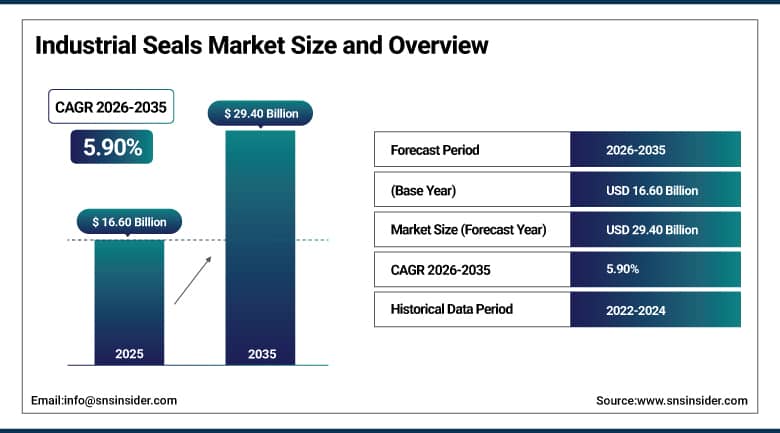
The Industrial Seals Market was valued at USD 16.60 Billion in 2025 and is expected to reach USD 29.40 Billion by 2035, growing at a CAGR of 5.90% from 2026 to 2035.
The Industrial Seals Market is expected to show a steady growth in its expansion due to the increasing need for reliable methods of preventing any kind of leakage or retaining pressure in manufacturing, automotive, oil and gas, and aerospace sectors. Industrial seals can be found in a number of applications to prevent any leakage, retain pressure, and also protect equipment from any contamination. Further expansion of the market is facilitated by the application of Industry 4.0 and smart manufacturing techniques that are creating the need for intelligent sealing solutions. The expanding production of electric vehicles is increasing the demand for specialized sealing products related to batteries and thermal management of vehicles. The ongoing innovation of materials such as PTFE and fluorosilicone also drives the expansion of the market.
Flowserve Corporation and Trelleborg both expanded their mechanical seal and PTFE sealing solution production capacity in 2026 to meet growing demand from automotive, aerospace, and oil and gas operators amid tightening equipment reliability standards across North America, Europe, and Asia Pacific industrial markets.
To Get More Information On Industrial Seals Market - Request Free Sample Report
Industrial Seals Market Trends
-
Rising adoption of IIoT-enabled sealing systems is enabling predictive maintenance across industrial machinery.
-
Growing demand for electric vehicle battery and thermal management seals is expanding automotive sealing applications.
-
Increasing use of high-performance PTFE and fluorosilicone materials is improving seal durability in extreme conditions.
-
Expanding semiconductor and renewable energy manufacturing is driving demand for precision static and dynamic seals.
-
Strategic capacity expansions by major sealing solution providers are strengthening supply reliability for OEM and aftermarket customers.
U.S. Industrial Seals Market Outlook
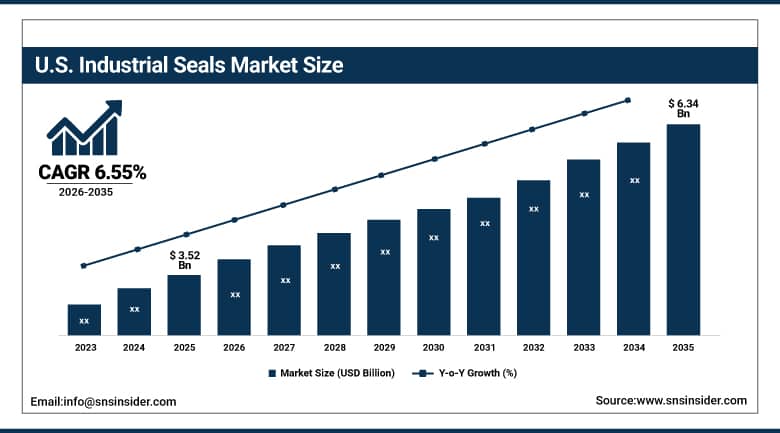
The U.S. Industrial Seals Market was valued at USD 3.52 Billion in 2025 and is projected to reach USD 6.34 Billion by 2035, growing at a CAGR of 6.55% during 2026-2035.
The United States is still a vital part of the North America Industrial Seals Market because of the involvement of the country in automotive, oil & gas, aerospace, and industrial manufacturing industry, and the practice of reshoring. The domestic manufacturers are becoming more and more interested in advanced sealing systems for their operations because of the need for better performance in the demanding conditions, as well as because of the development of EVs that require special battery and thermal management seals. The expansion of the semiconductor and renewable energy infrastructure is also contributing to the growth in the use of industrial seals, and the investment in the manufacturing facilities in the country is creating an even greater demand for such solutions.
In 2026, Parker Hannifin expanded its U.S. manufacturing capacity for high-performance PTFE and fluorosilicone seals through the addition of a new production line, strengthening its ability to supply aerospace and semiconductor equipment manufacturers seeking extreme-condition sealing solutions.
Industrial Seals Market Segment Analysis
-
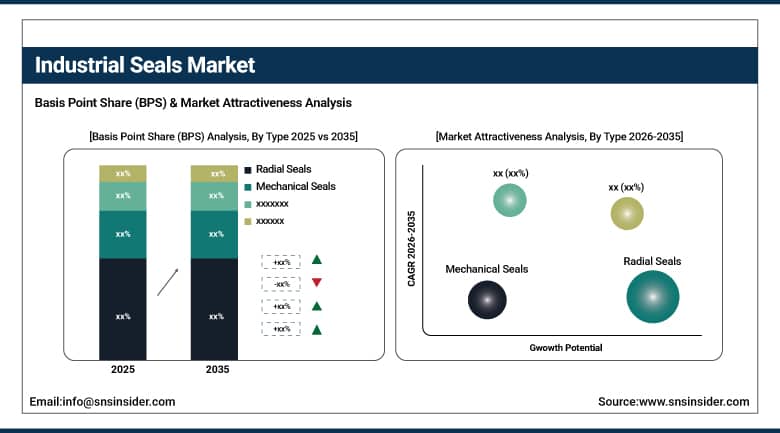
By Type, Radial Seals dominated the Industrial Seals Market with a 40.00% share in 2025, while Mechanical Seals is the fastest-growing type segment with a CAGR of 7.20% from 2026-2035.
-
By Material, Rubber dominated the Industrial Seals Market with a 30.00% share in 2025, while PTFE is the fastest-growing material segment with a CAGR of 7.00% from 2026-2035.
-
By End-Use, Automotive dominated the Industrial Seals Market with a 32.60% share in 2025, while Aerospace & Defense is the fastest-growing end-use segment with a CAGR of 7.20% from 2026-2035.
-
By Application, Dynamic Sealing dominated the Industrial Seals Market with a 58.40% share in 2025, while Static Sealing is the fastest-growing application segment with a CAGR of 6.90% from 2026-2035.
By Type, Radial Seals dominated the market, while Mechanical Seals is the fastest-growing segment.
The Radial Seals segment was the leading contributor with 40.00% revenue share in the Industrial Seals Market. Such classification is attributed to the reason why they are the biggest share because they have widespread applicability on automobile, aerospace, and power generation machinery where the use of radial seals creates a seal on the rotary shaft required to avoid the loss of lubricants and contamination of fluids. Radial seals' versatility on different diameters and speeds of shafts along with improvements made to enhance their lifespan under tough rotary conditions makes them dominant seal types across both developed and developing industrial manufacturing zones.
The Mechanical Seals segment is expected to witness the highest CAGR of 7.20% during the forecast period 2026-2035. Rising demand for zero-leakage sealing solutions in pumps, compressors, and mixers used across chemical processing, oil and gas, and pharmaceutical manufacturing is propelling mechanical seal consumption at an accelerated pace. Growing regulatory emphasis on fugitive emission control in process industries, combined with expanding investment in IIoT-enabled predictive maintenance systems integrated into mechanical seal assemblies, is adding further impetus to segment demand. Continuous innovation in dry-running and cartridge seal technology is driving the above-average growth rate of this segment relative to the broader industrial seals category.
By Material, Rubber dominated the market, while PTFE is the fastest-growing segment.
The Rubber category held a market share of 30.00% of the Industrial Seals Market in 2025. Rubber seals have prevailed in the market because of their superior flexibility, economical nature, and suitability with a broad range of standard applications used in industry and automobile sectors. The compatibility of rubber seals with high volume production operations and efficient supply chains that link elastomer manufacturers to seal producers have made them the industry standard seals purchased for automobile, industrial machinery, and consumer equipment sectors.
The PTFE segment is anticipated to grow at the fastest rate during the forecast period 2026-2035, at a CAGR of 7.00%. There is growing need for sealants that have high chemical resistance and heat resistance capabilities in aerospace, semiconductor, and chemical processing applications. Growing investment in advanced PTFE compounding technology that further improves wear resistance and reduces friction is further accelerating segment growth across premium sealing applications requiring maximum chemical compatibility and thermal stability.
By End-Use, Automotive dominated the market, while Aerospace & Defense is the fastest-growing segment.
The Automotive segment dominated the Industrial Seals Market with a revenue share of 32.60% in 2025. Automotive applications remain the largest category owing to the extensive use of seals across engine, transmission, and braking systems, where reliable sealing performance is essential for both conventional internal combustion and increasingly electric vehicle platforms, driving sustained procurement of radial, axial, and mechanical seals by automotive OEMs and tier-one suppliers across major vehicle manufacturing hubs including the United States, China, Germany, and Japan.
The Aerospace & Defense segment is expected to register the fastest CAGR of 7.20% during the forecast period 2026-2035. Increased demand for military seal products and high performance seal products for the commercial aircraft industry as a result of increased defense modernization projects, growth in commercial aircraft manufacture, and increased need for high reliability seal products that can withstand extreme altitude, temperature, and pressure is resulting in very high demand for aerospace sealing products.
By Application, Dynamic Sealing dominated the market, while Static Sealing is the fastest-growing segment.
The Dynamic Sealing segment dominated the Industrial Seals Market with a revenue share of 58.40% in 2025. Dynamic sealing applications remain the largest category owing to their essential role in preventing leakage at moving interfaces such as rotating shafts, pistons, and reciprocating components, which require continuous, high-frequency sealing performance across virtually every piece of rotating and reciprocating industrial machinery, driving sustained procurement of dynamic seals by equipment manufacturers across automotive, industrial machinery, and process industry applications worldwide.
The Static Sealing segment is expected to register the fastest CAGR of 6.90% during the forecast period 2026-2035. The increasing requirement for effective and tamper-proof sealing at fixed connections like flanges, bolted connections, and entries of enclosures, along with the increasing use of modern-day gasket and O-rings in semiconductor and renewable energy devices, is generating high demand for static seals, owing to the desire of minimizing any kind of leakages in order to increase safety.
Regional Insights
|
Region |
Major Country |
Share within Region, 2025 (%) |
|---|---|---|
|
North America |
United States |
85.40% |
|
Europe |
Germany |
24.60% |
|
Asia Pacific |
China |
42.80% |
|
Middle East & Africa |
Saudi Arabia |
27.20% |
|
Latin America |
Brazil |
40.60% |
North America Industrial Seals Market Insights
The North America Industrial Seals Market is expected to witness the fastest growth rate during the forecast period 2026-2035, registering a CAGR of 6.60%. The market growth is driven by expanding domestic manufacturing reshoring activity, rising electric vehicle production requiring specialized battery sealing technology, and growing semiconductor and renewable energy infrastructure investment as the region's manufacturers pursue supply chain resilience and advanced sealing technology adoption.
The United States is one of the main growth drivers in the North America Industrial Seals Market, owing to its expanding electric vehicle and semiconductor manufacturing base and rapidly growing domestic sealing solution production capability supporting both established and newly developed industrial applications. Canada is also contributing to regional growth through rising investment in industrial machinery manufacturing and growing adoption of advanced sealing technologies across its expanding automotive and energy sectors.
Get Customized Report as Per Your Business Requirement - Enquiry Now
Europe Industrial Seals Market Insights
The Europe region was a major contributor to the Industrial Seals Market in 2025, expected to register comparatively steady demand for precision, high-performance sealing technologies during the forecast period. This is attributed to the region's strong industrial base, advanced automotive and aerospace manufacturing presence, and stringent equipment reliability and emission control regulations driving adoption of advanced sealing materials across member states.
Germany is one of the major markets in Europe owing to its extensive automotive and industrial machinery manufacturing base, along with the presence of leading producers such as Trelleborg and Freudenberg Sealing Technologies serving both domestic and international customers. Other countries such as France, Italy, and the United Kingdom, home to significant industrial and aerospace manufacturing infrastructure, are also contributing to market growth through continued investment in advanced sealing technology adoption.
Asia Pacific Industrial Seals Market Insights
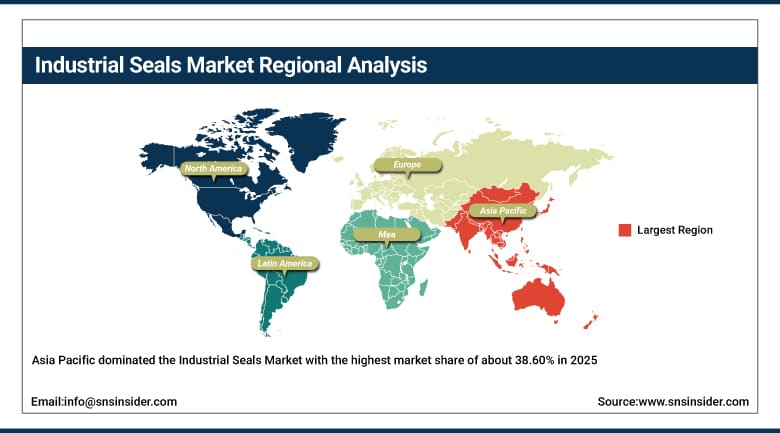
Asia Pacific dominated the Industrial Seals Market with the highest market share of about 38.60% in 2025, owing to the region's dominant position in global automotive, electronics, and industrial equipment manufacturing, extensive heavy-duty industrial applications, and rapidly expanding semiconductor and renewable energy infrastructure across China, India, and Southeast Asia. The region's cost-competitive manufacturing base, combined with substantial investment in industrial automation and automotive production, continues to support strong industrial seal consumption across both domestic and export-oriented manufacturing operations.
China was the leading country within the Asia Pacific Industrial Seals Market in 2025 with a market share of 42.80% of the regional market, driven by its position as the world's largest automotive and industrial equipment producer and dense sealing solution manufacturing clusters. India is contributing to regional growth through its own expanding manufacturing base and growing investment in industrial infrastructure supporting sustained demand for both dynamic and static sealing solutions.
Middle East & Africa and Latin America Industrial Seals Market Insights
Middle East & Africa and Latin American regions are gradually expanding industrial seals adoption as oil and gas infrastructure and industrial manufacturing capacity grow across both regions, supported by increasing energy sector investment and growing government focus on strengthening domestic industrial manufacturing capability.
Brazil is set to be a prominent Latin American market fueled by its substantial automotive and industrial machinery manufacturing base requiring extensive sealing solution supply and growing domestic manufacturing investment. The Middle East & Africa region has Saudi Arabia and the UAE investing heavily in oil and gas infrastructure and industrial diversification programs requiring substantial sealing solution volumes, positioning the region as a growing contributor to global demand.
Growth Drivers: Industry 4.0 adoption and rising equipment reliability demand driving market growth
The advent of Industry 4.0 and smart manufacturing, rising demand for reliable leak prevention across automotive, oil and gas, and aerospace equipment, and growing electric vehicle production are among the primary drivers of the Industrial Seals Market. Industrial seals provide manufacturers with the leak prevention, pressure containment, and contamination control capability required to maintain optimal equipment performance and safety, improving operational efficiency and reducing maintenance costs across virtually every major rotating and reciprocating machinery application requiring reliable sealing components, from automotive engines through large-scale industrial processing equipment.
Technological advancements in IIoT-enabled sealing systems have significantly increased predictive maintenance capability, with recent innovations improving seal condition monitoring and reducing unplanned equipment downtime across commercial industrial operations. Rising private-sector investment in dedicated high-performance material manufacturing capacity, growing integration of advanced PTFE and fluorosilicone compounds into premium sealing applications, and continued expansion of electric vehicle and semiconductor manufacturing are further supporting demand across the forecast period, as manufacturers continue strengthening capability against increasingly stringent reliability and performance requirements.
Restraints: Raw material price volatility and intense price competition limiting market expansion
One of the most critical obstacles in terms of market growth comes in the form of the volatility of elastomer, PTFE, and specialty metal feedstock pricing, which directly impacts industrial seal production costs and complicates long-term procurement planning for both manufacturers and downstream buyers. This comes down to the fact that sealing material formulations rely heavily on petrochemical and specialty polymer pricing subject to fluctuating global commodity markets, which limits smaller manufacturers from securing stable, cost-predictable production without substantial long-term contractual commitment.
Moreover, intense price competition among regional and low-cost manufacturers across different jurisdictions directly impacts profit margins and causes pricing pressure for both established and emerging sealing solution providers. Besides, the high technical requirements in terms of maintaining consistent sealing performance across varying temperature, pressure, and chemical exposure conditions require considerable ongoing research and development investment from industrial seal producers.
Opportunities: Expansion of smart sealing technology and EV-compatible seals creating new growth avenues
The increasing need for IIoT-enabled, condition-monitoring sealing systems across expanding smart manufacturing operations, the rise of electric vehicle production requiring specialized battery and thermal management seals, and greater emphasis on high-performance material innovation due to tightening reliability and emission requirements will provide ample growth opportunities in the Industrial Seals Market. The need for compliance-driven, high-reliability sealing capability across automotive, aerospace, and process industry operations will ensure future growth due to strict performance and environmental policies worldwide.
There is immense potential for growth in the area of dry-running and low-friction sealing technology that reduces energy consumption and extends service life for equipment manufacturers and end users. The increase in semiconductor, renewable energy, and industrial manufacturing investment across emerging economies of Asia Pacific and Latin America, along with manufacturer efforts toward strengthening advanced material production capability, will drive growth in demand for advanced industrial sealing solutions.
Recent Developments
-
2025: Flowserve Corporation launched its new IPS-C Cartridge Mechanical Seal, offering improved fugitive emission control for chemical processing and oil and gas pump applications.
-
2025: Trelleborg introduced its Isolast Zurcon extreme-condition PTFE seal line, targeting aerospace and semiconductor equipment manufacturers seeking chemical and thermal resistance.
-
2026: Parker Hannifin expanded its EV battery sealing solution production capacity with a new manufacturing line dedicated to electric vehicle thermal management customers.
-
2026: Freudenberg Sealing Technologies partnered with a leading industrial IoT provider to integrate condition-monitoring sensors into its mechanical seal product line for predictive maintenance applications.
Industrial Seals Companies are:
-
Flowserve Corporation
-
Trelleborg AB
-
SKF AB
-
Freudenberg Sealing Technologies GmbH & Co. KG
-
Parker Hannifin Corporation
-
EKK Eagle Industry Co., Ltd. (EagleBurgmann)
-
EnPro Industries, Inc. (Garlock)
-
A.W. Chesterton Company
-
Smiths Group plc (John Crane)
-
NOK Corporation
-
Dana Incorporated
-
Tenneco Inc.
-
Saint-Gobain Performance Plastics
-
Hutchinson SA
-
Minnesota Rubber and Plastics
-
SSP Manufacturing, Inc.
-
Ergoseal, Inc.
-
Specialized Engineering Against Leakage GmbH
Industrial Seals Market Report Scope:
| Report Attributes | Details |
|---|---|
| Market Size in 2025 | USD 16.60 Billion |
| Market Size by 2035 | USD 29.40 Billion |
| CAGR | CAGR of 5.90% From 2026 to 2035 |
| Base Year | 2025 |
| Forecast Period | 2026-2035 |
| Historical Data | 2022-2024 |
| Report Scope & Coverage | Market Size, Segments Analysis, Competitive Landscape, Regional Analysis, DROC & SWOT Analysis, Forecast Outlook |
| Key Segments | • By Type (Radial Seals, Axial Seals, Mechanical Seals & Others) • By Material (Rubber, PTFE, Metal & Others) • By End-Use (Automotive, Oil & Gas, Aerospace & Defense, Food & Beverage & Others) • By Application (Dynamic Sealing, Static Sealing) |
| Regional Analysis/Coverage | North America (US, Canada), Europe (Germany, UK, France, Italy, Spain, Russia, Poland, Rest of Europe), Asia Pacific (China, India, Japan, South Korea, Australia, ASEAN Countries, Rest of Asia Pacific), Middle East & Africa (UAE, Saudi Arabia, Qatar, South Africa, Rest of Middle East & Africa), Latin America (Brazil, Argentina, Mexico, Colombia, Rest of Latin America). |
| Company Profiles | Flowserve Corporation, Trelleborg AB, SKF AB, Freudenberg Sealing Technologies GmbH & Co. KG, Parker Hannifin Corporation, James Walker & Co. Ltd., EKK Eagle Industry Co., Ltd. (EagleBurgmann), EnPro Industries, Inc. (Garlock), A.W. Chesterton Company, Smiths Group plc (John Crane), NOK Corporation, Dana Incorporated, Tenneco Inc., Saint-Gobain Performance Plastics, Hutchinson SA, Precision Associates, Inc., Minnesota Rubber and Plastics, SSP Manufacturing, Inc., Ergoseal, Inc., Specialized Engineering Against Leakage GmbH. |

Frequently Asked Questions
Key players in the Industrial Seals Market include Flowserve Corporation, Trelleborg AB, SKF AB, Freudenberg Sealing Technologies GmbH & Co. KG, among others.
Key opportunities include IIoT-enabled predictive maintenance sealing systems and specialized seals for electric vehicle batteries and thermal management applications.
Growth is driven by Industry 4.0, smart manufacturing, reliable leak prevention across industries, and increasing electric vehicle production worldwide.
The Radial Seals segment dominated the Industrial Seals Market, accounting for approximately 40.00% market share.
The Asia Pacific region dominated the Industrial Seals Market in 2025 with a 38.60% share, driven by extensive automotive, electronics and industrial equipment manufacturing.
