
Automotive Rear Seat Infotainment Market Report Scope & Overview:
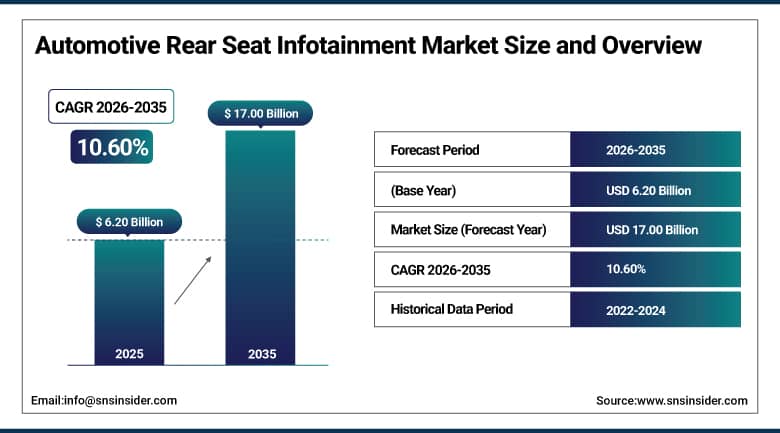
The Automotive Rear Seat Infotainment Market was valued at USD 6.20 Billion in 2025 and is expected to reach USD 17.00 Billion by 2035, growing at a CAGR of 10.60% from 2026–2035.
Automotive rear seat infotainment encompasses automotive audio/video/entertainment systems designed especially for back-seat passengers in the second and third rows of a car, featuring technologies such as touchscreens of high resolution, wireless connection, streamable content, and video game interfaces, transforming driving time into leisure and productivity. With the increasing transformation of vehicles from mere modes of transport to mobile living spaces, the need for sophisticated rear seat technologies is rising among premium and luxury automakers, as vehicle satisfaction is influenced more and more by in-vehicle technologies since consumers require an infotainment system to be as advanced as the one on their smartphones. The presence of smartphones affects expectations of passengers in general, and therefore, technologies like Wi-Fi speed and voice command become essential.
SoundHound AI integrated its generative AI voice assistant into vehicles from three major automotive brands across North America in August 2025, building on a voice commerce platform the company estimates could unlock as much as $35 billion in annual revenue for automakers through hands-free food ordering, payments, and loyalty program integration. DS Automobiles, an early adopter of the same underlying technology in Europe, reported that adding generative AI capability increased how often drivers and passengers actually used their voice assistant by more than 50%, a reminder that rear-seat and cabin infotainment increasingly competes on how naturally a system responds to a spoken request rather than how many buttons or menus it packs onto a screen.
To Get More Information On Automotive Rear Seat Infotainment Market - Request Free Sample Report
Automotive Rear Seat Infotainment Market Trends:
-
Rising adoption of generative AI voice assistants delivering conversational, context-aware interaction beyond basic voice commands
-
Growing share shift from sedans toward SUVs and MPVs, reflecting evolving global vehicle preference patterns
-
Increasing transition from wired to wireless connectivity, with cellular connectivity emerging as the fastest-growing option supporting cloud content and OTA updates
-
Expanding adoption of Android Automotive OS alongside established Linux-based platforms, driven by OEM demand for customizable software stacks
-
Growing recurring software and platform value capture relative to standalone hardware, as OTA updates and personalized experiences differentiate premium tiers
-
Rising aftermarket segment growth as consumers retrofit existing vehicles with advanced rear seat entertainment and connectivity systems
U.S. Automotive Rear Seat Infotainment Market Outlook:
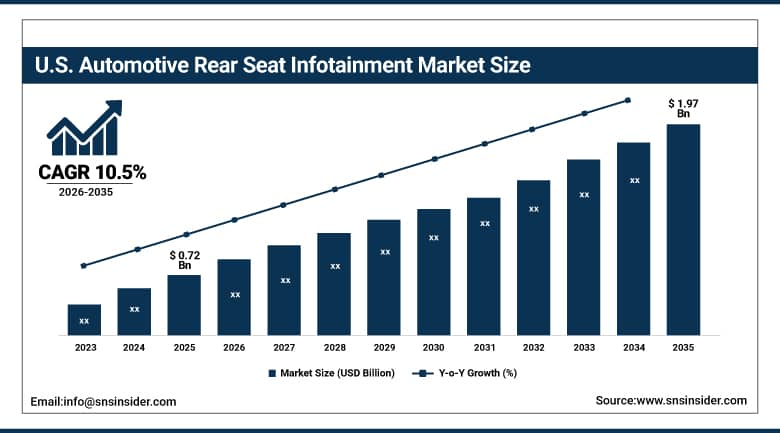
The U.S. Automotive Rear Seat Infotainment Market was valued at approximately USD 0.72 Billion in 2025 and is expected to reach approximately USD 1.97 Billion by 2035, growing at a CAGR of approximately 10.5%.
The demand for infotainment systems in America has been boosted by the presence of leading automotive manufacturers in addition to the increasing adoption of premium infotainment systems due to the consumers’ need for more comfort and connectivity on long road trips. The adoption of connected cars keeps improving the integration of technology in cars in America, where car makers are treating rear-seat infotainment as a genuine way to distinguish their products from those of other carmakers. The use of artificial intelligence keeps improving content personalization.
SoundHound AI, headquartered in Santa Clara, California, built its automotive voice assistant business on partnerships that started with European Stellantis brands like DS Automobiles, Peugeot, and Jeep before expanding into three major automotive brands across North America in August 2025. That expansion path, proving the technology in Europe first before bringing it home to American vehicles, reflects how much of the cutting-edge conversational AI now appearing in U.S. rear-seat and cabin infotainment systems was actually validated abroad first, a genuinely different pattern than the domestic-first rollout strategy most American technology companies typically follow.
Automotive Rear Seat Infotainment Market Segment Analysis:
-
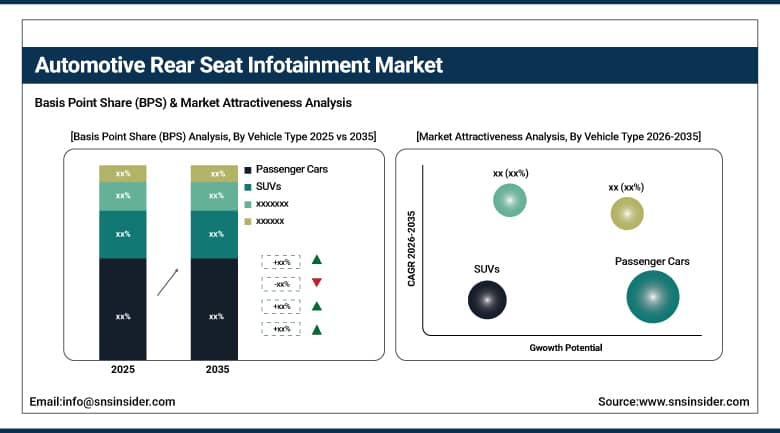
By Vehicle Type, the Passenger Cars/Sedans segment dominated the Automotive Rear Seat Infotainment Market with approximately 44.60% share in 2025, while the SUVs segment is the fastest growing with a CAGR of approximately 10.80%.
-
By Component, the Display/Touch-Screen Module segment dominated the Automotive Rear Seat Infotainment Market with approximately 52.40% share in 2025, while the Software/Infotainment Platforms segment is the fastest growing with a CAGR of approximately 13.20%.
-
By Connectivity, the Wireless segment dominated the Automotive Rear Seat Infotainment Market with approximately 60.20% share in 2025, while the Cellular Connectivity sub-segment is the fastest growing with a CAGR of approximately 11.10%.
-
By Operating System, the Linux-Based segment dominated the Automotive Rear Seat Infotainment Market with approximately 45.76% share in 2025, while the Android Automotive OS segment is the fastest growing with a CAGR of approximately 13.62%.
-
By Sales Channel, the OEM-Installed segment dominated the Automotive Rear Seat Infotainment Market with approximately 86.32% share in 2025, while the Aftermarket segment is the fastest growing with a CAGR of approximately 14.10%.
By Vehicle Type, Passenger Cars/Sedans dominates, SUVs grows fastest
Passenger cars and sedans held the largest share of the vehicle-type segment in 2025, reflecting the sheer scale of the global sedan and compact vehicle fleet that continues generating the bulk of overall rear seat infotainment installation volume worldwide. That established, high-volume vehicle category keeps sedans the anchor vehicle-type segment across the broader market, even as global vehicle preference patterns continue shifting toward larger body styles.
SUVs are the fastest-growing vehicle segment, reflecting the global share shift from sedans to SUVs and driven by premium SUV rear entertainment systems that automakers increasingly treat as a primary purchase motivator. Rising demand for third-row and second-row entertainment in larger family vehicles continues reinforcing this above-average growth trajectory relative to the broader, sedan-dominated vehicle-type mix.
By Component, Display/Touch-Screen Module dominates, Software grows fastest
Display and touch-screen modules held the largest share of the component segment in 2025, remaining the visible hardware backbone that every rear seat infotainment installation depends on to deliver content to passengers regardless of the underlying software platform. Seatback display systems remain the largest system category, keeping this hardware component the dominant category across the broader market.
Software and infotainment platforms are growing fastest as faster growth in recurring software capability means personalized experiences and application updates are becoming more valuable than stand-alone hardware alone. Larger displays increase demand for richer content, which in turn increases reliance on secure connectivity, operating systems, and over-the-air updates, reinforcing this above-average growth trajectory relative to the broader, hardware-dominated component mix.
By Connectivity, Wireless dominates, Cellular grows fastest
Wireless connectivity held the largest share of the connectivity segment in 2025, supporting the smartphone mirroring, streaming, and wireless casting capabilities that passengers increasingly expect as baseline functionality rather than a premium add-on. That combination of convenience and smartphone integration keeps wireless connectivity the dominant approach across the broader rear seat infotainment market.
Cellular connectivity is growing fastest, representing the fastest connectivity growth rate as it supports cloud content, gaming, and over-the-air updates without passenger-device dependency. That device-independent capability continues reinforcing this above-average growth trajectory relative to the broader, general-wireless-dominated connectivity mix, particularly as automakers seek to deliver content without relying on passengers bringing their own connected devices.
By Operating System, Linux-Based dominates, Android Automotive OS grows fastest
Linux-based platforms controlled the largest share of the operating-system segment in 2025, benefiting from open-source flexibility and OEM demand for customizable software stacks that let automakers tailor the user interface to their specific brand experience. That customization flexibility keeps Linux-based platforms the dominant operating-system category across the broader rear seat infotainment market.
Android Automotive OS is growing fastest, driven by Google Android Automotive OS momentum and its growing app ecosystem that gives automakers access to a broader range of third-party applications and services than proprietary systems typically offer. Rising OEM adoption of this Google-backed platform continues reinforcing this above-average growth trajectory relative to the broader, Linux-dominated operating-system mix.
By Sales Channel, OEM-Installed dominates, Aftermarket grows fastest
The OEM installed system was dominant in the sales-channel share in 2025 because the installation of rear seat infotainment has become a part of the initial specification for vehicles rather than an after-installation accessory. This high level of integration of the infotainment into the vehicle engineering process has helped OEM-installed systems retain their dominant position in the sales-channel mix for all kinds of vehicles.
The aftermarket system has been growing at a rapid pace because there is an increasing trend among consumers of retrofitting their old cars with more sophisticated rear seat infotainment systems, which were not available to them initially when they purchased their cars.
Regional Analysis:
|
Region |
Major Country |
Share within Region, 2025 (%) |
|---|---|---|
|
Asia Pacific |
China |
40.60% |
|
North America |
United States |
91.70% |
|
Europe |
Germany |
25.40% |
|
Middle East & Africa |
UAE |
32.60% |
|
Latin America |
Brazil |
27.80% |
Asia Pacific Automotive Rear Seat Infotainment Market Insights
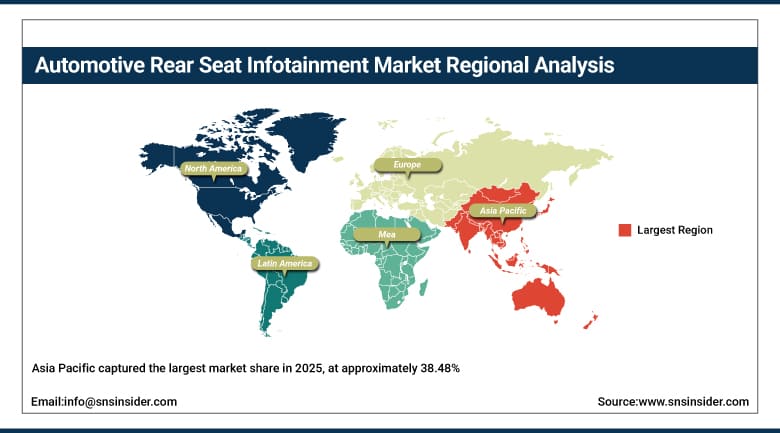
Asia Pacific captured the largest market share in 2025, at approximately 38.48%, supported by high rear-seat utilization in Southeast Asia, China, and the growing premium minivan segment where rear-seat occupant experience is a primary purchase motivator. Rising disposable incomes and increasing demand for feature-rich vehicles across the region's largest and fastest-growing automotive economies continue reinforcing this leading position.
China's massive vehicle production base and growing consumer preference for MPVs and premium SUVs give the region substantial baseline demand, while India's expanding automotive market is drawing significant new investment in rear seat infotainment adoption. Japan and South Korea represent more mature, technology-forward markets with established infotainment supplier bases, while Southeast Asian markets continue following a similar rear-seat-utilization-driven growth trajectory.
Get Customized Report as Per Your Business Requirement - Enquiry Now
North America Automotive Rear Seat Infotainment Market Insights
North America represents a substantial automotive rear seat infotainment market, with the United States accounting for the large majority of regional demand due to the presence of major automotive manufacturers and a high adoption rate of premium infotainment systems. That deep concentration of premium and luxury vehicle production keeps the region a key market for advanced rear seat entertainment technology.
Canada contributes additional demand through its own vehicle sales and growing consumer preference for connected in-car technology, expanding at a steady pace alongside broader North American automotive trends. Cross-border supply relationships tie much of North American demand together, with major suppliers typically serving both markets through shared production and distribution networks.
Europe Automotive Rear Seat Infotainment Market Insights
Europe is a matured and premium-oriented automotive rear-seat infotainment market where the penetration is prevalent in premium compact segments and luxurious cars in the largest automobile manufacturing nations of Europe. Germany leads the regional demand, which houses many manufacturers of luxurious and premium vehicles as well as many providers of infotainment technologies.
France, Italy make a noteworthy contribution as well. Hatchback and premium compact car segments lead to steady penetration in these regions. The increasing significance of integrating generative AI voice assistants into the vehicles by Stellantis brands, as the first mover in Europe across several European nations, is leading regional product developments.
MEA & Latin America Automotive Rear Seat Infotainment Market Insights
The Middle East and Africa are projected to be the fastest-growing region, driven by rising demand for premium and luxury vehicles equipped with advanced rear seat entertainment systems tied to the region's affluent consumer base. The UAE anchors this growth, driving demand through its position as a major luxury vehicle market and growing automotive retail investment tied to broader economic diversification goals.
Latin America is a growing market led by Brazil, where expanding vehicle sales and rising consumer preference for connected in-car technology continue driving rear seat infotainment adoption. Mexico and Argentina contribute meaningful secondary demand, tied to their own growing automotive markets and consumer technology adoption trends.
Market Dynamics:
Growth Drivers: Enhanced in-car entertainment demand and connected vehicle adoption fueling growth
Consumer preference for improved in-car entertainment has been identified as one of the most obvious drivers fueling the increased demands for rear-seat infotainment, due to their need for improved traveling experience. Use of AI-infused rear seat infotainment system providing personalization of the entertainment and convenience features to passengers is among the factors driving the demand further for the rear seat infotainment segment.
Increased use of connected vehicles is the second significant factor increasing the demand for rear seat infotainment because it provides increased in-car connectivity and availability of various types of streaming media, navigation information, and interaction possibilities for the rear seat passengers. Advancement in technology, including use of AI and machine learning, continues to improve the user experience.
Restraints: High system costs and content licensing complexity limiting broader adoption
The high initial costs of advanced infotainment systems present a significant challenge for market growth, as manufacturers must find ways to reduce costs while maintaining quality and functionality to make these systems accessible to a wider consumer base. That cost sensitivity can slow adoption in price-sensitive vehicle segments and emerging markets where consumers weigh infotainment features against other purchase priorities.
Content licensing complexity adds a further restraint, since delivering streaming video, gaming, and cloud-based services across different regions and vehicle markets requires navigating varying content rights and regional licensing agreements. That complexity can limit how quickly automakers can offer a fully consistent rear seat entertainment experience across their global vehicle lineups.
Opportunities: Generative AI voice integration and second and third row personalization opening new growth avenues
Generative AI voice integration offers manufacturers a genuine path to capturing premium business from automakers seeking differentiated, conversational in-cabin experiences that go beyond basic voice command recognition. Companies that build strong generative AI capability, backed by real usage data showing increased passenger engagement, are positioned to capture disproportionate growth as this technology continues expanding across mainstream vehicle segments.
Personalized, multi-screen second and third row experiences represent a second significant opportunity, as consumers increasingly seek immersive experiences during travel with larger displays and multi-screen setups tailored to individual passenger preferences. Manufacturers that build genuine personalization and multi-user content capability are positioned to capture premium pricing from automakers targeting family and luxury vehicle segments.
Recent Developments:
-
In August 2025, SoundHound AI integrated its Chat AI Automotive voice assistant into vehicles from three major automotive brands across North America.
-
In August 2025, SoundHound AI brought its generative AI-powered voice assistant to Jeep vehicles across Europe, expanding its Stellantis brand partnerships.
-
In 2025, SoundHound AI introduced an in-car voice commerce agent integrating commerce, loyalty programs, and navigation directly into vehicle infotainment systems, enabling hands-free food ordering and payment.
-
In 2024, Lancia integrated SoundHound Chat AI into its S.A.L.A. infotainment system across seven European countries, expanding generative AI voice assistant availability within the Stellantis brand family.
Automotive Rear Seat Infotainment Market Key Players:
-
Harman International Industries, Incorporated (Samsung)
-
Panasonic Automotive Systems Co., Ltd.
-
LG Electronics Inc.
-
Robert Bosch GmbH
-
Continental AG
-
Visteon Corporation
-
Sony Group Corporation
-
Alpine Electronics, Inc. (Alps Alpine)
-
Pioneer Corporation
-
Denso Corporation
-
Aptiv PLC
-
Faurecia SE (FORVIA)
-
Clarion Co., Ltd.
-
JVCKenwood Corporation
-
Voxx International Corporation
-
Marelli Holdings Co., Ltd.
-
Valeo SA
-
Garmin Ltd.
-
SoundHound AI, Inc.
-
Qualcomm Incorporated
Automotive Rear Seat Infotainment Market Report Scope:
| Report Attributes | Details |
|---|---|
| Market Size in 2025 | USD 6.20 Billion |
| Market Size by 2035 | USD 17.00 Billion |
| CAGR | CAGR of 10.60% From 2026 to 2035 |
| Base Year | 2025 |
| Forecast Period | 2026-2035 |
| Historical Data | 2022-2024 |
| Report Scope & Coverage | Market Size, Segments Analysis, Competitive Landscape, Regional Analysis, DROC & SWOT Analysis, Forecast Outlook |
| Key Segments | • by Vehicle Type (Passenger Cars, Sedans, SUVs, MPVs, Hatchbacks, Luxury Vehicles, Commercial Vehicles) • by Component (Display/Touch-Screen Module, Others) • by Connectivity (Wired, Wireless) • by Operating System (Linux-Based, Android Automotive OS, QNX, Microsoft, Others) • by Sales Channel (OEM-Installed, Aftermarket) |
| Regional Analysis/Coverage | North America (US, Canada), Europe (Germany, UK, France, Italy, Spain, Russia, Poland, Rest of Europe), Asia Pacific (China, India, Japan, South Korea, Australia, ASEAN Countries, Rest of Asia Pacific), Middle East & Africa (UAE, Saudi Arabia, Qatar, South Africa, Rest of Middle East & Africa), Latin America (Brazil, Argentina, Mexico, Colombia, Rest of Latin America). |
| Company Profiles | Harman International Industries, Incorporated (Samsung), Panasonic Automotive Systems Co., Ltd., LG Electronics Inc., Robert Bosch GmbH, Continental AG, Visteon Corporation, Sony Group Corporation, Alpine Electronics, Inc. (Alps Alpine), Pioneer Corporation, Denso Corporation, Aptiv PLC, Faurecia SE (FORVIA), Clarion Co., Ltd., JVCKenwood Corporation, Voxx International Corporation, Marelli Holdings Co., Ltd., Valeo SA, Garmin Ltd., SoundHound AI, Inc., Qualcomm Incorporated |
Frequently Asked Questions
Leading companies include Harman International Industries, Incorporated, Panasonic Automotive Systems Co., Ltd., LG Electronics Inc., Robert Bosch GmbH, and Continental AG, among other major infotainment and automotive electronics manufacturers.
Opportunities include generative AI voice integration delivering differentiated, conversational in-cabin experiences and personalized, multi-screen second and third row experiences tailored to individual passenger preferences.
Growth is driven by increasing consumer preference for enhanced in-car entertainment, increasing adoption of connected vehicles, and integration of AI and machine learning enabling personalized content delivery.
Passenger Cars/Sedans dominates by vehicle type with approximately 44.60% share, Display/Touch-Screen Module dominates by component with roughly 52.40% share, Linux-Based dominates by operating system with about 45.76% share, and OEM-Installed dominates by sales channel with approximately 86.32% share; SUVs, Software/Infotainment Platforms, Android Automotive OS, and Aftermarket are the fastest-growing segments within their respective categories.
Asia Pacific is the largest regional market with approximately 38.48% share, led by China, while the Middle East & Africa is the fastest-growing region at approximately 14.25% CAGR through the forecast period.
