
Battery Energy Storage System Fire Protection Market Report Scope and Overview:
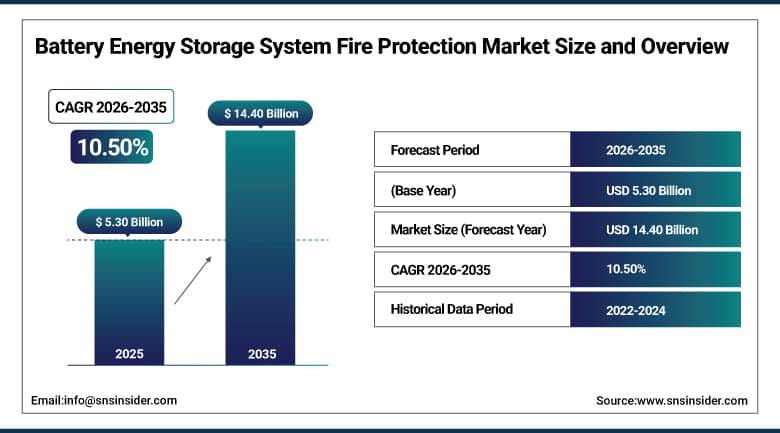
The Battery Energy Storage System Fire Protection Market was valued at USD 5.30 Billion in 2025 and is projected to reach USD 14.40 Billion by 2035, registering a CAGR of 10.50% from 2026 to 2035.
The Battery Energy Storage System Fire Protection Market growth is driven by the accelerating BESS deployments across utility, commercial, and residential sectors, increasingly stringent fire safety regulations, such as NFPA 855 and UL 9540A, heightened insurance industry requirements, and growing adoption of AI-driven pre-fire detection technology worldwide. Multi-gas electrochemical sensing, partnerships between fire protection vendors and BESS manufacturers, and expansion of cloud-connected monitoring capability have followed heavy investment from electric utilities, independent power producers, and industrial operators pursuing certified, insurable, and reliable battery storage fire protection.
The market encompasses the integrated set of systems and protocols designed to detect, prevent, and suppress fire events within battery energy storage installations, addressing the unique behavior of lithium-ion and related battery chemistries including thermal runaway propagation and the release of toxic off-gases well before any visible flame. A complete safety architecture typically includes multi-gas early-detection sensors, thermal imaging or heat-flux monitoring, dedicated suppression agents such as clean agents, high-pressure water mist, and inert gas systems, and automated response platforms integrated with battery management and SCADA infrastructure.
To Get More Information On Battery Energy Storage System Fire Protection Market - Request Free Sample Report
Battery Energy Storage System Fire Protection Market Trends
-
Rising adoption of pre-fire gas detection continues shifting procurement toward early-warning platforms.
-
Growing insurance industry requirements continue elevating fire protection from best practice to underwriting prerequisite.
-
Expanding NFPA 855 and UL 9540A compliance is broadening demand for certified suppression and detection systems.
-
Increasing OEM partnerships between BESS manufacturers and fire protection vendors continue simplifying project permitting.
-
Growing retrofit demand among older BESS installations continues expanding recurring service revenue streams.
U.S. Battery Energy Storage System Fire Protection Market Outlook
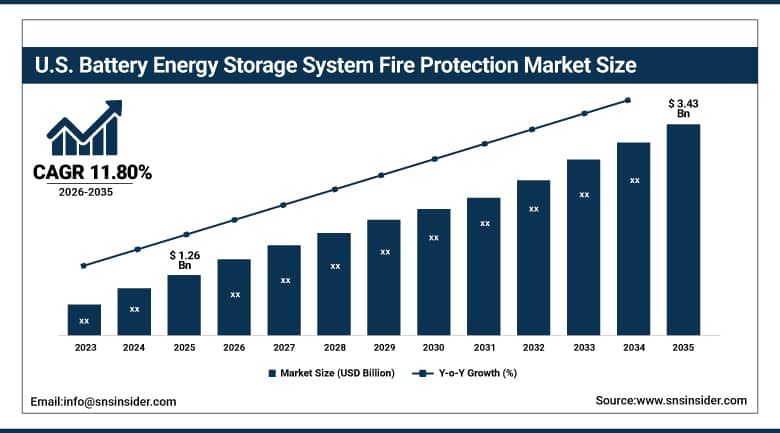
The U.S. Battery Energy Storage System Fire Protection Market was valued at approximately USD 1.26 Billion in 2025 and is projected to reach approximately USD 3.43 Billion by 2035, registering a CAGR of approximately 11.80% from 2026 to 2035.
The main driver of demand in the U.S. is the aggressive construction of energy storage with Inflation Reduction Act incentives, mandates from California, Texas, New York, and Florida states, as well as the broad acceptance of NFPA 855 2023 revisions by AHJ nationwide. The utility procurement mandate and favorable ISO tariff structure in favor of dispatchable storage have led to the formation of the multi-gigawatt installation pipeline that creates the demand for fire protection systems in proportion to this pipeline.
The deployment of artificial intelligence (AI)-based pre-fire gas detection and multi-sensor technology has played an extremely important role in ensuring the dominance of the Battery Energy Storage System Fire Protection Market in the U.S. Besides, growing insurance underwriting mandates for multi-layer fire protection have created additional demand for this product.
Battery Energy Storage System Fire Protection Market Segment Analysis
-
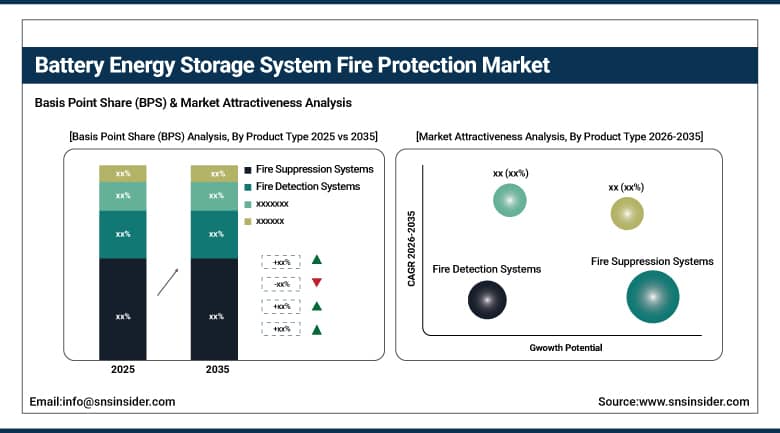
By Product Type, Fire Suppression Systems segment dominated the Market in 2025 with 40.60% share; Fire Detection Systems segment is the fastest growing segment, registering a CAGR of approximately 11.00%.
-
By Application, Utility segment dominated the market in 2025 with 37.20% share; Residential segment is the fastest growing segment, registering a CAGR of approximately 12.60%.
-
By Battery Type, Lithium-ion segment dominated the market in 2025 with 59.80% share; Others segment is the fastest growing segment, registering a CAGR of approximately 14.10%.
-
By End-User, Energy segment dominated the market in 2025 with 39.80% share; Automotive segment is the fastest growing segment, registering a CAGR of approximately 10.80%.
By Product Type, Fire Suppression Systems Dominates the Battery Energy Storage System Fire Protection Market While Fire Detection Systems Grows Fastest
Fire Suppression Systems accounted for the highest market share of 40.60% in the Battery Energy Storage System Fire Protection Market in 2025, including clean agent, water mist, inert gas, and aerosol fire suppression solutions, designed specifically for particular environments. Fike Corporation's UL 9540A-rated BESS Protection System, which is based on knowledge gathered through incident investigations into major thermal runaway incidents, is a good example explaining the continued dominance of investments in the fire suppression system over other fire protection systems.
The fastest-growing product type in the Product Type segment is Fire Detection Systems, which is expected to grow at a rate of around 11.00%. This trend reflects the industry trend of moving towards pre-fire interventions that detect thermal stress conditions prior to ignition. Honeywell International's VESDA-E laser-aspirating smoke detectors in combination with its Connected Life Safety Services platform is a great example of the importance of early warning fire sensing and machine learning-driven anomaly detection.
By Application, Utility Dominates the Battery Energy Storage System Fire Protection Market While Residential Grows Fastest
Utility held the largest application share in 2025 at approximately 37.20%, owing to the high cost of BESS installation and strict fire code regulations on the grid scale. Containerized BESS requires fire protection on an individual container basis and also at facility level, which leads to a compounding factor on spending for fire safety on a project basis.
The residential application segment is expected to witness a CAGR of around 12.60% during the forecast period, the fastest growing among all applications, as solar energy storage system in homes picks up steam on account of revisions in residential fire codes, such as California’s revised Title 19 fire code requiring smoke detector on home battery storage systems.
By Battery Type, Lithium-ion Dominates the Battery Energy Storage System Fire Protection Market While Others Grows Fastest
In 2025, lithium-ion will maintain the largest market share of battery type at approximately 59.80%. This is attributable to the prevalence of lithium-ion chemistry in the entire BESS deployment mix, along with the high fire risk associated with this chemistry, which results in higher fire protection cost per kWh compared to the rest of the battery chemistries. Full compliance to NFPA 855 fire protection standards will be required for both LFP and NMC sub-chemistries.
The Others battery type segment, which includes chemistries such as sodium-ion, solid state, and upcoming hybrid batteries, will register growth at a CAGR of around 14.10%, which is the highest of all battery types, due to the shift of the next generation of batteries from pilot phase to full-scale production. Fire protection vendors are engaged in R&D activities for understanding the safety profile of these emerging battery types.
By End-User, Energy Leads the Battery Energy Storage System Fire Protection Market While Automotive Grows Fastest
Energy was the dominant end-user application segment in 2025, contributing to almost 39.80% of revenue share in the global market, including electrical utility companies, independent power producers, renewable energy providers, and grid operators who require most advanced and highest specification fire protection systems. Utility level fire regulations, high replacement cost of big battery installations, and fire incidents in the infrastructure of public organizations will continue to support dominance in this segment.
The fastest-growing segment is expected to be automotive, growing at a CAGR of about 10.80%. This growth can be attributed to the deployment of the DC fast charging network, battery energy storage systems in automotive assembly plants, and battery testing centers for EVs. The installation of individual charging hubs with significant buffer storage in the form of batteries will provide an excellent opportunity for fire protection systems.
Regional Analysis:
|
Region |
Major Country |
Share within Region, 2025 (%) |
|---|---|---|
|
Asia Pacific |
China |
35.00% |
|
North America |
United States |
78.00% |
|
Europe |
Germany |
26.00% |
|
Middle East and Africa |
Saudi Arabia |
35.00% |
|
Latin America |
Brazil |
50.00% |
Asia Pacific Battery Energy Storage System Fire Protection Market Insights
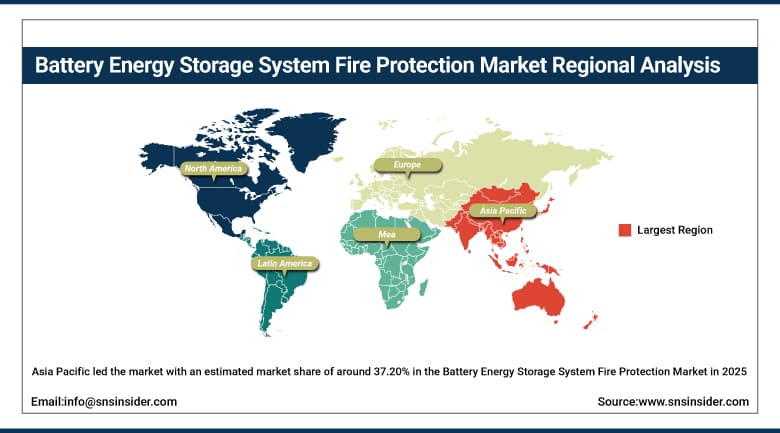
Asia Pacific led the market with an estimated market share of around 37.20% in the Battery Energy Storage System Fire Protection Market in 2025, due to extensive deployments of grid-scale energy storage systems and the leading role of China in terms of being the largest BESS market in the world as well as being a dominant BESS systems manufacturer. Countries like Japan and South Korea, which witnessed extreme BESS fires in the latter part of the 2010s decade, have some of the toughest fire safety codes for energy storage worldwide, while Australia, whose battery storage industry is growing fast, has seen significant purchases of fire detection and suppression solutions.
China led in Asia Pacific in terms of revenue share with an estimated share of around 35.00%, on account of the Five-Year Plan target of the government of new energy storage systems, which is leading to high demand for fire protection infrastructure solutions in grid-scale BESS and distributed BESS systems.
Get Customized Report as Per Your Business Requirement - Enquiry Now
North America Battery Energy Storage System Fire Protection Market Insights
The Battery Energy Storage System Fire Protection Market in North America held a considerable market share of around 30.50% in 2025, thanks to the United States of America's vigorous development of clean energy storage through the Inflation Reduction Act and mandates by California, Texas, New York, and Florida. The utility procurement needs and ISO tariffs, which are more favorable for dispatchable storage, have created the multi-gigawatt pipeline installation that creates the need for the fire protection systems.
The U.S. alone accounted for almost 78.00% of the total revenue generated in North America, owing mainly to the use of the 2023 version of NFPA 855 by the Authorities Having Jurisdiction, making the fire suppression and detection system an essential part of the BESS project.
Europe Battery Energy Storage System Fire Protection Market Insights
Europe had captured a considerable market share of around 19.80%, driven by its commitment towards clean energy transition through initiatives such as the European Green Deal and REPowerEU, both of which highlight energy storage as the bedrock of flexible grids. Germany, United Kingdom, Italy, and Spain dominate the regional adoption of BESS systems, where the countries have adopted energy storage-specific fire codes in their national fire code systems.
Germany dominated the European market in terms of revenue, accounting for around 26.00% of regional share, propelled by harmonized regulatory efforts and established fire safety supply chains. United Kingdom's guidance from the National Fire Chiefs Council was a key driver for regional demand due to one of the most advanced battery portfolios in the grid scale of the world.
MEA and Latin America Battery Energy Storage System Fire Protection Market Insights
The Middle East & Africa is expected to become the fastest-growing region at a CAGR of around 12.20% between 2026 and 2035, while Latin America & MEA are estimated to contribute to about 7.20% & 5.30% of market revenue respectively in 2025. High ambient temperature conditions in gulf regions lead to accelerated battery aging and raise the chances of fire incidents, thereby rendering fire safety systems not only a compliance but a need for operations.
In the Middle East & Africa, Saudi Arabia emerged as the leader, holding around 35.00% share of regional demand, due to large scale utility storage installation linked with vision 2030 & NEOM related renewable installations. Meanwhile, in Latin America region, Brazil continued to dominate the market and held around 50.00% of regional market revenue share, due to utility-scale energy storage installations linked with solar & wind power integration following IEC & NFPA guidelines.
Market Dynamics:
Growth Drivers: Rapid Global BESS Capacity Expansion
The market is growing due to the fast development of BESS capacity around the world, with the reason that any megawatt-hour of electrochemical storage capacity requires thermal management and fire safety equipment in order to provide insurance compliance, regulatory compliance and technical operation. It is estimated that the relationship between installed BESS capacity and expenditures for fire protection systems is approximately 2.0-2.5% of the total project capital cost, thus making fire safety one of the most valuable non-electrical systems in the BESS ecosystem.
There is also the presence of tough regulations, such as NFPA 855 2023 edition that has implemented mandatory fire protection measures including smoke and gas detection and thermal runaway control in BESS installations. Insurance industry requirements have made fire safety from an optional measure into an obligatory component of underwriting. The global concern about the prevention of thermal runaway accidents is yet another reason why demand and growth are expected during the forecast period.
Restraints: Technology Substitution Risk and Price Competition
The technology substitution risk, in particular, the risk that future developments in battery chemistries, which would feature natural thermal stability advantages over existing chemistries, will make fire protection requirements for BESS installations much less stringent and, therefore, less lucrative, remains an issue over the long term. Competitive pressure from cheaper but non-certified fire protection equipment, especially in cost-conscious emerging markets, remains a threat for market share and profitability in the short term.
One more potential issue that could pose a problem for BESS fire protection providers is the complexity and constant change of BESS fire protection regulations, especially since there is quite a difference between the regulatory environments in different countries, thus creating compliance risks for international players. There is also some supply chain risk for specialized fire suppression agents faced recently.
Opportunities: Digitalization and Emerging Market Expansion
The digitalization of the fire protection system through IoT, AI, and monitoring through cloud-based platform provides a great opportunity for companies that can provide real-time monitoring along with predictive analysis through artificial intelligence to recognize thermal runaway before its physical manifestations. The platform offerings by companies such as Honeywell and Siemens with connected life safety services in addition to building safety platform show how companies are benefiting from this expanding workflow.
Geographic diversification into less penetrated emerging markets in South Asia, India, and the Middle East as well as the increasing retrofit market from the existing BESS with noncompliant code standards also offers great opportunities for manufacturers and distributors. Companies that can provide value through OEM partnerships with BESS manufacturers will benefit greatly from the ongoing investment from utilities and industries.
Recent Developments:
-
2026: Tesla Energy, CATL, BYD, and Fluence deepened preferred-vendor relationships with fire protection companies to offer pre-engineered, factory-integrated BESS-plus-fire-protection packages.
-
2026: Schneider Electric expanded integration of fire safety monitoring within its end-to-end power conversion and energy management solutions for large-scale BESS projects.
-
2025: Johnson Controls integrated its Kidde, Tyco, and Simplex brand portfolio into an end-to-end BESS fire protection offering spanning detection, suppression, and cloud-connected monitoring.
-
2025: Honeywell International expanded its VESDA-E aspirating detection platform with enhanced Connected Life Safety Services cloud monitoring for BESS operators.
-
2025: Siemens AG advanced its BT300 integrated building safety platform, combining aspirating smoke detection, gas detection, and suppression system interfaces for BESS applications.
Battery Energy Storage System Fire Protection Market key players are:
-
Johnson Controls International plc
-
Siemens AG
-
Honeywell International Inc.
-
ABB Ltd.
-
Schneider Electric SE
-
Eaton Corporation plc
-
Tyco International Ltd.
-
Kidde Fire Systems
-
Minimax Viking GmbH
-
Securiton AG
-
Fike Corporation
-
Gentex Corporation
-
Halma plc
-
Bosch Security Systems
-
Firetrace International, LLC
-
Marioff Corporation
-
Consilium AB
-
Rotarex Firetec
-
WAGNER Group GmbH
-
FirePro Systems
Battery Energy Storage System Fire Protection Market Report Scope:
| Report Attributes | Details |
|---|---|
| Market Size in 2025 | USD 5.30 Billion |
| Market Size by 2035 | USD 14.40 Billion |
| CAGR | 10.50% from 2026 to 2035 |
| Base Year | 2025 |
| Forecast Period | 2026-2035 |
| Historical Data | 2022-2024 |
| Report Scope & Coverage | Market Size, Segments Analysis, Competitive Landscape, Regional Analysis, DROC & SWOT Analysis, Forecast Outlook |
| Key Segments | •Product Type (Fire Suppression Systems, Fire Detection Systems, Fire Extinguishers, Others) •Application (Utility, Commercial, Industrial, Residential) •Battery Type (Lithium-ion, Lead-acid, Flow Batteries, Others) •End-User (Energy, Automotive, Manufacturing, Others) |
| Regional Analysis/Coverage | North America (US, Canada), Europe (Germany, UK, France, Italy, Spain, Russia, Poland, Rest of Europe), Asia Pacific (China, India, Japan, South Korea, Australia, ASEAN Countries, Rest of Asia Pacific), Middle East & Africa (UAE, Saudi Arabia, Qatar, South Africa, Rest of Middle East & Africa), Latin America (Brazil, Argentina, Mexico, Colombia, Rest of Latin America). |
| Company Profiles | Johnson Controls International plc, Siemens AG, Honeywell International Inc., ABB Ltd., Schneider Electric SE, Eaton Corporation plc, Tyco International Ltd., Kidde Fire Systems, Minimax Viking GmbH, Securiton AG, Fike Corporation, Gentex Corporation, Halma plc, Bosch Security Systems, Firetrace International, LLC, Marioff Corporation, Consilium AB, Rotarex Firetec, WAGNER Group GmbH, FirePro Systems. |

Frequently Asked Questions
Key players in the Battery Energy Storage System Fire Protection Market include Johnson Controls International plc, Siemens AG, Honeywell International Inc., ABB Ltd., and Schneider Electric SE, among others.
Key opportunities in the Battery Energy Storage System Fire Protection Market include digitalization of fire protection systems through IoT and AI-driven predictive analytics, alongside geographic expansion into underpenetrated emerging markets and a growing retrofit market for existing BESS installations.
The market is driven by rapid global BESS capacity expansion, stringent and evolving regulatory frameworks such as NFPA 855 and UL 9540A, and insurance industry requirements that have elevated fire protection to an underwriting prerequisite.
The Fire Suppression Systems segment dominated the Battery Energy Storage System Fire Protection Market, accounting for approximately 40.60% market share.
The Asia Pacific region dominated the Battery Energy Storage System Fire Protection Market in 2025 with a 37.20% share, driven by massive grid-scale storage rollouts and China's dominant position in BESS manufacturing and deployment.
