
Flow Battery Energy Storage Systems Market Report Scope and Overview:
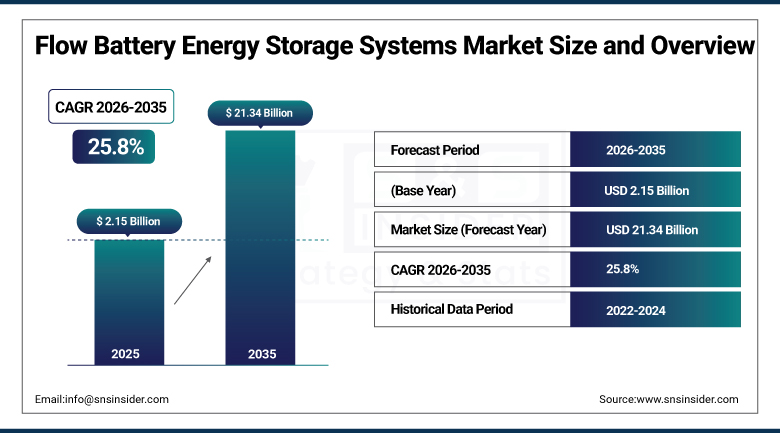
The Flow Battery Energy Storage Systems Market was valued at USD 2.15 Billion in 2025 and is projected to reach USD 21.34 Billion by 2035, registering a CAGR of 25.8% over 2026-2035.
The Flow Battery Energy Storage Systems Market represents the future of grid long duration storage with the ability of liquid electrolyte chemistries to separate the power and energy capacities of flow batteries, allowing for multi-hour discharges free from degradation issues that plague traditional batteries. The market is segmented based on the rise in the demand for renewable integration by grid operators, deployment of vanadium and zinc bromide flow cells, manufacturing capacity at gigawatt-hours level and its application in grid stabilization, industrial backup power and data centers.
In February 2025, Sumitomo Electric displayed its new vanadium redox flow battery (VRFB) during Energy Storage North America to demonstrate its long-term energy storage ability.
To Get more information On Flow Battery Energy Storage Systems Market - Request Free Sample Report
Flow Battery Energy Storage Systems Market Trends
-
Expanding gigawatt-hour-scale manufacturing capacity continues easing project-to-commissioning lead times for developers.
-
Growing AI and hyperscale data center power demand continues accelerating large-format flow battery engineering contracts.
-
Rising government long-duration energy storage funding programs continue de-risking early utility procurement decisions.
-
Increasing industrial decarbonization mandates continue expanding flow battery adoption in steel, mining, and manufacturing backup power.
-
Growing investment in iron-chromium and hydrogen-iron chemistries continues diversifying supply beyond vanadium-dependent systems.
U.S. Flow Battery Energy Storage Systems Market Outlook
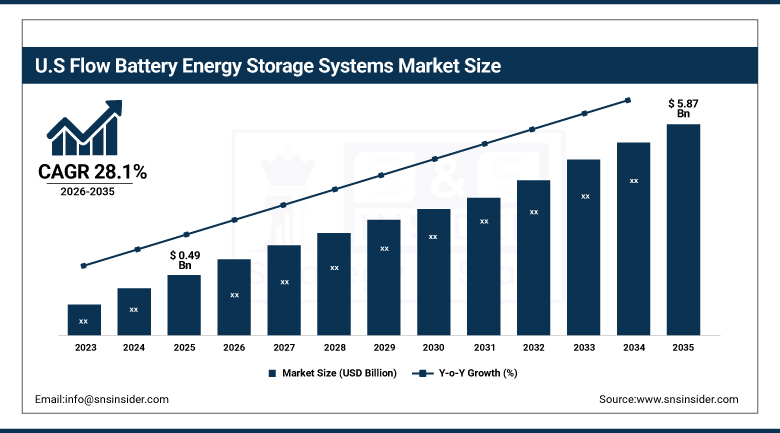
The U.S. Flow Battery Energy Storage Systems Market was valued at approximately USD 0.49 Billion in 2025 and is projected to reach approximately USD 5.87 Billion by 2035, registering a CAGR of approximately 28.1% from 2026 to 2035.
In the U.S the demand, has been largely driven by high government funding for DOE’s long duration storage program, heavy investment in domestic vanadium and zinc bromine manufacturing capabilities, and high industrial demand for non-degradation, multi-hour back-up power. Installation of many flow batteries at the utility scale, in addition to increasing industrial applications in sectors such as steel, mining and data center campus, have served in reinforcing the status of the U.S. as a leader in both installation and manufacturing of flow batteries. In addition to that, the use of flow batteries in grid stabilization, renewables integration, and industrial back-up power applications has served to keep up the demand for this storage technology high.
In 2026, ESS Tech deployed its iron flow batteries in the USA to provide long-duration energy storage that helps integrate renewable sources and improve grid resilience. ESS Tech uses technology designed to provide non-flammable energy storage that operates over multiple hours.
Flow Battery Energy Storage Systems Market Segment Analysis
-
By Battery Chemistry, Vanadium Redox Flow Batteries segment dominated the Flow Battery Energy Storage Systems Market in 2025 with 58% share; Zinc-Bromine Flow Batteries segment is the fastest growing segment, registering a CAGR of 27.6% over 2026-2035.
-
By Component, Electrolyte segment dominated the market in 2025 with 38% share; Power Electronics & BMS segment is the fastest growing segment, registering a CAGR of 27.3% over 2026-2035.
-
By Storage Capacity, 10-50 MWh segment dominated the market in 2025 with 43% share; Above 50 MWh segment is the fastest growing segment, registering a CAGR of 28.1% over 2026-2035.
-
By Application, Utility-Scale Energy Storage segment dominated the market in 2025 with 47% share; Renewable Energy Integration segment is the fastest growing segment, registering a CAGR of 27.8% over 2026-2035.
-
By End User, Energy Utilities segment dominated the market in 2025 with 54% share; Industrial Users segment is the fastest growing segment, registering a CAGR of 27.2% over 2026-2035.
By Battery Chemistry, Vanadium Redox Flow Batteries Lead, While Zinc-Bromine Systems Grow Fastest
Vanadium Redox Flow Batteries were leading the Flow Battery Energy Storage Systems Market in 2025 owing to their electrolyte chemistry that does not pose a risk of fire, degradation, and permits continuous cycling of the same vanadium electrolyte solution over decades of project lifetimes. The use of vanadium chemistry in batteries has been preferred by utilities and industries because of its ability to provide more than 20,000 deep discharge cycles and safe working conditions in high throughput applications including steel plants and power grid substations. Continued research and development investments by companies, such as Invinity Energy Systems and Sumitomo Electric Industries in scaling up the manufacturing of vanadium cells and stacks has further cemented the dominant position of this chemistry for gigawatt hour scale flow batteries projects, despite the higher initial electrolyte costs compared to other chemistries.
Zinc-Bromine Flow Batteries are forecast to witness the fastest growth in battery chemistry in the Flow Battery Energy Storage Systems Market with continued scaling of modular and low-cost systems for commercial and industrial backup applications by companies like Primus Power and Redflow. The cheaper cost of this chemistry has enabled it to emerge as a better choice for shorter duration distributed energy storage applications where the high electrolyte costs for vanadium systems would not make much sense. Applications that include peak shaving for data centers, backup power for telecommunications, and off-grid microgrids fall into these categories.
By Component, Electrolyte Dominates, Power Electronics & BMS Post Fastest Growth
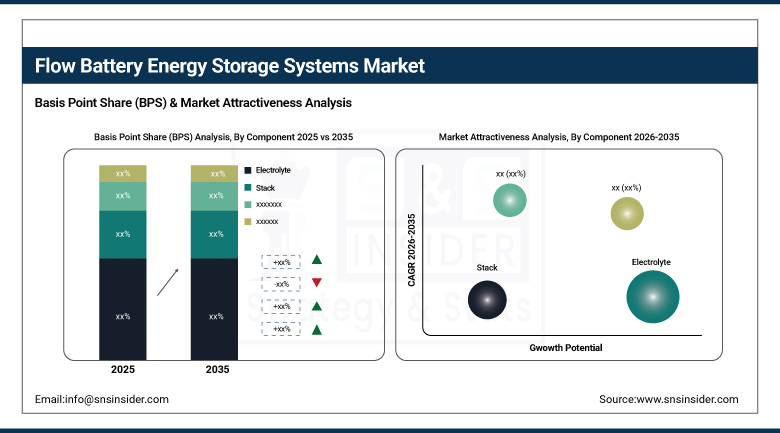
The Electrolyte segment is anticipated to be the highest contributor among components in the Flow Battery Energy Storage Systems market in 2025 due to the fact that electrolyte, being a liquid solution used in flow batteries, is the storage element as well as a significant part of the total system price especially in cases where vanadium electrolyte is used, with electrolyte representing almost 50% of total project price. Manufacturers of vanadium electrolyte have introduced leasing and buyback programs to alleviate the initial capital expenses for developers making electrolyte the most carefully monitored cost element.
The Power Electronics & BMS segment is predicted to demonstrate the fastest growth rate within the Flow Battery Energy Storage Systems market due to the introduction by manufacturers of more sophisticated converters, controllers, and battery management systems in order to increase round-trip efficiency and provide access to ancillary grid services. More complex hybrids and multi-stack flow battery systems including those with gigawatt-hours capacity such as Invinity Laufenburg installation lead to the growing demand for power electronics that would be able to control multiple flow battery units.
By Storage Capacity, 10-50 MWh Systems Lead, Above 50 MWh Segment Posts Fastest Growth
The 10-50 MWh storage capacity segment constituted the largest market segment in terms of revenue share for Flow Battery Energy Storage Systems Market in 2025 due to the reason that it aligns with the capacity range of flow batteries installed in utility substations and industrial sites which form the majority of all installed flow battery energy storage systems till date. Developers have focused on this capacity range in order to test the performance capabilities and grid interconnectivity needs at a relatively smaller budget.
Above 50 MWh segment is expected to show fastest growth during the forecast period due to increasing interest among hyperscale data centers and heavy industrial users to deploy gigawatt-hours worth of energy storage. This is evident from the deployment of Invinity's 1.5 GWh vanadium flow battery by Technology Centre Laufenburg in Switzerland which can be scaled up to 2.1 GWh.
By Application, Utility-Scale Storage Leads, Renewable Integration Posts Fastest Growth
The Utility-Scale Energy Storage category had been the largest among all application segments within the Flow Battery Energy Storage Systems Market in 2025 as utilities procure long-duration assets to postpone the upgrade of their transmission infrastructure and ensure resource adequacy. The utilities see flow battery energy storage systems as bankable peaking resources, which can be installed close to substations and can provide continuous energy delivery for hours to cover gaps in demand, making such an application segment the main revenue driver for flow battery developers in North America, Europe, and Asia-Pacific.
The Renewable Energy Integration is the fastest-growing application segment within the Flow Battery Energy Storage Systems Market due to increasing amounts of wind and solar energy curtailment on grids with high penetration of renewable sources. The Invinity Energy Storage system, 24-hour vanadium flow battery microgrid installed at Pacific Northwest National Laboratory Richland campus, is the clear example of how flow battery storage is capable of ensuring reliable energy provision and renewable integration simultaneously.
By End User, Energy Utilities Dominate, Industrial Users Gain Fastest Traction
Energy Utilities dominated the end-user landscape of the Flow Battery Energy Storage Systems Market in 2025 with a significant number of grid operators mandating long duration and non-degradation storage facilities to fulfill their resource adequacy obligations and renewable portfolio standards. The adoption of flow battery storage technology by utilities within the UK, Switzerland, and the U.S. demonstrates the inclusion of flow battery technology in long term generation and capacity planning by grid operators and highlights the dominant position of utilities as major consumers of flow batteries globally.
Industrial Users are expected to witness the fastest growth among end-user segments in the Flow Battery Energy Storage Systems Market driven by manufacturers, steel plants, and miners opting for integration of flow battery storage technology along with renewables within the same premises to cut their reliance on the grid and achieve sustainable operations. The installation of a 32 MWh vanadium flow battery system at Mojave Micro Mill of Pacific Steel Group is a prime example of how industrial users are harnessing flow battery storage for sustainable production.
Regional Analysis:
|
Region |
Major Country |
Share within Region, 2025 (%) |
|---|---|---|
|
North America |
United States |
85.60% |
|
Europe |
Germany |
24.90% |
|
Asia Pacific |
China |
52.30% |
|
Middle East and Africa |
Saudi Arabia |
28.60% |
|
Latin America |
Brazil |
32.40% |
North America Flow Battery Energy Storage Systems Market Insights
North America is the highest-growing market with a CAGR of around 29.4% until 2035 due to significant investments from the Department of Energy into long-duration energy storage systems, procurement of high-capacity data centers and mandates to industrial decarbonization in steel, mining, and manufacturing industries. The fast growth in grid modernization investment coupled with the demand for utility-scale storage made North America the highest growing market in this report.
The share of revenue for the U.S. in North America was highest due to deployment of projects in the country from Invinity Energy Systems and Primus Power and the increasing adoption by industry, such as the 32 MWh vanadium flow battery installation by the Pacific Steel Group in California. Canada has added to the strength of the region by providing increasing grid modernization investments, which are becoming increasingly attractive to regional utilities as a way of firming up the grid in their province.
Europe Flow Battery Energy Storage Systems Market Insights
Europe held a sustainable share of global revenue in the Flow Battery Energy Storage Systems Market, owing to the significant funding in Long Duration Energy Storage competition in the UK, increase in demand for power for AI data centers, and growing energy security concerns due to less use of imported fossil fuels. The momentum in developing EU-funded long duration storage demonstration projects has forced European utilities and developers to concentrate on degradation free and non-lithium storage solutions, making Europe as the hub for leading flow battery chemistry projects.
Germany accounted for the largest share of Europe in terms of demand due to the investments made in modernizing grids as a part of Energiewende plan and increasing decarbonization needs in industries. Switzerland made an impressive contribution to the regional demand with Invinity's vanadium flow battery at Technology Centre Laufenburg, and the regional trend of developing energy resilient solutions for AI data centers would continue to increase Europe's flow battery energy storage demand in the coming years.
Asia Pacific Flow Battery Energy Storage Systems Market Insights
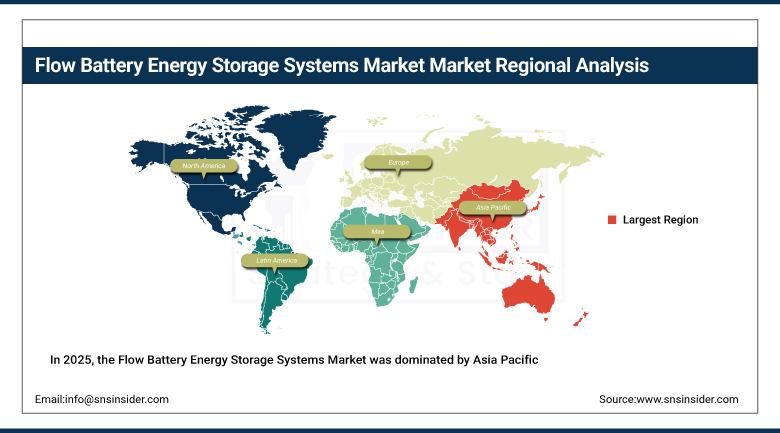
In 2025, the Flow Battery Energy Storage Systems Market was dominated by Asia Pacific with the market share of 44.6%. The region held the leadership position on the back of substantial flow battery manufacturing capabilities, strict carbon neutrality policy by the government, and the presence of utilities that are commissioning the utility scale flow battery energy storage systems for improving grid stability and shaving the peak load.
China topped the list with large scale manufacturing capability and increasing commissioned project quantity of more than 100 MWh of grid scale products. Other countries that were making a mark on the regional level include Japan through its vanadium flow battery project by Sumitomo Electric Industries, and South Korea through the commercial deployment activity by Standard Energy.
Get Customized Report as per Your Business Requirement - Enquiry Now
Middle East & Africa and Latin America Flow Battery Energy Storage Systems Market Insights
The Middle East and Africa and Latin America both showed steady growth in the Flow Battery Energy Storage Systems Market owing to the investments being made in the renewable energy infrastructure, funding from the government towards grid modernization initiatives, and collaboration among regional utility companies and foreign flow battery companies. There is an increasing need for degradation free and long duration energy storage systems for grid stabilization programs in these regions, which have been highly dependent on conventional batteries for their energy storage needs.
Saudi Arabia led as the largest country market in ME&A on account of its renewable energy investment program as well as increasing interest in grid scale storage systems to meet their solar power deployment goals. Further, the region saw substantial contribution from the South African based vanadium flow battery development project by Bushveld Energy. Brazil emerged as the largest country market in terms of revenues in LATAM owing to its significant renewable power generation infrastructure.
Market Dynamics:
Growth Drivers: Rising Demand for Degradation-Free Storage and Expanding Gigawatt-Hour Manufacturing Capacity
The market is gaining momentum from growing demands for guaranteed long duration degradation free storage capacity, growth of gigawatt hour scale flow cell production capabilities, rising hyperscale data center and industrial power purchases, and growing penetration in grid stabilization, industrial decarbonization, and renewable curtailment mitigation use cases. As more and more utilities and industrial end-users announce their goals for resource adequacy and decarbonization, the need for reliable supplies of degradation free long duration storage capacity is expected to continue pushing the development of production capacities along the value chain.
Strategic engineering and offtake deal between utilities, industrial customers and flow battery manufacturers support this trend, as hyperscale buyers are becoming increasingly focused on acquiring their own long duration storage capacities in anticipation of the growing demand for data center and industrial power. Venture and governmental investments into domestic manufacturing facilities also contribute to building up baseline production capacities, thus generating constantly growing demand throughout the forecast period.
Restraints: High Upfront Electrolyte Cost and Lower Energy Density Versus Lithium-Ion
The high cost of electrolyte up front is a genuine limitation for the quicker growth of the market, particularly the vanadium flow battery, whose electrolyte cost could reach up to 50% of the total system cost, forming a financial hurdle for developers and new utility clients. This has put the use of highly reliable and competitively priced flow batteries solely in the domain of a limited number of financially strong developers and utilities.
The other limitation that has persisted is lower energy density compared to lithium-ion battery systems, as flow battery technology needs significantly greater physical footprint to hold equal amounts of energy, rendering it unsuitable for space-limited residential and commercial deployments. Bridging this physical footprint limitation will involve continuous development efforts from developers, who are competing on both the cost and footprint fronts.
Opportunities: Hyperscale Data Center Demand and Emerging Non-Vanadium Chemistries
The need for reliable and long-term supply of clean energy in the ever-increasing hyperscale data centers provides a genuine business opportunity in the sense that technology purchasers are ready to commit themselves to multiyear engineering and offtake agreements, thus mitigating risks for investment in gigawatt-hour manufacturing capacity of flow batteries. Having won an anchor customer in such projects as the Technology Centre Laufenburg project of the FlexBase Group, flow battery manufacturers can capitalize on this segment while making the transition from megawatt-hour to gigawatt-hour flow battery production.
Moreover, there is another significant opportunity linked to commercialization of new non-vanadium flow batteries with reduced capital costs per kilowatt-hour compared to traditional vanadium systems. Companies, such as Elestor with its hydrogen-iron flow battery with round-trip efficiency over 75% and capital cost of €15 per kWh provide an example of how flow batteries of the next generation will be able to open up additional markets dominated at present by lithium-ion batteries.
Recent Developments:
-
2026: Invinity Energy Systems was selected by FlexBase Group to design a gigawatt-hour-scale vanadium flow battery system for the Technology Centre Laufenburg in Switzerland, an AI data center and technology campus project with an initial 1.5 GWh capacity expandable to 2.1 GWh, positioned to become the world's largest vanadium flow battery installation.
-
2026: Jena Batteries and its parent company Suqian Time Energy Technology entered a strategic partnership with Allegro Energy to expand deployment of organic flow battery technology for long-duration, grid-scale storage projects.
-
2025: Sumitomo Electric showcased its advanced vanadium redox flow battery (VRFB) at Energy Storage North America, highlighting its long-duration energy-storage capabilities.
Flow Battery Energy Storage Systems Market key players are:
-
Invinity Energy Systems plc
-
Sumitomo Electric Industries, Ltd.
-
VRB Energy
-
Enerox GmbH (CellCube)
-
ESS Tech, Inc.
-
Elestor B.V.
-
Primus Power Corporation
-
Redflow Limited
-
Largo Clean Energy Corp.
-
Standard Energy Co., Ltd.
-
StorEn Technologies, Inc.
-
Volterion GmbH
-
Bushveld Energy (Pty) Ltd
-
WattJoule Corporation
-
Jena Batteries GmbH
-
CMBlu Energy AG
-
H2, Inc.
-
Dalian Rongke Power Co., Ltd.
-
Beijing Puneng Century Technology Co., Ltd.
-
Australian Vanadium Limited (VSUN Energy)
Flow Battery Energy Storage Systems Market Report Scope:
| Report Attributes | Details |
|---|---|
| Market Size in 2025 | USD 2.15 Billion |
| Market Size by 2035 | USD 21.34 Billion |
| CAGR | 25.8% from 2026 to 2035 |
| Base Year | 2025 |
| Forecast Period | 2026-2035 |
| Historical Data | 2022-2024 |
| Report Scope & Coverage | Market Size, Segments Analysis, Competitive Landscape, Regional Analysis, DROC & SWOT Analysis, Forecast Outlook |
| Key Segments |
•By Battery Chemistry (Vanadium Redox Flow Batteries, Zinc-Bromine Flow Batteries, Iron-Chromium Flow Batteries, Others) •By Component (Electrolyte, Power Electronics & BMS, Stack, Others) •By Storage Capacity (10-50 MWh, Above 50 MWh, Below 10 MWh) •By Application (Utility-Scale Energy Storage, Renewable Energy Integration, Commercial & Industrial Storage, Microgrids & Remote Power)
•By End User (Energy Utilities, Industrial Users, Commercial Users, Telecommunications)
|
| Regional Analysis/Coverage | North America (US, Canada), Europe (Germany, UK, France, Italy, Spain, Russia, Poland, Rest of Europe), Asia Pacific (China, India, Japan, South Korea, Australia, ASEAN Countries, Rest of Asia Pacific), Middle East & Africa (UAE, Saudi Arabia, Qatar, South Africa, Rest of Middle East & Africa), Latin America (Brazil, Argentina, Mexico, Colombia, Rest of Latin America). |
| Company Profiles | Invinity Energy Systems plc, Sumitomo Electric Industries, Ltd., VRB Energy, Enerox GmbH (CellCube), ESS Tech, Inc., Elestor B.V., Primus Power Corporation, Redflow Limited, Largo Clean Energy Corp., Standard Energy Co., Ltd., StorEn Technologies, Inc., Volterion GmbH, Bushveld Energy (Pty) Ltd, WattJoule Corporation, Jena Batteries GmbH, CMBlu Energy AG H2, Inc., Dalian Rongke Power Co., Ltd., Beijing Puneng Century Technology Co., Ltd., Australian Vanadium Limited (VSUN Energy). |

Frequently Asked Questions
