
Smartwatch Battery Market Report Scope & Overview:
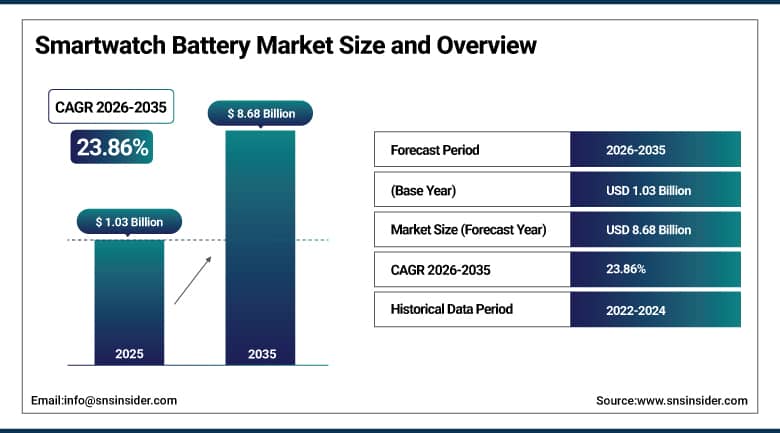
The global Smartwatch Battery Market size was valued at USD 1.03 Billion in 2025 and is expected to reach USD 8.68 Billion by 2035, growing at a CAGR of 23.86% from 2026 to 2035.
The smartwatches battery market is growing due to the increasing adoption of smart wearable devices, growing demand for advanced health and fitness monitoring features, and technological advancements in battery technologies. Smartwatches require batteries that are small, light weight and high capacity to enable health tracking, GPS, wireless connectivity and AI-enabled apps. The growing consumer preference for connected devices, the increasing penetration of fitness trackers and the increasing investments by manufacturers in energy-efficient lithium-ion, solid-state and next-generation battery solutions further support the market growth. Demand for better battery performance and longer operating life is being driven by growing smartwatch ecosystems in healthcare, sports, lifestyle, and enterprise applications.
Samsung Electro-Mechanics said Tuesday its ultra-small all-solid-state batteries were confirmed to meet the energy density standard of 200 Wh/L in internal sample tests in 2025. The technology is aimed at wearable devices, including future smartwatch applications, offering more safety, flexibility and energy efficiency than traditional coin-cell and lithium-ion battery systems.
Market Size and Forecast
-
Market Size in 2026E: USD 1.27 Billion
-
Market Size by 2035: 8.68 Billion
-
CAGR: 23.86% from 2026 to 2035
-
Fastest Growing Region: North America
-
Largest Region: Asia Pacific
To Get More Information On Smartwatch Battery Market - Request Free Sample Report
Smartwatch Battery Market Trends
-
Increasing adoption of smartwatches, fitness trackers, and connected wearable devices is driving demand for compact, high-capacity batteries with improved energy efficiency and longer operating life.
-
Growing integration of advanced health monitoring, GPS tracking, AI-based features, and wireless connectivity is accelerating the need for high-performance smartwatch batteries with enhanced power management capabilities.
-
Rising demand for lightweight, flexible, and fast-charging battery technologies is supporting the development of advanced lithium-ion and solid-state battery solutions for next-generation smartwatches.
-
Increasing focus on extended battery life and improved user experience is creating strong demand for batteries that support continuous monitoring, smart applications, and always-on wearable functionality.
-
Strategic collaborations among battery manufacturers, smartwatch brands, and semiconductor companies are supporting the development of safer, energy-efficient, and next-generation battery technologies for wearable devices.
U.S. Smartwatch Battery Market Size Outlook
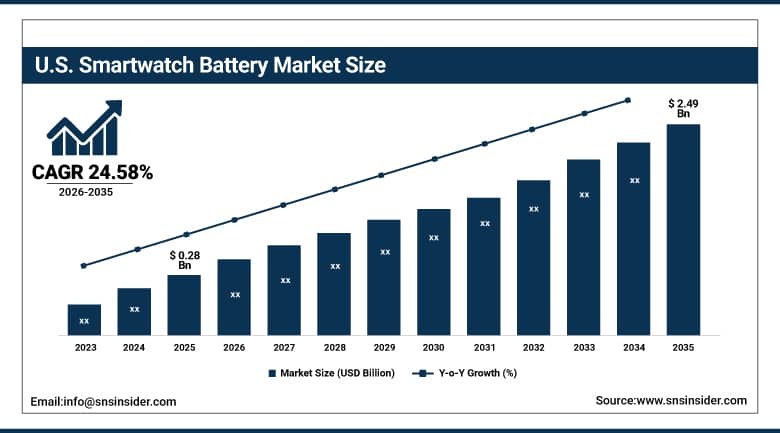
The U.S. Smartwatch Battery Market was valued at USD 0.28 Billion in 2025 and is expected to reach USD 2.49 Billion by 2035, growing at a CAGR of 24.58% from 2026 to 2035.
The U.S. Smartwatch Battery market is expanding due to the growing adoption of smart wearables, the increasing demand for advanced health monitoring features, and the growing consumer preference for connected electronics. The existence of strong players in the smartwatch manufacturing, battery technology, semiconductor and research segments is favourable for market expansion. The rising demand for longer battery life, rapid charging, lighter battery designs, and efficient energy storage solutions are the main drivers behind the growing acceptance of advanced smartwatch batteries in healthcare, fitness, lifestyle and consumer electronics applications.
In 2026, the U.S. Department of Energy gave out more than USD 1.5 billion in grants to innovators and manufacturers in the energy storage industry, to build domestic battery supply chains. Private investments in silicon-dominant lithium-ion and solid-state battery developers further pushed forward next-generation wearable battery advances.
Smartwatch Battery Market Segment Analysis
-
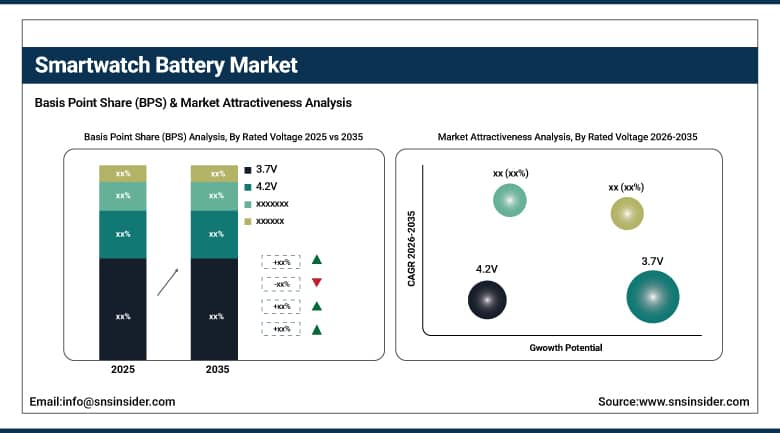
By Rated Voltage, 3.7V dominated the Smartwatch Battery Market with a 58.40% share in 2025, while 4.2V is the fastest-growing rated voltage segment with a CAGR of 26.43% from 2026–2035.
-
By Battery Life, Up to 7 Days dominated the Smartwatch Battery Market with a 34.80% share in 2025, while Up to 21 Days is the fastest-growing battery life segment with a CAGR of 28.57% from 2026–2035.
-
By Application, Android System Smartwatch dominated the Smartwatch Battery Market with a 52.80% share in 2025, while Android System Smartwatch is also the fastest-growing application segment with a CAGR of 24.94% from 2026–2035.
By Rated Voltage, 3.7V dominated the Smartwatch Battery Market, while 4.2V is expected to register the fastest growth.
The 3.7V segment dominated the Smartwatch Battery Market with a 58.40% revenue share in 2025. The segment’s growth is fueled by the popularity of 3.7V lithium-ion batteries as a preferred power source in consumer smartwatches due to the compromise between energy density, size, safety, and cost-effectiveness. 3.7V lithium-ion batteries are widely applied in wearable devices since they offer reliable energy performance while retaining light designs necessary for consumer convenience. The growing trend in fitness tracking, health monitoring, and connected wearables will continue fueling the adoption of 3.7V batteries in smartwatches.
4.2V segment is projected to grow at the fastest CAGR of 26.43% from 2026 to 2035. The segment’s growth is attributed to the increased demand for high-capacity smartwatch batteries, better charging capabilities, and innovative wearable functions that require more power. With the increasing demand for health sensors, GPS, artificial intelligence, and always-on display technology, smartwatch manufacturers are shifting their attention towards the batteries of higher voltages. Advances in lithium-ion and solid-state battery technologies will further drive the adoption of 4.2V batteries in smartwatches.
By Battery Life, Up to 7 Days dominated the Smartwatch Battery Market, while Up to 21 Days is expected to register the fastest growth.
The Up to 7 Days segment dominated the Smartwatch Battery Market with a 34.80% revenue share in 2025. The segment continues to be led as consumers seek a balance between battery performance, device thickness and usability. Most mainstream smartwatches can last a week if you stretch them thin. That’s enough for fitness tracking, notifications, health monitoring and general smart functions without having to be recharged all the time. With the increasing use of smart wearables by fitness people and consumers in general, the demand for batteries that can be trusted to last for a week is growing.
The Up to 21 Days segment is expected to hold the fastest CAGR of 28.57% during the forecast period of 2026-2035. Growth is driven by demand from outdoor users, and health-conscious consumers and professionals who require continuous monitoring. To achieve longer operating cycles, producers are working on advanced battery chemistries, power-efficient processors and optimised energy management systems. Long-life smartwatch batteries are expected to witness lucrative growth opportunities with increasing adoption of premium smartwatches with advanced sensors, GPS tracking and remote health monitoring capabilities.
By Application, Android System Smartwatch dominated the Smartwatch Battery Market, while Android System Smartwatch is expected to register the fastest growth.
The Android System Smartwatch segment dominated the Smartwatch Battery Market with a 52.80% revenue share in 2025. The segment is expanding owing to the proliferation of Android-enabled wearable devices from a variety of manufacturers and the rising consumer adoption of wearable devices in different price bands. Android smartwatches need efficient battery solutions to support features like health tracking, notifications, GPS, voice assistance and mobile connectivity. Moreover, increasing adoption of smartwatches in emerging economies and rising demand for affordable connected devices are also stimulating demand for batteries for Android-based smartwatches.
The Android System Smartwatch segment is expected to register the fastest CAGR of 24.94% during the forecast period. Increasing investments by smartwatch manufacturers in advanced wearable technologies, rising smartphone integration, and growing adoption of fitness and healthcare applications support the growth. The demand for Android smartwatches with more features, longer battery life, better processing power and better connectivity is encouraging battery manufacturers to create higher performance solutions. The segment is expected to grow on account of increasing adoption of smart wearables in Asia Pacific and other emerging economies.
Regional Analysis:
|
Region |
Major Country |
Share within Region, 2025 (%) |
|---|---|---|
|
North America |
United States |
82.31% |
|
Europe |
Germany |
26.40% |
|
Asia Pacific |
China |
52.80% |
|
Middle East & Africa |
UAE |
28.60% |
|
Latin America |
Brazil |
41.40% |
Asia Pacific Smartwatch Battery Market Insights
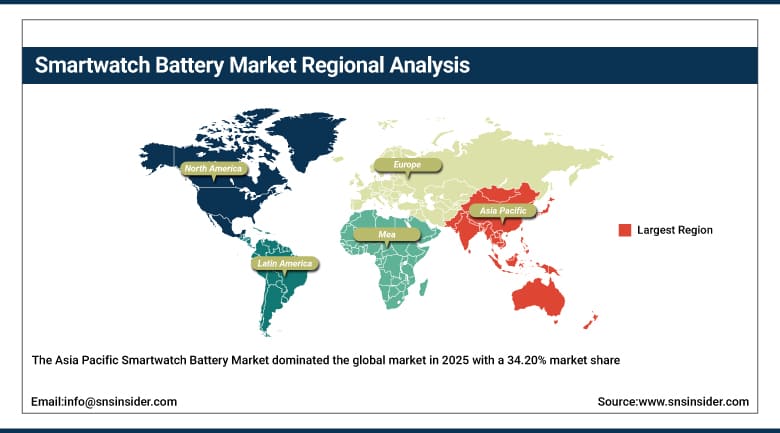
The Asia Pacific Smartwatch Battery Market dominated the global market in 2025 with a 34.20% market share and is expected to maintain its leading position during the forecast period. The fast expansion of consumer electronics manufacturing, increasing smartwatch penetration and strong battery manufacturing infrastructure is fueling the region’s growth. The regional market growth is driven by the presence of major electronics manufacturing hubs, increasing demand for wearable healthcare devices, and increasing investments in advanced battery technologies.
The Asia Pacific Smartwatch Battery Market is being driven by the growing demand for smart wearable devices, increasing applications of healthcare monitoring, and innovations in lithium-ion and solid-state battery technologies. China is the major contributor to the regional market with its strong electronics manufacturing ecosystem, battery manufacturing capabilities and large consumer base. Major contributions are also coming from Japan, South Korea and India in the areas of semiconductor technology, wearable electronics, energy storage solutions and digital healthcare platforms. Rising investments in the next-generation battery materials and manufacturing infrastructure are likely to drive the market growth across the region.
Get Customized Report as Per Your Business Requirement - Enquiry Now
North America Smartwatch Battery Market Insights
The North America Smartwatch Battery Market is projected to grow at the fastest CAGR of 25.26% over the forecast period 2026-2035.The growth of the region can be attributed to the rising adoption of smart wearable devices, growing demand for advanced health and fitness tracking features, and growing investments in next-generation battery technologies. Major consumer electronics companies, battery developers, semiconductor manufacturers and research institutions are all working to develop high-performance smartwatch batteries that will store more energy, charge faster and last longer.
The US had the largest share in the North America Smartwatch Battery Market in 2025 with a share of 85.03%. Increased adoption of consumer electronics, rising demand for high-end smartwatches, and ongoing innovations in lithium-ion and solid-state battery technologies are driving the market. The country’s strong tech ecosystem, advanced research capabilities and investments in domestic energy storage solutions are driving the commercialisation of advanced wearable batteries. Canada is also helping to drive regional growth by encouraging the wider use of smart wearables, healthcare monitoring technologies and investment in advanced battery research.
Europe Smartwatch Battery Market Insights
The Europe Smartwatch Battery Market is experiencing consistent growth, attributed to the expanding adoption of smart wearables, the surge in demand for health monitoring devices, and the heightened focus on energy-efficient battery solutions. The region boasts a dynamic consumer electronics industry, underpinned by technological innovation, research capacity and growing investment in sustainable battery technologies. To cater the rising need of smartwatches, manufacturers are working on the development of new battery systems that offer improved battery life, lighter weights and more sophisticated charging options. Increasing adoption of wearable devices across healthcare, fitness, lifestyle and enterprise applications will likely help the regional market growth.
Germany holds a leading position in the Europe Smartwatch Battery Market owing to the strong electronics manufacturing base and research infrastructure along with increasing focus on battery technology innovation. The country’s expertise in automotive and industrial engineering is also being harnessed to develop energy storage technologies. Other countries including the United Kingdom, France, Italy and the Netherlands are driving the market growth with the increasing adoption of smart wearable devices, healthcare technology solutions and investments in sustainable battery innovations. The need for connected devices and energy storage for the next generation of energy is likely to create new opportunities across Europe.
Middle East & Africa and Latin America Smartwatch Battery Market Insights
Middle East & Africa and Latin America Smartwatch Battery Markets are experiencing steady growth owing to increasing adoption of smart wearable devices, increasing digital healthcare applications and increasing consumer interest in connected electronics. The growth of technology infrastructure, the increasing availability of smart devices and the wider range of healthcare monitoring solutions are creating new opportunities for smartwatch battery manufacturers. The demand for longer battery life, efficient charging systems and reliable energy storage solutions is expected to support the development of the market across these emerging regions.
Brazil is a key contributor to the Latin America Smartwatch Battery market due to the rising adoption of wearable technology, growing demand for consumer electronics, and increasing use of digital health applications. UAE backs Middle East & Africa market growth with investments in smart healthcare, digital transformation and advanced consumer technologies Expect to see Saudi Arabia and South Africa contribute as well by increasing the adoption of connected devices and modernisation of technology infrastructure. Increasing awareness about fitness tracking, health monitoring, and smart lifestyle solutions will further propel regional demand for smartwatch batteries.
Market Dynamics
Growth Drivers: Rising adoption of smart wearable devices and demand for advanced energy storage solutions driving market growth
The global smartwatch battery market is expected to witness rapid growth on account of increasing acceptance of wearable gadgets, growing demand for health and fitness monitoring and increasing consumer preference for connected electronics. Smart watch batteries are getting traction with healthcare, fitness, lifestyle and consumer electronics sectors with growing importance of batteries in smart wearable devices integrated with advanced functionalities like health tracking, GPS, AI-based monitoring, connectivity and always on display.
Innovations in battery technology such as solid state batteries, better lithium-ion batteries, silicon anode batteries and energy efficient power management systems have made remarkable changes in the wearable electronics industry. Increasing production of premium smartwatches, increasing digital health sector and increasing investments in wearable technology are providing new growth opportunities for the smartwatch battery makers. Collaborations between smartwatch makers and battery makers and semiconductor firms are on the rise as better batteries are being created.
Restraints: Limited battery capacity and high manufacturing costs restricting market expansion
Market development is still hampered by substantial constraints related to energy storage capacity and size. Smartwatches require powerful batteries of small size to run features such as advanced sensors, GPS functionality, health trackers and HD displays. But for market leaders, the challenge is to find the right trade-off between energy storage capacity, battery size and operational lifetime. Moreover, the frequent charging requirement and the battery degradation can adversely affect the consumer satisfaction and hinder the widespread adoption of the product by the users interested in durable wearable devices.
Another major impediment to market expansion is the high cost of using advanced energy storage technology and components. As next-generation batteries are implemented, companies making new smartwatch batteries face high research and manufacturing costs. Constraints on the supply chain of materials, technology integration, along with battery safety and recycling can also affect the market growth. Last but not least, the challenge of balancing energy efficiency and device thickness reduction is another technological obstacle for companies.
Opportunities: Expansion of solid-state batteries and advanced wearable technologies creating new growth avenues
Increasing acceptance of smart healthcare devices, connected wearables and advanced monitoring technologies are expected to provide significant growth opportunities to the Smartwatch Battery Market. Increasing demand for smartwatches with advanced health tracking, continuous monitoring, and better connectivity is forcing manufacturers to develop batteries with higher energy density, faster charging times, and longer battery life. Advances in solid-state batteries, flexible batteries and energy efficient components will likely improve performance of smartwatches and create more opportunities for applications.
Emerging markets in Asia Pacific, Latin America, and Middle East & Africa, will provide significant growth opportunities due to increasing smartphone penetration, rising disposable income, and increasing consumer adoption for wearable technologies. The continuous improvement in battery materials, compact energy storage systems, wireless charging technologies, and power optimisation solutions are expected to improve the battery performance of smartwatches. Partnerships between smart watch producers, battery technology providers, semiconductor providers, and healthcare technology providers to develop safer, efficient and high performing wearable battery solutions will help the market to grow in the long run.
Recent Developments:
-
2026: Samsung SDI showcased pouch-type all-solid-state battery (ASSB) solutions at InterBattery, targeting next-generation smartwatches and wearables with higher energy density, improved safety, and compact designs.
-
2026: Asia Pacific governments, including India, increased investments in digital healthcare and wearable technology manufacturing, strengthening regional smartwatch battery supply chains and local production capabilities.
-
2025: TDK Corporation advanced its CeraCharge solid-state battery technology with oxide-based electrolytes and lithium-alloy anodes, enabling thinner wearable devices with improved energy density and longer battery life.
-
2025: Enovix expanded production of silicon-anode batteries for connected devices, offering higher energy capacity and faster charging capabilities to support advanced smartwatch applications.
Smartwatch Battery Companies are:
-
LG Energy Solution Ltd.
-
Panasonic Holdings Corporation
-
TDK Corporation
-
Murata Manufacturing Co., Ltd.
-
VARTA AG
-
EVE Energy Co., Ltd.
-
BYD Company Limited
-
Contemporary Amperex Technology Co. Limited (CATL)
-
Amperex Technology Limited (ATL)
-
Sunwoda Electronic Co., Ltd.
-
Panasonic Energy Co., Ltd.
-
Maxell Holdings, Ltd.
-
Renata SA
-
Saft Groupe S.A.
-
Kokam Co., Ltd.
-
AESC Group Ltd.
-
Energizer Holdings, Inc.
-
Duracell Inc.
Smartwatch Battery Market Report Scope:
| Report Attributes | Details |
|---|---|
| Market Size in 2025 | USD 1.03 Billion |
| Market Size by 2035 | USD 8.68 Billion |
| CAGR | CAGR of 23.86% From 2026 to 2035 |
| Base Year | 2025 |
| Forecast Period | 2026-2035 |
| Historical Data | 2022-2024 |
| Report Scope & Coverage | Market Size, Segments Analysis, Competitive Landscape, Regional Analysis, DROC & SWOT Analysis, Forecast Outlook |
| Key Segments | • By Rated Voltage (3.7V, 4.2V, Others) • By Battery Life (Up to 5 Days, Up to 7 Days, Up to 10 Days, Up to 21 Days, Up to 30 Days) • By Application (iOS System Smartwatch, Android System Smartwatch, Windows System Smartwatch) |
| Regional Analysis/Coverage | North America (US, Canada), Europe (Germany, UK, France, Italy, Spain, Russia, Poland, Rest of Europe), Asia Pacific (China, India, Japan, South Korea, Australia, ASEAN Countries, Rest of Asia Pacific), Middle East & Africa (UAE, Saudi Arabia, Qatar, South Africa, Rest of Middle East & Africa), Latin America (Brazil, Argentina, Mexico, Colombia, Rest of Latin America). |
| Company Profiles | Samsung SDI Co., Ltd., LG Energy Solution Ltd., Panasonic Holdings Corporation, TDK Corporation, Murata Manufacturing Co., Ltd., Enovix Corporation, VARTA AG, EVE Energy Co., Ltd., BYD Company Limited, Contemporary Amperex Technology Co. Limited (CATL), Amperex Technology Limited (ATL), Sunwoda Electronic Co., Ltd., Panasonic Energy Co., Ltd., Maxell Holdings, Ltd., Renata SA, Saft Groupe S.A., Kokam Co., Ltd., AESC Group Ltd., Energizer Holdings, Inc., Duracell Inc. |
Frequently Asked Questions
The Smartwatch Battery Market was valued at USD 1.03 Billion in 2025.
The Smartwatch Battery Market is expected to grow at a CAGR of 23.86% from 2026 to 2035.
The market is driven by increasing adoption of smart wearable devices, rising demand for longer battery life, advanced health monitoring features, and development of next-generation battery technologies.
The Asia Pacific region dominated the Smartwatch Battery Market in 2025, accounting for approximately 34.20% market share.
