
Battery Binder Materials Market Report Scope & Overview:
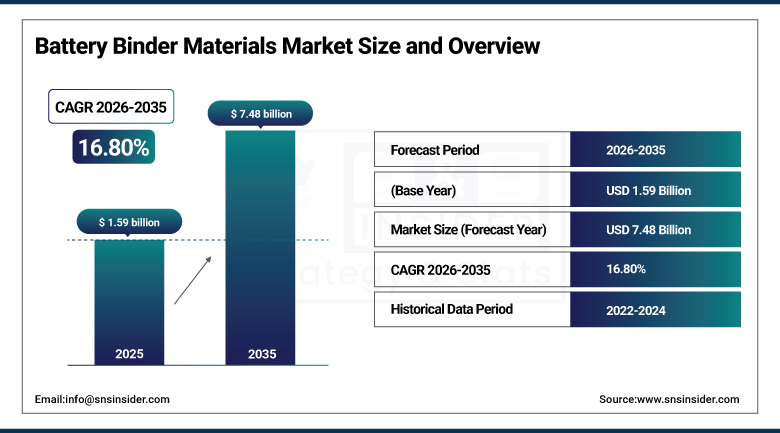
The Battery Binder Materials Market was valued at USD 1.59 Billion in 2025 and is projected to reach USD 7.48 Billion by 2035, expanding at a CAGR of 16.80% during the forecast period 2026–2035.
Binders are key functional components that ensure electrode integrity, help in the attachment of active materials, and affect electrode processing, cycle stability, and manufacturing efficiency. The increase in the production of lithium-ion batteries is, therefore, driving up the need for performance-based binders. Deployment of batteries globally offers a good structural basis for binder demand. According to the International Energy Agency, the global deployment of EV battery reached about 1.2 TWH in 2025, rising by almost 30% year over year, while the global lithium-ion battery manufacturing capacity surpassed 4 TWH at the end of 2025.
This expanding manufacturing capacity is driving battery-material producers to develop better binders that will help them manufacture electrodes with LFP, high nickel, silicon and novel material compositions. The market is also being driven by battery manufacturers looking for better performing products that have higher energy density, processing efficiency, environmentally friendly and can accommodate new electrode chemistry. Binders such as PVDF are still benefiting from existing cathode processing needs, whereas SBR and cellulose-based water-based systems are becoming more important in anode processing.
To Get more information Battery Binder Materials Market - Request Free Sample Report
Battery Binder Materials Market Trends:
-
Rapid expansion of EV battery manufacturing is increasing binder consumption.
-
Growing LFP deployment is strengthening demand for optimized PVDF formulations.
-
Water-based SBR and cellulose binders support lower-solvent electrode processing.
-
PAA adoption is increasing with silicon-rich anode development.
-
Energy storage deployment is creating an additional high-growth binder demand channel.
U.S. Battery Binder Materials Market Size Outlook:
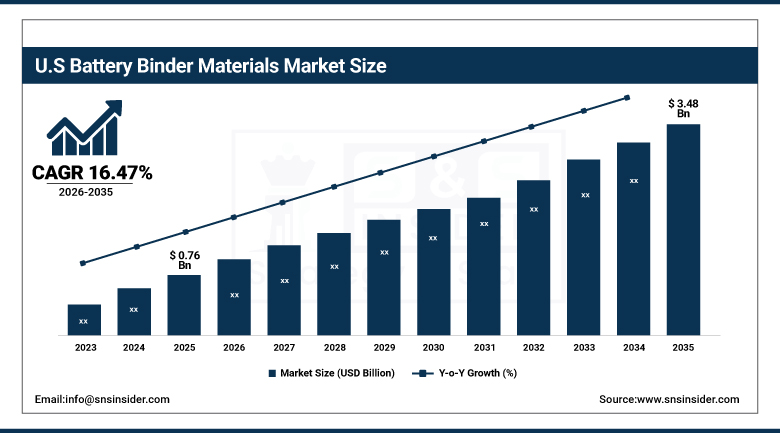
The U.S. Battery Binder Materials Market was valued at USD 0.76 billion in 2025 and is expected to reach approximately USD 3.48 billion by 2035, expanding at a CAGR of 16.47% during 2026–2035.
The US market is also influenced by localization driven by policy for battery materials and components. In 2026, the U.S. Department of Energy offered USD 500 million worth of funding opportunities for domestic critical-material processing, recycling, battery materials, components, and manufacturing technologies. Although binder technology is not among the key funding areas, overall localization of battery material and component manufacturing is expected to create future business opportunities for domestic suppliers of binders and binder technology.
U.S. demand for batteries is becoming increasingly tied to the needs of electric mobility and stationary storage. According to the IEA, the US accounted for 10% of all deployed EV batteries in 2025, and in excess of 50 GWH worth of manufacturing capacity for U.S. batteries was repurposed for LFP manufacture, much of it intended for stationary storage purposes. From the commercial standpoint, LFP manufacturing presents an opportunity for suppliers of binders due to need for good adhesion and processability.
Battery Binder Materials Market Segment Analysis:
-
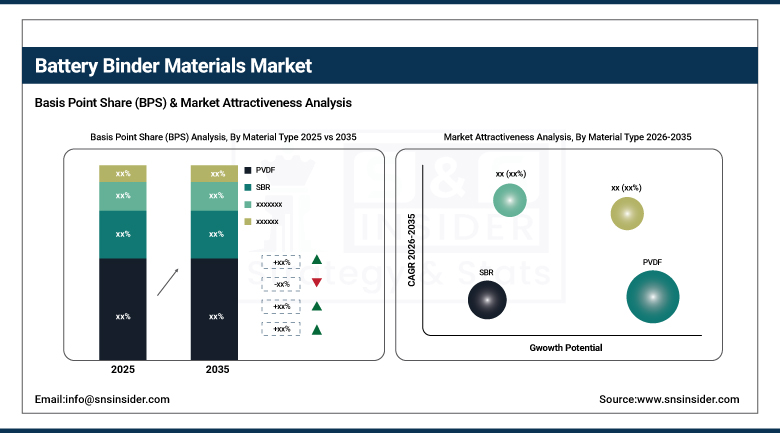
By Material Type, PVDF dominated the market with 39.00% share in 2025, while PAA is projected to witness the fastest growth with 20.21% CAGR during the forecast period.
-
By Battery Type, lithium-ion batteries dominated the market with 76.00% share in 2025, while sodium-ion batteries are projected to witness the fastest growth with 24.26% CAGR during the forecast period.
-
By Application, cathode binders dominated the market with 42.00% share in 2025, while anode binders are projected to witness the fastest growth with 18.41% CAGR during the forecast period.
-
By End User, electric vehicles dominated the market with 51.00% share in 2025, while energy storage systems are projected to witness the fastest growth with 20.70% CAGR during the forecast period.
By Material Type, PVDF dominated, while PAA grows fastest.
The material category with the largest share of 39.00% in the battery binder materials market in 2025 was PVDF, which is the dominating material in the ME model. The commercial standing of PVDF binders is facilitated by the proven use in lithium-ion electrode production when there is the need for chemical stability, adhesion capacity, and compatibility with traditional cathode processing technologies. The function of PVDF binders is to keep the cohesion of active materials, conductive agents, and current collectors and ensure mechanical stability during electrode formation and battery cycling. Increased production of lithium-ion batteries offers a significant installed base of demand for PVDF binders.
The fastest-growing material category is expected to be PAA with a forecasted CAGR of 20.21% in 2026–2035. The growing popularity of this type of binder is related to the increasing development of anodes made of high-capacity and silicon-based materials, for which there can be more mechanical difficulties because of the repeated expansion and shrinking of electrodes that can occur due to conventional binder systems. PAA can offer good interactions with active particles and ensure the structural stability of the electrode, being therefore commercially relevant for advanced anode constructions.
By Application, cathode binders dominated, while anode binders grows fastest.
Cathode binders captured the leading market share of 42.00% in the battery binder materials market in 2025. A significant amount of binder demand comes from cathode fabrication because the binder should be able to keep the electrode structure cohesive while providing stable connection between the active cathode materials, conductive additive, and current collector. Increased production of lithium-ion batteries for electric vehicles and energy storage is expanding the demand for cathode-binder systems. Characteristics such as binder performance are currently evaluated alongside electrode loading, coating efficiency, drying properties, adhesion, and electrochemical stability because they influence the manufacturing yield and cell performance. Proven cathode processing methods using PVDF binders add to the commercial value of the segment.
Anode binders are forecast to be the fastest-growing segment with a CAGR of 18.41% in 2026-2035. Technological advancements to increase anode capacity with silicon-containing materials, advanced graphite, and other types of electrodes drive this growing segment. Such materials may exert increased mechanical pressure on the electrodes due to recharging and discharging cycles and therefore make binder flexibility, adhesion, and structure retention important. Thus, advanced binders may help retain electrodes and ensure increased active-material loading. Batteries are increasingly being designed as an integrated system, and batteries manufacturers evaluate the chemistry of the binders together with electrodes.
By End User, electric vehicles dominated, while energy storage systems grows fastest.
Electric vehicles were responsible for 51.00% of the battery binder materials market in 2025. Electric Vehicle battery manufacture needs a lot of electrode materials since battery packs in vehicles contain much more cell capacity than batteries in consumer-electronics devices. Continuous growth of electric mobility results in increased need for cathode and anode binder materials for cells manufacturing. In addition, battery producers are looking for increasing energy density, fast charging capabilities, improved cycle life and reduced costs of production resulting in additional demands for binder formulation supporting modern electrode constructions. Automotive electrification is thus one of the key demands drivers for binder manufacturers in its relation to battery manufacturing capacities.
Energy storage systems are expected to have the highest CAGR of 20.70% during the forecast period of 2026–2035. Growth is explained by the increase in the number of grid-scale batteries, integration of renewable energy sources into the network, construction of distributed storage systems and backup power systems. Storage projects require battery capacities to grow and thus there is the need for electrode materials and binder materials. The economic aspect of stationary energy storage stimulates producers to choose cost-effective chemistries including LFP and alternatives.
Regional Analysis:
|
Region |
Major Country |
Share within Region, 2025 (%) |
|---|---|---|
|
North America |
United States |
92.00% |
|
Europe |
Germany |
19.00% |
|
Asia Pacific |
China |
22.00% |
|
Middle East & Africa |
UAE |
4.00% |
|
Latin America |
Brazil |
3.00% |
North America Battery Binder Materials Market Insights
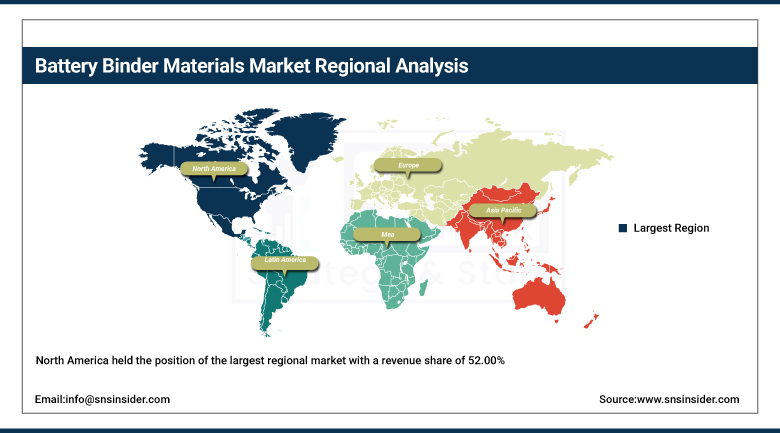
North America held the position of the largest regional market with a revenue share of 52.00% of the global battery binder materials market in 2025. This regional dominance in the global market is mostly driven by the United States since the country contributes a whopping 92.00% of revenues within the region in the specified period. Demand for electrode materials used by batteries is boosted by significant investments in battery manufacturing, growth in EV production and use of stationary energy storage, and growing focus on domestic supply chains of batteries.
Localized manufacturing of battery cells and components is commercially significant since it leads battery producers to qualify regional suppliers of these parts and components. Binder producers may gain an edge due to this shift by producing formulations that meet requirements of local electrode production without relying on imported specialty materials. Investment in battery technologies for transportation and power systems applications is increasing in the region. In the US, battery manufacturing is being increased and manufacturers are starting to diversify cell chemistries for particular applications.
Get Customized Report as per Your Business Requirement - Enquiry Now
Europe Battery Binder Materials Market Insights
Europe region presents itself as a key market due to its well-developed manufacturing base in the automotive sector, rapidly increasing electrification ambitions and the development of domestic production of batteries. Germany, France, the UK, Italy and other European economies are making investments into battery manufacturing, battery recycling and materials supply locally to minimize reliance on battery manufacturing concentrated overseas.
These investments create downstream opportunities for binders' suppliers as the manufacturers of batteries will need a reliable source of electrode manufacturing materials. In addition to that, the battery manufacturers in Europe will be more interested in developing efficient, sustainable, secure in terms of materials and high performing products, which will require formulations able to provide electrode architectures and be compatible with highly automated manufacturing process.
Asia Pacific Battery Binder Materials Market Insights
Asia Pacific is forecasted to be the most promising region with the highest rate of growth at a CAGR of 17.99% in 2026–2035. The region's share in the global market was 22.00% in 2025, and the share is anticipated to rise with increased manufacturing capabilities in China, Japan, South Korea, India, and Southeast Asia. Asia Pacific has a pronounced competitive edge due to high shares of global cell manufacturing, cathode and anode manufacturing, chemical processing, and battery material supply chain infrastructure in the region.
The manufacturing cluster makes it easier for the binder suppliers to be situated near large electrode manufacturers, simplifying the logistics and fastening the process of qualification of the formulation. Higher consumption rates of binders are expected due to increasing adoption of EVs and energy storage installations in the region. China is one of the key players in the regional battery ecosystem due to huge manufacturing capacity of lithium-ion batteries and well-developed supply chain for battery materials.
Middle East & Africa and Latin America Battery Binder Materials Market Insights
The Middle East & Africa regional base has a comparatively smaller size; however, opportunities are arising out of the deployment of renewables, grid modernization, electric mobility, and the construction of energy storage infrastructure. Gulf countries are highly relevant, as large-scale solar installations need storage technology to account for its intermittent nature and enhance the flexibility of the grid. The battery deployment would hence generate secondary demand for electrode materials such as binders. Latin America's developing battery ecosystem will generate not only manufacturing opportunities but also distributor and specialty material supplier opportunities rather than purely manufacturing opportunities. The demand for reliable battery components in energy storage projects which are increasingly commercialized and larger will gradually develop in selected Middle Eastern countries.
The long-term opportunity in the Latin American region is driven by rising renewable energy penetration, increasing electrification, EV adoption, and the need for energy storage infrastructure. The countries such as Brazil, Mexico, and Chile along with some other economies in Latin America are at varying levels of development in their battery value chains, which may give rise to demand for imported and locally distributed electrode materials. Energy storage is highly relevant in areas where solar or wind power generation needs flexibility and grid balancing. However, the battery binder market in the region will largely depend on how fast the battery cells are localized in Latin American countries due to imported batteries limiting demand for electrode materials.
Market Dynamics:
Growth Drivers: Rise in manufacturing of electric vehicles and batteries.
The significant growth in the manufacture of electric-vehicle batteries can be considered a major driver for the Battery Binder Materials Market. Batteries used in electric vehicles need a large amount of electrode materials, and binders play a key role in providing the necessary cohesion, adhesion, and stability in manufacturing and operation. By 2025, the total global deployment of EV batteries amounted to about 1.2 TWh, marking an almost 30% rise compared to 2024, which is evidence of the downstream demand created by electrified cars.
Another important factor for battery manufacturers is developing new electrode designs featuring higher energy density, faster charging speeds, longer cycle life, and reduced manufacturing costs. All of these goals presuppose the optimization of active material loading, particle adhesion, uniformity of the coating, its drying and electrode strength.
Restraints: Strict materials qualification requirements and supply chain concentration.
The industry faces restraints from strict material qualification requirements and the technical challenges related to altering the composition of binders used in battery production processes. The function of binders is to facilitate interaction between active materials, conductive additives, solvents, current collectors, and other components used in the electrodes. As such, even the slightest alteration of the formula may affect properties of the coating, its adhesion to other materials, drying process, electrochemical properties, and cycle life.
Hence, battery producers normally demand rigorous testing before using alternative materials, which imposes substantial entry barriers and extends the time needed to bring new products to market. As a result, companies producing proven binders with consistent quality have a competitive edge, while new producers need to allocate significant resources to carry out research and tests to obtain relevant qualifications and reach a sufficient scale of operations.
Opportunities: The development of next-generation and sustainable binder systems.
The shift toward next-generation battery chemistries represents many opportunities for development in next-generation binder systems. Silica anode systems, sodium ion batteries, solid state designs, and higher-loaded cathodes have mechanical requirements which are not compatible with those of standard Li-ion electrode systems. There are some binders which have better properties in terms of adhesion, flexibility, thermal stability, chemical resistance or compatibility with different solvents and electrode material compared to traditional binder materials.
Water-based and PAA systems could take advantage of such shift in battery technologies because the properties of such polymers could be optimized to satisfy certain requirements of electrodes. The chemistry-based suppliers could overcome their standard volume competition and occupy more valuable niches.
Recent Developments:
-
2026: Arkema expanded North American PVDF capacity- Arkema started a 15% PVDF capacity expansion at its Calvert City, Kentucky facility, strengthening regional supply for energy storage and strategic applications. A further 20% expansion in China is planned for completion in 2028.
-
2026: At Battery Show Europe 2026, Arkema showcased new PVDF grades and Incellion acrylic solutions for LFP cells, silicon anodes, separator coatings, and next-generation batteries, focusing on adhesion, lower binder loading, and dry-processing compatibility.
-
2026: LG Chem highlighted specialized SB and SA blending technologies for anode binders, emphasizing stronger adhesion, lower resistance, and improved cycling performance to enhance electrode stability during repeated charging and discharging.
-
2026: Solvay strengthened automotive PVDF positioning- Solvay’s Solef PVDF facility in Tavaux, France, received IATF 16949:2016 accreditation for automotive-related PVDF applications, reinforcing its qualification as a supplier for battery and e-mobility applications.
Battery Binder Materials Market Key Players are:
-
Arkema S.A.
-
Zeon Corporation
-
Solvay S.A.
-
LG Chem Ltd.
-
Daikin Industries, Ltd.
-
Kureha Corporation
-
JSR Corporation
-
Synthomer plc
-
Dow Inc.
-
BASF SE
-
Ashland Inc.
-
Mitsubishi Chemical Group Corporation
-
Toyo Ink SC Holdings Co., Ltd.
-
Resonac Holdings Corporation
-
Wacker Chemie AG
-
Lubrizol Corporation
-
DIC Corporation
-
KISCO Ltd.
-
DuPont de Nemours, Inc.
-
APV Engineered Coatings
Battery Binder Materials Market Report Scope:
| Report Attributes | Details |
|---|---|
| Market Size in 2025 | USD 1.59 Billion |
| Market Size by 2035 | USD 7.48 Billion |
| CAGR | CAGR of 16.80% From 2026 to 2035 |
| Base Year | 2025 |
| Forecast Period | 2026-2035 |
| Historical Data | 2022-2024 |
| Report Scope & Coverage | Market Size, Segments Analysis, Competitive Landscape, Regional Analysis, DROC & SWOT Analysis, Forecast Outlook |
| Key Segments | • By Material Type (PVDF, SBR, CMC & Cellulose-Based Binders, PAA, Others) • By Battery Type (Lithium-Ion Batteries, Sodium-Ion Batteries, Others) • By Application (Cathode Binders, Anode Binders, Separator & Functional Layer Binders, Others) • By End User (Electric Vehicles, Energy Storage Systems, Consumer Electronics, Industrial & Mobility Batteries, Others) |
| Regional Analysis/Coverage | North America (US, Canada), Europe (Germany, UK, France, Italy, Spain, Russia, Poland, Rest of Europe), Asia Pacific (China, India, Japan, South Korea, Australia, ASEAN Countries, Rest of Asia Pacific), Middle East & Africa (UAE, Saudi Arabia, Qatar, South Africa, Rest of Middle East & Africa), Latin America (Brazil, Argentina, Mexico, Colombia, Rest of Latin America). |
| Company Profiles | Arkema S.A., Zeon Corporation, Solvay S.A., LG Chem Ltd., Daikin Industries, Ltd., Kureha Corporation, JSR Corporation, Synthomer plc, Dow Inc., BASF SE, Ashland Inc., Mitsubishi Chemical Group Corporation, Toyo Ink SC Holdings Co., Ltd., Resonac Holdings Corporation, Wacker Chemie AG, Lubrizol Corporation, DIC Corporation, KISCO Ltd., DuPont de Nemours, Inc., APV Engineered Coatings |
Frequently Asked Questions
The Battery Binder Materials Market was valued at USD 1.59 Billion in 2025.
The market is projected to reach USD 7.48 Billion by 2035.
The market is anticipated to expand at a 16.80% CAGR during the forecast period.
North America dominated the global Battery Binder Materials Market with a 52.00% share in 2025.
PVDF accounted for the largest share, representing 39.00% of the market in 2025.
