
Sodium-Ion Battery Binder Market Report Scope & Overview:
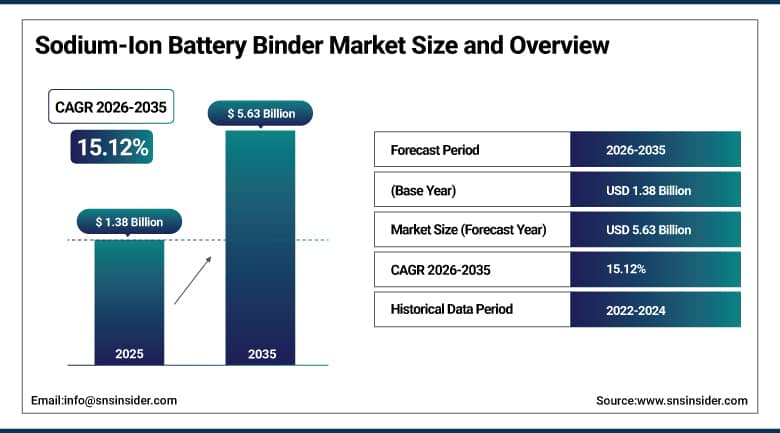
The Sodium-Ion Battery Binder Market was valued at USD 1.38 Billion in 2025 and is expected to reach USD 5.63 Billion by 2035, growing at a CAGR of 15.12% from 2026–2035.
Key factors behind the growth of the worldwide sodium-ion battery binder market include the increasing adoption of sodium-ion batteries as a cost-efficient substitute for lithium-ion batteries and the rising requirement for low-cost and dependable energy storage devices. The abundance and availability of lower cost of sodium compounds along with the apprehension about lithium raw material costs and uncertainty in their supply chain are encouraging manufacturers of battery to increase production of sodium-ion batteries. With the increased adoption of sodium-ion batteries for various applications such as grid energy storage, electric vehicles, two-wheelers, etc., the requirement for high-efficiency binders which offer good adhesion properties, mechanical stability, flexibility, and integrity of the electrodes increases.
Furthermore, investments in sodium-ion battery manufacturing capacity, battery materials, and research and development efforts are driving market growth. Also, significant growth potential exists for the market due to increasing adoption of sodium-ion batteries in stationary energy storage systems, renewable energy integration, electric vehicles, etc. Manufacturers of batteries are now looking for advanced binder systems which enhance the performance and longevity of electrodes, electrochemical stability and manufacturing efficiency of batteries.
In June 2026, ZEON Corporation expanded its battery materials development initiatives, focusing on advanced binder technologies and electrode materials to support the growing commercialization of next-generation batteries, including sodium-ion battery applications.
To Get More Information On Sodium-Ion Battery Binder Market - Request Free Sample Report
Sodium-Ion Battery Binder Market Trends
-
Increasing adoption of sodium-ion batteries as a cost-effective alternative to lithium-ion batteries is driving the sodium-ion battery binder market.
-
Growing demand for high-performance binders with strong adhesion, flexibility, and mechanical stability is accelerating market growth.
-
Expanding adoption of sodium-ion batteries in energy storage systems, electric vehicles, and two-wheeled vehicles is enhancing market demand.
-
Rising investments in sodium-ion battery manufacturing capacity, electrode materials, and battery research and development are supporting market innovation.
-
Increasing development of advanced binder formulations with improved cycle life, electrochemical stability, and resistance to electrode volume changes is strengthening market growth.
U.S. Sodium-Ion Battery Binder Market Outlook
The U.S. Sodium-Ion Battery Binder Market was valued at USD 0.16 Billion in 2025 and is expected to reach around USD 1.54 Billion by 2035, growing at a CAGR of 25.42% from 2026–2035.
The rising use of sodium-ion batteries is anticipated to fuel the U.S. sodium-ion battery binders market in the forecast period. Battery manufacturers and energy storage companies are increasingly interested in sodium-ion batteries as an affordable solution to lithium-ion batteries. It can be used for various applications, such as stationary energy storage, electric vehicles, and two-wheeler. In addition, growing interest in local battery production, energy security, and next generation battery technology will drive the market forward. Rising demand for binders with high performance is due to manufacturers' need for materials with excellent adhesion capability, mechanical stability, flexibility, and electrode volume change tolerance.
Moreover, advances in sodium-ion battery technology, including developments in battery chemistry, electrode material, aqueous processes, and polymer formulation are contributing to increased binder performance. The growing investment in energy storage infrastructure and renewable energy storage is also anticipated to support the use of sodium-ion batteries. With increased production of sodium-ion batteries in the U.S., rising demand for binders with improved cycle life, electrochemical stability, and manufacturability is expected to rise in the forecast period.
In July 2026, Peak Energy announced plans to build a commercial-scale sodium-ion battery manufacturing facility in Sacramento, California, with annual production capacity of 4 GWh for large-scale grid energy storage, marking a major step toward expanding sodium-ion battery manufacturing in the United States
Sodium-Ion Battery Binder Market Segment Analysis
-
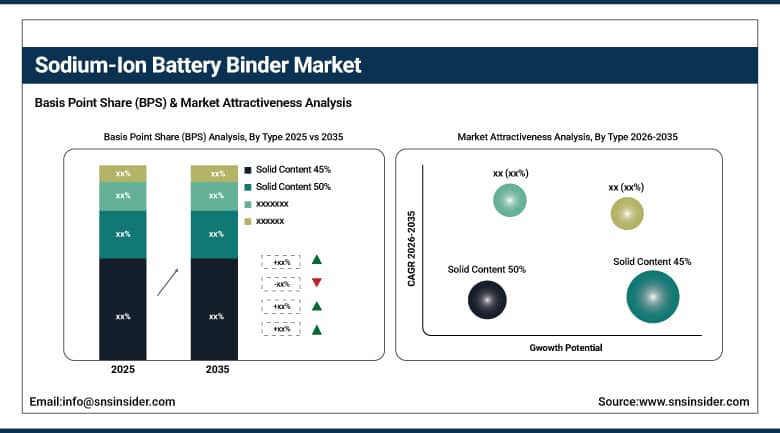
By Type, solid content 45% dominated the sodium-ion battery binder market with a 31.82% share in 2025, while solid content 50% is projected to be the fastest-growing segment, registering an 18.07% CAGR during 2026–2035.
-
By Application, energy storage battery dominated the sodium-ion battery binder market with a 52.84% share in 2025, while energy storage battery is projected to be the fastest-growing segment, registering a 14.49% CAGR during 2026–2035.
-
By Electrode Type, anode binders dominated the sodium-ion battery binder market with a 54.73% share in 2025, while cathode binders are projected to be the fastest-growing segment, registering a 16.34% CAGR during 2026–2035.
-
By Binder Functionality, standard adhesion binders dominated the sodium-ion battery binder market with a 56.38% share in 2025, while multi-functional binders are projected to be the fastest-growing segment, registering an 18.87% CAGR during 2026–2035.
-
By End User, battery manufacturers (OEMs) dominated the sodium-ion battery binder market with a 46.82% share in 2025, while energy storage system integrators are projected to be the fastest-growing segment, registering a 17.78% CAGR during 2026–2035.
By Type, solid content 45% dominated the sodium-ion battery binder market, while solid content 50% is expected to grow fastest
The segment of solid content 45% became the key player in the sodium-ion battery binder market in 2025, making up 31.82% of the market share since these binders offer a combination of proper binder ratio, adhesive strength, processibility, and stability of electrodes. They fit the needs of electrode production and the manufacturing process of sodium-ion batteries, driving their use.
The segment of solid content 50% will become the fastest-growing one during the forecast period due to the need of increased binding strength and electrode stability of advanced sodium-ion batteries.
By Application, energy storage battery dominated the sodium-ion battery binder market, and is expected to grow fastest
Energy Storage Battery dominated the share of the market in the sodium-ion battery binder market in 2025, with 52.84%, since sodium-ion batteries are increasingly viewed as feasible in energy storage applications. With the increasing implementation of renewable energy systems, grid-scale storage systems, and backup power systems, there will be an increase in demand for sodium-ion battery cells along with their binders.
This sector is anticipated to witness the highest growth rate during the forecast period owing to growing investments in energy storage, grid stabilization, and renewable energy systems.
By Electrode Type, anode binders dominated the sodium-ion battery binder market, is expected to grow fastest
The anode binders emerged as the biggest contributors to market share in the sodium-ion battery binder market in 2025, total share owing to their importance in retaining the electrode adhesion, stability, and structural integrity in repetitive charging and discharging. The rising production of sodium-ion anode materials and managing changes in electrode volumes are driving the need for more innovative anode binders formulations.
It is forecasted that the anode binders will be the fastest-growing segment in the coming years due to increased cycle stability and electrode performance.
Regional Analysis
|
Region |
Major Country |
Share within Region, 2025(%) |
|---|---|---|
|
North America |
United States |
76.84% |
|
Europe |
Germany |
27.63% |
|
Asia Pacific |
China |
45.18% |
|
Middle East & Africa |
Saudi Arabia |
31.42% |
|
Latin America |
Brazil |
44.76% |
North America Sodium-Ion Battery Binder Market Insights
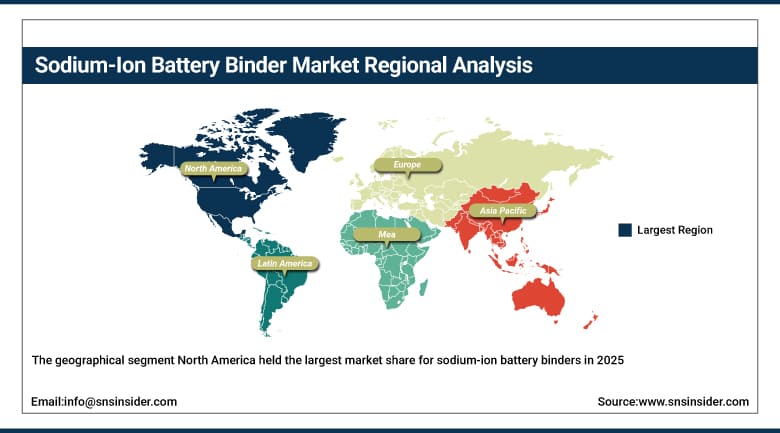
The geographical segment North America held the prominent market share and is forecast to witness the highest growth rate in the sodium-ion battery binder market of around 19.32% from 2026-2035, owing to the rising investments made in the research of sodium-ion batteries, production of electrodes, energy storage systems, and battery manufacturing process. This region enjoys rising investment in battery technology research and rising interest in sodium-ion batteries as an alternative energy storage solution. Growing usage of renewable energy and energy storage solutions leads to the requirement of sodium-ion battery technology and binders used for them. In North America, the U.S. was found to be the largest regional market in 2025 owing to the presence of battery research, growing energy storage industry, and advanced battery manufacturing.
Get Customized Report as Per Your Business Requirement - Enquiry Now
Europe Sodium-Ion Battery Binder Market Insights
The sodium-ion battery binders market in Europe is expected to witness stable growth on account of rising investments in battery production, renewable energy incorporation, and energy storage systems. Battery manufacturers in Europe are becoming more inclined toward using sodium-ion technology owing to the cost benefits associated with the same, availability of resources, and application in stationary storage. Increasing investments in battery research, electrode materials, and cell manufacturing have been driving the demand for binders that are specific to this technology. Sodium-ion batteries are being tested for their applications in the areas where cost, safety, and diversification of the supply chain are important considerations. Germany held the largest market share in the European region in 2025.
Asia Pacific Sodium-Ion Battery Binder Market Insights
The Asia Pacific region held the major share of around 42% due to fast-paced development of sodium-ion battery manufacturing capacity, increasing energy storage deployment, and heavy investments in the advanced batteries. Countries like China, Japan, South Korea, and India are making significant investments in battery research, battery cell manufacturing, renewable energy storage, and electric vehicles. Sodium-ion batteries have become increasingly prevalent due to the growing battery manufacturing network of the region and demand for economic energy storage technology. In 2025, the Asia Pacific region was led by China in terms of market share because of its well-established battery manufacturing network, sodium-ion battery manufacturing capability, and heavy investments in energy storage technologies.
Middle East & Africa and Latin America Sodium-Ion Battery Binder Market Insights
The sodium-ion battery binder market in the Middle East & Africa is experiencing steady growth due to the rise in investment in renewable energy, energy storage, and energy diversification. Countries across the region are building more capacity for solar power generation and energy storage, providing chances for efficient batteries that can be used in stationary applications. The use of sodium-ion batteries is increasing in applications where resource availability, safety, and low cost are a factor. Saudi Arabia is the largest market in the Middle East & Africa sodium-ion battery binder market in 2025 due to large investments in renewable energy and energy diversification.
There is growing demand for sodium-ion battery binders in Latin America owing to increased investment in renewable energy sources, grid modernization, and energy storage systems. With the rising installation of renewable energy such as solar and wind in Latin America, there is an increased demand for batteries which can help manage energy supply from renewable sources. Sodium-ion battery technology has been gaining traction for stationary use because of their lower cost and easy material availability. In 2025, Brazil accounted for the highest share in the Latin American market owing to its large energy market and investments in energy storage systems and batteries.
Market Dynamic
Growth Driver: Rising adoption of sodium-ion batteries for energy storage driving sodium-ion battery binder market growth
One of the major factors driving the market of sodium-ion battery binders is the growing use of sodium-ion batteries in energy storage applications and other applications where cost matters. There is increasing interest in sodium-ion battery technology owing to the availability of sodium sources, possible cost benefits, and suitability in stationary energy storage applications. With battery producers stepping up their efforts to manufacture sodium-ion batteries, there is rising need for advanced binders that ensure good bonding, stability, and flexibility. The investments being made in renewable energy sources, energy storage solutions, and next-generation batteries have further supported the growth of the sodium-ion batteries industry.
Restraints: Limited commercial-scale adoption and evolving electrode formulations may restrict sodium-ion battery binder market growth
Despite the vast potential that sodium-ion batteries have, lack of commercial-scale application and the nascent nature of the technology relative to the more developed lithium-ion batteries may hamper growth in the market. The manufacturers continue to tweak their electrode, cell chemistry, production techniques, and binder formulation in order to increase energy density, longevity, and cost-effectiveness of the batteries. Differences in the materials used for anode and cathode may also call for unique binder formulation, leading to increased expenses on research, testing, and development. Lack of standardization of sodium-ion battery chemistries and production process may present another challenge for the binder suppliers.
Opportunities: Growing deployment of sodium-ion batteries in stationary energy storage creating new growth opportunities
Several notable opportunities will arise in the sodium-ion battery binder market owing to the increased usage of sodium-ion batteries for energy storage purposes in the future. Battery makers and energy storage firms have begun researching the use of sodium-ion technology to decrease their reliance on limited battery materials and create affordable energy storage solutions. This will lead to a rising demand for improved binders that will help improve the performance and efficiency of these batteries. In addition, the development of multi-functional binders, high solid content binders, water-based binders, and electrode manufacturing techniques will open up opportunities for the use of sodium-ion battery binders.
Recent Developments
-
2026: Arkema continued advancing specialty materials for battery applications, including its Kynar PVDF portfolio used as a binder material for lithium-ion and emerging battery technologies. These developments are expected to support demand for advanced binder materials as manufacturers optimize electrode adhesion, mechanical stability, and electrochemical performance.
-
2026: Syensqo continued developing advanced specialty materials for next-generation batteries, with a focus on materials that improve electrode and cell performance. These developments are expected to support the adoption of advanced binder technologies as sodium-ion battery manufacturers seek improved electrode stability and cycling performance.
-
2026: Kureha Corporation continued its development and supply of PVDF materials for battery applications. The company's battery-material activities are expected to support demand for high-performance binders as sodium-ion battery manufacturers optimize electrode formulations and manufacturing processes.
-
2026: Zeon Corporation continued advancing battery-related materials, including functional polymers and binder technologies for electrodes. These developments are expected to contribute to sodium-ion battery binder innovation by improving adhesion, flexibility, and electrode durability.
-
2026: Arakawa Chemical Industries continued developing functional materials for battery applications, including binder-related technologies. These advancements are expected to support the development of high-performance sodium-ion battery electrodes by improving binding characteristics and electrode structural stability.
Sodium-Ion Battery Binder Market Key Players are:
-
Arakawa Chemical Industries, Ltd.
-
Syensqo
-
Arkema
-
Kureha Corporation
-
Zeon Corporation
-
Solvay
-
Daikin Industries, Ltd.
-
AGC Inc.
-
Ashland
-
Dow Inc.
-
BASF SE
-
LG Chem Ltd.
-
Resonac Holdings Corporation
-
Toyo Ink SC Holdings Co., Ltd.
-
Nippon Paper Industries Co., Ltd.
-
Gujarat Fluorochemicals Limited
-
SRF Limited
-
Dongyue Group Limited
-
Zhejiang Fluorine Chemical Co., Ltd.
-
Shandong Huaxia Shenzhou New Material Co., Ltd.
Sodium-Ion Battery Binder Market Report Scope:
| Report Attributes | Details |
|---|---|
| Market Size in 2025 | USD 1.38 Billion |
| Market Size by 2035 | USD 5.63 Billion |
| CAGR | CAGR of 15.12% From 2026 to 2035 |
| Base Year | 2025 |
| Forecast Period | 2026-2035 |
| Historical Data | 2022-2024 |
| Report Scope & Coverage | Market Size, Segments Analysis, Competitive Landscape, Regional Analysis, DROC & SWOT Analysis, Forecast Outlook |
| Key Segments | • By Type (Solid Content 40%, Solid Content 45%, Solid Content 50%, Other Formulations) • By Application (Power Battery, Energy Storage Battery, Other Applications) • By Electrode Type (Anode Binders, Cathode Binders) • By Binder Functionality (Standard Adhesion Binders, Multi-Functional Binders, Conductive Binders) • By End User (Battery Manufacturers (OEMs), Energy Storage System Integrators, Consumer Electronics Brands, Automotive Companies) |
| Regional Analysis/Coverage | North America (US, Canada), Europe (Germany, UK, France, Italy, Spain, Russia, Poland, Rest of Europe), Asia Pacific (China, India, Japan, South Korea, Australia, ASEAN Countries, Rest of Asia Pacific), Middle East & Africa (UAE, Saudi Arabia, Qatar, South Africa, Rest of Middle East & Africa), Latin America (Brazil, Argentina, Mexico, Colombia, Rest of Latin America) |
| Company Profiles | Arakawa Chemical Industries, Ltd.; Syensqo; Arkema; Kureha Corporation; Zeon Corporation; Solvay; Daikin Industries, Ltd.; AGC Inc.; Ashland; Dow Inc.; BASF SE; LG Chem Ltd.; Resonac Holdings Corporation; Toyo Ink SC Holdings Co., Ltd.; Nippon Paper Industries Co., Ltd.; Gujarat Fluorochemicals Limited; SRF Limited; Dongyue Group Limited; Zhejiang Fluorine Chemical Co., Ltd.; Shandong Huaxia Shenzhou New Material Co., Ltd. |
Frequently Asked Questions
The sodium-ion battery binder market is expected to grow at a CAGR of 15.12% from 2026 to 2035.
The sodium-ion battery binder market was valued at USD 1.38 billion in 2025.
The market is driven by the increasing adoption of sodium-ion batteries for energy storage, growing investments in grid-scale and renewable energy storage systems, and the expanding development of advanced sodium-ion battery technologies.
Solid Content 45% dominated the sodium-ion battery binder market in 2025 with a 31.82% share.
Asia-Pacific dominated the sodium-ion battery binder market in 2025 with a 48.63% share.
