
Biodegradable Orthopedic Implants Market Report Scope & Overview:
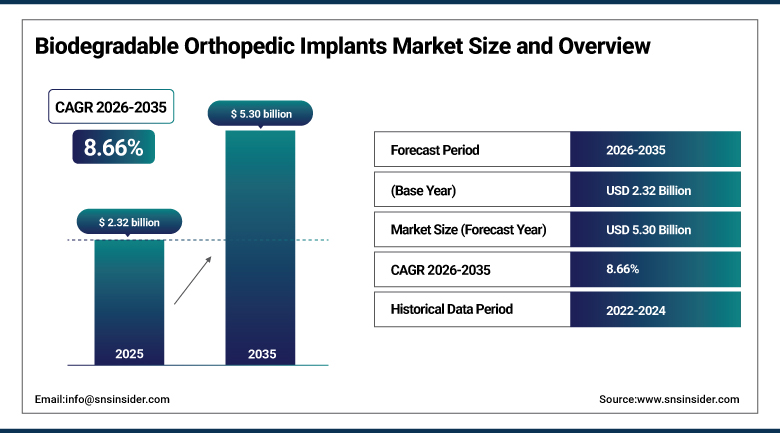
The Biodegradable Orthopedic Implants Market was valued at USD 2.32 billion in 2025 and is expected to reach USD 5.30 billion by 2035, growing at a CAGR of 8.66% from 2026-2035.
The Biodegradable Orthopedic Implants Market The industry is seeing steady growth because of the rise in orthopedic surgeries, increased instances of fractures, and rising need for implants that do not require secondary operations for removal. Biodegradable implants dissolve slowly with time after the completion of healing of the bone and tissues, thus making the procedure more convenient for patients and eliminating the health risks involved in using non-biodegradable implants. The use of minimally invasive procedures in orthopedics along with developments in the area of bioabsorbable materials is helping expand the scope of application in this field. Furthermore, the increase in sports injuries, aging population, and spending on healthcare is boosting market demand.
CDC data show that millions of older adults experience falls each year, with falls frequently resulting in fractures and other injuries requiring medical treatment.
To Get more information Biodegradable Orthopedic Implants Market - Request Free Sample Report
Biodegradable Orthopedic Implants Market Trends
-
Rising demand for minimally invasive orthopedic treatments is driving adoption of biodegradable implants that eliminate additional surgeries for implant removal.
-
Increasing prevalence of bone fractures, sports injuries, and orthopedic disorders is expanding demand for bioabsorbable fixation devices and implants.
-
Growing preference for patient-friendly implant solutions is encouraging adoption of biodegradable materials that gradually degrade as natural bone healing progresses.
-
Advancements in bioabsorbable polymers, magnesium alloys, and composite materials are improving implant strength, biocompatibility, degradation rates, and clinical performance.
-
Increasing adoption of biodegradable implants in pediatric orthopedics is creating opportunities for growth by reducing complications associated with permanent implants.
U.S. Biodegradable Orthopedic Implants Market Outlook
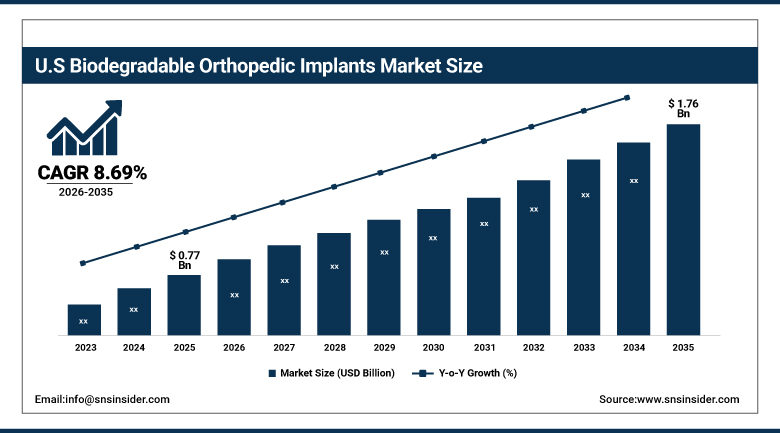
U.S. Biodegradable Orthopedic Implants Market was valued at USD 0.77 billion in 2025 and is expected to reach USD 1.76 billion by 2035, growing at a CAGR of 8.69% from 2026-2035.
The U.S. Biodegradable Orthopedic Implants Market The market is experiencing high growth due to the rise in orthopedic surgeries, fractures, and the inclination towards biodegradable implants that degrade slowly after bone regeneration. The use of biodegradable implants may minimize the necessity for further surgeries involving implant removal, thus making it easier for patients and ensuring better results. Moreover, innovations in biodegradable materials like polylactic acid and magnesium enhance the performance of implants and widen their scope of use. High use of minimally invasive orthopedic surgeries, increased healthcare spending, and sports injuries are some other drivers for this market.
The American Joint Replacement Registry's 2025 annual report captured more than 3.1 million hip and knee procedures, demonstrating the substantial scale of orthopedic intervention in the United States.
Biodegradable Orthopedic Implants Market Segment Analysis
-
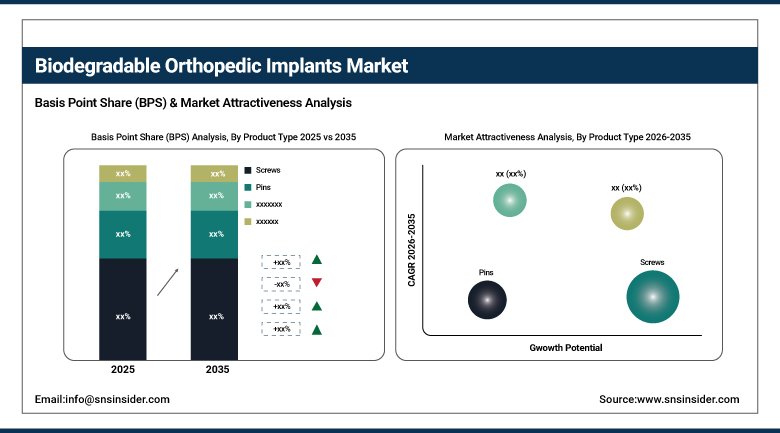
By Product Type, Screws dominated the Biodegradable Orthopedic Implants Market with 36% share in 2025; Sutures are expected to grow at the fastest CAGR of 11.75% from 2026–2035.
-
By Material Type, Polylactic Acid dominated the Biodegradable Orthopedic Implants Market with 30% share in 2025; Magnesium is expected to grow at the fastest CAGR of 11% from 2026–2035.
-
By Application, Trauma dominated the Biodegradable Orthopedic Implants Market with 38% share in 2025; Sports Injury is expected to grow at the fastest CAGR of 10.65% from 2026–2035.
-
By End User, Hospitals dominated the Biodegradable Orthopedic Implants Market with 58% share in 2025; Ambulatory Surgical Centers are expected to grow at the fastest CAGR of 9.76% from 2026–2035.
By Product Type, Screws dominate the biodegradable orthopedic implants market, Sutures grow fastest.
Screws segment dominated the Biodegradable Orthopedic Implants Market with the highest revenue share of about 36% in 2025 Because of their extensive application in fracture management and bone fixation and orthopedic surgery. Biodegradable screws offer mechanical strength along with degrading slowly post-healing, possibly decreasing the need for removal surgeries. The increasing cases of trauma and orthopedic surgeries also contribute to its growing demand.
Sutures segment is expected to grow at the fastest CAGR of 11.75% from 2026-2035 As a result of rising usage of absorbable materials in wound closure and soft tissue repair. The biodegradable sutures eliminate the need of suture removal and can minimize patient pain and additional procedures. Increasing use of minimal invasive surgeries, sport injuries, and demand for surgical procedures will fuel their global adoption.
By Material Type, Polylactic Acid dominates the biodegradable orthopedic implants market, Magnesium grows fastest.
Polylactic Acid segment dominated the Biodegradable Orthopedic Implants Market with the highest revenue share of about 30% in 2025 Because of its proven history, biocompatibility, biodegradability, and excellent processability, PLA can be used for orthopedic fixation that is temporary, degrading within the body. Research, proven production ability, and the rising need for absorbable implants all help in the widespread use of PLA.
Magnesium segment is expected to grow at the fastest CAGR of 11% from 2026-2035 Because of its good mechanical behavior, biocompatibility, and ability to break down slowly within the body. The use of magnesium will help offer temporary support without the need for permanent implants. More studies in relation to bioresorbable metals, orthopedics, and implants are likely to increase their use worldwide.
By Application, Trauma dominates the biodegradable orthopedic implants market, Sports Injury grows fastest.
Trauma segment dominated the Biodegradable Orthopedic Implants Market with the highest revenue share of about 38% in 2025 as a result of high rates of fractures, bone injuries, and orthopedic emergencies. The use of bioresorbable implants helps to offer temporary fixation of bones that can be resorbed after healing without the need for removal surgery. An increase in accidents and orthopedic injuries adds to this problem.
Sports Injury segment is expected to grow at the fastest CAGR of 10.65% from 2026-2035 due to the increase in participation in recreational and professional sports and an increase in injuries to ligaments, tendons, and bones. Biodegradable implants help in repairing the tissues while possibly decreasing the complications that may arise from implants. Increased awareness of sports health care, minimal invasive procedures, and development of orthopedic biomaterials will fuel growth worldwide.
By End User, Hospitals dominate the biodegradable orthopedic implants market, Ambulatory Surgical Centers grow fastest.
Hospitals segment dominated the Biodegradable Orthopedic Implants Market with the highest revenue share of about 58% in 2025 Due to the high number of patients, advanced surgical facilities, orthopedic department specialization, and capability to conduct difficult surgeries. Hospitals see a significant number of trauma and orthopedic cases that need implant fixation. Increased cost of health care, increased number of surgeries, and specialized care make adoption easier.
Ambulatory Surgical Centers segment is expected to grow at the fastest CAGR of 9.76% from 2026-2035 Due to the growing preference for minimally invasive and shorter surgeries in orthopedics and efficient ambulatory care. New technologies in surgery have made possible that more procedures are conducted without being admitted into the hospital. Growing pressure on healthcare costs, improved ASC facility and the number of orthopedic procedures conducted will drive acceptance worldwide.
Regional Analysis
|
Region |
Major Country |
Share within Region, 2025 (%) |
|---|---|---|
|
North America |
United States |
89.0% |
|
Europe |
Germany |
24.0% |
|
Asia Pacific |
China |
40.0% |
|
Middle East & Africa |
UAE |
18.0% |
|
Latin America |
Brazil |
35.0% |
North America Biodegradable Orthopedic Implants Market Insights
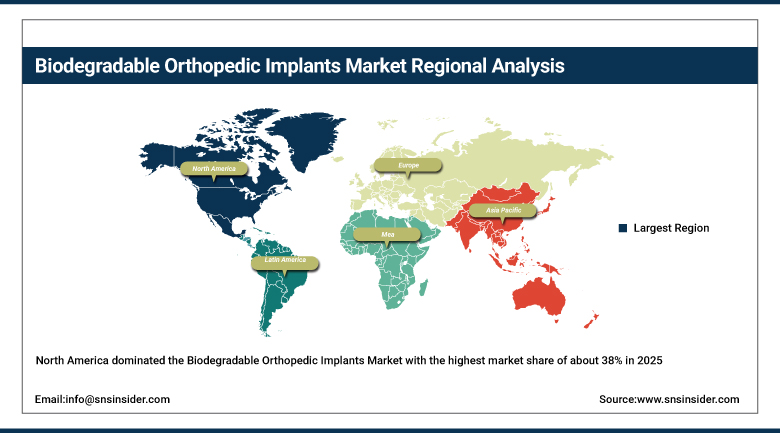
North America dominated the Biodegradable Orthopedic Implants Market with the highest market share of about 38% in 2025, The factors that contribute to the success of the healthcare infrastructure, orthopedic surgery procedures, and adoption of innovative implant technology in the region include: The demand for minimally invasive procedures, preference for absorbable implants, research and development investments, and the presence of prominent medical device companies.
The U.S. Biodegradable Orthopedic Implants Market accounted for a market share of 89.0%, backed by a well-developed healthcare infrastructure, large number of orthopedic surgeries, and high use of cutting-edge medical devices. The increasing demand for minimally invasive techniques, bioabsorbable implants, and medical devices that lower the need for removing implants is fuelling the uptake. High research and development spending and the availability of orthopedic device makers add to the growth.
Get Customized Report as per Your Business Requirement - Enquiry Now
Europe Biodegradable Orthopedic Implants Market Insights
Europe Biodegradable Orthopedic Implants Market This market has been showing steady growth, owing to the presence of advanced healthcare facilities, rise in orthopedic surgeries, and adoption of bioabsorbable medical devices. The rising need for minimally invasive procedures and devices with less frequent surgeries is contributing towards the adoption rate. Efficient medical device research and developments are adding to market growth in Europe.
The Germany Biodegradable Orthopedic Implants Market accounted for a market share of 24.0%, It will be driven by the presence of advanced health care infrastructure, increase in orthopedic surgeries, and increase in adoption of bioabsorbable medical technology. There is an increasing need for minimally invasive procedures and implants which can do away with the need for removal surgeries, thereby aiding the growth of the market.
Asia Pacific Biodegradable Orthopedic Implants Market Insights
Asia Pacific is expected to grow at the fastest CAGR of about 9.71% from 2026–2035, Backed by increasing orthopedic surgery procedures, aging demographics, better healthcare infrastructure, and increased investment in medical devices. Increasing awareness about the benefits of absorbable implants, increasing access to healthcare, and technological innovations are also boosting the growth of the regional market.
The China Biodegradable Orthopedic Implants Market accounted for a market share of 40.0%, Backed up by the increase in orthopedic surgery cases, expansion of healthcare facilities, and investments in medical devices. The increasing popularity and understanding of the bioabsorbable implants due to their ability to help avoid secondary removal procedures have contributed to their adoption. Further boosting the market growth include healthcare modernization, technological innovations, and homegrown medical devices in China.
Middle East & Africa and Latin America Biodegradable Orthopedic Implants Market Insights
The Middle East & Africa and Latin America Biodegradable Orthopedic Implants Market It is growing slowly due to rising numbers of orthopedic surgeries, development of healthcare facilities, and investment in medical devices. Opportunities are arising owing to high awareness about the advantages of using bioabsorbable implants and availability of orthopedic treatment. Growth in the regional market can also be attributed to healthcare advancement and investments in medical technology.
The UAE Biodegradable Orthopedic Implants Market accounted for a market share of 18.0%, backed by the development of the health care infrastructure, increase in orthopedic surgeries, and investments in medical technology. The rising trend of minimally invasive techniques along with increased awareness regarding bioabsorbable implants is paving the way for growth in the market. Health care reforms driven by government initiatives, specialized orthopedic care, and investments in medical devices are also driving the market.
Market Dynamics
Growth Drivers: Growing demand for minimally invasive orthopedic procedures is accelerating adoption of biodegradable implant technologies across healthcare systems globally
Increasing demand for minimally invasive orthopedic procedures is one of the most important factors which is playing an important role in shaping the market for Biodegradable Orthopedic Implants. The implants offer temporary support to the bones until the process of healing and then disintegrate after performing their desired function, hence avoiding the second implant removal surgery procedure. Some of the uses of the implants are fracture fixation, bone repair, and many other orthopedic uses. Awareness among surgeons for offering personalized treatments to the patients and to avoid secondary surgeries are some of the factors fueling the demand for these implants. Increasing number of orthopedic injuries, sports injuries, and bone injuries among the aged people are also contributing to the growth of the market.
Restraints: Limited mechanical strength and unpredictable degradation characteristics can restrict adoption of biodegradable orthopedic implants in demanding procedures
Performance limitations remain a significant challenge for biodegradable orthopedic implants, particularly in procedures requiring high mechanical strength and long-term structural stability. Certain biodegradable materials might have less loading capability compared to metals, making it less ideal for fractures that are more complicated or in parts of the body where loads are greater. The biodegradation process might be affected by factors like the composition of the material, the design of the implant, biological processes within the patient's body, and the nature of the tissues in which it is placed. Rapid degradation might decrease mechanical support when the bone has not yet healed sufficiently, while slower degradation would delay the intended degradation process. Degradation of the material might even lead to products that need to be assessed for tissue compatibility.
Opportunities: Advancements in bioresorbable materials and implant design are creating significant opportunities for next-generation orthopedic solutions globally
Rapid advancements in bioresorbable polymers, composites, and implant engineering are creating substantial opportunities for the Biodegradable Orthopedic Implants Market. Scientists are creating new materials that are more mechanically robust, have better controlled degradation rates, are biocompatible, and facilitate tissue integration. With the help of modern manufacturing techniques, such as additive manufacturing and precision manufacturing, scientists can create implants that have optimized geometry and patient-specific design. The addition of bioactive materials can assist in bone regeneration and healings. These developments can make biodegradable implants useful for purposes other than certain types of fixation surgery. Pharmaceutical and medical equipment manufacturers can develop materials that are more effective clinically. Thus, technology development can contribute to increasing competition of biodegradable implants vis-a-vis traditional implants.
Recent Developments:
-
2026: Bioretec continued expanding its RemeOs™ and Activa™ absorbable implant platforms, strengthening its portfolio of biodegradable orthopedic solutions designed to support bone healing while eliminating implant-removal surgery.
-
2026: Inion continued advancing its bioabsorbable orthopedic portfolio, with 2026 activities focused on its Freedom™ and CompressOn™ product lines for specialty orthopedic applications and surgeon education.
-
2026: Evonik continued advancing RESOMER® bioresorbable polymers for medical devices, including orthopedic applications, offering tunable degradation rates and mechanical properties for temporary implants.
-
2022: Stryker launched Citrefix™, a suture-anchor system using Citregen™ bioresorbable material designed to mimic native bone chemistry, support controlled resorption, and promote natural bone regeneration.
Biodegradable Orthopedic Implants Market key players are:
-
Stryker Corporation
-
Zimmer Biomet Holdings, Inc.
-
Smith & Nephew plc
-
Johnson & Johnson – DePuy Synthes
-
Medtronic plc
-
B. Braun SE
-
Arthrex, Inc.
-
CONMED Corporation
-
Bioretec Ltd.
-
OrthoPediatrics Corp.
-
Evonik Industries AG
-
Inion Oy
-
KLS Martin Group
-
Acumed LLC
-
Orthofix Medical Inc.
-
Teijin Limited
-
Meril Life Sciences Pvt. Ltd.
-
Citieffe S.r.l.
-
Gunze Limited
-
Orthomed S.A.S.
Biodegradable Orthopedic Implants Market Report Scope:
| Report Attributes | Details |
|---|---|
| Market Size in 2025 | USD 2.32 Billion |
| Market Size by 2035 | USD 5.30 Billion |
| CAGR | CAGR of 8.66% From 2026 to 2035 |
| Base Year | 2025 |
| Forecast Period | 2026-2035 |
| Historical Data | 2022-2024 |
| Report Scope & Coverage | Market Size, Segments Analysis, Competitive Landscape, Regional Analysis, DROC & SWOT Analysis, Forecast Outlook |
| Key Segments | • By Product Type (Screws, Pins, Plates, Rods, Sutures, Other Product Types) • By Material Type (Polyglycolic Acid, Polylactic Acid, Polydioxanone, Polycaprolactone, Magnesium, Other Materials) • By Application (Trauma, Spine, Sports Injury, Craniofacial, Other Applications) • By End-User (Hospitals, Ambulatory Surgical Centers, Specialty Clinics, Other End Users) |
| Regional Analysis/Coverage | North America (US, Canada), Europe (Germany, UK, France, Italy, Spain, Russia, Poland, Rest of Europe), Asia Pacific (China, India, Japan, South Korea, Australia, ASEAN Countries, Rest of Asia Pacific), Middle East & Africa (UAE, Saudi Arabia, Qatar, South Africa, Rest of Middle East & Africa), Latin America (Brazil, Argentina, Mexico, Colombia, Rest of Latin America). |
| Company Profiles | Stryker Corporation, Zimmer Biomet Holdings, Inc., Smith & Nephew plc, Johnson & Johnson – DePuy Synthes, Medtronic plc, B. Braun SE, Arthrex, Inc., CONMED Corporation, Bioretec Ltd., OrthoPediatrics Corp., Evonik Industries AG, Inion Oy, KLS Martin Group, Acumed LLC, Orthofix Medical Inc., Teijin Limited, Meril Life Sciences Pvt. Ltd., Citieffe S.r.l., Gunze Limited, and Orthomed S.A.S. |

Frequently Asked Questions
The Biodegradable Orthopedic Implants Market is expected to grow at a CAGR of 8.66% from 2026 to 2035.
The Biodegradable Orthopedic Implants Market was valued at USD 2.30 billion in 2025.
The major growth factor is rising incidence of orthopedic injuries and growing preference for minimally invasive procedures, as biodegradable implants eliminate secondary removal surgeries and support faster recovery.
North America dominated the Biodegradable Orthopedic Implants Market in 2025.
