
Blockchain in Insurance Market Report Scope & Overview:
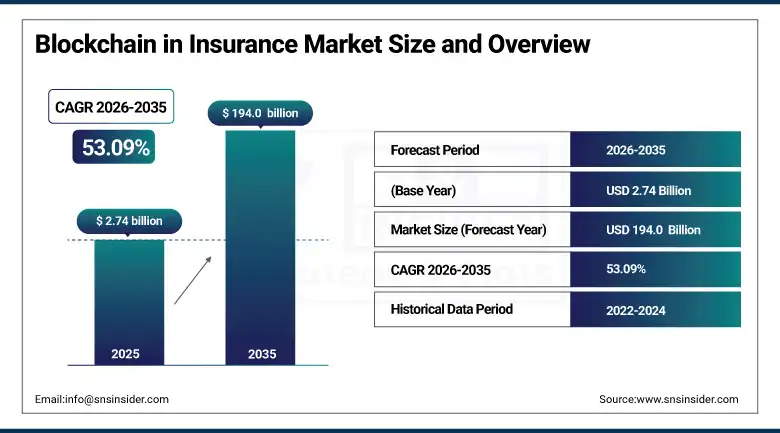
The Blockchain in Insurance market was valued at USD 2.74 billion in 2025 and is expected to reach USD 194.0 billion by 2035, growing at a CAGR of 53.09% from 2026–2035.
Blockchain technology is reshaping the insurance industry by addressing longstanding operational inefficiencies, opacity, and fraud vulnerabilities through an immutable, distributed ledger architecture that creates shared, cryptographically verified records of policy agreements, claims submissions, payment histories, and identity verification data that all authorized participants in an insurance transaction can access and trust without requiring a central intermediary to validate the accuracy of information exchanged between insurers, reinsurers, brokers, policyholders, and service providers. The insurance industry's particular suitability for blockchain adoption stems from its fundamental reliance on contractual trust between parties who may have limited prior relationships and conflicting information sets, where the blockchain's ability to enforce pre-programmed smart contract terms automatically upon verified trigger events eliminates the costly, slow, and error-prone manual verification processes that characterised conventional insurance claims processing, policy endorsement, and premium reconciliation workflows.
The insurance industry loses an estimated USD 80 billion annually to fraudulent claims globally according to the Insurance Information Institute, a figure that creates an extraordinary financial motivation for blockchain adoption as fraud detection and prevention applications that leverage the immutability and cross-carrier data sharing capabilities of distributed ledger technology represent the most immediately commercial blockchain insurance use case in terms of documented return on investment.
Market Size and Forecast
-
Market Size in 2026E: USD 4.19 Billion
-
Market Size by 2035: USD 194.0 Billion
-
CAGR: 53.09% from 2026 to 2035
-
Fastest Growing Region: Asia Pacific
-
Largest Region: North America
To Get more information On Blockchain in Insurance Market - Request Free Sample Report
Blockchain in Insurance Market Trends
-
Rapid commercialization of parametric insurance smart contracts that automatically trigger payouts upon verified occurrence of pre-defined events such as flight cancellation, hurricane wind speed thresholds, crop yield shortfalls, or earthquake magnitude readings without requiring manual claims submission or adjuster investigation, dramatically reducing claims processing costs and settlement times for high-frequency, objectively measurable peril categories.
-
Growing adoption of distributed ledger technology for reinsurance placement and premium settlement, where blockchain platforms enable real-time sharing of underlying risk data between cedants and reinsurers, automated premium calculation based on verified exposure data, and instant settlement of reinsurance recoveries upon primary claims payment confirmation that eliminates the months-long reconciliation delays characterizing conventional reinsurance accounting.
-
Increasing insurer investment in blockchain-based customer identity and know-your-customer platforms that store verified digital identity credentials on a distributed ledger accessible to authorized insurers, enabling instant onboarding for new policies without repeated identity document submission and reducing the cost and time of mandatory customer due diligence for anti-money laundering compliance.
-
Expanding use of blockchain in marine cargo insurance where the technology's ability to track cargo condition and location data from IoT sensors through an immutable ledger record creates the real-time risk visibility and automated claims triggers for damage or delay events that traditional paper-based marine insurance documentation processes cannot provide.
-
Rising interest from health insurance sectors in blockchain-enabled claims interoperability networks that allow patients' complete coverage histories, pre-authorization records, and explanation of benefits to be shared securely across primary insurer, employer benefit plan, and government programme boundaries without the data silos and manual verification delays that contribute to duplicate billing, coordination of benefits errors, and subrogation recovery inefficiencies.
U.S. Blockchain in Insurance Market Outlook
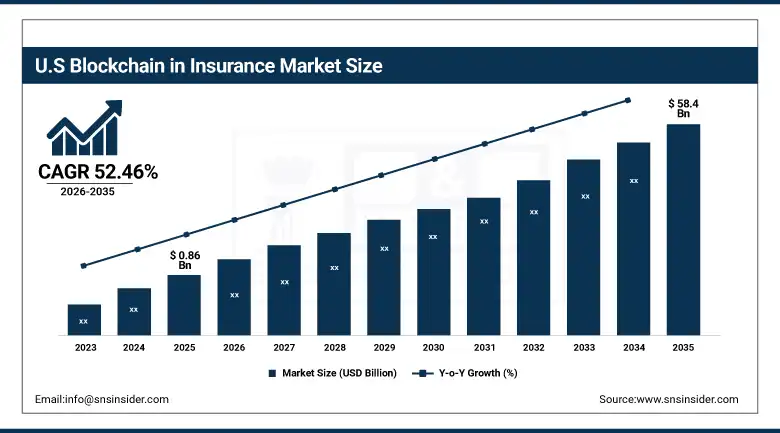
The U.S. Blockchain in Insurance Market was valued at approximately USD 0.86 billion in 2025 and is expected to reach approximately USD 58.4 billion by 2035, growing at a CAGR of 52.46%, driven by the insurance industry's acute fraud loss burden, the advanced digital infrastructure supporting complex smart contract deployment, and the active Insurtech ecosystem pioneering blockchain-native insurance product innovation.
The United States is the world's largest insurance market and the leading geography for blockchain in insurance adoption and investment, reflecting the combination of the highest aggregate insurance fraud losses creating the strongest financial motivation for blockchain fraud prevention investment, the most developed Insurtech startup ecosystem that is commercializing blockchain-native insurance products at the fastest pace globally, and the regulatory environment that while complex is progressively engaging with distributed ledger technology innovation through state insurance department no-action letters, sandbox programmes, and National Association of Insurance Commissioners technology working groups. Major U.S. carriers including MetLife, Allianz, AIG, and Nationwide have publicly committed to blockchain pilot and production programmes across claims processing, fraud detection, and identity management applications, and the federal government's interest in blockchain for federal workers' compensation and healthcare claims processing creates an additional public sector procurement opportunity for blockchain insurance solutions.
The National Association of Insurance Commissioners' Blockchain Working Group's ongoing engagement with distributed ledger technology regulatory implications, combined with several state insurance departments' explicit guidance permitting smart contract-encoded insurance policies that meet applicable policy disclosure and consumer protection requirements, is progressively establishing the regulatory clarity framework that large insurers require before committing to production-scale blockchain programme investment.
Blockchain in Insurance Market Segment Analysis
-
By Provider, Blockchain Solution Providers dominated with approximately 60.15% in 2025; Technology Vendors are the fastest-growing at a CAGR of 55.45%.
-
By Technology, Private Blockchain held the largest share at approximately 28.50% in 2025; Hybrid Blockchain is the fastest-growing at a CAGR of 56.40%.
-
By Application, Claims Management dominated with approximately 30.20% in 2025; Fraud Detection & Risk Management is the fastest-growing application at a CAGR of 57.35%.
-
By Insurance Type, Property & Casualty Insurance held the largest share in 2025; Health Insurance is growing rapidly driven by claims interoperability, prior authorization automation, and coordination of benefits efficiency applications.
By Application, Claims Management dominates, fraud detection is expected to grow fastest
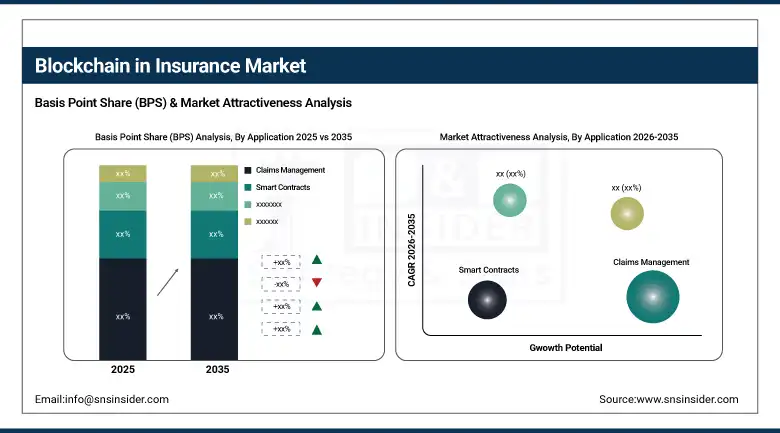
Claims Management retained the dominant application position with approximately 30.20% of the Blockchain in Insurance Market in 2025, as the insurance claims process represents the single highest-impact blockchain automation opportunity across the industry value chain, where the combination of high transaction volumes, multi-party information verification requirements, manual adjudication bottlenecks, and endemic fraud vulnerability creates a compelling business case for distributed ledger technology that is recognized by virtually every major carrier evaluating digital transformation investment priorities. Blockchain-enabled claims management systems create a shared, immutable record of the insured event, supporting documentation, coverage verification, and settlement terms that eliminates the information asymmetry and documentation authenticity disputes between policyholders and insurers that are the primary drivers of claims processing delay and contested settlement litigation.
Fraud Detection and Risk Management is the fastest-growing application at a CAGR of 57.35% through 2035, as the scale of the global insurance fraud problem creates an extraordinary financial motivation for blockchain investment whose documented return on investment cases from early deployment programmes are accelerating adoption across carriers who can quantify the fraud loss reduction benefits achievable through distributed ledger-based cross-carrier fraud intelligence sharing.
By Technology, Private Blockchain dominates, hybrid is expected to grow fastest
Private Blockchain retained the dominant technology position with approximately 28.50% of blockchain in insurance market revenues in 2025, reflecting the insurance industry's regulatory sensitivity around policyholder data privacy and competitive intelligence that makes the permissionless, publicly visible architecture of public blockchain networks unsuitable for the majority of insurance operational applications where transaction participants are known, data must remain confidential, and regulatory compliance requires documented access control and audit trail capabilities that private permissioned blockchain architectures provide inherently. Private blockchain platforms including Hyperledger Fabric, R3 Corda, and Quorum provide the enterprise-grade data privacy controls, transaction throughput performance, and regulatory compliance documentation capabilities that large insurance carriers require for production-scale blockchain deployments across claims management, underwriting, and identity verification applications.
Hybrid Blockchain is the fastest-growing technology at a CAGR of 56.40% through 2035, as the insurance industry increasingly recognizes that optimal blockchain architecture for many applications combines the data privacy and access control of private permissioned networks for sensitive policyholder information storage with the standardization, interoperability, and trust of public blockchain connectivity for cross-carrier identity verification, parametric trigger oracle data, and tokenized insurance-linked security transactions that benefit from public chain transparency and censorship resistance.
Regional Analysis
|
Region |
Major Country |
Share within Region, 2025 (%) |
|---|---|---|
|
North America |
United States |
84.7% |
|
Europe |
United Kingdom |
27.3% |
|
Asia Pacific |
China |
38.6% |
|
Middle East & Africa |
UAE |
31.2% |
|
Latin America |
Brazil |
42.4% |
North America Blockchain in Insurance Market Insights
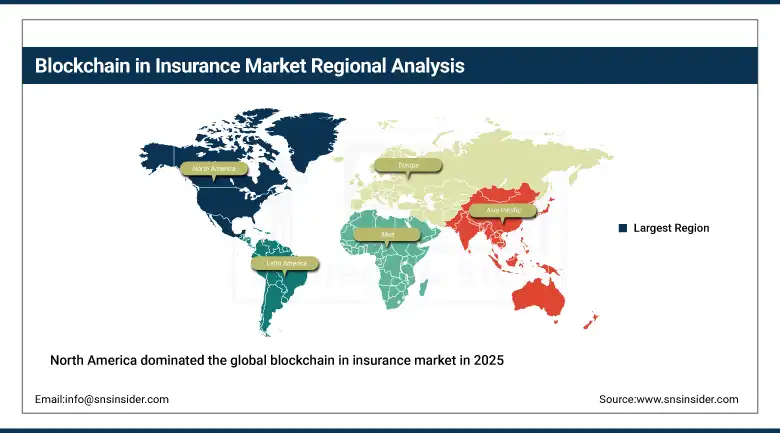
North America dominated the global blockchain in insurance market in 2025 with approximately 38.5% of revenues, with the United States accounting for approximately 84.7% of North American revenues. The region's market leadership reflects the world's largest absolute insurance market creating the greatest aggregate opportunity for blockchain-enabled efficiency gains and fraud loss reduction, the most active Insurtech investment ecosystem financing blockchain-native insurance product innovation, and the presence of major insurance technology solution providers including IBM, Microsoft, AWS, and specialist blockchain insurance platforms that sustain a competitive commercial ecosystem for insurance blockchain application development and deployment.
Get Customized Report as per Your Business Requirement - Enquiry Now
Europe Blockchain in Insurance Market Insights
Europe is a technically sophisticated blockchain insurance market driven by the EU's regulatory framework engagement with distributed ledger technology through the Markets in Crypto-Assets Regulation and Digital Finance Strategy, combined with the active consortium blockchain initiatives of major European reinsurers and specialty insurers who have been among the earliest institutional blockchain adopters in the global insurance industry. The United Kingdom accounts for approximately 27.3% of European blockchain insurance revenues as the home of Lloyd's of London, whose placement platform digitalization programme and active engagement with parametric insurance innovation has made the London specialty market one of the world's most advanced insurance blockchain deployment environments for complex risk placement, reinsurance settlement, and marine cargo tracking applications.
Asia Pacific Blockchain in Insurance Market Insights
Asia Pacific is the fastest-growing blockchain insurance market, reflecting the convergence of the region's large and rapidly growing insurance markets across China, India, South Korea, Japan, and Southeast Asia with government-backed digital finance initiatives that include explicit support for blockchain technology adoption in financial services, and the Insurtech innovation ecosystems of Singapore, Hong Kong, and Seoul that are developing blockchain insurance applications for the unique characteristics of Asian insurance markets including microinsurance, agricultural risk, and digital health insurance products that are well suited to smart contract automation. China accounts for approximately 38.6% of Asia Pacific blockchain insurance revenues through its combination of the world's fastest-growing insurance market, government blockchain infrastructure investment including the Blockchain-based Service Network, and major technology company engagement with insurance blockchain applications from Ant Group, Tencent, and Ping A Technology.
MEA & Latin America Blockchain in Insurance Market Insights
The Middle East and Africa and Latin America are developing blockchain insurance markets where progressive digital insurance regulatory frameworks, high smartphone penetration enabling mobile-first insurance product distribution, and in the MEA region substantial government investment in blockchain infrastructure are creating enabling conditions for blockchain insurance application adoption. UAE leads MEA blockchain insurance revenues at approximately 31.2% of regional revenues through the Dubai Financial Services Authority's progressive fintech regulatory sandbox, the government's blockchain strategy targeting 50% of government transactions on blockchain by 2021 which extended to the insurance sector, and the concentration of regional insurance and reinsurance operations in the DIFC financial center. Brazil leads Latin American revenues at approximately 42.4% of regional revenues through its large insurance market, active digital finance innovation ecosystem, and SUSEP insurance regulator's engagement with Insurtech innovation.
Market Dynamics
Growth Drivers: Rising insurance fraud, increasing adoption of smart contract automation, and growing digital transformation initiatives are driving demand for blockchain-based insurance solutions.
The primary structural growth drivers for the Blockchain in Insurance Market are the USD 80 billion annual insurance fraud loss burden that creates the most financially compelling business case for blockchain investment of any technology application in the insurance industry, combined with the competitive differentiation opportunity that smart contract-automated claims settlement provides to carriers who can offer policyholders instant, transparent, and undisputed claims payment for parametric products that competing carriers processing equivalent claims through manual adjudication workflows requiring weeks cannot match. The insurance industry's own digital transformation mandates, driven by competitive pressure from blockchain-native Insurtech challengers who are acquiring younger consumer segments with frictionless digital insurance experiences that legacy carrier processes cannot replicate, are creating board-level urgency for distributed ledger technology investment across carriers who recognize that blockchain infrastructure is becoming a competitive necessity rather than an exploratory innovation initiative.
Restraints: Regulatory uncertainty, legacy system integration challenges, and limited multi-carrier blockchain network adoption are restraining market growth.
A significant restraint on the Blockchain in Insurance Market is the regulatory uncertainty that persists across major insurance markets regarding the legal enforceability of smart contract-encoded policy terms, the jurisdictional treatment of automated claims payments triggered by algorithmic oracle verification of insured events, and the compliance requirements for distributed ledger-based customer identity and document storage under insurance regulatory frameworks that were designed for paper-based and centralized database architectures rather than immutable distributed ledger environments. The integration of blockchain platforms with the established core insurance systems including policy administration platforms, claims management systems, and financial accounting infrastructure of large carriers represents a significant technical and project management challenge whose complexity and cost frequently exceeds initial implementation budgets and timelines, creating procurement hesitation among carriers who have observed early blockchain programme cost overruns at peer institutions.
Opportunities: Growing adoption of decentralized insurance models, rising demand for parametric insurance, and increasing embedded insurance integration in digital commerce platforms are creating market opportunities.
Decentralized autonomous organization-based insurance protocols including Nexus Mutual, Etheric, and similar blockchain-native mutual risk pools represent a structurally novel insurance model that eliminates the traditional insurer intermediary by pooling premium contributions from token-holding community members who collectively govern claims assessment and payment through token-weighted voting, creating a genuinely disruptive blockchain application that cannot be replicated by conventional carriers adopting blockchain technology as an efficiency tool within their existing operational architecture. Parametric climate risk insurance represents the most commercially significant near-term growth opportunity for blockchain smart contracts in insurance, as the accelerating frequency and severity of climate-related weather events is creating demand for rapid-payout parametric protection products whose trigger verification and payment execution requirements are perfectly matched to blockchain oracle and smart contract capabilities.
Recent Developments:
-
October 2025: Bharat Re announced an AI and blockchain-powered reinsurance platform partnership with Xceedance, deploying smart contract-automated premium calculation and claims bordereau reconciliation capabilities that aim to reduce reinsurance accounting cycle times from monthly manual reconciliation to near real-time settlement across its treaty and facultative reinsurance book.
-
2025: Allianz expanded its blockchain-based trade finance insurance platform incorporating digital letter of credit verification and automated claims settlement for trade credit policies, leveraging the immutable documentation chain of distributed ledger records to accelerate claims resolution for commercial clients experiencing buyer default events in international trade finance transactions.
-
2025: B3i Services, the insurance industry blockchain consortium, continued expansion of its property catastrophe excess of loss reinsurance smart contract platform, onboarding additional carrier and reinsurer members and processing growing volumes of property catastrophe treaty placements through its standardized digital contract framework.
Blockchain in Insurance Market Key Players
-
IBM Corporation
-
Microsoft Corporation
-
Amazon Web Services (AWS)
-
Oracle Corporation
-
SAP SE
-
Accenture plc
-
Infosys Limited
-
Wipro Limited
-
Cognizant
-
Mphasis Limited
-
Applied Blockchain
-
Auxesis Group
-
B3i Services AG
-
Everledger
-
Lemonade Inc.
-
Etherisc GmbH
-
Nexus Mutual
-
Xceedance
-
RiskBlock Alliance
-
Guard Time
Blockchain in Insurance Market Report Scope:
| Report Attributes | Details |
|---|---|
| Market Size in 2025 | USD 2.74 Billion |
| Market Size by 2035 | USD 194.0 Billion |
| CAGR | CAGR of 53.09% From 2026 to 2035 |
| Base Year | 2025 |
| Forecast Period | 2026-2035 |
| Historical Data | 2022-2024 |
| Report Scope & Coverage | Market Size, Segments Analysis, Competitive Landscape, Regional Analysis, DROC & SWOT Analysis, Forecast Outlook |
| Key Segments | • By Provider (Blockchain Solution Providers, Technology Vendors, Insurance Companies) • By Technology (Private Blockchain, Public Blockchain, Consortium Blockchain, Hybrid Blockchain) • By Application (Claims Management, Fraud Detection & Risk Management, Underwriting & Policy Administration, Customer Identity Management, Smart Contracts, Others) • By Insurance Type (Life Insurance, Health Insurance, Property & Casualty Insurance, Marine & Cargo Insurance, Others) |
| Regional Analysis/Coverage | North America (US, Canada), Europe (Germany, UK, France, Italy, Spain, Russia, Poland, Rest of Europe), Asia Pacific (China, India, Japan, South Korea, Australia, ASEAN Countries, Rest of Asia Pacific), Middle East & Africa (UAE, Saudi Arabia, Qatar, South Africa, Rest of Middle East & Africa), Latin America (Brazil, Argentina, Mexico, Colombia, Rest of Latin America). |
| Company Profiles | IBM Corporation, Microsoft Corporation, Amazon Web Services (AWS), Oracle Corporation, SAP SE, Accenture plc, Infosys Limited, Wipro Limited, Cognizant, Mphasis Limited, Applied Blockchain, Auxesis Group, B3i Services AG, Everledger, Lemonade Inc., Etherisc GmbH, Nexus Mutual, Xceedance, RiskBlock Alliance, and Guard Time. |
Frequently Asked Questions
North America dominated with approximately 38.5% of revenues in 2025.
Claims Management dominated with approximately 30.20% of revenues in 2025.
The USD 80 billion annual insurance fraud loss burden creating compelling ROI for blockchain fraud detection combined with smart contract automation enabling instant claims settlement that transforms customer experience and reduces operational costs across the insurance value chain.
The Blockchain in Insurance Market was valued at USD 2.74 billion in 2025.
The Blockchain in Insurance Market is expected to grow at a CAGR of 53.09% from 2026 to 2035.
