
Clinical Risk Grouping Solutions Market Report Scope & Overview:
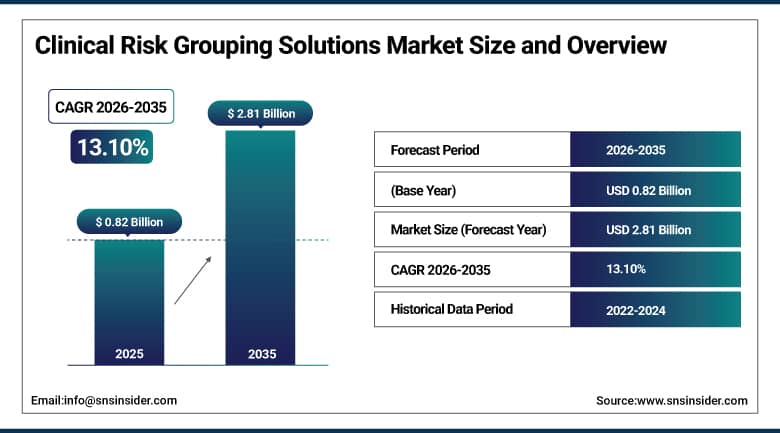
The Clinical Risk Grouping Solutions Market was valued at USD 0.82 Billion in 2025 and is expected to reach USD 2.81 Billion by 2035, growing at a CAGR of 13.10% from 2026 to 2035.
The market for Clinical Risk Grouping Solutions is witnessing robust growth, attributable to the shift towards value-based care models where it becomes imperative to categorize patients based on the expected risk and resource utilization. The increasing prevalence of chronic diseases, increased expenditure on healthcare, and increasing use of electronic health record systems have led to an increased demand for sophisticated risk categorization systems. Use of artificial intelligence and machine learning technologies in clinical analytics has helped in improved risk assessment of patients, facilitating better population health management and resource utilization. Apart from this, regulatory push for risk adjustment systems and digitization of healthcare data has contributed to this trend.
In March 2025, Optum launched InterQual 2025, incorporating AI-enabled criteria to boost transparency in value-based care workflows, reflecting the industry’s continued shift toward AI-powered clinical analytics platforms that combine risk grouping with broader utilization management capabilities.
Market Size and Forecast
- Market Size in 2026E: USD 0.93 Billion
- Market Size by 2035: USD 2.81 Billion
- CAGR: 13.10% from 2026 to 2035
- Fastest Growing Region: Asia Pacific
- Largest Region: North America
To Get More Information On Clinical Risk Grouping Solutions Market - Request Free Sample Report
Clinical Risk Grouping Solutions Market Trends
- Rising use of predictive risk stratification models is helping payers and providers identify high-risk patient cohorts earlier for preventive intervention.
- Growing adoption of real-time population health analytics is broadening use cases beyond retrospective claims-based risk grouping.
- Increasing integration of clinical risk grouping platforms with electronic health record systems is streamlining clinician workflows and data capture.
- Expanding emphasis on cost and outcomes transparency is driving demand for risk grouping tools that support value-based reimbursement models.
- Growing adoption of cloud-based deployment is enabling smaller healthcare organizations to access advanced risk grouping capabilities without significant upfront infrastructure investment.
U.S. Clinical Risk Grouping Solutions Market Outlook
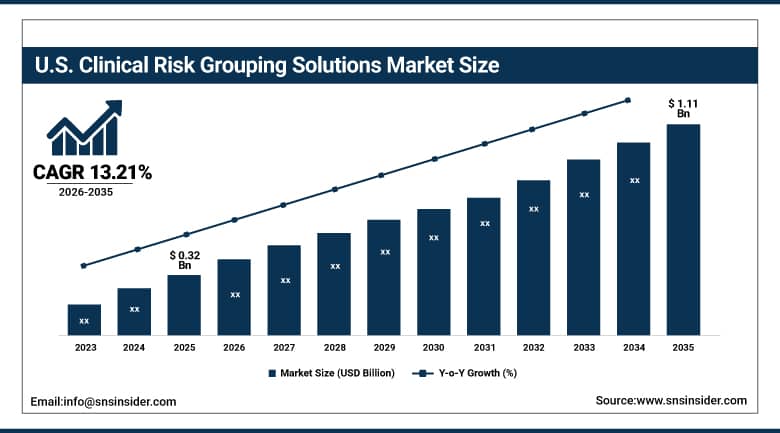
The U.S. Clinical Risk Grouping Solutions Market was valued at USD 0.32 Billion in 2025 and is projected to reach USD 1.11 Billion by 2035, growing at a CAGR of 13.21% during 2026-2035.
The U.S. Clinical Risk Grouping Solutions Market is growing steadily, due to the increasing need for healthcare organizations to improve patient care, reduce costs, and enhance clinical outcomes under value-based reimbursement arrangements. The increased adoption of advanced risk management technologies among health plans and integrated delivery networks is contributing to the growth of consumption. Providers and payers are expanding use of risk grouping platforms across chronic disease management, fraud detection, and population health initiatives. Innovations such as AI-enabled criteria and real-time monitoring integration are driving customer choice options. Robust distribution networks through direct enterprise sales and health IT system integrators are increasing product availability. Furthermore, increasing investments by technology vendors and shifting healthcare policy toward risk-adjusted reimbursement are opening up new growth avenues.
In 2025, Evolent Health launched a new clinical risk grouping platform that combines risk stratification with real-time patient monitoring, demonstrating a 20% improvement in clinical outcomes in pilot testing, reflecting continued vendor investment in integrated, outcomes-linked risk grouping technology.
Clinical Risk Grouping Solutions Market Segment Analysis
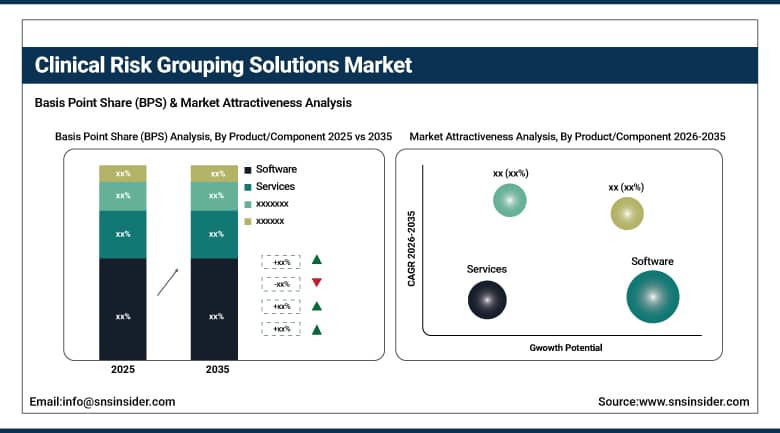
- By Product/Component, Software segment dominated the Clinical Risk Grouping Solutions Market in 2025 with around 62% share; Services segment is the fastest-growing segment.
- By Deployment Mode, On-Premises segment dominated the market in 2025 with around 54% share; Cloud-Based segment is the fastest-growing segment.
- By Application, Population Health Management segment dominated the market in 2025 with around 34% share; Fraud Detection & Prevention segment is the fastest-growing segment.
- By End-User, Healthcare Payers segment dominated the market in 2025; Healthcare Providers segment is the fastest-growing segment.
By Product/Component, Software Dominates the Clinical Risk Grouping Solutions Market While Services Registers the Fastest Growth
Software dominates the Clinical Risk Grouping Solutions Market owing to its central role in automating patient classification, risk score calculation, and predictive analytics across large patient populations. Health plans and provider organizations rely on established grouping software platforms for consistent, auditable risk scoring that integrates with claims and clinical data systems. The scalability, configurability, and established regulatory track record of leading software platforms are reinforcing the segment’s market leadership.
Services is growing rapidly driven by increasing demand for implementation support, data integration, and ongoing analytics consulting as healthcare organizations customize risk grouping platforms to their specific patient populations and reimbursement models. Growing complexity of value-based care arrangements is compelling organizations to seek specialized advisory and managed services support. Increased interest in outcomes measurement and program optimization is spurring innovation and premiumization of services offerings.
By Deployment Mode, On-Premises Dominates the Clinical Risk Grouping Solutions Market While Cloud-Based Emerges as the Fastest-Growing Mode
On-Premises is the leading segment in the Clinical Risk Grouping Solutions Market due to many large health systems and payers preferring to have direct control over sensitive information and the existing integrations with legacy claims and clinical systems. The On-Premises deployment allows enterprises to customize and integrate with data governance and compliance strategies that they are already using within their organization. Existing vendor relations and system integrations are contributing to maintaining the market presence of this segment.
The Cloud-Based segment is witnessing rapid growth because of growing demand for flexible, affordable deployment options that do not place a significant infrastructure strain on smaller health plans and provider organizations. Cloud deployment allows for faster go-lives and easy integration with modern interoperability protocols. Increased trust in security of cloud computing and specific healthcare certification programs is adding fuel to the growth.
By Application, Population Health Management Dominates the Clinical Risk Grouping Solutions Market While Fraud Detection & Prevention Experiences the Fastest Growth
Population Health Management dominates the Clinical Risk Grouping Solutions Market due to its foundational role in identifying and stratifying patient populations for care management, preventive screening, and resource allocation programs. Health plans and accountable care organizations rely on population-level risk grouping to prioritize outreach and design targeted interventions for high-risk cohorts. The broad applicability of population health use cases across payer and provider organizations is driving consumption in this application space.
Fraud Detection & Prevention is growing rapidly on account of increasing use of risk grouping analytics to identify anomalous billing patterns and coding irregularities tied to risk-adjusted reimbursement programs. Rising regulatory scrutiny of risk adjustment accuracy in government health programs is compelling payers to invest in advanced analytics capable of flagging inconsistencies. Advances in machine learning-based anomaly detection are opening up several opportunities for commercial utilization in this segment.
Regional Analysis
|
Region |
Country |
Share (2025) |
|
North America |
United States |
86.20% |
|
Asia Pacific |
China |
32.40% |
|
Europe |
Germany |
21.60% |
|
Middle East & Africa |
UAE |
17.10% |
|
Latin America |
Brazil |
23.40% |
North America Clinical Risk Grouping Solutions Market Insights
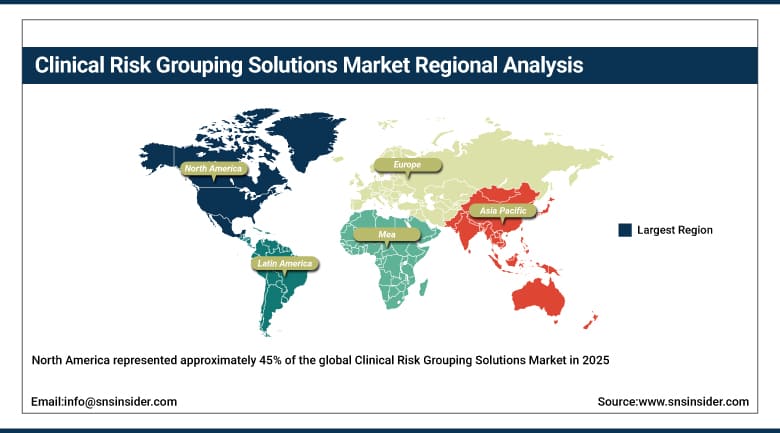
North America represented approximately 45% of the global Clinical Risk Grouping Solutions Market in 2025, supported by the region’s advanced value-based care ecosystem and well-established risk-adjusted reimbursement programs across both government and commercial health plans. Increasing prevalence of chronic disease and rising healthcare costs are reinforcing demand for sophisticated patient stratification tools. Growing consumer and regulatory emphasis on healthcare cost transparency is encouraging payers and providers to expand analytics capabilities. Well-established health IT infrastructure and a mature electronic health record ecosystem across the United States and Canada are also improving solution accessibility and sustaining regional market development.
The United States accounted for approximately 86.20% of the North American market in 2025, reflecting its large base of health plans and provider organizations operating under risk-adjusted and value-based reimbursement models. Canada is contributing to regional growth through steady expansion of population health management initiatives within its provincial health systems.
Get Customized Report as Per Your Business Requirement - Enquiry Now
Europe Clinical Risk Grouping Solutions Market Insights
The European region captured a substantial share of the market size for Clinical Risk Grouping Solutions Market in 2025 due to increased focus on population health management and prevention of chronic diseases in the national health systems. Increased demand for care coordination systems among Germany, UK, and France is driving innovations within the product. Increased government support for healthcare data interoperability and focus on cost-efficient care delivery is fueling the growth of the market within Europe.
Germany has been dominating the European market with 21.60% regional market share in 2025 due to the advanced health information technology infrastructure and increasing focus on integrated care models in the region. UK and France are playing an equally important role in fueling regional market growth.
Asia Pacific Clinical Risk Grouping Solutions Market Insights
Asia Pacific is expected to register the fastest CAGR in the Clinical Risk Grouping Solutions Market during 2026–2035, driven by rising healthcare expenditure, growing prevalence of chronic diseases, and increasing adoption of digital health solutions supported by government initiatives. China, Japan, and India are witnessing expanding health information technology investment as healthcare systems modernize risk management and population health infrastructure. Rising product innovation and growing awareness regarding value-based care principles are further supporting market expansion. Rising demand for digital health platforms is also reinforcing Asia Pacific’s above-average growth trajectory compared with more mature markets.
China accounted for approximately 32.40% of the Asia Pacific market in 2025, supported by its expanding health information technology infrastructure and government-driven digital health initiatives. Japan, India, and South Korea are also contributing meaningfully to regional growth, with India benefiting from rapidly expanding health insurance penetration and digital health adoption.
Middle East & Africa and Latin America Clinical Risk Grouping Solutions Market Insights
The Middle East & Africa segment is registering steady growth in light of the growing adoption of healthcare digitization initiatives in the Gulf countries with increased investments in health information exchange infrastructure development. The Latin America segment is similarly seeing benefits due to increased health insurance coverage as well as an increased focus on population health management in major urban cities of the region.
In 2025, the UAE dominated the Middle East & Africa market accounting for 17.10% share, owing to increased investments in healthcare digitization initiatives and modern health IT infrastructure. In 2025, Brazil accounted for 23.40% of the Latin America market, due to increased health insurance penetration while Mexico contributed to the regional growth by its interest in population health analysis.
Market Dynamics
Growth Drivers: Value-Based Care Adoption and Chronic Disease Prevalence Driving Market Growth
The main factors influencing the growth of the Clinical Risk Grouping Solutions Market include the increasing shift toward value-based care reimbursement models, rising prevalence of chronic diseases, and growing healthcare costs that require more precise resource allocation tools. As healthcare organizations are increasingly required to manage financial risk for defined patient populations, payers and providers are recognizing the benefits of sophisticated risk grouping platforms, contributing to growth in the global market for this technology category.
Growing application of artificial intelligence and machine learning in clinical risk stratification continues to expand as predictive accuracy improvements gain wider recognition among health plans and provider organizations. Increasing integration with electronic health record systems is influencing new workflow efficiency trends across the overall clinical risk grouping solutions market.
Restraints: Data Privacy Concerns and Integration Complexity Limiting Market Expansion
While demand conditions are positive, the category is restricted by considerations of data privacy and security related to the use of sensitive clinical and claims data in an interlinked system. The different regulations related to the protection of health care data, interoperability, and risk-adjustment models in various regions affect the time it takes vendors to enter the market. Compatibility issues with existing electronic health records and claims systems could extend implementation times and raise deployment costs for the health care organizations.
The high cost involved in customization of the platform and the continuous analytics validation raises the total cost of ownership, which constrains small health care organizations from adopting due to budget constraints in terms of information technology. In addition, stiff competition between health IT vendors and specialized analytics firms is causing price pressure. As the category grows, vendors have to strike a balance between functionality, data security, interoperability, and costs.
Opportunities: AI-Powered Analytics and Emerging Market Expansion Creating New Growth Avenues
There is room for significant growth with AI-driven predictive analytics, enhanced fraud detection, and expansion into new healthcare markets. Creating even more complex machine learning algorithms may enhance the ability to predict risks and perform better population health interventions. Vendors may take advantage of rising interest in real-time analytics that combine risk stratification with clinical decision support in point-of-care settings. Increasing popularity of the value-based approach to healthcare delivery in emerging markets offers another way to grow the footprint and number of platforms in the market.
Building innovative solutions based on interoperability standards and cloud architecture is likely to provide differentiation and become appealing to healthcare providers looking to implement their solutions quickly. Collaborations between vendors of technology and health systems will allow them to develop special risk grouping algorithms for particular clinical groups of patients. In addition, integration of wearable and remote monitoring data will increase differentiation and make solutions more attractive.
Recent Developments:
- 2025: Optum launched InterQual 2025, incorporating AI-enabled criteria to boost transparency in value-based care workflows.
- 2025: Evolent Health launched a new clinical risk grouping platform combining risk stratification with real-time patient monitoring, demonstrating a 20% improvement in clinical outcomes in pilot testing.
Clinical Risk Grouping Solutions Market key players are:
- 3M Company
- Optum Inc.
- Conduent Incorporated
- Oracle Health (Cerner Corporation)
- Change Healthcare
- Health Catalyst, Inc.
- Lightbeam Health Solutions
- HBI Solutions, Inc.
- Nuance Communications, Inc.
- Dynamic Healthcare Systems, Inc.
- 4S Information Systems
- Evolent Health, Inc.
- Pera Health
- Johns Hopkins HealthCare Solutions
- Merative (IBM Watson Health)
- Verscend Technologies (Cotiviti)
- Milliman, Inc.
- Inovalon Holdings, Inc.
- SCIO Health Analytics
- Edifecs, Inc.
Clinical Risk Grouping Solutions Market Report Scope :
| Report Attributes | Details |
|---|---|
| Market Size in 2025 | USD 0.82 Billion |
| Market Size by 2035 | USD 2.81 Billion |
| CAGR | CAGR of 13.10% From 2026 to 2035 |
| Base Year | 2025 |
| Forecast Period | 2026-2035 |
| Historical Data | 2022-2024 |
| Report Scope & Coverage | Market Size, Segments Analysis, Competitive Landscape, Regional Analysis, DROC & SWOT Analysis, Forecast Outlook |
| Key Segments | • By Product/Component (Software, and Services) • By Deployment Mode (On-Premises, and Cloud-Based) • By Application (Population Health Management, Chronic Disease Management, Clinical Decision Support, and Fraud Detection & Prevention) • By End-User (Healthcare Payers, Healthcare Providers, and Others) |
| Regional Analysis/Coverage | North America (US, Canada), Europe (Germany, UK, France, Italy, Spain, Russia, Poland, Rest of Europe), Asia Pacific (China, India, Japan, South Korea, Australia, ASEAN Countries, Rest of Asia Pacific), Middle East & Africa (UAE, Saudi Arabia, Qatar, South Africa, Rest of Middle East & Africa), Latin America (Brazil, Argentina, Mexico, Colombia, Rest of Latin America). |
| Company Profiles | 3M Company; Optum Inc.; Conduent Incorporated; Oracle Health (Cerner Corporation); Change Healthcare; Health Catalyst, Inc.; Lightbeam Health Solutions; HBI Solutions, Inc.; Nuance Communications, Inc.; Dynamic Healthcare Systems, Inc.; 4S Information Systems; Evolent Health, Inc.; Pera Health; Johns Hopkins HealthCare Solutions; Merative (IBM Watson Health); Verscend Technologies (Cotiviti); Milliman, Inc.; Inovalon Holdings, Inc.; SCIO Health Analytics; Edifecs, Inc. |
Frequently Asked Questions
Some of the major companies that operate in the global clinical risk grouping solutions market are 3M Company, Optum Inc., Conduent Incorporated, Oracle Health (Cerner Corporation), Change Healthcare, Health Catalyst, Inc., Lightbeam Health Solutions, HBI Solutions, Inc.
AI-Powered Analytics and Emerging Market Expansion Creating New Growth Avenues
The market is driven by increasing adoption of value-based care models, rising prevalence of chronic diseases, and growing application of artificial intelligence in clinical analytics.
The Software segment dominated the Clinical Risk Grouping Solutions Market in 2025.
The North America region dominated the Clinical Risk Grouping Solutions Market in 2025, accounting for approximately 39% of global market share.
