
Code Signing as a Service Market Report Scope & Overview:
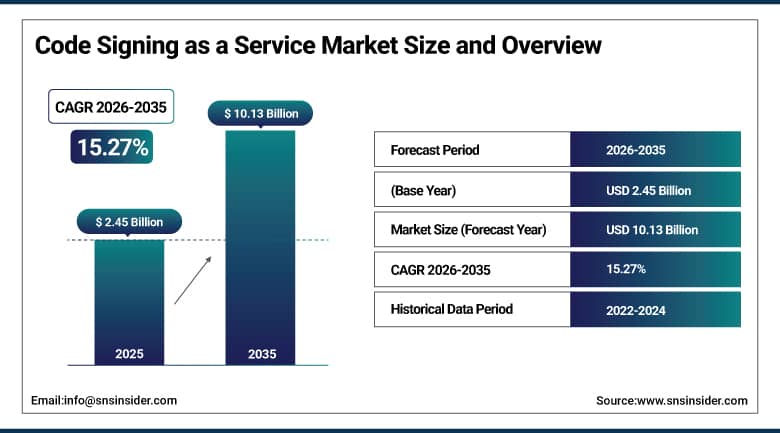
Code Signing as a Service Market was valued at USD 2.45 Billion in 2025 and is expected to reach USD 10.13 Billion by 2035, growing at a CAGR of 15.27% from 2026–2035.
The global code signing as a service market is experiencing strong growth as organizations increasingly prioritize software security, application integrity, and trusted digital software distribution. The growing adoption of cloud computing, DevSecOps, CI/CD pipelines, mobile applications, IoT devices, firmware, and enterprise software is increasing demand for secure code-signing solutions that authenticate software publishers and protect code from unauthorized modification. The shift from traditional certificate and key management toward cloud-based code-signing services is further supporting market expansion. Organizations are adopting managed code-signing platforms to simplify certificate lifecycle management, secure cryptographic keys, automate signing workflows, and integrate code signing into software development and release environments.
In February 2025, Esri made ArcGIS Location Platform’s Batch Geocoding and Last Mile Delivery services generally available, expanding access to scalable geocoding, routing, and location-data capabilities. For the Code Signing as a Service Market, the updates support growing demand for cloud-based location intelligence across mapping, navigation, and transportation applications.
To Get More Information On Code Signing as a Service Market - Request Free Sample Report
Code Signing as a Service Market Trends
-
Growing adoption of cloud-based code signing is driving demand for scalable and secure software authentication services.
-
Rising use of cloud applications, mobile applications, IoT devices, firmware, and connected systems is increasing the need for software integrity verification.
-
Increasing adoption of DevSecOps, CI/CD pipelines, automated software delivery, and digital transformation is supporting market growth.
-
Growing focus on software security, compliance, certificate management, and protection against code tampering is creating opportunities for Code Signing as a Service providers.
-
Advancements in cloud security, cryptographic key management, hardware-backed protection, and automation are improving code signing efficiency and security.
The U.S. Code Signing as a Service Market Outlook
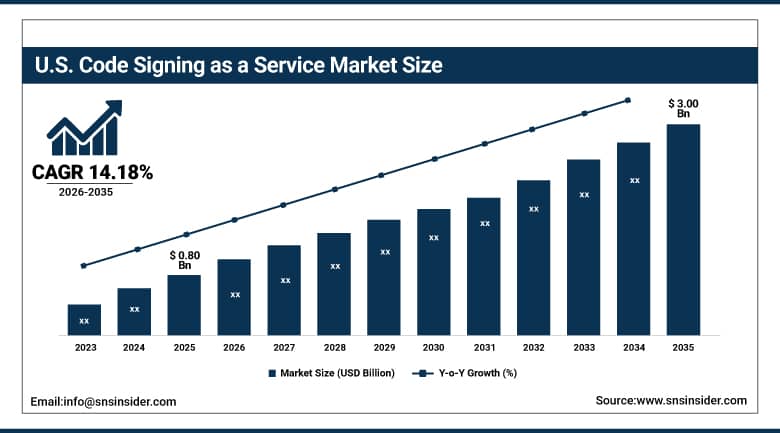
The U.S. Code Signing as a Service Market was valued at USD 0.80 Billion in 2025 and is expected to reach around USD 3.00 Billion by 2035, growing at a CAGR of 14.18% from 2026–2035.
The US code signing as a service market is expected to become very lucrative in the coming years owing to several reasons. Firstly, there is an increasing demand for real-time location intelligence, geospatial analysis, mapping, navigation, and tracking of assets, which is prompting businesses to use location data as a service. In addition to that, the presence of some big names from the technology, retail, transport, finance, healthcare, and government industry is also contributing to the rising demand. Secondly, the increasing use of Internet of Things (IoT) devices, connected cars, GPS-based systems, cloud technology, and AI is leading to the creation of huge amounts of location data.
In April 2026, Google Cloud introduced enhancements to its cross-cloud capabilities at Google Cloud Next ’26, focusing on cross-cloud connectivity, unified data management, and distributed infrastructure. For the Code Signing as a Service Market, these developments support growing demand for scalable cloud-based location data, cross-platform integration, real-time data management, and geospatial services across distributed enterprise environments.
Code Signing as a Service Market Segment Analysis
-
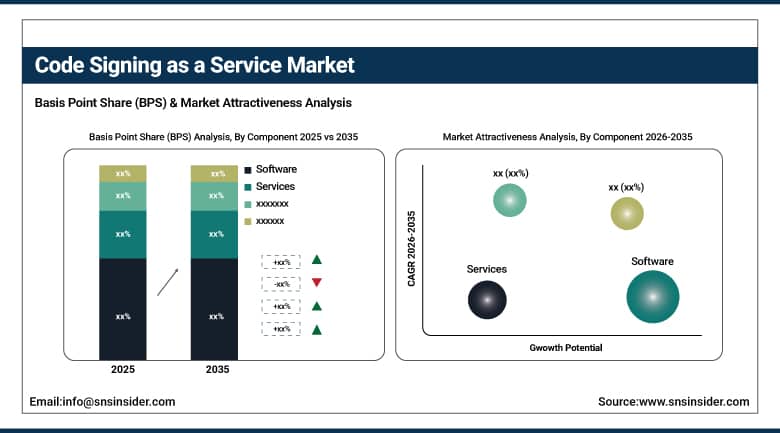
By Component, software dominated the code signing as a service market with a 65.00% share in 2025, while software is also the fastest-growing segment, registering a 16.49% CAGR during 2026–2035.
-
By Deployment Mode, cloud-based dominated the code signing as a service market with a 62.00% share in 2025, while cloud-based is projected to be the fastest-growing segment, registering a 16.72% CAGR during 2026–2035.
-
By Organization Size, large enterprises dominated the code signing as a service market with a 68.00% share in 2025, while small and medium enterprises is projected to be the fastest-growing segment, registering a 17.93% CAGR during 2026–2035.
-
By End-User, IT and Telecom dominated the code signing as a service market with a 30.00% share in 2025, while IT and Telecom is also projected to be the fastest-growing segment, increasing its share to 35.00% by 2035.
By Component, software dominated the code signing as a service market, while software is also the fastest-growing segment.
The software segment held the leading position in the code signing as a service market in 2025. Its dominance is supported by the increasing adoption of cloud-based software development, DevOps, CI/CD pipelines, and software supply-chain security practices. Software-based code signing solutions help organizations authenticate software publishers, protect code integrity, secure signing credentials, and streamline certificate management. Growing cybersecurity concerns and the increasing need to prevent software tampering and unauthorized code modification are further supporting demand for software-based code signing solutions.
The software segment is projected to register the fastest growth during 2026–2035, supported by increasing adoption of automated signing workflows, cloud-based development environments, secure software distribution, and software supply-chain security. Growing demand for scalable and centralized code signing solutions is expected to further strengthen adoption of software-based platforms.
By Organization Size, large enterprises dominated the code signing as a service market, while small and medium enterprises are the fastest-growing segment.
The large enterprises segment held the leading position in 2025. Its dominance is supported by the extensive use of enterprise software, complex software development environments, large-scale application portfolios, and stringent cybersecurity and compliance requirements. Large organizations increasingly require centralized certificate management, secure private-key protection, auditability, and controlled access to code signing infrastructure.
The small and medium enterprises segment is projected to register the fastest growth during 2026–2035. Increasing availability of cloud-based and managed code signing services is reducing the infrastructure and operational complexity associated with code signing for smaller organizations. Growing awareness of software supply-chain security and increasing adoption of secure development practices are expected to accelerate SME adoption.
By End-User, IT and Telecom dominated the code signing as a service market, while IT and Telecom is also the fastest-growing segment.
The IT and Telecom segment held the leading position in 2025. Its dominance is driven by the extensive development and distribution of software applications, operating systems, firmware, cloud services, and digital platforms across the IT and telecommunications industry. Growing cybersecurity threats, software supply-chain risks, and the need to authenticate software and protect application integrity are increasing demand for code signing solutions.
The IT and Telecom segment is projected to register the fastest growth during 2026–2035, supported by the rapid expansion of cloud applications, connected devices, software-defined technologies, and automated development environments. Increasing requirements for secure software distribution, application authentication, and supply-chain protection are expected to further strengthen adoption across the IT and Telecom sector.
Regional Analysis
|
Region |
Major Country |
Share within Region, 2025(%) |
|---|---|---|
|
North America |
United States |
84.60% |
|
Europe |
Germany |
27.38% |
|
Asia Pacific |
China |
45.72% |
|
Middle East & Africa |
Saudi Arabia |
22.84% |
|
Latin America |
Brazil |
21.63% |
North America code signing as a service market Insights
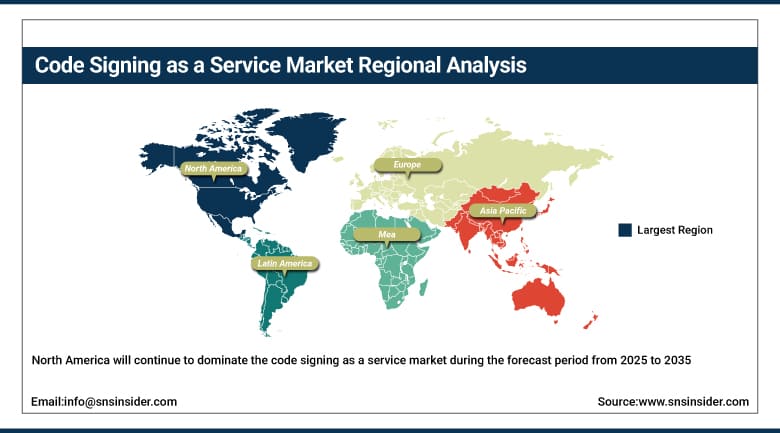
North America will continue to dominate the code signing as a service market during the forecast period from 2025 to 2035, accounting for 38.50% of the global market in 2025. The region's dominance is supported by the strong presence of technology companies, software developers, cybersecurity providers, cloud service providers, and large enterprises with sophisticated software development environments. Growing adoption of DevOps, CI/CD pipelines, cloud computing, and software supply-chain security is increasing demand for secure code signing solutions.
The United States represents the largest country-level market in North America, supported by widespread adoption of enterprise software, cloud-native applications, IoT devices, and advanced cybersecurity technologies. Growing concerns over software tampering, malware injection, unauthorized code modification, and compliance requirements are further supporting regional market growth.
Get Customized Report as Per Your Business Requirement - Enquiry Now
Europe code signing as a service market Insights
The code signing as a service market in Europe is expected to experience steady growth through 2035, supported by increasing digital transformation, cloud adoption, software development, and strengthening software supply-chain security requirements. Germany represents one of the leading country-level markets in the region due to its strong industrial, automotive, manufacturing, technology, and enterprise software sectors. Businesses across Europe are increasingly adopting code signing solutions to authenticate software, protect application integrity, secure signing credentials, and support regulatory and cybersecurity requirements. The UK, France, Italy, and other European countries are also contributing to regional growth through continued investments in cloud infrastructure, cybersecurity, digital services, and secure software development.
Asia Pacific code signing as a service market Insights
Asia Pacific is forecast to be the fastest-growing region, registering a CAGR of 17.32% during 2026–2035. Regional growth is driven by rapid digitalization, expanding software development activities, increasing cloud adoption, growing cybersecurity awareness, and the rapid expansion of connected devices and digital platforms. China is expected to remain a major country-level market due to its large technology ecosystem, expanding digital economy, and extensive software and application development activities. Japan and South Korea are also important markets, supported by their advanced technology, electronics, telecommunications, automotive, and manufacturing industries. India is expected to witness strong growth as enterprises increasingly adopt cloud computing, digital applications, DevOps practices, and software supply-chain security solutions.
Middle East & Africa and Latin America code signing as a service market Insights
The Middle East & Africa and Latin America regions are anticipated to demonstrate steady growth through 2035, supported by digital transformation, cloud infrastructure expansion, cybersecurity investments, and increasing adoption of enterprise software and digital services. Saudi Arabia represents an important market in the Middle East & Africa region, supported by technology modernization and digital transformation initiatives. Brazil is a prominent market in Latin America, driven by increasing adoption of cloud solutions, digital platforms, enterprise applications, and cybersecurity technologies. Mexico and other Latin American countries are also contributing to regional growth as organizations increasingly prioritize software security and digital trust.
Market Dynamics
Growth Driver: Increasing adoption of cloud-based software development and secure digital signing is driving market growth
The increasing adoption of cloud-based software development, digital transformation, and software distribution is one of the key factors driving the growth fMarket. Organizations are increasingly using code signing to authenticate software publishers, verify software integrity, and protect applications from unauthorized modification. The growing development and distribution of applications, firmware, mobile applications, and enterprise software is creating greater demand for secure and scalable code-signing solutions.
The expansion of DevOps, continuous integration and continuous deployment (CI/CD), cloud computing, and automated software delivery is further supporting market growth. Code Signing as a Service solutions enable organizations to integrate signing processes into development workflows while reducing the complexity associated with managing signing certificates and cryptographic keys.
Restraint: Certificate management complexity and security concerns can limit market adoption
The complexity associated with managing code-signing certificates, cryptographic keys, and signing policies can limit adoption, particularly among organizations with limited cybersecurity resources. Improper key storage or unauthorized access to private signing keys can create significant security risks because compromised keys may be used to sign malicious or unauthorized software.
In addition, organizations may face challenges related to certificate issuance, renewal, revocation, compliance requirements, integration with existing development environments, and migration from traditional on-premises signing infrastructure. The costs associated with subscriptions, implementation, security controls, and integration may also discourage adoption among smaller organizations.
Opportunity: Growing adoption of DevSecOps, cloud development, and automated software delivery creates new market opportunities
The growing adoption of DevSecOps, cloud-native development, CI/CD pipelines, and automated software delivery is creating significant opportunities for Code Signing as a Service providers. Organizations are increasingly seeking automated and centrally managed solutions that can integrate code signing into software development and release workflows while maintaining strong security and compliance controls.
The increasing use of software applications, mobile applications, firmware, IoT devices, and connected systems is further expanding the need for software authentication and integrity verification. Cloud-based code-signing platforms, hardware-backed key protection, automated certificate management, and integration with development and DevOps platforms are expected to create additional opportunities for market participants.
Recent Developments
-
March 2026: Google Cloud expanded its geospatial capabilities with enhancements to Google Maps Platform, strengthening location intelligence, mapping, routing, and location-based data services for enterprise applications.
-
April 2026: Microsoft expanded Azure Maps capabilities to support enterprise mapping, geocoding, routing, and location intelligence applications, enabling organizations to integrate location data into business workflows and customer-facing services.
-
February 2026: Esri enhanced ArcGIS Location Platform with additional location services and developer capabilities, supporting scalable access to geocoding, mapping, routing, and geospatial data for enterprise applications.
-
2026: HERE Technologies continued expanding its location platform capabilities for mapping, routing, traffic information, and location intelligence, supporting transportation, logistics, automotive, and enterprise applications requiring real-time location data.
Code Signing as a Service Market key players are:
-
DigiCert Inc.
-
Sectigo
-
GlobalSign
-
Entrust Corporation
-
SSL.com
-
Microsoft Corporation
-
Amazon Web Services, Inc. (AWS)
-
Thales
-
Keyfactor
-
Fortanix
-
AppViewX
-
Venafi
-
Google Cloud
-
IBM
-
IdenTrust
-
WISeKey International Group
-
SignPath
-
Codemagic
-
Buypass
-
Futurex.
Code Signing as a Service Market Report Scope:
| Report Attributes | Details |
|---|---|
| Market Size in 2025 | USD 2.45 Billion |
| Market Size by 2035 | USD 10.13 Billion |
| CAGR | CAGR of 15.27% From 2026 to 2035 |
| Base Year | 2025 |
| Forecast Period | 2026-2035 |
| Historical Data | 2022-2024 |
| Report Scope & Coverage | Market Size, Segments Analysis, Competitive Landscape, Regional Analysis, DROC & SWOT Analysis, Forecast Outlook |
| Key Segments | • By Component (Software, Services) • By Deployment Mode (Cloud-based, On-premises) • By Organization Size (Large Enterprises, Small and Medium Enterprises) • By End-User (BFSI, IT and Telecom, Healthcare, Government, Retail, Others) |
| Regional Analysis/Coverage | North America (US, Canada, Mexico), Europe (Eastern Europe [Poland, Romania, Hungary, Turkey, Rest of Eastern Europe] Western Europe] Germany, France, UK, Italy, Spain, Netherlands, Switzerland, Austria, Rest of Western Europe]), Asia Pacific (China, India, Japan, South Korea, Vietnam, Singapore, Australia, Rest of Asia Pacific), Middle East & Africa (Middle East [UAE, Egypt, Saudi Arabia, Qatar, Rest of Middle East], Africa [Nigeria, South Africa, Rest of Africa], Latin America (Brazil, Argentina, Colombia, Rest of Latin America) |
| Company Profiles | DigiCert Inc., Sectigo, GlobalSign, Entrust Corporation, SSL.com, Microsoft Corporation, Amazon Web Services, Inc. (AWS), Thales, Keyfactor, Fortanix, AppViewX, Venafi, Google Cloud, IBM, IdenTrust, WISeKey International Group, SignPath, Codemagic, Buypass, Futurex. |
Frequently Asked Questions
The Code Signing as a Service Market was valued at approximately USD 2.45 billion in 2025.
The market is primarily driven by the increasing adoption of cloud-based software development, DevSecOps, automated software delivery, digital transformation, and the growing need for secure software authentication and integrity verification.
Software dominated the Code Signing as a Service Market in 2025, accounting for a 65.00% share.
