
Commercial Vehicle Financing Market Report Scope & Overview:
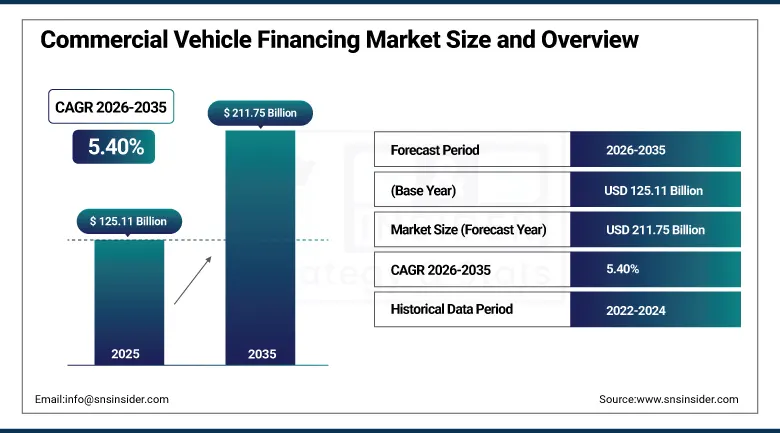
The Commercial Vehicle Financing Market was valued at USD 125.11 Billion in 2025 and is expected to reach USD 211.75 Billion by 2035, growing at a CAGR of 5.40% from 2026 to 2035.
The Commercial Vehicle Financing Market is set to grow due to the increasing number of mandates for electrification, embedding of finance within OEM telematics, and expansion of last-mile delivery vehicle fleets. Banks provide the majority of loans, but non-banking financial institutions keep on growing even faster due to their reliance on online lending, alternative credit scoring, and innovative repayment options. The captive finance units of automotive manufacturers provide credits within dashboards of vehicles, thus reducing the time of approvals and cutting the costs of financing, while the growth of e-commerce and logistics continues to play an important role as companies need their commercial vehicle fleets for deliveries.
Billor, a US company, which was established in 2023 as a fintech firm providing financing and insurance services to the owners of used commercial vehicles through installment loan programs, received USD 335 million of equity investment and credit facility from a private investment company in January 2025.
To Get more information On Commercial Vehicle Financing Market - Request Free Sample Report
Commercial Vehicle Financing Market Trends
-
Non-banking financial companies continue expanding market share faster than traditional banks through digital underwriting innovation.
-
Captive finance arms from manufacturers are embedding credit offers directly into vehicle dashboards to cut approval times.
-
Rising electrification mandates are directing financing product design toward battery leasing and charging-infrastructure bundles.
-
Zero-emission delivery-zone policies across Europe and several U.S. cities are reshaping light commercial vehicle financing products.
-
Digital lending platforms and fintech innovations continue streamlining loan approvals and reducing customer turnaround time.
United States Commercial Vehicle Financing Market Outlook
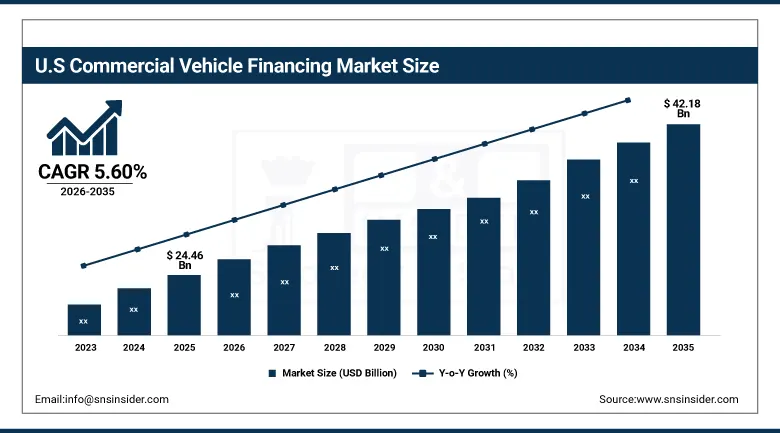
The United States Commercial Vehicle Financing Market was valued at USD 24.46 Billion in 2025 and is expected to reach USD 42.18 Billion by 2035, growing at a CAGR of 5.60% from 2026 to 2035.
The United States held onto its leading market position in North America in terms of commercial vehicle financing demand, aided by digital transformation influencing the entire financing process and making it more efficient and customer friendly. Increased fuel and operational costs remained an important factor driving business decisions to consider alternative financing solutions that would enable them to invest in more fuel-efficient vehicles, allowing the country to remain one of the most commercially significant countries in terms of this innovation.
Ford Motor Credit Company also made additional strides in the commercial vehicle financing sector in 2025, maintaining its position as one of the leading captive finance companies for American businesses seeking financing of their light and medium duty commercial vehicles.
Commercial Vehicle Financing Market Segment Analysis
-
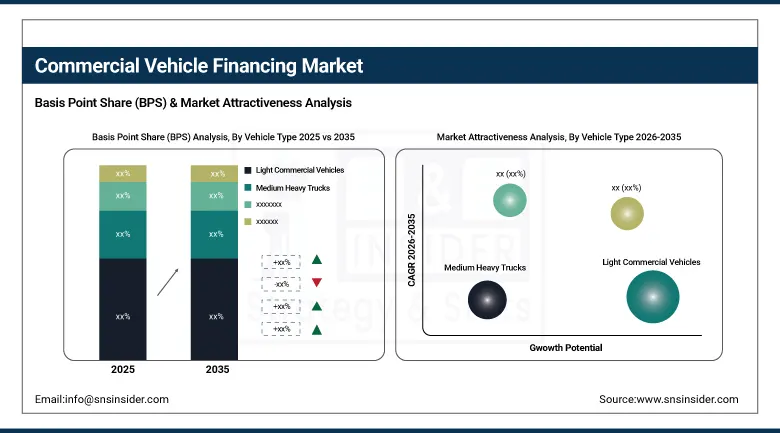
By Vehicle Type, the Light Commercial Vehicles segment held approximately 42.38% share in 2025, while the Medium Heavy Trucks segment is the fastest growing.
-
By Provider Type, the Banks segment held the largest share in 2025, while the Non-Banking Financial Companies segment is the fastest growing.
-
By Financing Type, the Loans segment held approximately 73.10% share in 2025, while the Leasing segment is the fastest growing, with a CAGR of approximately 7.81%.
-
By Vehicle Condition, the New segment held the larger share in 2025, while the Used segment is the fastest growing.
By Vehicle Type, Light Commercial Vehicles led the market, Medium Heavy Trucks grew fastest
The Light Commercial Vehicles segment dominated the vehicle type category in 2025, holding approximately 42.38% of total revenue, buoyed by e-commerce fulfillment and urban warehousing that continue driving sustained demand for last-mile delivery fleets. Electrification continues hitting this vehicle class first because lower battery mass eases range constraints, keeping light commercial vehicles firmly at the top of the broader vehicle type segmentation.
The Medium Heavy Trucks segment is projected to grow at the fastest CAGR during the forecast period, as construction and long-haul freight applications continue requiring dedicated financing products tailored to higher-value vehicle acquisitions. Rising infrastructure development and logistics expansion continue pushing this vehicle type category's growth rate ahead of the broader vehicle type segmentation, even as growth trails the pace of highway freight moderation in certain mature markets.
By Provider Type, Banks led the market, Non-Banking Financial Companies grew fastest
In 2025, the Banks market segment dominated by accounting for the largest share of the provider type segmentation due to banks providing the majority of funding for commercial vehicle finance through underwriting relationships and extensive branches. The existing lending structure makes banks continue being the leading provider of the broader provider type market segment in most transactions related to commercial vehicle finance across the world.
The fastest CAGR is expected for the Non-Banking Financial Companies segment due to their ability to use digital underwriting, alternative credit scoring, and repayment solutions that traditional banks fail to do. Increasing demand for convenient and flexible solutions continues driving the growth of adoption in the non-banking financial companies segment against the overall provider type segmentation.
By Financing Type, Loans led the market, Leasing grew fastest
The Loans segment held the largest financing type share in 2025, at approximately 73.10%, reflecting the established preference among commercial vehicle buyers for ownership-based financing that builds equity in the underlying asset over time. That ownership preference keeps loans firmly at the top of the broader financing type segmentation across the majority of commercial vehicle acquisitions worldwide.
The Leasing segment is projected to grow at the fastest CAGR of approximately 7.81% during the forecast period, driven by rising adoption of electric and hybrid commercial vehicles where leasing structures help offset battery technology uncertainty and residual value risk. Growing subscription-style fleet management models continue pushing leasing adoption ahead of the broader financing type segmentation, particularly among fleet operators prioritizing flexibility over asset ownership.
By Vehicle Condition, New led the market, Used grew fastest
The New segment held the larger vehicle condition share in 2025, anchored by fleet operators prioritizing manufacturer warranties, predictable maintenance schedules, and the latest emission compliance technology that new vehicles offer. That combination of reliability and regulatory compliance keeps new vehicle financing the dominant vehicle condition category across the broader segmentation.
The Used segment is projected to grow at the fastest CAGR during the forecast period, as AI-driven vehicle condition assessment, digital title transfer, and blockchain-based vehicle history verification continue improving lender confidence in used asset quality. Growing availability of these confidence-building technologies continues pushing used vehicle financing adoption ahead of the broader vehicle condition segmentation, particularly among cost-conscious independent operators.
Regional Insights
|
Region |
Major Country |
Share within Region, 2025 (%) |
|---|---|---|
|
Asia Pacific |
China |
38.20% |
|
North America |
United States |
85.00% |
|
Europe |
Germany |
27.60% |
|
Middle East & Africa |
UAE |
27.20% |
|
Latin America |
Brazil |
37.50% |
North America Commercial Vehicle Financing Market Insights
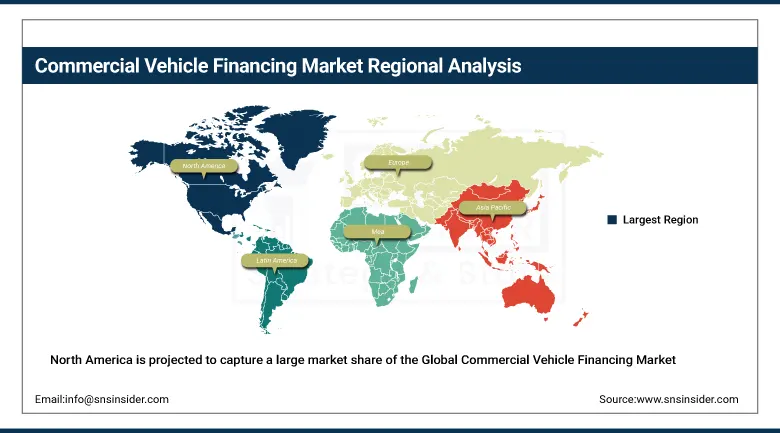
North America is projected to capture a large market share of the Global Commercial Vehicle Financing Market in 2025 on account of digital transformation transforming the process of financing and a well-developed captive financing environment across the region. High fuel prices and high costs remained one of the reasons for companies turning to finance solutions aimed at obtaining fuel-efficient vehicles throughout the year.
The United States comprised a share of about 85.00% of the regional market value on account of the presence of large numbers of banks, captive finance units, and financial technology lending platforms in the country. The contribution of Canada towards regional revenue was lower but continuously increasing due to logistics and e-commerce finance requirements in the country.
Get Customized Report as per Your Business Requirement - Enquiry Now
Europe Commercial Vehicle Financing Market Insights
Europe held a meaningful share of the global Commercial Vehicle Financing Market in 2025, though European lenders already earmarked lower growth ceilings for commercial vehicle exposures in their 2025 budget plans amid broader macroeconomic caution. Germany accounted for roughly 27.60% of regional revenue, supported by its concentration of commercial vehicle manufacturers and captive finance operations.
France, the United Kingdom, and Italy followed a broadly similar trajectory, as continued zero-emission delivery-zone policy implementation extended financing product innovation across the continent's largest logistics markets. Continued regulatory emphasis on fleet electrification is expected to keep shaping European commercial vehicle financing product design through the remainder of the forecast period.
Asia Pacific Commercial Vehicle Financing Market Insights
Asia Pacific held the largest share of the global Commercial Vehicle Financing Market in 2025, supported by expanding logistics infrastructure, rising e-commerce penetration, and growing fleet electrification investment across the region's largest economies. Continued urbanization and online purchasing growth in smaller cities continued reinforcing regional demand throughout the year.
China accounted for roughly 38.20% of regional revenue, supported by its massive domestic commercial vehicle fleet and expanding digital lending platform adoption. India and Southeast Asian markets contributed significant additional regional demand through their own rapidly growing logistics and e-commerce sectors, reinforcing Asia Pacific's position as the clear global leader in commercial vehicle financing volume.
MEA & Latin America Commercial Vehicle Financing Market Insights
The Middle East and Africa region was the fastest-growing region in the global Commercial Vehicle Financing Market, driven by expanding logistics infrastructure investment and growing government support for fleet modernization across the Gulf states in particular. The UAE accounted for roughly 27.20% of regional revenue, supported by national logistics hub strategies and rising enterprise demand for flexible commercial vehicle financing options.
Latin America expanded at a comparable pace, led by Brazil at roughly 37.50% of regional revenue, where growing e-commerce fulfillment and logistics fleet expansion continued to support category growth. Mexico and Argentina followed a similar trajectory as regional commercial vehicle financing adoption expanded further through the remainder of the forecast period.
Growth Drivers: E-commerce fleet expansion and digital lending innovation
The evolution in the e-commerce industry and logistics operations remains a key factor driving commercial vehicle financing market growth, as companies need strong commercial vehicles for meeting the growing demands of deliveries. As the online shopping sector expands further, companies are looking for financing methods to procure vehicles which cater to their growing requirements, thus aiding the financing market.
Digital lending solutions and technological advancements in financing remain key factors contributing towards the improvement in loan approval processes and customer experience within the market. Growing popularity of electric and hybrid commercial vehicles, owing to incentives and subsidies provided by the government, along with the flexibility of non-banking financial companies, continues to fuel structural demand growth within all major categories of commercial vehicles.
Restraints: Credit risk exposure and interest rate sensitivity
European lenders already earmarking lower growth ceilings for commercial vehicle exposures in recent budget plans reflects broader caution around credit risk exposure amid macroeconomic uncertainty. That lending caution continues restricting credit availability for smaller, higher-risk commercial fleet operators in certain mature markets.
Rising fuel prices and operational costs continue compelling businesses to reassess vehicle financing strategies, adding genuine uncertainty to residual value assumptions that underpin many commercial vehicle lease and loan structures. That valuation uncertainty continues requiring lenders to build additional risk premium into financing terms, potentially raising costs for commercial vehicle buyers.
Opportunities: Embedded finance expansion and used vehicle technology adoption
With embedded finance becoming increasingly entrenched within OEM telematics and vehicle dashboard solutions, there is ample potential to benefit captive finance companies and tech-savvy lenders that can capitalize on making financing decisions through such interactions. Lenders that can offer seamlessly integrated finance options are set to capitalize on a larger share of opportunities going forward as more embedded distribution models come online.
Further innovation of AI-driven vehicle condition assessment as well as blockchain-based vehicle history verification can be viewed as an additional path to growth, as the technology keeps increasing lender trust in used commercial vehicles as assets. Financial institutions able to utilize these trust-building technologies will be able to capture lucrative revenues in the used vehicle financing space through 2035.
Recent Developments:
-
2025: Ally Financial continued expanding its commercial vehicle lending portfolio, strengthening its digital underwriting capability to serve small and medium-sized fleet operators seeking flexible financing terms.
-
2025: Daimler Truck Financial Services continued advancing its captive finance offerings, integrating electric vehicle leasing and battery-as-a-service products for commercial fleet customers transitioning toward zero-emission operations.
-
2024: Element Fleet Management continued expanding its fleet financing and management services, strengthening its position serving large enterprise customers managing extensive commercial vehicle fleets across North America.
Commercial Vehicle Financing Market key players are:
-
Ally Financial Inc.
-
Bank of America Corporation
-
Wells Fargo & Company
-
Daimler Truck Financial Services
-
PACCAR Financial Corp.
-
Volvo Financial Services
-
Ford Motor Credit Company LLC
-
CNH Industrial Capital LLC
-
John Deere Financial
-
Navistar Financial Corporation
-
Element Fleet Management Corp.
-
Toyota Financial Services
-
Mercedes-Benz Financial Services
-
Crest Capital
-
Balboa Capital Corporation
-
Commercial Fleet Financing, Inc.
-
BMO Financial Group
-
General Electric Capital
Commercial Vehicle Financing Market Report Scope:
| Report Attributes | Details |
|---|---|
| Market Size in 2025 | USD 125.11 Billion |
| Market Size by 2035 | USD 211.75 Billion |
| CAGR | CAGR of 5.40% From 2026 to 2035 |
| Base Year | 2025 |
| Forecast Period | 2026-2035 |
| Historical Data | 2022-2024 |
| Report Scope & Coverage | Market Size, Segments Analysis, Competitive Landscape, Regional Analysis, DROC & SWOT Analysis, Forecast Outlook |
| Key Segments | • By Vehicle Type (Light Commercial Vehicles, Medium Heavy Trucks, Buses Coaches) • By Provider Type (Banks, Non-Banking Financial Companies) • By Financing Type (Loans, Leasing) • By Vehicle Condition (New, Used) |
| Regional Analysis/Coverage | North America (US, Canada), Europe (Germany, UK, France, Italy, Spain, Russia, Poland, Rest of Europe), Asia Pacific (China, India, Japan, South Korea, Australia, ASEAN Countries, Rest of Asia Pacific), Middle East & Africa (UAE, Saudi Arabia, Qatar, South Africa, Rest of Middle East & Africa), Latin America (Brazil, Argentina, Mexico, Colombia, Rest of Latin America). |
| Company Profiles | Ally Financial Inc., Bank of America Corporation, Wells Fargo & Company, JPMorgan Chase & Co., Daimler Truck Financial Services, PACCAR Financial Corp., Volvo Financial Services, Ford Motor Credit Company LLC, CNH Industrial Capital LLC, John Deere Financial, Navistar Financial Corporation, Element Fleet Management Corp., Toyota Financial Services, Mercedes-Benz Financial Services, Billor, Inc., Crest Capital, Balboa Capital Corporation, Commercial Fleet Financing, Inc., BMO Financial Group, General Electric Capital |

Frequently Asked Questions
The Commercial Vehicle Financing Market is expected to grow at a CAGR of 5.40% from 2026 to 2035.
The Commercial Vehicle Financing Market was valued at USD 125.11 Billion in 2025.
The rise of e-commerce and logistics services combined with digital lending platform innovation is the major growth factor.
The Light Commercial Vehicles segment held approximately 42.38% share in 2025.
Asia Pacific held the largest share of the Commercial Vehicle Financing Market in 2025, while the Middle East and Africa was the fastest-growing region.
