
Compressed Air Energy Storage Market Report Scope and Overview:
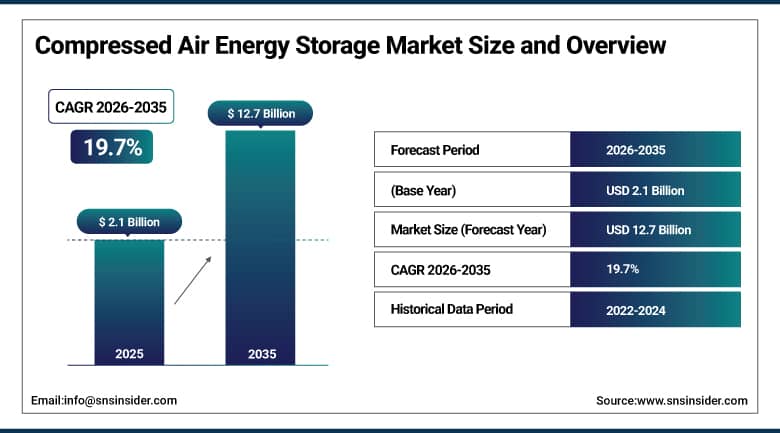
The Compressed Air Energy Storage Market was valued at USD 2.1 Billion in 2025 and is projected to reach USD 12.7 Billion by 2035, registering a CAGR of 19.7% from 2026 to 2035.
The Compressed Air Energy Storage Market is enhancing the long-term capability of grid storage through the advancement of technologies of diabatic, adiabatic, and isothermal compression technologies used in conventional cavern-based storage methods and the more advanced methods of liquid gas-based storage technologies. The market is distinguished by growth in investments from utilities and independent power producers in storage facilities on the scale of power stations, increase in the use of adiabatic technology with thermal recovery capabilities, increased use with wind and solar power generation to firm up renewables, and increasing use in automotive power applications.
The rise of mandates for energy storage with a longer duration, changes to the capacity market rules, and targets for renewable energy integration has been achieved as a consequence of the significant financial input from the developers of the technology, utilities, and IPPs.
To Get More Information On Compressed Air Energy Storage Market - Request Free Sample Report
Compressed Air Energy Storage Market Trends
-
Expanding development of adiabatic CAES projects with integrated thermal storage continues improving round-trip efficiency toward 70%.
-
Growing capacity market reforms in Europe and the United States continue recognizing multi-hour storage value in reliability planning.
-
Rising interest in liquid gas CAES storage formats continues expanding siting flexibility beyond conventional cavern geology.
-
Increasing standardization of turbomachinery and modular compressor packages continues compressing project build times.
-
Growing revenue stacking across energy arbitrage, frequency regulation, and black start continues improving CAES project bankability.
U.S. Compressed Air Energy Storage Market Size Outlook
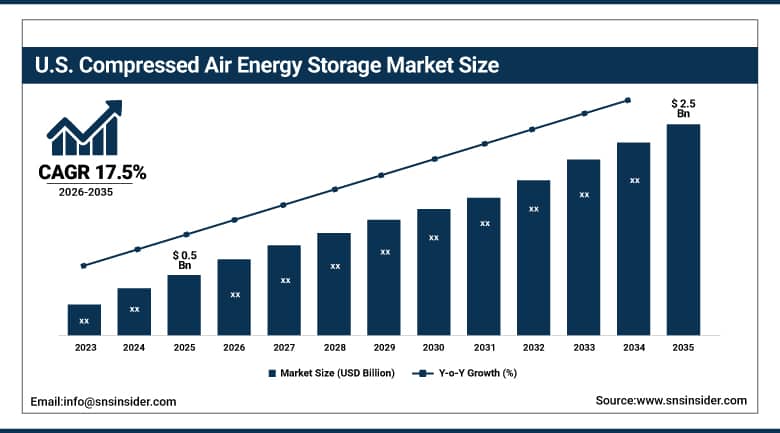
The U.S. Compressed Air Energy Storage Market was valued at approximately USD 0.5 Billion in 2025 and is projected to reach approximately USD 2.5 Billion by 2035, registering a CAGR of approximately 17.5% from 2026 to 2035.
Demand for long-duration grid storage in the US was also fueled by resource adequacy planning and transmission constraints in high-renewable regions, aggressive rollout of federal incentives and state capacity constructs, and strong demand from ERCOT, SPP, and CAISO markets for peaker displacement and congestion relief.
The utilization of adiabatic and near-adiabatic compressed air storage technology along with detailed reservoir characterization in major utility-scale projects has been crucial in raising the reputation of the United States as one of the largest buyers of compressed air energy storage technology in the world. Apart from this, the use of this technology in long-duration dispatch roles beyond lithium-ion's economic sweet spot has been fueling continued domestic demand for this storage solution, even as growth trails faster-scaling markets in Europe and Asia.
Compressed Air Energy Storage Market Segment Analysis
-
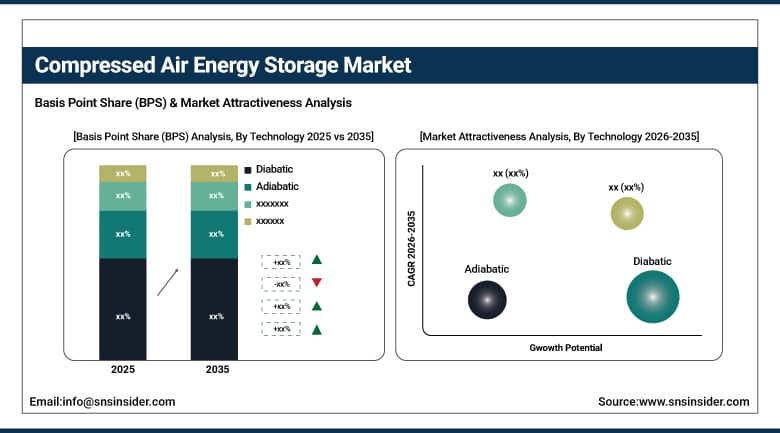
By Technology, Diabatic led in 2025 with 46% share; Adiabatic is fastest growing.
-
By Storage Type, Traditional CAES Storage led in 2025 with 62% share; Liquid Gas CAES Storage is fastest growing.
-
By Application, Power Station led in 2025 with 48% share; Distributed Energy System is fastest growing.
-
By End-User, Utilities led in 2025 with 60% share; Industrial Facilities is fastest growing.
Diabatic Leads, Adiabatic Grows Fastest
Diabatic CAES dominated the Compressed Air Energy Storage Market in 2025 because this conventional technology, exemplified by the operating Huntorf and McIntosh plants, has the longest commercial operating track record of any compressed air storage approach, making it the most bankable route for utility-scale procurement. This technology has been used by utilities and independent power producers for the longest sustained period of commercial deployment in this space, benefiting from proven turbine and compressor supply chains and predictable performance characteristics. Further advances made by technology companies like Baker Hughes with its compression equipment platforms and Siemens Energy with its combustion turbine systems have made diabatic CAES more dominant than any other technology, supported by well-established natural gas co-firing configurations and lower upfront technical risk relative to newer approaches.
Adiabatic CAES is expected to register the fastest growth rate amongst all technologies in the Compressed Air Energy Storage Market owing to its ability to capture and store heat generated during air compression for reuse during expansion, significantly improving efficiency compared to diabatic designs without reliance on fossil fuel co-firing. Development of the adiabatic CAES platform by the company Hydrostor, which has secured offtake agreements for its Willow Rock Energy Storage Center in California, highlights the ongoing commercialization of this type of technology apart from that demonstrated in pilot facilities under the governance of Corre Energy and other long-duration storage developers seeking to align with decarbonization and clean energy objectives.
Traditional CAES Storage Leads, Liquid Gas CAES Storage Grows Fastest
Traditional CAES storage was the leading storage type in the Compressed Air Energy Storage Market in 2025 due to the considerably lower cost per unit of storage capacity achieved by using underground caverns or reservoirs, thus being the technically most feasible approach to achieve gigawatt-hour-scale, long-duration discharge cycles. Corre Energy and Storelectric are among the developers that specialize in underground salt cavern CAES projects, and the expansion in 2026 of geological site assessment programs by regional developers is a clear indicator of the further development of the traditional storage market.
Liquid Gas CAES Storage is set to be the fastest growing storage type in the market for Compressed Air Energy Storage. This is due to the development of compact, higher energy density systems by organizations such as ALACAES that liquefy compressed air or gases for storage, reducing reliance on specific geological formations and expanding geographic feasibility. The technology partnership between Energy Dome and regional industrial customers, in which modular liquid gas storage units will be delivered to sites lacking suitable cavern geology starting in 2027, has led to increased attention towards liquid gas compressed air storage deployment techniques.
Power Station Leads, Distributed Energy System Grows Fastest
The Power Station segment held the leading position in the Compressed Air Energy Storage Market in 2025, owing to the large number of utility-scale power stations deploying compressed air energy storage systems to balance electricity supply and demand across the grid. The application segment has the advantage of leveraging existing plant control infrastructure and business models of developers such as Hydrostor's utility-scale offtake portfolio expansion across North America. The power station application segment is the most funded application segment amongst all the CAES developers globally, supported by long-duration discharge capability suitable for base-load support and peak shaving.
The Distributed Energy System application segment represents the fastest growing application segment within the Compressed Air Energy Storage Market. It has been gaining a lot of attention from microgrid operators, industrial campuses, and community energy projects that are looking to balance locally generated renewable energy with consumption patterns, which are not feasible to manage without localized long-duration storage capacity. The work done by Cheesecake Energy in deploying modular CAES designs for flexible installation in distributed environments is a testament to the importance of the idea of decentralized compressed air storage in grid edge development.
Utilities Dominate, Industrial Facilities Gain Fastest Traction
The utility segment was at the forefront of the end-user segment share in the Compressed Air Energy Storage Market in 2025 because grid operators and independent power producers have been sponsoring most of the major long-duration storage procurement programs carried out for capacity resource adequacy and renewable firming. The large-scale utility investment in the United States, European Union, and China indicates that utility-funded programs are considering compressed air energy storage for securing their future grid reliability requirements, and hence are the main driving forces in the adoption of compressed air energy storage technology.
Industrial Facilities are expected to gain the fastest traction in the Compressed Air Energy Storage Market as end-users due to the fact that there have been early-stage agreements between industrial operators and technology companies for on-site long-duration backup capacity in preparation for the increase in grid outage frequency and demand charge penalties. It is because of the increasing trend of industrial facilities deploying CAES to store off-peak electricity and manage load fluctuations that this end-user segment is growing faster than other end-users, aided by falling equipment costs and expanding project financing options.
Regional Analysis:
|
Region |
Major Country |
Share within Region, 2025 (%) |
|---|---|---|
|
North America |
United States |
85.00% |
|
Europe |
Germany |
27.00% |
|
Asia Pacific |
China |
45.00% |
|
Middle East and Africa |
Saudi Arabia |
25.00% |
|
Latin America |
Brazil |
50.00% |
Europe Compressed Air Energy Storage Market Insights
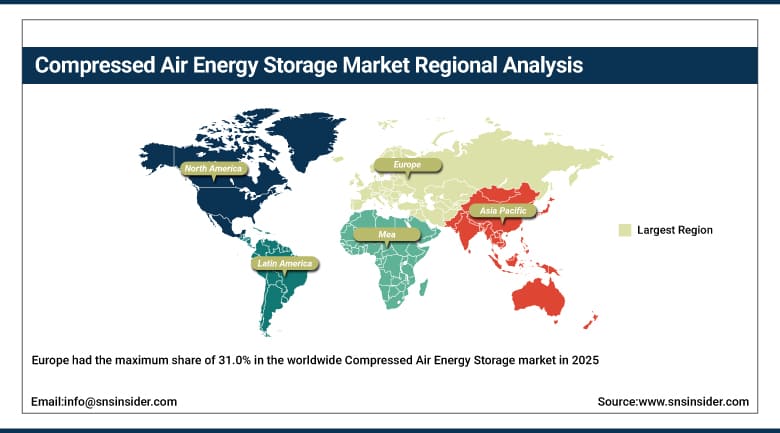
Europe had the maximum share of 31.0% in the worldwide Compressed Air Energy Storage market in 2025 because of strong decarbonization targets, energy security concerns, and grid flexibility needs supported by initiatives like the European Green Deal. The increased collaboration between the public and private sectors through agencies like the German Federal Network Agency and the UK's capacity market auctions has encouraged the developers in Europe to focus on scalable adiabatic storage solutions capable of easing renewable curtailment across increasingly congested transmission networks.
Germany emerged to be the most demanding market amongst all other European countries, generating almost 27.0% of Europe's total revenue because of significant investment made in adiabatic storage clusters and the presence of legacy CAES operating experience from the Huntorf plant in the country. Another significant contributor to market demands in the region was the United Kingdom, which is providing significant contributions to regional market demand owing to its capacity market reforms and long duration procurement rounds tied to offshore wind ramps. The rising demands of compressed air energy storage technology in Europe are expected to increase in future.
Get Customized Report as Per Your Business Requirement - Enquiry Now
North America Compressed Air Energy Storage Market Insights
North America held a share of 28.0% in the worldwide Compressed Air Energy Storage market in 2025, ranking behind Europe as the second-largest regional market. This was possible due to the growth in investments made by utilities and independent power producers into long-duration storage demonstration projects, presence of the best funded CAES developers globally, and consistent investments into policy frameworks such as long-duration procurement mandates in California. A good relationship between the technology developers, turbomachinery suppliers, and utility companies working towards utilizing the output from the storage systems in their home country has also played an important role, alongside expanding state-level clean energy procurement mandates.
The United States accounted for around 85.0% of the total revenue market share of North America because of its presence and continuous raising of funds by Hydrostor, APEX CAES, and Baker Hughes, along with storage procurement agreements made by utilities and community choice aggregators across California, Texas, and the broader ERCOT and CAISO markets. Increased budgeting for long-duration energy storage under federal incentive programs and involvement of Canada through Hydrostor's Ontario project pipeline contributed to North America's strong position in the market.
Asia Pacific Compressed Air Energy Storage Market Insights
The Asia-Pacific region is experiencing the fastest growth rate among all the other regions analyzed in the market, with the expected CAGR of approximately 23.5% for 2026-2035 owing to substantial state-backed tenders, grid flexibility targets, and provincial incentives in China and India, increased governmental emphasis on ensuring reliable electricity access in the long run, and rapid development of compressed air storage demonstration capabilities in this region. The sum effect of various factors discussed above guaranteed the fact that this region experienced the fastest growth rate compared to all other regions analyzed in the report, even though it currently trails Europe in overall revenue share.
This category was dominated by China owing to significant compressed air energy storage demonstration project investments, including a recent national technological breakthrough in core CAES equipment under the country's 14th Five-Year Plan, making up for 45.0% of the revenues of the region. The other countries that have contributed to this result include India because of its viability gap support and resource adequacy rules, and Japan because of its collaborative research in advanced compression technology supported by regional turbomachinery suppliers.
MEA and Latin America Compressed Air Energy Storage Market Insights
Compressed Air Energy Storage Market in the Middle East, Africa, and Latin America exhibited consistent growth due to the growing number of sovereign wealth funds investing in long-duration energy storage technology, the involvement of governments in grid stability and electrification projects in the long run, and the cooperation between utilities of these regions and international compressed air storage technology providers. The early adoption of decentralized clean power technologies was increasingly gaining importance as a strategically vital aspect for the energy diversification projects implemented in the regions due to the insufficiency of centralized generation and transmission capacity to meet future demand reliably.
In ME&A, Saudi Arabia was the biggest country market in terms of the market because of its increased advanced energy technology investments through its sovereign wealth funds, as well as increased long-duration storage project partnerships. In addition, within ME&A, there were contributions from the implementation of storage-backed grid stability projects within the UAE and other GCC countries. Within LATAM, the biggest revenue generator was Brazil as a result of its large number of renewable generation assets and increased grid modernization programs.
Market Dynamics:
Growth Drivers: Long-Duration Storage Mandates and Capacity Market Reform
The market is driving because of the rising demand for long-duration energy storage solutions to support renewable energy integration, capacity markets in Europe and the United States increasingly recognizing the unique role of multi-hour storage in reliability planning, growing use of hybrid thermal-compression technologies, and an expanded set of applications, such as power station-scale storage, distributed energy systems, and emerging automotive power concepts. As more and more utilities are making announcements of long-term storage procurement contracts for future capacity resource adequacy, the need for concrete permitting timelines and interconnection reform will guarantee that the ability to raise funds by developers stays high throughout the supply chain.
Increasing collaboration among CAES developers and turbomachinery suppliers, along with increasing dedication from utilities to acquire flexible, long-duration capacity that is carbon free in anticipation of future regulation on grid decarbonization reporting, constitute additional supporting evidence for this trend. Capital investment by venture and infrastructure investors in the development of utility-scale and hybrid CAES projects is adding to the growing baseline capability, and this is all adding up to ever-increasing demand during the forecast period, particularly as revenue stacking across energy arbitrage, frequency regulation, and transmission deferral improves project economics.
Restraints: High Infrastructure Costs and Site-Specific Geological Dependence
The high upfront infrastructure requirement remains a constraint for the further rapid development of the market since CAES systems often depend on specific geological conditions such as underground caverns, limiting site availability, and construction complexity and long development timelines may slow adoption before any profits are made from the venture. It is owing to this reason that the leading-edge compressed air storage technology is developed only by well-funded companies that have access to venture capital or corporate funding as shown in the case of several developers scaling project pipelines in 2025.
Technical uncertainty around site-specific geological dependence remains a challenge because suitable salt caverns, aquifers, and mined reservoirs are not evenly distributed, limiting the geographic footprint, and environmental assessments for cavern development can delay projects while community concerns around land use and seismic activity complicate approvals; thus, investment into these technologies needs to occur alongside continued site characterization work. It is a challenge that can be solved through liquid gas and above-ground modular vessel designs, which is a dynamic process requiring large amounts of funding from both storage developers and geological research institutions within the industry.
Opportunities: Liquid Gas Storage Formats and Industrial Decarbonization Demand Growth
Increased funding in liquid gas and modular compressed air storage platforms becomes a major trend as developers commit to long-term storage optimization contracts, in which the entire system is built, that includes compact design, thermal management, and turbomachinery integration. Companies that are capable of attracting early customers of their storage capacity, such as Energy Dome with its contracts with industrial customers, will be able to claim a sizable market share as they move from single project demonstrations to fleet-scale storage portfolios.
A third potential opportunity is presented by the development of industrial decarbonization demand, because industrial facilities operating in power-constrained grids are actively searching for firm, long-duration backup power sources and compressed air storage technologies can deliver that capability to them via on-site procurement agreements. Those developers who can show credibility of construction timelines and standardized turbomachinery packages will get substantial market share.
Recent Developments:
-
2026: China's Zhongchu Guoneng Technology (ZCGN) advanced deployment of its next-generation compressed air energy storage turbomachinery following completion of a national four-year core equipment development initiative under China's 14th Five-Year Plan.
-
2026: Hydrostor secured final permitting approval for its 500 MW/4,000 MWh Willow Rock Energy Storage Center in California, advancing the project toward shovel-ready construction status.
Compressed Air Energy Storage Companies are:
-
Hydrostor Inc.
-
Corre Energy B.V.
-
APEX CAES
-
ALACAES SA
-
Cheesecake Energy Ltd.
-
AUGWIND Energy Ltd.
-
Green-Y Energy AG
-
Bright Energy Storage Technologies
-
Magnum Development, LLC
-
TerraStor Energy Corp.
-
Zhongchu Guoneng Technology (ZCGN)
-
EnergyNest AS
-
Siemens Energy AG
-
Dresser-Rand (a Siemens Energy company)
-
Baker Hughes Company
-
Atlas Copco AB
-
MAN Energy Solutions SE
-
Sumitomo Heavy Industries, Ltd.
Compressed Air Energy Storage Market Report Scope:
| Report Attributes | Details |
|---|---|
| Market Size in 2025 | USD 2.1 Billion |
| Market Size by 2035 | USD 12.7 Billion |
| CAGR | 19.7% from 2026 to 2035 |
| Base Year | 2025 |
| Forecast Period | 2026-2035 |
| Historical Data | 2022-2024 |
| Report Scope & Coverage | Market Size, Segments Analysis, Competitive Landscape, Regional Analysis, DROC & SWOT Analysis, Forecast Outlook |
| Key Segments | • By Technology (Diabatic, Adiabatic, and Isothermal) • By Storage Type (Traditional CAES Storage, and Liquid Gas CAES Storage) • By Application (Power Station, Distributed Energy System, and Automotive Power) • By End-User (Utilities, Industrial Facilities, and Commercial & Institutional Facilities) |
| Regional Analysis/Coverage | North America (US, Canada), Europe (Germany, UK, France, Italy, Spain, Russia, Poland, Rest of Europe), Asia Pacific (China, India, Japan, South Korea, Australia, ASEAN Countries, Rest of Asia Pacific), Middle East & Africa (UAE, Saudi Arabia, Qatar, South Africa, Rest of Middle East & Africa), Latin America (Brazil, Argentina, Mexico, Colombia, Rest of Latin America). |
| Company Profiles | Hydrostor Inc., Corre Energy B.V., Storelectric Ltd., APEX CAES, ALACAES SA, Cheesecake Energy Ltd., AUGWIND Energy Ltd., Energy Dome S.p.A., Green-Y Energy AG, Bright Energy Storage Technologies, Magnum Development, LLC, TerraStor Energy Corp., Zhongchu Guoneng Technology (ZCGN), EnergyNest AS, Siemens Energy AG, Dresser-Rand (a Siemens Energy company), Baker Hughes Company, Atlas Copco AB, MAN Energy Solutions SE, Sumitomo Heavy Industries, Ltd. |

Frequently Asked Questions
Key players in the Compressed Air Energy Storage Market include Hydrostor Inc., Corre Energy B.V., Storelectric Ltd., APEX CAES, Baker Hughes Company, and Siemens Energy AG, among others.
Key opportunities in the compressed air energy storage market include liquid gas and modular storage platforms and growth in industrial decarbonization demand and expansion of long-duration storage procurement agreements.
The market is driven by rising demand for long-duration energy storage, capacity market reforms recognizing multi-hour storage value, and growing need to firm intermittent renewable generation.
The Diabatic segment dominated the Compressed Air Energy Storage Market, accounting for approximately 46% market share.
The Europe region dominated the Compressed Air Energy Storage Market in 2025 with a 31.0% share, driven by strong decarbonization targets, energy security concerns, and supportive policy frameworks such as the European Green Deal.
