
Concrete Floor Coating Market Report Scope & Overview:
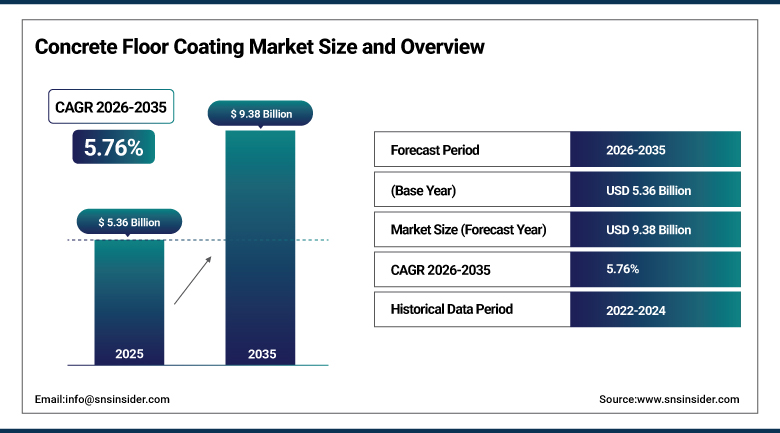
The Concrete Floor Coating Market was valued at USD 5.36 Billion in 2025 and is expected to reach USD 9.38 Billion by 2035, growing at a CAGR of 5.76% from 2026-2035.
The Concrete Floor Coating Market is witnessing steady growth owing to increased activities of construction, infrastructure improvement, and rise in demand for coatings in the commercial, industrial, and residential segment due to increased wear and tear of concrete floors from heavy load and other mechanical actions, water, abrasive chemicals. With increasing investments in warehouse, industries, logistics, hospital, retail sector, etc., protective floor coating products have become more popular. The demand for epoxy and polyurethane coating and growing focus towards safety at the work place is also fueling the growth of concrete floor coating market.
⮞In February 2026, the Government of India raised central capital expenditure in Union Budget 2026-27 alongside the creation of an infrastructure risk fund. Larger public works pipelines across roads, rail and logistics hubs enlarge the concrete slab base that requires protective flooring in Asia Pacific.
To Get more information Concrete Floor Coating Market - Request Free Sample Report
Concrete Floor Coating Market Trends
-
Polyaspartic and one-coat fast-cure systems are taking share from conventional epoxy and urethane topcoat stacks.
-
Low-VOC, water-based and solvent-free formulations are advancing as emission limits tighten.
-
Static-dissipative and chemical-resistant floors are being specified for battery gigafactories, pharmaceutical cleanrooms and semiconductor plants.
-
Seamless and antimicrobial coatings are spreading across food processing, cold chain and healthcare facilities.
-
Decorative flake, quartz and metallic systems are entering retail, hospitality and residential garages alongside installer training programs.
U.S. Concrete Floor Coating Market Outlook
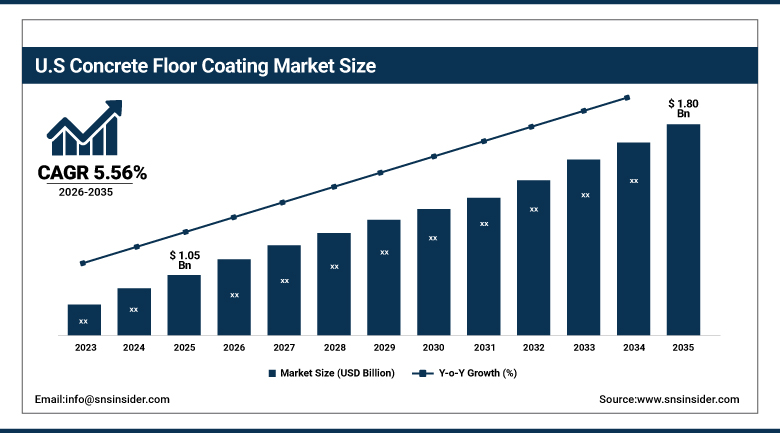
The U.S. Concrete Floor Coating Market was valued at USD 1.05 Billion in 2025 and is expected to reach USD 1.80 Billion by 2035, growing at a CAGR of 5.56% from 2026-2035.
The U.S. Concrete Floor Coating Market draws demand from a large installed base of warehouses, manufacturing plants and retail centers that require periodic recoating. Residential garages add a steady retail channel through one-part epoxy kits sold at home improvement chains. Battery and semiconductor plants under construction call for electrostatic control and solvent resistance. Food and beverage processors follow sanitation audits that favor seamless floors. State-level VOC rules in ozone nonattainment areas push formulators toward water-borne and low-emission grades. Contractors value polyaspartic systems because they return a floor to service within hours. Retrofit of aging distribution centers keeps contractors busy throughout the year. Large national paint and flooring brands also maintain wide dealer coverage.
⮞The U.S. Census Bureau reported in February 2026 that total U.S. construction spending reached USD 2,164.40 Billion during 2025. Spending on this scale sustains a continuing pipeline of new slabs and recoating work for floor coating contractors.
Concrete Floor Coating Market Segment Analysis
-
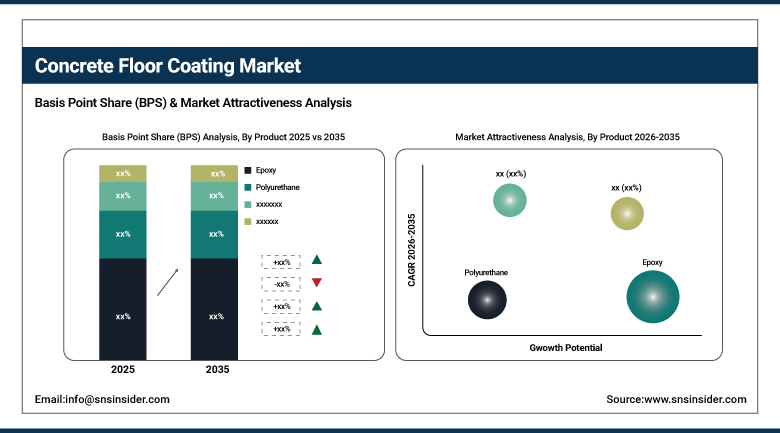
By Product, the Epoxy segment dominated the Concrete Floor Coating Market with approximately 48.47% share in 2025, while the Polyaspartic segment is the fastest growing with a CAGR of approximately 7.96%.
-
By Application, the Indoor segment dominated the Concrete Floor Coating Market with approximately 66.33% share in 2025, while the Outdoor segment is the fastest growing with a CAGR of approximately 6.46%.
-
By End Use, the Industrial segment dominated the Concrete Floor Coating Market with approximately 42.57% share in 2025, while the Commercial segment is the fastest growing with a CAGR of approximately 6.56%.
-
By Technology, the Solvent-Borne segment dominated the Concrete Floor Coating Market, while the Water-Borne segment is the fastest growing with a CAGR of approximately 6.36%.
By Product, Epoxy Dominates Concrete Floor Coating Market; Polyaspartic to Register Fastest Growth.
Epoxy dominates because its heat tolerance, chemical resistance and strong bond to cured concrete suit the demands of factories, warehouses and commercial spaces. Good electrical insulation and a comparatively low cost keep it the default choice for engineers and facility managers. Application is simple and results are dependable across contractor skill levels, which lowers perceived project risk. A long record as a durable base layer under heavy traffic reinforces its position against newer chemistries in most heavy-duty floor schedules.
Polyaspartic is growing fastest because it cures quickly and withstands ultraviolet exposure without yellowing, which returns floors to service far sooner. Its abrasion resistance and flexibility exceed those of standard epoxy, and it avoids the moisture sensitivity that complicates polyurethane. One-coat systems can replace the traditional epoxy plus urethane topcoat sequence, improving contractor productivity. Garages, retail units and multifamily renovation projects, where downtime carries a direct cost, are accelerating adoption of this chemistry across professional and consumer channels.
⮞In July 2025, the European Commission introduced anti-dumping duties on epoxy resins from China, Taiwan and Thailand, with rates for Chinese producers ranging from 17.3% to 33%. Higher input costs for the main floor coating resin influence formulation pricing across the region.
By Application, Indoor Dominates Concrete Floor Coating Market; Outdoor to Register Fastest Growth.
Indoor installations dominate because most coated slabs sit inside factories, kitchens, warehouses and retail premises where durability and cleanability are specified from the outset. Remodeling and redevelopment projects convert bare concrete into tougher and better-looking surfaces under the direction of construction firms and interior designers. Food-safety rules and hygiene audits favor seamless coatings that sanitize easily. Lifecycle cost comparisons and compliance monitoring further support spending, although upfront cost and installation downtime restrain smaller facilities with limited maintenance budgets.
Outdoor applications are advancing quickest from a smaller base as UV-stable polyaspartic and polyurethane chemistries make exterior slabs viable coating candidates. Sports facilities, transit stations, parks and parking structures are emerging as additional project areas. Public agencies and property owners seek slip resistance and protection against freeze-thaw cycles, de-icing salts and prolonged weather exposure. Faster-curing products also shorten closures of public spaces, so authorities and operators can schedule work inside narrow weather windows with fewer disruptions to daily use.
⮞Euroconstruct forecast in November 2025 that European construction output across 19 countries would grow 2.4% in 2026, with non-residential renovation rising on energy-performance rules and aging-facility upgrades. Renovation of occupied buildings favors indoor systems with a rapid return to service.
By End Use, Industrial Dominates Concrete Floor Coating Market; Commercial to Register Fastest Growth.
Industrial lead consumption because battery, chemical, food and semiconductor sites carry process-zone risks that call for multilayer and qualified floor systems. Manufacturing plants, warehouses and processing facilities need load-bearing strength and chemical resistance that bare slabs cannot provide. New warehouses, factories and data centers add fresh coating area each year while older sites are recoated on fixed maintenance cycles. Food and pharmaceutical safety rules, cold-chain expansion and gigafactory construction keep specification volumes high and favor proven suppliers.
Commercial are expanding fastest as investment in offices, retail centers and hospitality venues lifts demand for floors that combine appearance, safety and easy upkeep. Developers of malls, commercial complexes and urban infrastructure specify coatings to avoid the cost of tile or carpet replacement. Premium flake, quartz and metallic systems give designers a polished look at moderate cost, while rapid-cure chemistries limit trading downtime during renovations. Rising attention to slip resistance and hygiene in shared spaces adds further momentum.
⮞In January 2026, Colliers India reported that industrial and warehousing leasing in India reached 36.9 million square feet during 2025. Leased logistics and manufacturing space of this scale translates into large floor areas requiring chemical-resistant and load-bearing coatings.
By Technology, Solvent-Borne Dominates Concrete Floor Coating Market; Water-Borne to Register Fastest Growth.
Solvent-borne systems retain the lead because installers know them well and specifiers trust their long field record on industrial and maintenance floors. These products wet and penetrate dense or slightly contaminated slabs effectively and perform in cool or humid conditions where water-borne films dry slowly. High film build supports heavy-duty protection in a single pass, and broad product availability keeps supply chains simple. Established specifications at manufacturing and logistics sites also favor proven formulations over unfamiliar alternatives today.
Water-borne coatings are growing fastest as tightening VOC regulation pushes owners and formulators toward low-emission products. Antimicrobial and anti-slip mandates, together with incentives for VOC-free systems in the Nordic countries, widen their addressable use. Low odor allows work in occupied buildings such as schools, hospitals and food outlets, while water-based grades continue to gain share in Europe under solvent rules. Improving resin technology has narrowed the durability gap with solvent systems and encourages specifiers to adopt them widely.
⮞In September 2025, the U.S. Environmental Protection Agency proposed to approve Maricopa County Rule 335, which sets stricter VOC limits for architectural coatings in the Phoenix-Mesa ozone area. Limits of this kind favor water-borne and low-emission formulations over conventional solvent systems.
Regional Analysis
|
Region |
Major Country |
Share within Region, 2025 (%) |
|---|---|---|
|
Asia Pacific |
China |
40.30 |
|
North America |
United States |
81.75 |
|
Europe |
Germany |
24.60 |
|
Latin America |
Brazil |
48.20 |
|
Middle East & Africa |
Saudi Arabia |
33.90 |
North America Concrete Floor Coating Market Insights
North America, defined here as the United States and Canada, is a mature market where recoating and retrofit work outweigh greenfield additions. Large warehouse and distribution networks, food and beverage plants and expanding battery and semiconductor capacity sustain demand for resin flooring. Consumer garage floor kits widen the retail base across suburban housing. Strict occupational safety and VOC regulations steer buyers toward low-odor and fast-curing chemistries, and many contractors have moved to polyaspartic systems to shorten facility shutdowns. Repeat orders from distribution centers keep contractor schedules full.
The United States anchors regional demand through its dense industrial base and a deep pool of experienced applicators, while Canada contributes cold-climate projects where freeze-thaw resilience and moisture tolerance decide the specification. Cold storage, grocery distribution and food processing sites in both countries require washdown-capable floors. Owners increasingly favor maintenance-driven recoating programs that extend slab life and defer costly replacement. Healthcare and education facilities also commission antimicrobial and low-odor systems during summer renovation windows, when buildings sit empty. Regional manufacturers and distributors maintain extensive dealer networks that support quick product availability. Rising labor costs also favor systems that install faster.
⮞Statistics Canada reported in February 2026 that non-residential building permits in Canada posted their first annual decline since 2020 during 2025. Softer new-build activity shifts contractor attention toward maintenance and recoating of existing industrial and commercial slabs.
Europe Concrete Floor Coating Market Insights
Europe is shaped by regulation and renovation more than by new construction volume. Energy-performance rules and aging facility upgrades keep non-residential refurbishment active, and each project opens a coating opportunity on existing slabs. Germany leads with automotive, machinery and chemical sites that specify high-performance resin flooring. VOC and worker-exposure rules steer buyers toward water-based and low-emission grades, and incentive schemes in the Nordic countries reward VOC-free systems. Water-based polyurethane and polyaspartic grades are gaining acceptance in laboratories and schools where indoor air quality is a priority. Germany and the Nordic countries also set the technical benchmark that other markets follow.
Premium decorative systems find steady demand in hospitality, retail and public buildings across Southern and Western Europe, while the United Kingdom has experienced slower construction activity that tempers volumes. Trade defense measures on imported resins raise raw material costs for formulators, which supports local sourcing and long-term supply contracts. Suppliers differentiate through sustainability credentials and technical training for certified applicators. Retrofit demand is strong in logistics centers built a generation ago, where owners replace worn coatings to meet current safety standards. Energy-efficient building programs also tie floor upgrades to wider refurbishment budgets.
⮞In July 2025, Eurostat reported that buildings production in the European Union rose 5.3% year on year in May 2025. Higher building output expands the pool of new slabs eligible for protective coatings across the bloc.
Asia Pacific Concrete Floor Coating Market Insights
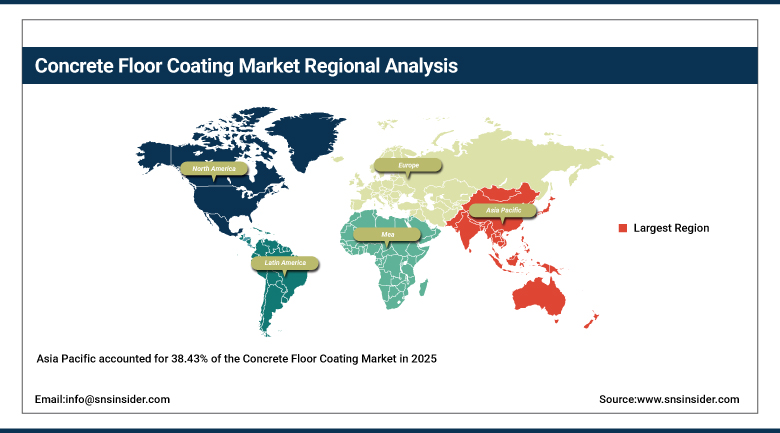
Asia Pacific accounted for 38.43% of the Concrete Floor Coating Market in 2025, which makes it the largest regional pool. Rapid urbanization, large industrial parks and sustained infrastructure investment in China, India and Southeast Asia keep new slab area growing. Government incentives for local manufacturing keep factory construction active. Electronics, EV and pharmaceutical plants require chemical-resistant and static-dissipative floors that raise specification levels. China remains the biggest national consumer, supported by government-backed construction programs, while Japan and South Korea add high-specification demand from cleanroom and semiconductor sites.
Growth is expected to stay strongest here, with the region forecast to compound at 6.66% over 2026-2035. India stands out as warehousing, manufacturing and public works programs widen the customer base for resin flooring. Relocation of contract manufacturing to Vietnam, Indonesia and Thailand creates fresh factory floors, and local formulators compete aggressively on price while multinational suppliers push premium polyaspartic and low-VOC grades. Rising consumer spending also lifts demand for decorative floors in residential garages and retail outlets across urban centers. Training of applicators remains a priority for suppliers entering secondary cities.
⮞In January 2026, the National Bureau of Statistics of China reported that manufacturing investment rose 0.6% in 2025. Continued capital spending on factories sustains requirements for durable industrial flooring across China's factory base.
Get Customized Report as per Your Business Requirement - Enquiry Now
Latin America and Middle East & Africa Concrete Floor Coating Market Insights
The Latin American region, including Mexico in this report, is headed by Brazil, where expansion of logistics warehouses and food processing plants are responsible for driving the consumption of resin flooring. In Mexico, there are advantages in terms of industrial parks catering to export manufacturing, while Colombia has commercial and mortar construction as well. Fluctuations in currency and pricing make the epoxy systems more cost-effective, but multinational companies are expanding local manufacturing facilities and technical services to tap into high-end projects. Other regions have mining, food export and automotive plants that require chemical resistant floors.
⮞In January 2026, CBRE Mexico reported that industrial gross absorption in Mexico City reached a record 1,598,150 square meters during 2025. Absorption at that pace adds warehouse and manufacturing floor area that must be coated to meet logistics and sanitation requirements.
In the Middle East & Africa segment, Saudi Arabia occupies a commanding position owing to the industrial localization and logistics parks there, while in the UAE, commercial and infrastructural construction activities provide growth impetus. Higher UV resistance and thermal resilience are needed in hot countries. Development of warehouses and logistics parks in African countries boosts interest in resilient flooring, but slow adoption is witnessed due to low applicator base and import dependency. Tourism and investments in the healthcare sector increase the demand for decorative and hygienic flooring.
⮞Knight Frank reported in October 2025 that Saudi Arabia delivered more than 1.3 million square meters of new industrial and logistics space in the first half of 2025. Expanding factory and warehouse capacity widens the addressable floor area for coating contractors in the Gulf.
Market Dynamics
Growth Drivers: Expanding warehouse, battery and pharmaceutical facilities are raising demand for seamless, chemical-resistant floors
Warehousing, battery fabrication, and pharmaceutical processing applications are expanding the square footage in need of flooring materials that are capable of resisting forklift traffic, chemical spills, and stringent cleaning. The operators of e-commerce fulfillment centers and cold chain operations seek flooring materials that will resist jointing and bacterial growth. These systems can be found in resin systems that have a lifecycle cost lower than that of tiles or frequent concrete repairs. Higher labor costs mean more value for systems that go in quickly and have low maintenance. Insurance companies and safety auditors prefer those floors that have tested slip resistance. This means repeat purchases.
Hygiene audits, antimicrobial requirements, and slip-resistance and green building initiatives are driving specifiers toward systems that are certified for low VOC emissions. Fast curing chemistry is adding further momentum since fewer shutdown times reduce plant throughput loss. Training for the installer provided by leading manufacturers of flooring systems is widening the base of contractors able to install multilayer systems, and projects that would have been previously considered too disruptive are going in now. Pharmaceutical and food processors are providing further business in cleanroom expansion.
⮞Cushman & Wakefield reported in January 2026 that prime logistics warehouses in Brazil recorded net absorption of 1.63 million square meters in 2025. Warehouse take-up at this level generates sizable demand for load-bearing and abrasion-resistant floor coatings.
Restraints: Volatile resin costs, installer shortages and slower construction activity are limiting project volumes
Epoxy and polyurethane resins and solvents are subject to feedstock volatility and government interventions that make pricing difficult for formulators and contractors bidding on a fixed price basis. Compliance with VOC and HAP regulations incurs reformulation and testing costs, while the restriction on fluorinated topcoats limits some of the high performance solutions. The small players are affected by these challenges since they do not have the economies of scale to cushion against volatility in input costs. Pricing conflicts between formulators and contractors frequently delay project awarding when material quotations expire before the start of the projects. Disruptions in logistics can also prolong the delivery time of hardeners and additives.
The lack of skilled applicators limits the installation capacity, while inadequate surface preparation and concrete moisture are major reasons behind coatings' failure that erode buyer confidence. High initial cost, installation downtime and stiff competition from counterfeit products deter some owners from opting for high-quality systems especially in developing countries where buyers may not be aware of the long term benefits. The selection of the lowest bid and unavailability of training facilities in smaller towns make the transition from paint to engineered floor systems slow.
⮞In February 2026, the Brazilian Chamber of Construction Industry (CBIC) estimated that construction GDP in Brazil grew 1.3% in 2025. Slower growth in the construction sector tempers tendering activity for new flooring projects.
Opportunities: Retrofit programs, new technology plants and low-VOC formulations are opening fresh revenue pools for suppliers
The recoating option for existing slabs is an advantage to owners since no demolition will be required for owners who want to improve appearance and performance. This benefit fits well in the greenfield and brownfield industrial settings. Control of dust, performance of the systems, and appearance increase acceptance in retail and healthcare environments where the owners have used tiles before. The ease of coating during shut-down periods is highly appreciated. Multilayered coated systems that are qualified will do well in semiconductor, pharmaceutical, and battery plants since they require premium margins.
Differentiators in the market will be fast curing of polyaspartic systems, decorative metallic or flake finishing, and training of installers. There are new market opportunities from industrial and infrastructure programs in India and Gulf. Moreover, there is growing market demand for waterborne grades of the system in Europe during refurbishment. Companies that are ready to differentiate by offering their products, installation training, and warranties have the opportunity of winning the long term maintenance contracts in the coatings industry. The technical service agreement, color matching, and estimation tools are other ways through which the business relationships will be built.
⮞MEED reported in June 2025 that the United Arab Emirates had awarded about USD 31.00 Billion of construction projects so far in 2025. A strong award pipeline in the Gulf creates openings for flooring systems across commercial, industrial and logistics developments.
Recent Developments:
-
February 2026, Sika announced five new plants located in Haines City in Florida, Puerto Tirol in Argentina, Cali in Colombia, Narayanganj in Bangladesh and Mwanza in Tanzania. The sites cover concrete admixtures, dry mortars and acrylic coatings, which strengthens local supply of construction chemicals used alongside concrete floor systems.
-
December 2025, AkzoNobel completed the sale of AkzoNobel India, its liquid paints and coatings business, to JSW Group while retaining its powder coatings operations and research center. The transaction reshapes competitive ownership in a fast-growing Indian coatings market.
-
January 2026, Mapei launched Mapefloor Finish 56, a two-component clear polyaspartic resin with high gloss, low odor and UV resistance, for industrial flooring. The product serves as a primer, binder and seal coat, addressing demand for fast-return systems.
-
November 2025, BirlaNu agreed to acquire Clean Coats, a supplier of epoxy and polyurethane flooring systems. The deal extends the construction chemicals portfolio of the buyer into resin flooring and signals consolidation among regional applicators.
Concrete Floor Coating Market Key Players
-
Sherwin-Williams
-
RPM International
-
PPG
-
Sika
-
Mapei
-
Jotun
-
Nippon Paint
-
Armorpoxy
-
Key Resin
-
Behr
Concrete Floor Coating Market Report Scope:
| Report Attributes | Details |
|---|---|
| Market Size in 2025 | USD 5.36 Billion |
| Market Size by 2035 | USD 9.38 Billion |
| CAGR | CAGR of 5.76% From 2026 to 2035 |
| Base Year | 2025 |
| Forecast Period | 2026-2035 |
| Historical Data | 2022-2024 |
| Report Scope & Coverage | Market Size, Segments Analysis, Competitive Landscape, Regional Analysis, DROC & SWOT Analysis, Forecast Outlook |
| Key Segments | • By Product (Epoxy, Polyurethane, Polyaspartic, Acrylic, and Others) • By Application (Indoor and Outdoor) • By End Use (Industrial, Commercial, Residential, and Institutional) • By Technology (Solvent-Borne, Water-Borne, and 100% Solids) |
| Regional Analysis/Coverage | North America (US, Canada), Europe (Germany, UK, France, Italy, Spain, Russia, Poland, Rest of Europe), Asia Pacific (China, India, Japan, South Korea, Australia, ASEAN Countries, Rest of Asia Pacific), Middle East & Africa (UAE, Saudi Arabia, Qatar, South Africa, Rest of Middle East & Africa), Latin America (Brazil, Argentina, Mexico, Colombia, Rest of Latin America). |
| Company Profiles | Sherwin-Williams, RPM International, PPG, Sika, Mapei, Jotun, Nippon Paint, Armorpoxy, Key Resin, Behr |

Frequently Asked Questions
Key players in the Concrete Floor Coating Market include Sherwin-Williams, RPM International, PPG, Sika and Mapei among others.
Recoating of existing industrial slabs, flooring systems for battery, semiconductor and pharmaceutical plants and low-VOC water-borne formulations present the main opportunities, while infrastructure programs in India and the Gulf add new project volume.
The expansion of warehousing, manufacturing and cold-chain facilities that need durable, chemical-resistant and easy-to-clean floors is the major growth factor, supported by tightening hygiene and emission regulations.
The Epoxy segment dominated the Concrete Floor Coating Market with approximately 48.47% share in 2025, owing to its adhesion to concrete, chemical resistance and favorable cost.
Asia Pacific dominated the Concrete Floor Coating Market in 2025 with a 38.43% share, attributed to rapid industrialization, large infrastructure programs and expanding electronics, EV and pharmaceutical manufacturing in China and India.
