
Contract Furniture Market Report Scope & Overview:
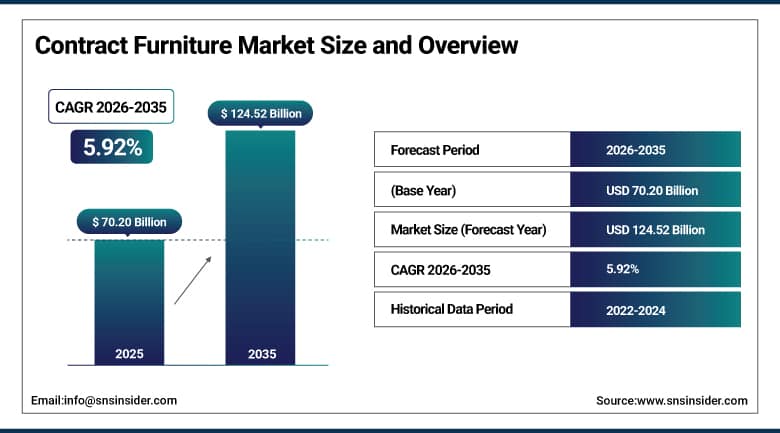
The Contract Furniture Market was valued at USD 70.20 billion in 2025 and is expected to reach USD 124.52 billion by 2035, growing at a CAGR of 5.92% from 2026–2035.
The contract furniture market is witnessing significant growth in the global market due to expanding commercial infrastructure and workplace modernization initiatives. Rising demand for ergonomic, flexible, and aesthetically appealing furniture solutions is driving strong market expansion across multiple sectors. Increasing investments in corporate offices, educational institutions, and healthcare facilities are significantly supporting market growth. Growing adoption of modular furniture and sustainable design practices is further strengthening demand. Rapid urbanization and the expansion of hospitality and co-working spaces are boosting consumption of contract furniture products worldwide.
Current trends point toward consolidation, sustainability, and innovation in the office space transforming the Contract Furniture Market. In December 2025, HNI concluded its $2.2 billion merger with Steelcase to form a merged company with a revenue of about $5.8 billion annually. MillerKnoll posted its sales from its North America Contract division at $1.97 billion for its fiscal year 2025. Manufacturers have increasingly invested in modular, ergonomic, and sustainable furniture to meet the needs of hybrid workplaces and commercial facilities.
To Get More Information On Contract Furniture Market - Request Free Sample Report
Contract Furniture Market Trends:
-
AI-driven demand forecasting adoption increased over 35%, reducing inventory waste and improving sell-through rates across global retailers.
-
Circular fashion investments accelerated during 2024–2026, with resale, repair, and recycling programs expanding amid stricter sustainability regulations.
-
Digital product passports gained momentum across key markets, enhancing supply-chain transparency, traceability, and compliance with emerging regulations.
-
Nearshoring and regionalized sourcing strategies expanded significantly, reducing lead times by up to 30% amid geopolitical uncertainties.
-
Sustainable material adoption increased steadily, with recycled fibers exceeding 15% usage in collections targeting environmentally conscious consumers.
-
RFID, IoT, and automated warehouse technologies improved inventory accuracy above 95%, supporting faster fulfillment and omnichannel growth.
U.S. Contract Furniture Market Size Outlook:
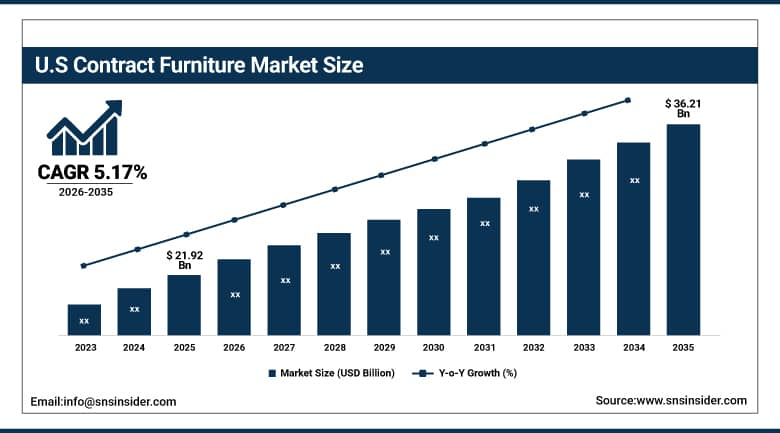
The U.S. Contract Furniture Market was valued at USD 21.92 billion in 2025 and is expected to reach around USD 36.21 billion by 2035, growing at a CAGR of 5.17% from 2026–2035.
The U.S. contract furniture is witnessing constant growth because of growing investments in the development of infrastructural facilities and modernizing of workplaces in the country. Contract furniture usage in corporate office spaces, healthcare centers, educational facilities, and hospitality establishments has been responsible for the constant growth in the market. Increasing investment in office modernization projects and infrastructure development has led to an increase in demand for such products.
The development of innovations is facilitated by increased hybridization of the working environment in the American contract furniture sector. By 2025, as part of its consolidation with HNI Corporation, Steelcase is implementing integration initiatives aimed at achieving a savings of $120 million, besides other gains, in the commercial furniture industry. Along the same lines, MillerKnoll is expanding its operations to incorporate nearly 70,000 square feet of workspace in Chicago and bringing in workplace innovations.
Contract Furniture Market Segment Analysis:
-
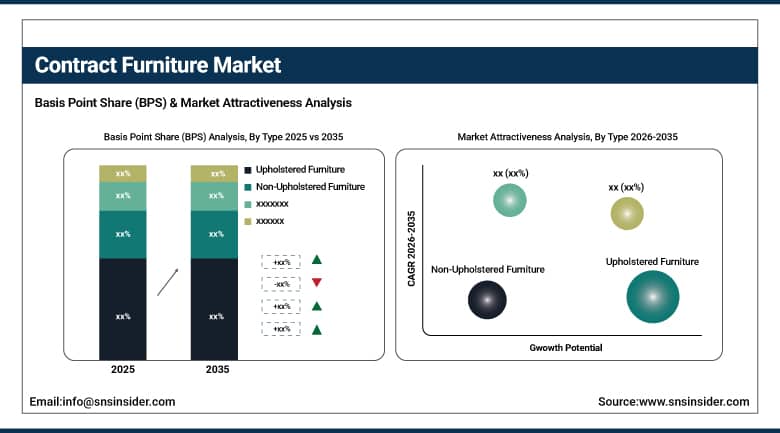
By Type, upholstered furniture dominated the contract furniture market with 58.42% share in 2025; while non-upholstered furniture is the fastest growing segment with CAGR of 6.55% during 2026 to 2035.
-
By End Use, corporate/office dominated the contract furniture market with 39.78% share in 2025; while healthcare is the fastest growing segment with CAGR of 8.70% during 2026 to 2035.
-
By Distribution Channel, offline dominated the contract furniture market with 71.36% share in 2025; while online are the fastest growing segment with CAGR of 8.28% during 2026 to 2035.
By Type, upholstered furniture dominated the contract furniture market, while non-upholstered furniture is the fastest growing segment.
Upholstered furniture category held the dominated share in terms of revenue in the contract furniture market in 2025. This is mainly due to growing demand for the same from corporate offices, hospitality industry, and healthcare sector as they offer better comfort and aesthetics. Companies are focusing more on improving the wellbeing of their employees and customer experience through ergonomic seats. Growing demand for premium office space and collaboration spaces has also helped the segment in gaining its position. Customization features, high durability, and improved functionality continue to drive the market dominance in the segment.
Non-Upholstered Furniture segment is projected to register the fastest CAGR between 2026 and 2035. This is due to growing demand for light and cost-efficient furniture among commercial establishments. Education institutes, government institutions, and industries are increasingly adopting these products owing to their increased durability and operational effectiveness. Increasing adoption of sustainable materials and modular furniture design is fueling the market expansion in this segment.
By End Use, corporate/office dominated the contract furniture market, while healthcare is the fastest growing segment.
Corporate/Office segment accounted for the dominated revenue share in the contract furniture market in 2025 owing to heavy investments made in corporate offices, business parks, and commercial infrastructure across the globe. Increase in demand for ergonomic workstations and collaborative work spaces enabled regular replacements of furniture. Expansion in hybrid workplace models and growing focus on improving employee health also fueled the segment demand. Procurement of large-scale contracts by enterprises strengthened the leadership position of the segment.
Healthcare segment was projected to witness the fastest growth rate (CAGR) from 2026-2035 owing to increasing investments in hospitals, clinics, and healthcare facilities across developed and developing countries. Increasing volume of patients and growing healthcare infrastructure is generating high demand for furniture that is both, durable as well as hygienic. Growing focus on patients' convenience, hygiene, and efficiency in operations is fueling adoption of advanced contract furniture solutions.
By Distribution Channel, offline dominated the contract furniture market, while online is the fastest growing segment.
Offline will lead in terms of revenue generation in the contract furniture market in 2025. The reason behind offline dominating is attributed to the inclination to examine products physically before ordering in large quantities for business use. The factors such as customization requirement, consultation need, dealer presence, presence of showrooms, installation services, and post-sale support helped in increasing the adoption of offline channels in contract furniture sourcing process worldwide.
Online is expected to witness fastest CAGR from 2026 to 2035. The factor behind the high CAGR witnessed by online will be the move towards digitalization of the procurement process. Companies will adopt the digital channels to evaluate products, place bulk orders, and facilitate procurement process. Factors like increase in online shopping activities, advanced visualization technologies, and more product availability will help in increasing the market size.
Regional Analysis:
|
Region |
Major Country |
Share within Region, 2025(%) |
|---|---|---|
|
North America |
United States |
84.76% |
|
Europe |
Germany |
24.68% |
|
Asia Pacific |
China |
41.35% |
|
Middle East & Africa |
UAE |
18.42% |
|
Latin America |
Brazil |
46.18% |
North America Contract Furniture Market Insights.
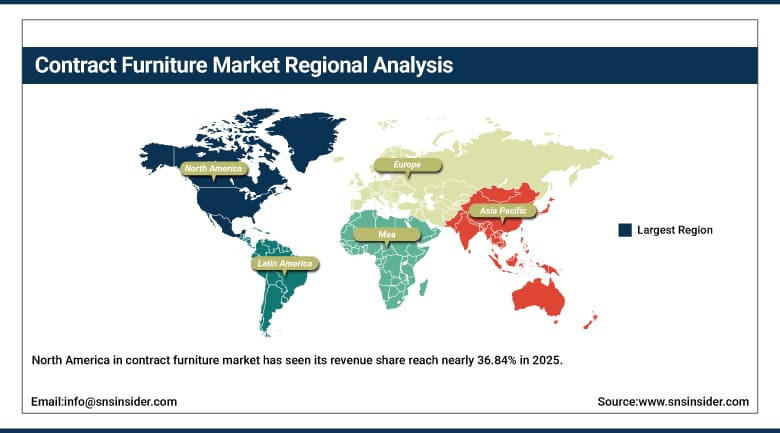
North America in contract furniture market has seen its revenue share reach nearly 36.84% in 2025 due to robust infrastructural development in commercial and workspace modernization. The region enjoys manufacturing prowess, a huge demand for office, healthcare, and education furniture. The presence of a well-established network and rising investments in flexible workspaces is contributing to the steady growth of the market in the US and Canada. An increasing number of renovations and usage of ergonomic furniture have resulted in growing demand for contract furniture in various end-use segments.
As per recent trends in the industry, the contract furniture market in North America is experiencing favorable growth due to workplace reinvestments and consolidations. After Kimball International integration, HNI has continued to expand through acquisitions, leading to the establishment of a combined furniture brand with annual revenues of more than $3 billion.
Get Customized Report as Per Your Business Requirement - Enquiry Now
Europe Contract Furniture Market Insights.
The Europe contract furniture market makes an important mark in the year 2025 owing to its strong sustainability trends and well-established business infrastructure. Countries like Germany, France, Italy, and the United Kingdom have made considerable contributions towards the demand in the region. Ergonomically designed furniture with sustainable and modular products are some of the factors that have enabled sustained growth in the market. In addition, higher spending on remodeling and improving office premises also result in buying furniture.
In addition to this, strategic initiatives in the contract furniture industry within Europe have taken momentum as HNI Corporation unveiled its plans to purchase Steelcase for a sum of $2.2 billion in 2025. MillerKnoll met its targets of using 100% renewable electricity across all manufacturing facilities in FY2026 while pledging to completely eliminate PFAS usage from all its products in FY2027.
Asia Pacific Contract Furniture Market Insights.
Asia Pacific is fastest growing in the contract furniture market 2025 with a CAGR of around 7.35% because of rapid urbanization and commercial construction activities. China, India, Japan, and countries from Southeast Asia are the key players. There are higher investments in the construction of office premises, health facilities, education sectors, and hotel chains, which contribute towards increased furniture consumption. Growing manufacturing, capacities will lower the cost structure of products.
Growing use of flexible designs in offices and hospitality sector is resulting in increased demand for contract furniture in the Asia-Pacific region, which has been valued at USD 20.54 billion in 2025 and will grow even further up to 2035. For instance, in 2024, Haworth opened one more manufacturing unit in India, with an area of 113,000 sq. ft. located in Chennai, while in 2025, Kokuyo launched its ergonomic chair ingCloud.
Middle East & Africa and Latin America Contract Furniture Market Insights.
The Middle East & Africa region along with the Latin America region is expected to have constant growth in the contract furniture market in 2025 due to growing commercial infrastructure and urbanization in the regions. The UAE, Saudi Arabia, South Africa, Brazil, and Mexico are likely to be the prominent contributors to the demand in their respective regions. Growth in hospitality projects, education institutions, healthcare infrastructure, and corporate offices is anticipated to drive more furniture purchases.
From recent development, it is evident that contract furniture demand in the Middle East & Africa region is gaining momentum due to the Vision 2030 projects in Saudi Arabia and 1.6 million sqm of Grade A office space by 2028. Sunon’s opening of 1,000sqm Riyadh Experience Center and launching of intelligent workspaces are intensifying the competition in the market, while the company’s Latin American expansion is benefiting from increased investments in the region.
Market Dynamics:
Growth Drivers: Expansion of commercial infrastructure and workplace modernization is accelerating procurement of ergonomic and flexible furniture solutions globally
Increased investments in office buildings, co-working spaces, educational institutes, hospitals, and hotels have been aiding demand increases. Companies are becoming conscious about developing productive and collaborative environments for their employees as well as guests. Flexible furniture arrangements become essential in contemporary workplaces for efficient use of available space. Employers are making expenditures on ergonomic chairs, work stations, and multi-purpose furniture to increase the comfort levels of workers. Urbanization and construction activities in the commercial sector are resulting in continuous demands. The rising requirement for aesthetic and durable furniture pieces for commercial applications is further boosting growth in the Contract Furniture Market.
The market will continue growing with the increasing trend of office renovation and the hybrid office system, together with the construction of the commercial real estate market globally. In 2025, HNI acquired Steelcase for $2.2 billion to build a multinational company in furniture products with revenues reaching up to $5.8 billion each year in the corporate, healthcare, and education sectors. The sales growth of Steelcase based on its orders increased by 9%. According to a survey conducted by MillerKnoll, 86.4% of people work at an office/hybrid environment.
Restraints: Economic uncertainty and delayed commercial construction projects are reducing furniture replacement and expansion spending
The buying of furniture by business organizations is extremely sensitive to the economic environment and commercial development efforts. During times of uncertainty, business organizations are likely to shy away from upgrading or renovating their offices. Budget constraints will ensure that the cycle of renewing office furniture becomes much longer before the purchase of new furniture is done. Less investment in commercial property will act as an obstacle to the sales of furniture in many industries. Hotel operators and corporate clients usually delay making decisions to buy furniture during tough economic times.
From the current trend, it is clear that the uncertain economic environment and slow pace of developing business structures has been restricting the development of contract furniture sales. The Indian office supply declined by 13% in Q1 2025 from the previous year because of delayed construction projects. The demand for offices in the United States was steady during the same period although there was a sharp recovery in Q3.
Opportunities: Growing adoption of hybrid workspaces and flexible office concepts is creating demand for innovative furniture solutions
There are various changes in the trend that is encouraging companies to consider the arrangement and types of furniture they use. The organizations require furniture that is versatile and facilitates mobility. The requirement for flexible seats, portable dividers, and reconfigurable workstations has been increasing. Organizations are investing more in furniture products designed to accommodate the changing occupancy levels. The flexibility of working spaces requires that the organization purchases furniture that not only functions well but is also aesthetically pleasing. Innovative designs of contract furniture would be beneficial for organizations venturing into the contract furniture sector.
Adoption of hybrid workspaces creates numerous opportunities for contract furniture manufacturers to provide innovative products that offer flexibility in design. According to research by Steelcase in 2025, 69% of managers required more private spaces, thereby prompting the need for flexible furniture products, with Steelcase modular products catering to the new demands. MillerKnoll noted a 15.8% increase in North America contract orders in Q4 FY2025 due to increased investments in adaptable workplaces.
Recent Developments:
-
2026: Okamura earned CDP Climate Change “A List” recognition for the third consecutive year, highlighting sustainability leadership.
-
2025: Steelcase reported first-quarter fiscal 2026 revenue growth of 7%, driven by strong large-corporate customer demand and Americas expansion.
-
2025: Teknion expanded its workplace solutions portfolio through continued investment in flexible, technology-enabled collaborative furniture environments.
-
2024: MillerKnoll launched more than 30 new products across global design events while expanding dealer network integration initiatives.
Contract Furniture Market Key Players are:
-
Steelcase
-
MillerKnoll
-
Haworth
-
HNI Corporation
-
KI
-
Teknion
-
Global Furniture Group
-
Kinnarps
-
Okamura Corporation
-
Nowy Styl
-
Sedus Stoll
-
Vitra
-
Kimball International
-
Kokuyo
-
Fursys
-
Flokk
-
Ahrend
-
ITOKI
-
The Senator Group
-
Martela
Contract Furniture Market Report Scope:
| Report Attributes | Details |
|---|---|
| Market Size in 2025 | USD 70.20 Billion |
| Market Size by 2035 | USD 124.52 Billion |
| CAGR | CAGR of 5.92% From 2026 to 2035 |
| Base Year | 2025 |
| Forecast Period | 2026-2035 |
| Historical Data | 2022-2024 |
| Report Scope & Coverage | Market Size, Segments Analysis, Competitive Landscape, Regional Analysis, DROC & SWOT Analysis, Forecast Outlook |
| Key Segments | • By Type (Upholstered Furniture, Non-Upholstered Furniture) • By End Use (Government, Corporate/Office, Educational, Healthcare, Hospitality) • By Distribution Channel (Online, Offline) |
| Regional Analysis/Coverage | North America (US, Canada), Europe (Germany, UK, France, Italy, Spain, Russia, Poland, Rest of Europe), Asia Pacific (China, India, Japan, South Korea, Australia, ASEAN Countries, Rest of Asia Pacific), Middle East & Africa (UAE, Saudi Arabia, Qatar, South Africa, Rest of Middle East & Africa), Latin America (Brazil, Argentina, Mexico, Colombia, Rest of Latin America). |
| Company Profiles | Steelcase, MillerKnoll, Haworth, HNI Corporation, KI, Teknion, Global Furniture Group, Kinnarps, Okamura Corporation, Nowy Styl, Sedus Stoll, Vitra, Kimball International, Kokuyo, Fursys, Flokk, Ahrend, ITOKI, The Senator Group, Martela. |

Frequently Asked Questions
The contract furniture market is expected to grow at a CAGR of 5.92% from 2026 to 2035.
The contract furniture market was valued at USD 70.20 billion in 2025.
Expansion of commercial infrastructure and workplace modernization, coupled with rising demand for ergonomic and flexible furniture, is driving market growth.
Upholstered furniture led 2025 contract furniture demand due to office, healthcare, and hospitality comfort and aesthetics needs.
North America led the 2025 contract furniture market due to strong commercial infrastructure, workplace modernization, and high demand across office, healthcare, and education sectors.
