
Glass Tableware Market Report Scope & Overview:
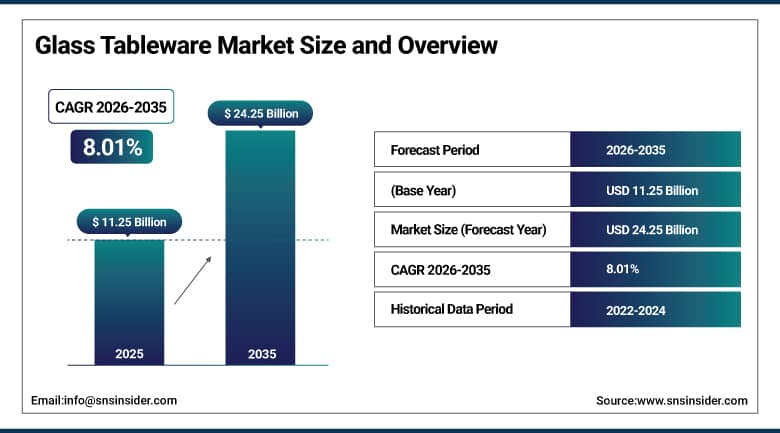
The Glass Tableware Market was valued at USD 11.25 billion in 2025 and is projected to reach around USD 24.25 billion by 2035, growing at a CAGR of 8.01% from 2026–2035.
The market for glass tableware is growing consistently and on value grounds. Rising demand from residential consumers, HoReCa, and upscale restaurant segments is fueling the growth of this market. The increasing preference for tableware solutions that are good-looking, durable, and eco-friendly is playing an important role in driving the growth of the market. The usage of glass tableware products is more common compared to plastic and ceramic counterparts since it is not toxic, easy to recycle, and looks premium. The rising trend of urbanization, changing lifestyles, and global expansion of restaurant chains is fueling demand for glass dinnerware, drinking wares, serveware, and bakeware products.
In 2025, major glassware manufacturers such as Arc International, Libbey, and Pasabahce expanded their premium product portfolios, focusing on designer and durable tempered glass collections to cater to rising hospitality demand and modern home dining trends. Companies also increased investments in automated manufacturing and energy-efficient glass production technologies to reduce costs and improve output quality.
To Get More Information On Glass Tableware Market - Request Free Sample Report
Glass Tableware Market Trends
-
Rising demand for premium and aesthetic glass tableware is boosting residential and HoReCa consumption globally.
-
Shift from plastic and ceramic to sustainable, recyclable glass products is driving market growth.
-
Increasing adoption of borosilicate and tempered glass is improving durability and heat resistance.
-
Expansion of e-commerce and D2C channels is accelerating global product accessibility.
-
Growth of hospitality and QSR sectors is increasing bulk demand for glass drinkware and serveware.
The US Glass Tableware Market Size Outlook
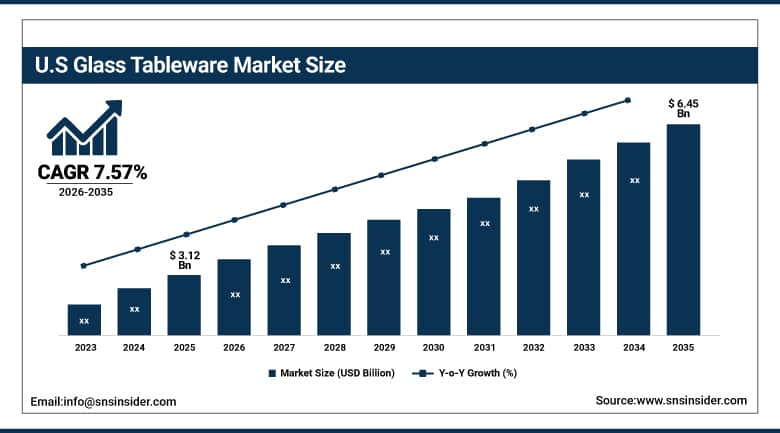
The U.S. Glass Tableware Market was valued at USD 3.12 billion in 2025 and is projected to reach around USD 6.45 billion by 2035, growing at a CAGR of 7.57% from 2026–2035.
The United States holds a strong position in the global glass tableware market, due to the presence of high consumer preference for aesthetic dining experiences, well-developed hospitality sector, and wide usage of branded kitchenware items. The trend toward the use of durable, reusable, and eco-friendly items will drive the shift away from plastic and ceramic options to glass-based ones. Growth in restaurants, cafes, and fast-food chains will drive higher bulk purchases of drink ware, dinner ware, and serveware made of glass. Moreover, increasing consumer preference for designer and luxury crystal glass items will propel market value growth in the U.S.
In early 2026, U.S.-based tableware manufacturers increased investments in lightweight, shatter-resistant glass technologies and expanded collaborations with major hospitality chains to supply customized glassware solutions for upscale dining and branded restaurant experiences.
Glass Tableware Market Segment Analysis
-
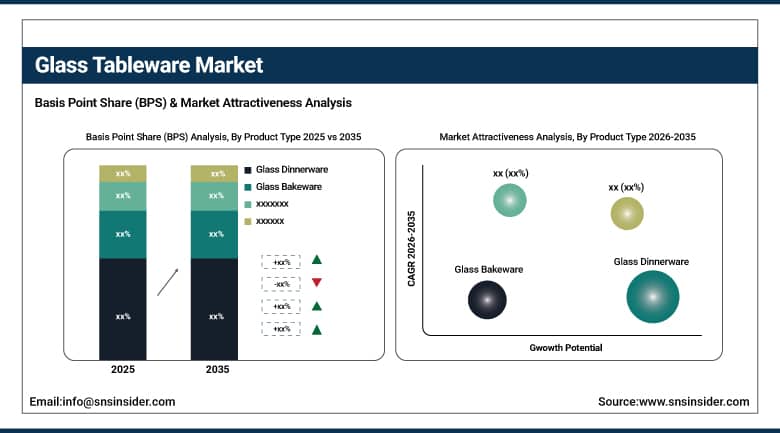
By Product Type, glass dinnerware dominated the market with 41.21% share in 2025; glass bakeware is the fastest growing segment with the highest CAGR.
-
By Material Type, soda-lime glass dominated the market with 52.31% share in 2025; borosilicate glass is the fastest growing segment with the highest CAGR.
-
By Distribution Channel, supermarkets/hypermarkets dominated the market with 38.45% share in 2025; online retail / e-commerce is the fastest growing segment with the highest CAGR.
-
By Product Design, plain/standard glassware dominated the market with 44.56% share in 2025; luxury crystal tableware is also the fastest growing segment with a CAGR.
By Product Type, glass dinnerware dominates the glass tableware market, while glass bakeware is the fastest-growing segment.
Glass dinnerware segment dominates the market with the highest revenue share of about 41.21% in 2025, owing to the increasing use of glass dinnerware across residential homes, hotels, restaurants, and catering services. Growing popularity of attractive and microwave-safe tableware has been contributing significantly to the growth of the market.
Glass bakeware is expected to register the highest CAGR during 2026–2035, driven by rising home baking trends, increasing influence of social media cooking content, expansion of modern kitchen lifestyles, and growing demand for heat-resistant and multi-functional cookware.
By Material Type, soda-lime glass dominates the glass tableware market, while borosilicate glass is the fastest-growing segment.
Soda-lime glass held the largest share of about 52.31% in 2025, which can be attributed to the relatively cheaper manufacturing cost, easier availability of raw materials, and suitability for large scale manufacture. It has a wide range of applications in consumer tableware products like plates, bowls, and glasses. Hence, it is the most commercially preferred product among the others.
Borosilicate glass is projected to grow at the fastest CAGR during 2026–2035, due to high durability and thermal strength as well as longer lifespan of the products made from this material. High consumption of heat resistant and premium quality kitchenware products due to increasing awareness about the safety and durability of the product is driving the adoption rate.
By Distribution Channel, supermarkets/hypermarkets dominate the glass tableware market, while online retail/e-commerce is the fastest-growing segment.
Supermarkets and hypermarkets accounted for around 38.45% share in 2025, supported by strong offline retail penetration, product visibility, and consumer preference for physical inspection before purchase. These retail formats offer bundled promotions, seasonal discounts, and immediate product availability, making them a dominant channel especially for household buyers and bulk purchasers.
Online retail and e-commerce platforms are expected to expand at the highest CAGR during 2026–2035, fueled by the fast adoption of technology, high penetration rates of smartphones, and increased demand for doorstep delivery, online shopping is receiving a significant boost from expanding range of products, competitive pricing, effective marketing through influencers, and comparison options.
By Product Design, plain/standard glassware dominates the market, while luxury crystal tableware is the fastest-growing segment.
Plain/standard glassware dominate the market with a share of about 44.56% in 2025, chiefly because of its relatively inexpensive nature, accessibility, and wide use in day-to-day domestic and commercial purposes. The cost-effective nature of the product makes it the most economical option among all others for widespread usage in international markets.
Luxury crystal tableware is projected to grow at the fastest CAGR during 2026–2035, due to the increasing levels of disposable income, growing interest in superior-quality dining, and development of luxury hospitality establishments. The rising preference of consumers for stylish homes, gifting, and luxury lifestyle items is adding further impetus to demand.
Regional Analysis:
|
Region |
Major Country |
Share within Region, 2025(%) |
|---|---|---|
|
North America |
United States |
76.54% |
|
Europe |
Germany |
29.38% |
|
Asia Pacific |
China |
52.36% |
|
Middle East & Africa |
UAE |
31.26% |
|
Latin America |
Brazil |
36.69% |
North America Glass Tableware Market Insights
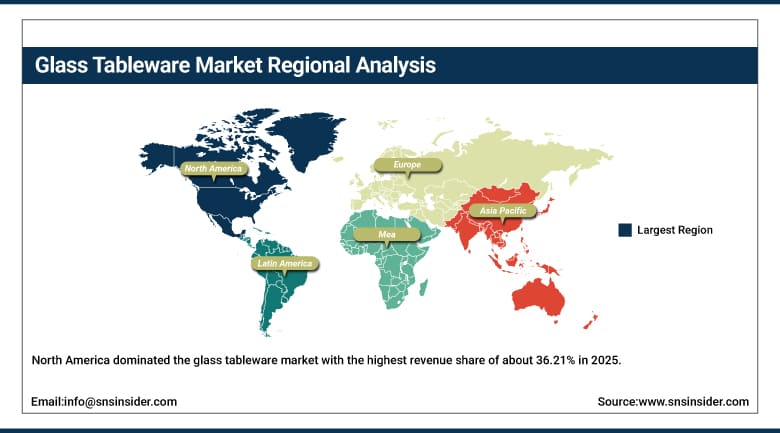
North America dominated the glass tableware market with the highest revenue share of about 36.21% in 2025, because of high demand from residential households, hospitality chains, and premium dining culture in both the United States and Canada. The high demand for durable and aesthetic tableware that can be used in microwave ovens, together with strong distribution channels, is greatly helping to build regional dominance. Existing foodservice industry and increasing demand for luxurious dining experiences are adding another dimension to the growth of the market.
A major development across North America is the shift toward sustainable glass manufacturing using recycled raw materials and energy-efficient production processes. Driven by increasing consumer environmental awareness and regulatory pressure to reduce single-use plastics, manufacturers are investing in circular economy practices and low-emission production technologies.
Get Customized Report as Per Your Business Requirement - Enquiry Now
Europe Glass Tableware Market Insights
Europe represents a key mature market for glass tableware, powered by high design orientation, strong consumer inclination towards premium glassware products, and stringent policies related to environmental sustainability. The countries which are driving the demand include Germany, France, the United Kingdom, and Italy owing to their developed hospitality industry, café culture, and use of high-end glassware products during dining. Growing emphasis on reduction of plastic material and increasing preference for reusable and recyclable tableware is adding impetus to the growth of the market. Growth in boutique restaurants, luxury hotels, and heritage dining places is also propelling the demand for premium designer glass tableware products in the region.
Asia Pacific Glass Tableware Market Insights
Asia Pacific is expected to be the fastest-growing region of about 8.62% CAGR from 2026-2035 in the glass tableware market owing to factors such as fast-paced urbanization, high disposable incomes, and an expanding middle class in nations such as China, India, Japan, and Southeast Asia. The trend towards modernization in lifestyles, increased number of retail outlets, and the growing phenomenon of dining out are some of the major forces that are influencing demand for glassware. High growth rates in residential constructions and hospitality infrastructures have also contributed positively to the expansion in the region.
Middle East & Africa and Latin America Glass Tableware Market Insights
Middle East & Africa (MEA) and Latin America regions are witnessing steady growth in the glass tableware market as a result of increased urbanization, expansion of facilities within the hospitality industry, and changing consumer preference towards contemporary ways of dining. In MEA, nations like UAE, Saudi Arabia, and South Africa are the ones leading the trend due to the fast growth of luxury hotels, restaurants, and tourism related infrastructure. In Latin America, two important countries that contribute significantly are Brazil and Mexico with the growing consumption trends of the middle class population and the growing network of organized retailing. In Latin America, the development of urban housing coupled with retail chains of supermarkets is helping in this regard.
Market Dynamics:
Growth Drivers: Rising demand for premium, durable, and aesthetically enhanced dining solutions is accelerating adoption of glass tableware globally
The trend among consumers for durable, clean, and attractive tableware is increasingly pushing up the demand for glass tableware. The factors of urbanization, increasing disposable income, and growing foodservice industry are other major factors that are fueling the market demand. Consumers are becoming more inclined toward microwavable, washable, and environment-friendly products rather than using plastics and poor-quality materials. Moreover, the growing practice of home dining because of changing lifestyle and social media influence is motivating people to replace their kitchenware items.
Restraints: High fragility and availability of low-cost substitutes are limiting widespread adoption of glass tableware products
The glass tableware industry is hindered by the nature of glass being breakable during transportation, handling, and use, despite the demand being very high. The cost of replacements is therefore high for the end-user and companies using the products. The competition posed by cheaper alternatives like plastics, steel, and ceramic tableware further limits the growth potential of the industry. The cheaper alternative is preferred by many smaller restaurants because of financial reasons. Fluctuations in the prices of inputs used in glass production may further influence pricing stability.
Opportunities: Rising demand for sustainable, premium, and design-driven tableware is creating strong growth opportunities in the glass tableware market
The increasing focus of the world on sustainability and decrease in the use of plastics is resulting in some very lucrative opportunities for glass tableware companies. The growing inclination towards recyclable and reusable dining products has paved the way for a switch towards glass tableware items both at domestic and business levels. The demand for premium products and luxury dining along with beautiful home decors is adding new prospects for designer and crystal glass tablewares. Advances in technology for strengthening glass products and making them lightweight and heat-resistant has helped the manufacturers to produce stronger products with added flexibility.
Recent Developments
-
2026: Libbey Inc. expanded its North America portfolio with enhanced tempered and impact-resistant glass tableware, focusing on improved durability and reduced breakage for hospitality and foodservice applications.
-
2026: Arc International increased production of eco-friendly, lead-free glass tableware using recycled glass and energy-efficient manufacturing processes to meet rising sustainability-driven demand.
-
2025: Anchor Hocking launched upgraded microwave-safe and scratch-resistant glass bakeware and dinnerware, targeting growing home cooking and premium household usage trends.
-
2025: Ocean Glass expanded its premium glass tableware exports with new crystal-style collections, strengthening presence in hospitality and gifting markets across global regions.
Glass Tableware Market Key Players are:
-
Arc International
-
Libbey Inc.
-
Bormioli Rocco
-
Pasabahce
-
Duralex
-
Sisecam
-
Anchor Hocking
-
Ocean Glass Public Company Limited
-
La Opala RG Limited
-
Borosil Limited
-
Krosno Glass
-
Zwiesel Glas
-
Riedel Crystal
-
Spiegelau
-
Nachtmann
-
Corelle Brands
-
Villeroy & Boch
-
Bonna Sera
-
Arcoroc
-
Ocean International (Glassware Division)
Glass Tableware Market Report Scope:
| Report Attributes | Details |
|---|---|
| Market Size in 2025 | USD 11.25 Billion |
| Market Size by 2035 | USD 24.25 Billion |
| CAGR | CAGR of 8.01% From 2026 to 2035 |
| Base Year | 2025 |
| Forecast Period | 2026-2035 |
| Historical Data | 2022-2024 |
| Report Scope & Coverage | Market Size, Segments Analysis, Competitive Landscape, Regional Analysis, DROC & SWOT Analysis, Forecast Outlook |
| Key Segments | • By Product Type (Glass Dinnerware, Glass Drinkware, Glass Serveware, Glass Bakeware, Others) • By Material Type (Soda-Lime Glass, Borosilicate Glass, Crystal Glass, Tempered Glass) •By Distribution Channel (Supermarkets/Hypermarkets, Specialty Stores, Online Retail / E-commerce, Wholesale & B2B Distributors) • By Product Design (Plain/Standard Glassware, Decorative/Designer Glassware, Printed/Patterned Glassware, Luxury Crystal Tableware) |
| Regional Analysis/Coverage | North America (US, Canada), Europe (Germany, UK, France, Italy, Spain, Russia, Poland, Rest of Europe), Asia Pacific (China, India, Japan, South Korea, Australia, ASEAN Countries, Rest of Asia Pacific), Middle East & Africa (UAE, Saudi Arabia, Qatar, South Africa, Rest of Middle East & Africa), Latin America (Brazil, Argentina, Mexico, Colombia, Rest of Latin America). |
| Company Profiles | Arc International, Libbey Inc., Bormioli Rocco, Pasabahce, Duralex, Sisecam, Anchor Hocking, Ocean Glass Public Company Limited, La Opala RG Limited, Borosil Limited, Krosno Glass, Zwiesel Glas, Riedel Crystal, Spiegelau, Nachtmann, Corelle Brands, Villeroy & Boch, Bonna Sera, Arcoroc, Ocean International (Glassware Division). |

Frequently Asked Questions
The glass tableware market is expected to grow at a CAGR of 8.01% from 2026 to 2035.
The glass tableware market was valued at USD 11.25 billion in 2025.
Rising demand from residential housing, hospitality, foodservice industry, and premium lifestyle dining is driving adoption of Glass Tableware globally.
The glass dinnerware segment dominated the Glass Tableware market in 2025.
North America dominated the Glass Tableware market in 2025.
