
Trenchless Pipe Rehabilitation Market Report Scope & Overview:
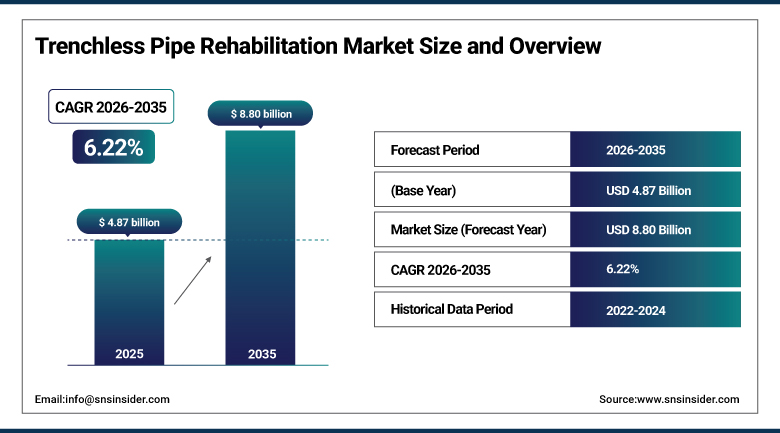
The Trenchless Pipe Rehabilitation Market was valued at USD 4.87 Billion in 2025 and is expected to reach USD 8.80 Billion by 2035, growing at a CAGR of 6.22% from 2026 to 2035.
The trenchless pipe rehabilitation market is positioned strategically within the global water infrastructure, wastewater treatment systems, and industrial pipelines industries, providing an innovative array of engineering solutions that allow for the restructuring, capacity restoration, and prolongation of aged underground pipelines without resorting to the expensive, disruptive, and destructive excavation necessary in the traditional dig-and-replacement approach to pipe repair. The basic economic value proposition behind trenchless pipe rehabilitation is based on the ability to perform durable pipe repairs of sewage, water mains, storm drainage pipes, and industrial pipelines with dramatically lower costs compared to traditional pipe repair procedures.
Globally, more than 800,000 miles (1.29 million km) of public sewer pipelines and over 2.2 million miles (3.5 million km) of drinking water distribution pipelines are in operation, with a significant portion exceeding 40–60 years of age.
To Get more information Trenchless Pipe Rehabilitation Market - Request Free Sample Report
Trenchless Pipe Rehabilitation Market Trends
-
Rapid aging of urban water and wastewater infrastructure in developed economies is driving accelerated municipal pipeline rehabilitation investment globally.
-
Cured-in-place pipe (CIPP) technology adoption is expanding into larger-diameter and higher-pressure applications through materials and process innovation.
-
Digitalization of pipeline inspection through AI-assisted CCTV analysis and robotics is improving rehabilitation planning efficiency and targeting accuracy.
-
Environmental regulations governing combined sewer overflow reduction and water loss control are creating structural compliance-driven demand for trenchless rehabilitation.
-
Emerging economies in Asia Pacific and Latin America are launching large-scale urban water infrastructure upgrade programs requiring trenchless rehabilitation technology deployment.
The U.S. Trenchless Pipe Rehabilitation Market Outlook
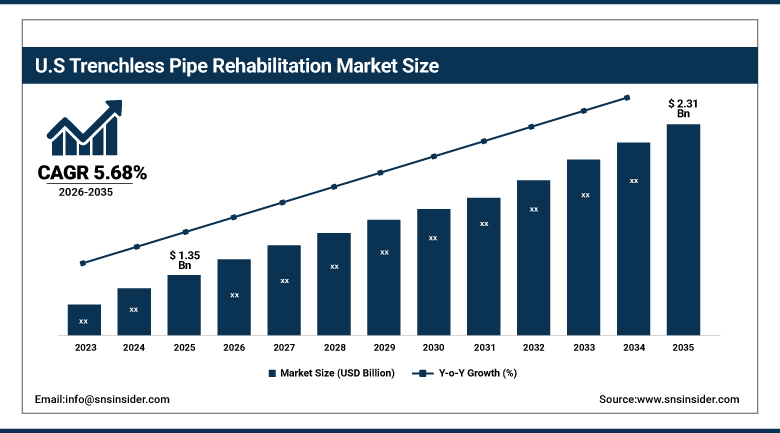
The U.S. Trenchless Pipe Rehabilitation Market was valued at USD 1.35 Billion in 2025 and is expected to reach USD 2.31 Billion by 2035, growing at a CAGR of 5.68%.
The United States is the largest national market for trenchless pipe rehabilitation in the world due to its extremely high concentration of old underground pipeline infrastructure, mature legal regulation requiring elimination of sanitary sewer overflow and combined sewer overflow, and developed infrastructure of contracting and technology providers enabling complex trenchless pipe rehabilitation projects implementation in all possible areas of municipal and industrial pipelines. The enforcement mechanism provided by the Clean Water Act of the US Environmental Protection Agency together with sewer systems consent decree investments required by municipalities ensures relatively steady market demand for trenchless pipe rehabilitation services regardless of the budgetary situation in municipalities.
Insituform Technologies, operating as part of Aegion Corporation, announced in 2025 the successful completion of a major CIPP lining project for a metropolitan U.S. water utility, rehabilitating over 15 miles of deteriorated large-diameter sewer trunk mains using its proprietary UV-cured glass fiber liner system, demonstrating the continued technical evolution and project scale capability of modern CIPP technology platforms.
Trenchless Pipe Rehabilitation Market Segment Analysis
-
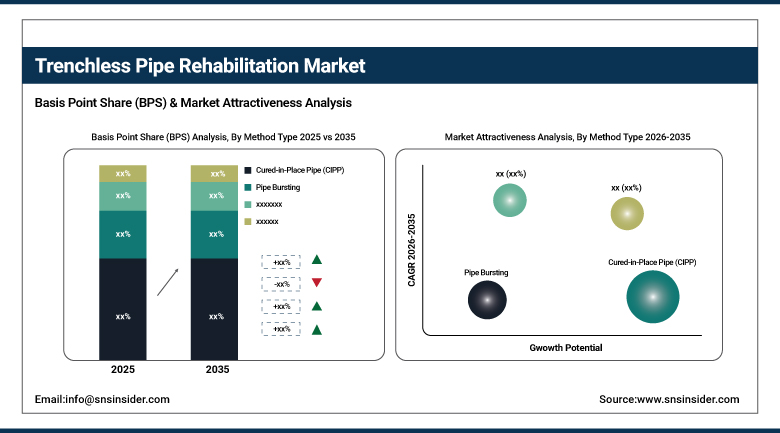
By Method Type, cured-in-place pipe (CIPP) dominated the market with 42.06% share in 2025, while pipe bursting is the fastest growing method type with the highest CAGR of 7.43% from 2026 to 2035.
-
By Pipe Diameter, below 18 inches dominated the market with 55.29% share in 2025, while above 36 inches is the fastest growing diameter segment with the highest CAGR of 7.69% from 2026 to 2035.
-
By Application, wastewater pipes dominated the market with 46.11% share in 2025, while water main pipes is the fastest growing application segment with the highest CAGR of approximately 7.10% from 2026 to 2035.
-
By Material, polyvinyl chloride (PVC) dominated the market with 31.15% share in 2025, while polyethylene (PE/HDPE) is the fastest growing material type with the highest CAGR of 6.18% from 2026 to 2035.
By Method Type, cured-in-place pipe (CIPP) dominates the trenchless pipe rehabilitation market, while pipe bursting is the fastest-growing segment.
Cured-in-place pipe (CIPP) segment dominated the market with the highest revenue share of 42.06% in 2025 owing to its unparalleled versatility across pipeline diameters, materials, and structural conditions, its established contractor ecosystem and well-understood installation protocols, and its proven performance track record spanning over four decades of municipal sewer and water main rehabilitation applications globally. The technology's ability to restore structural integrity, eliminate infiltration and exfiltration, and renew hydraulic capacity without pipeline excavation across pipe diameters ranging from 6 inches to over 100 inches continues to position CIPP.
Pipe bursting segment is estimated to register the highest CAGR during the forecast period of 2026–2035 driven by the growing proportion of municipal water and sewer pipeline rehabilitation projects requiring full structural replacement rather than structural lining, particularly as aging cast iron and vitrified clay sewer systems transition beyond the point where structural lining can provide adequate long-term performance.
By Pipe Diameter, below 18 inches dominates the trenchless pipe rehabilitation market, while above 36 inches is the fastest-growing segment.
Below 18 Inches segment dominated the trenchless pipe rehabilitation market with the highest revenue share of 55.29% in 2025 due to the numerically dominant population of small-diameter sewer laterals, water service connections, and distribution mains that constitute the vast majority of underground pipeline network assets managed by municipal water and wastewater utilities globally. The high prevalence of deterioration-related defects including root intrusion, joint separation, cracking, and corrosion in small-diameter sewer collection system pipes, combined with the operational simplicity and cost-effectiveness of small-diameter CIPP and pipe bursting installations, sustains robust and consistent demand for small-diameter rehabilitation services across virtually every municipal market globally.
The above 36 Inches segment is projected to register the highest CAGR during the forecast period of 2026–2035 owing to the accelerating rehabilitation investment requirements of large-diameter trunk sewer mains and transmission water mains that represent disproportionately high infrastructure asset values and service consequence risks within municipal pipeline networks.
By Application, wastewater pipes dominate the trenchless pipe rehabilitation market, while water main pipes are the fastest-growing segment.
Wastewater pipes segment emerged as the market leader with a dominant share of 46.11% in 2025 owing to the severe and widespread structural deterioration affecting sanitary sewer collection systems in developed economies, the strong regulatory compliance drivers associated with sanitary sewer overflow and combined sewer overflow elimination consent decrees, and the long-established commercial maturity of CIPP and pipe bursting technologies for sewer rehabilitation applications.
Water main pipes segment is anticipated to record the fastest CAGR throughout the forecast period of 2026–2035 driven by growing regulatory and public pressure on municipal water utilities to reduce non-revenue water losses, eliminate lead service line contamination risks, and improve drinking water system reliability through proactive rehabilitation of deteriorated transmission and distribution mains. The combination of tightening water loss control regulations, increasing consumer sensitivity to water quality and supply reliability, and expanding water main rehabilitation technology capability is generating accelerating investment in trenchless water main rehabilitation across major North American, European, and emerging market municipal water systems.
By Material, polyvinyl chloride (PVC) dominates the trenchless pipe rehabilitation market, while polyethylene (PE/HDPE) is the fastest-growing segment.
Polyvinyl chloride (PVC) segment dominated the trenchless pipe rehabilitation material market with the highest revenue share of 31.15% in 2025 because of the properties of the substance, such as the resistance to chemicals, physical performance, installation flexibility, and overall cost-efficiency throughout the entire trenchless pipeline rehabilitation process, from CIPP felt tube impregnation to the production of slippipes, up to and including spray-in-place pipe coating formulations. The well-developed supply chain and production capability associated with PVC rehabilitation materials, in addition to its widespread recognition among the technical specifications of municipalities and construction contractors, continue to sustain its dominance in the trenchless rehabilitation industry.
Polyethylene (PE/HDPE) is expected to experience high growth from 2026 to 2035 owing to its exceptional pressure-resistance ability, chemical resistance, joint fusion strength, and suitability for aggressive soil conditions and groundwater, which makes PE/HDPE an excellent choice for pipe-bursting replacement pipes and close-fitting lining applications in addition to its use in industrial pipeline rehabilitation projects. The increasing usage of polyethylene in water main rehabilitation projects where pressure resistance is vital has further extended the use of PE/HDPE beyond its conventional application in the rehabilitation of industrial and chemical pipelines.
Regional Analysis
|
Region |
Major Country |
Share within Region, 2025 (%) |
|---|---|---|
|
North America |
United States |
72.45% |
|
Europe |
Germany |
31.16% |
|
Asia Pacific |
China |
41.06% |
|
Middle East & Africa |
UAE |
31.21% |
|
Latin America |
Brazil |
35.24%% |
North America Trenchless Pipe Rehabilitation Market Insights
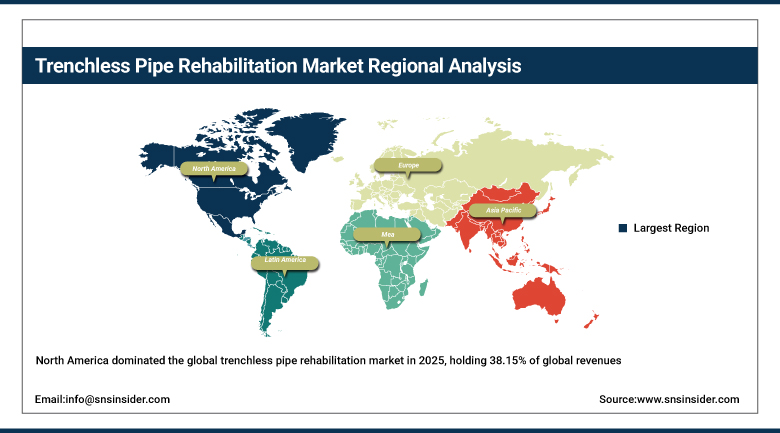
North America dominated the global trenchless pipe rehabilitation market in 2025, holding 38.15% of global revenues, where the United States represents 72.45% of the regional revenue. The dominance of this region is attributed to the unique presence of an aging network of water and wastewater infrastructure that needs to be rehabilitated, a rigorous regulatory environment that ensures sewer overflow control and the quality of the drinking water, as well as the most advanced commercial ecosystem in terms of suppliers of trenchless rehabilitation technologies, specialty contracting firms and municipal engineering consultants who have the capability to undertake extensive pipeline rehabilitation projects.
Canada also provides significant volume in terms of the regional market as a result of its substantial urban water and wastewater infrastructure rehabilitation programs.
The American Water Works Association estimates that U.S. drinking water utilities face a USD 1 trillion infrastructure investment gap over the next 25 years, with pipe rehabilitation and replacement representing the largest single component of this investment requirement, underscoring the structural depth and durability of long-term trenchless rehabilitation market demand across North America.
Get Customized Report as per Your Business Requirement - Enquiry Now
Europe Trenchless Pipe Rehabilitation Market Insights
The European trenchless pipe rehabilitation market is known to be the second largest regional market in terms of size, with an advanced ecosystem in terms of both contractor services and technologies, comprehensive regulations in terms of urban wastewater management as well as water framework directives within the EU region, and large amounts of aging sewage and water mains that provide steady demand for rehabilitation services in Western European cities. The European revenue leader is Germany – being the most powerful economy of the continent, Germany was the pioneer of trenchless technologies such as pipe bursting, spiral wound lining, and CIPP.
Europe's urban wastewater sector investment, supported by the EU Urban Wastewater Treatment Directive and Water Framework Directive compliance requirements, generates over EUR 15 billion annually in sewer system rehabilitation and upgrade expenditure, with trenchless rehabilitation technologies capturing a growing share as their cost and disruption advantages over open-cut methods become increasingly compelling in congested urban environments.
Asia Pacific Trenchless Pipe Rehabilitation Market Insights
Asia Pacific is the fastest-growing regional trenchless pipe rehabilitation market, projected to expand at a CAGR of 6.99% through 2035, driven by the extraordinary scale of urban water infrastructure investment programs underway across China, India, Southeast Asia, and Australia as these rapidly urbanizing economies address decades of underinvestment in water supply and wastewater collection infrastructure. China represents the dominant national market within the Asia Pacific region, with its ongoing urbanization program, expanding municipal wastewater treatment network, and growing governmental recognition of the economic and environmental costs of deteriorated underground pipeline infrastructure generating substantial and accelerating demand for trenchless pipe rehabilitation technology across its vast and rapidly expanding urban pipeline network.
China's urban pipeline network exceeds 800,000 kilometers of water supply and wastewater pipes, a substantial portion of which was installed during the rapid urbanization of the 1980s and 1990s and is now entering accelerated deterioration requiring rehabilitation investment, creating one of the world's largest potential markets for trenchless pipe rehabilitation technology deployment over the coming decade.
MEA & Latin America Trenchless Pipe Rehabilitation Market Insights
Middle East, Africa, and Latin American regions denote lucrative and emerging markets for trenchless pipe rehabilitation driven by increasing investments in urban water infrastructure systems, heightened regulation of non-revenue water management and sewage treatment processes, and higher government spending on urban infrastructure development projects, all of which contribute to higher purchases of trenchless rehabilitation technologies. The United Arab Emirates generates the highest revenues from the Middle East and Africa regional market owing to its advanced urban infrastructure development programs, highly effective water utility management system, and dedication towards non-revenue water management through trenchless pipeline rehabilitation.
The UAE water sector invested significantly in non-revenue water reduction programs targeting their aging distribution network, with trenchless pipe rehabilitation technologies playing a central role in delivering water loss control objectives across the Emirates. In Latin America, Brazil accounted for 46% of regional revenues driven by its large urban water utility base and growing municipal investment in sewer and water main rehabilitation programs across its major metropolitan areas.
Market Dynamics
Growth Drivers: Aging infrastructure investment imperative and environmental compliance mandates
The leading driver behind the expansion of the trenchless pipe rehabilitation industry is the ongoing degradation of the global underground water and wastewater pipelines, which were mostly installed from the 1940s through the 1980s and are approaching the end of their operational lifetime within the next several decades, thus forming the basis for a huge and unavoidable demand for investment in repair and replacement operations. The necessity to address the environmental and health-related problems connected to the elimination of sanitary sewer overflows, reduction of combined sewer overflows, and non-revenue water problems creates additional incentives for municipal companies to implement rehabilitation projects, especially with regulatory obligations driving the market through different phases of the budget and economic cycles.
The economic advantage of trenchless solutions compared to open-cut replacement, which normally comes with savings of up to 60% in total project costs, combined with the lack of associated traffic congestion, surface repairs, and other expenses, provides a clear economic incentive for choosing trenchless rehabilitation.
Restraints: Contractor capacity constraints and technology adoption barriers in emerging markets
The unique requirement for specific equipment, skilled labor, and technical know-how involved in installing trenchless rehabilitation technology creates capacity restraints for contractors, which can result in restraints on the number of projects completed when there is an increasing need for rehabilitation in the market but a lack of supply of qualified specialists in the trenchless rehabilitation field. The financial burden of setting up the infrastructure needed for trenchless rehabilitation, involving the purchase of special CIPP equipment, pipe bursting equipment, inspection, and preparation equipment, coupled with technical education for creating skilled labor, poses a high barrier to entry into the industry.
Opportunities: Smart water network integration and emerging market infrastructure expansion
Integrating trenchless pipe rehabilitation into wider smart water networks initiatives presents a noteworthy new opportunity, because municipal water utility companies have been showing increasing interest in sensor-based rehabilitation liners, structural condition monitoring solutions, and pipeline management platforms that demand the physical rehabilitation of aging pipelines as a prerequisite to using such smart systems. By combining investments in rehabilitation and the deployment of digital infrastructure, companies have the opportunity to engage with more complex projects, higher contract values, and ongoing maintenance needs of trenchless rehabilitation technology firms able to provide rehabilitation and monitoring solutions together.
Recent Developments:
-
2025: Aegion Corporation (Insituform) launched its next-generation UV-cured glass fiber CIPP lining system featuring enhanced structural performance specifications, reduced installation time, and integrated post-installation inspection capability, targeting large-diameter municipal sewer trunk main rehabilitation projects across North American and European utility markets.
-
2025: Sekisui Americas SPR introduced an advanced spiral wound lining system for large-diameter sewer rehabilitation incorporating improved structural connection mechanisms, enhanced hydraulic performance, and expanded diameter range capability up to 144 inches, targeting major metropolitan sewer rehabilitation programs requiring trenchless rehabilitation in active-flow conditions.
-
2026: LMK Technologies commercialized its proprietary robotic CIPP lateral lining system featuring automated liner placement, UV curing capability, and integrated post-lining inspection, significantly reducing the installation time and crew size requirements for residential sewer lateral rehabilitation applications.
-
2026: Trelleborg AB expanded its range of close-fit polyethylene pipe lining systems for water main rehabilitation, introducing enhanced fusion joint technology and a broader diameter range supporting distribution main rehabilitation programs for municipal water utilities across Europe and North America.
Trenchless Pipe Rehabilitation Market Key Players are:
-
Aegion Corporation (Insituform)
-
Granite Construction Incorporated
-
Sekisui Americas SPR
-
SAERTEX MultiCom GmbH
-
IMPREG GmbH
-
LMK Technologies
-
Perma-Liner Industries LLC
-
Ashimori Industry Co. Ltd.
-
Inland Pipe Rehabilitation (IPR)
-
Reline Group
-
SAK Construction LLC
-
Michels Corporation
-
Layne Inliner LLC
-
Primus Line GmbH
-
Trelleborg AB
-
Norditube Technologies AB
-
Bayou City Pipe Rehabilitation
-
CIPP Corporation
-
Inliner Technologies LLC
-
HammerHead Trenchless Equipment Inc.
The Trenchless Pipe Rehabilitation Market Report Scope:
| Report Attributes | Details |
|---|---|
| Market Size in 2025 | USD 4.87 Billion |
| Market Size by 2035 | USD 8.80 Billion |
| CAGR | CAGR of 6.22% From 2026 to 2035 |
| Base Year | 2025 |
| Forecast Period | 2026-2035 |
| Historical Data | 2022-2024 |
| Report Scope & Coverage | Market Size, Segments Analysis, Competitive Landscape, Regional Analysis, DROC & SWOT Analysis, Forecast Outlook |
| Key Segments | • By Method Type (Cured-in-Place Pipe (CIPP), Pipe Bursting, Sliplining, Spray-In-Place Pipe (SIPP), Spiral Wound Lining, Others) • By Pipe Diameter (Below 18 Inches, 18–36 Inches, Above 36 Inches) • By Application (Wastewater Pipes, Water Main Pipes, Stormwater Drainage Pipes, Industrial Pipelines, Others) • By Material (Polyvinyl Chloride (PVC), Polyethylene (PE/HDPE), Fiberglass Reinforced Polymer (FRP), Epoxy & Resin-Based Liners, Others) |
| Regional Analysis/Coverage | North America (US, Canada), Europe (Germany, UK, France, Italy, Spain, Russia, Poland, Rest of Europe), Asia Pacific (China, India, Japan, South Korea, Australia, ASEAN Countries, Rest of Asia Pacific), Middle East & Africa (UAE, Saudi Arabia, Qatar, South Africa, Rest of Middle East & Africa), Latin America (Brazil, Argentina, Mexico, Colombia, Rest of Latin America). |
| Company Profiles | Aegion Corporation (Insituform), Granite Construction Incorporated, Sekisui Americas SPR, SAERTEX MultiCom GmbH, IMPREG GmbH, LMK Technologies, Perma-Liner Industries LLC, Ashimori Industry Co. Ltd., Inland Pipe Rehabilitation (IPR), Reline Group, SAK Construction LLC, Michels Corporation, Layne Inliner LLC, Primus Line GmbH, Trelleborg AB, Norditube Technologies AB, Bayou City Pipe Rehabilitation, CIPP Corporation, Inliner Technologies LLC, HammerHead Trenchless Equipment Inc |

Frequently Asked Questions
The trenchless pipe rehabilitation market is expected to grow at a CAGR of 6.22% from 2026 to 2035.
The trenchless pipe rehabilitation market was valued at USD 4.87 Billion in 2025.
The primary growth factors include aging water and wastewater pipeline infrastructure, stricter environmental regulations, and the cost and operational advantages of trenchless rehabilitation over conventional open-cut replacement methods.
The pipe bursting is among the fastest-growing method type segments in the trenchless pipe rehabilitation market.
North America dominated the trenchless pipe rehabilitation market in 2025, holding 38.15% of global revenues, with the united states accounting for 72.45% of north american revenues.
