
Streetwear Market Report Scope & Overview:
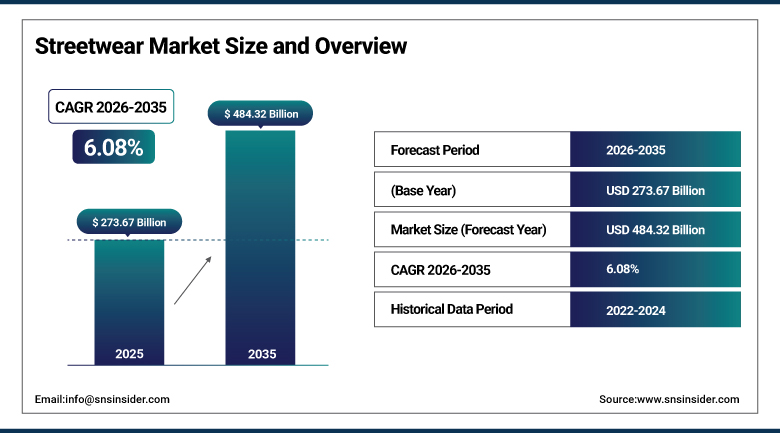
The Streetwear Market size was valued at USD 273.67 billion in 2025 and is projected to reach around USD 484.32 billion by 2035, growing at a CAGR of 6.08% during 2026–2035.
Streetwear Market is observing a consistent growth trend on a global scale, attributed to the growing importance of fashion culture centered around young people, social media-driven trends, and a high level of convergence between sports-wear, luxury wear, and casual wear segments. The increasing importance of consumers belonging to Gen Z and Gen Alpha is having a substantial impact on changing consumption patterns, which include more interest in limited releases, sneakers, and influencer-led fashion ecosystems. The fast-growing reach of e-commerce and D2C streetwear brands is fueling market dynamics even further.
Nike and Nike-owned Converse continue to expand their collaboration-driven sneaker releases with global artists and designers, while Adidas is strengthening its performance-lifestyle crossover strategy through new Yeezy-independent streetwear lines and sports-luxury partnerships. LVMH-owned brands such as Louis Vuitton and Off-White are further pushing luxury-streetwear convergence through limited capsule drops and digital-first marketing campaigns.
Market Size and Forecast
-
Market Size in 2025: USD 273.67 Billion
-
Market Size by 2035: USD 484.32 Billion
-
CAGR: 6.08% from 2026 to 2035
-
Base Year: 2025
-
Forecast Period: 2026–2035
-
Historical Data: 2022–2024
To Get more information Streetwear Market - Request Free Sample Report
Streetwear Market Trends
-
Rising sneaker culture and limited-edition drops are driving scarcity-led demand in the streetwear market.
-
Growing influence of Gen Z and Gen Alpha is boosting demand for casual, oversized, and identity-driven fashion.
-
Expansion of e-commerce and D2C brands is accelerating global accessibility and faster product launches.
-
Luxury-streetwear collaborations are increasing premiumization and high-value capsule collections.
-
Social media, influencers, and celebrity collaborations are significantly enhancing brand reach and sales.
-
Growth of resale platforms is reshaping pricing dynamics and extending product lifecycle value.
-
Rising adoption of digital fashion, NFTs, and virtual drops is enabling hybrid physical–digital streetwear ecosystems.
U.S. Streetwear Market Size Outlook:
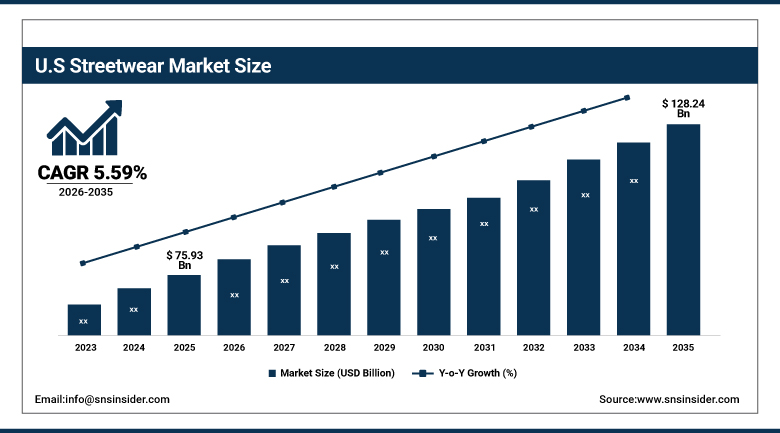
The U.S. Streetwear Market was valued at USD 75.93 billion in 2025 and is projected to reach around USD 128.24 billion by 2035, growing at a CAGR of 5.59% during 2026–2035.
The U.S. is still considered the biggest force behind streetwear, due to its strong sneaker culture and trends associated with hip hop and sports fashion, along with an increasing penetration of luxury-streetwear partnerships. High disposable incomes, rapid adaptation of releases and drops, and control over secondary sales websites like StockX and GOAT are some other key factors that facilitate growth in this regard. Moreover, there’s been a noticeable shift in demand towards premium hype products due to social media influence and Generation Z shoppers.
Recent developments highlight continued expansion of collaboration-led product strategies, with Nike and Jordan Brand launching multiple high-demand limited sneaker drops with global artists and athletes, reinforcing scarcity-driven demand in the U.S. market.
Additionally, StockX has expanded its authentication and real-time pricing intelligence platform in the U.S., improving transparency and strengthening its position as a key secondary marketplace for streetwear and sneakers.
Streetwear Market Segment Highlights
-
By Product Type, Apparel dominated the Streetwear Market with 54.15% share in 2025; Accessories fastest growing CAGR.
-
By Distribution Channel, Online Retail / E-commerce dominated the Streetwear Market with 42.15% share in 2025; Resale Platforms fastest growing CAGR.
-
By Consumer Type, Men segment dominated the Streetwear Market with 48.85% share in 2025; Women fastest growing CAGR.
-
By Price Positioning, Mass Market Streetwear dominated the Streetwear Market with 33.87% share in 2025; Luxury Streetwear also fastest growing CAGR.
-
By End User / Style Influence, Skateboarding Culture dominated the Streetwear Market with 20.54% share in 2025; High-Fashion / Luxury Fusion fastest growing CAGR.
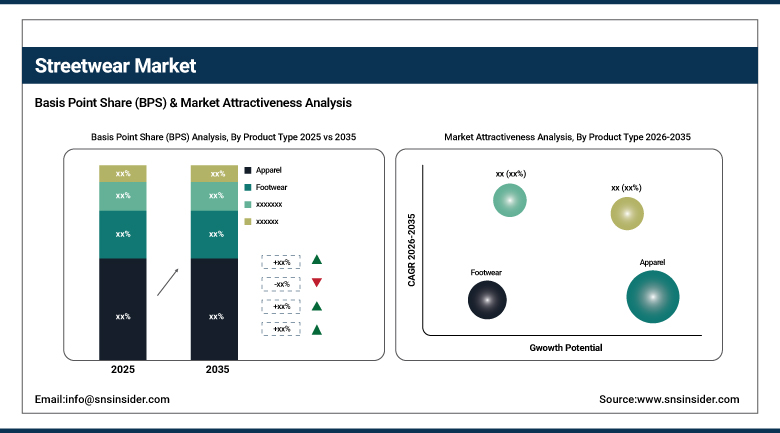
By Product Type, Apparel segment dominates the Streetwear Market, Accessories expected to grow fastest
In 2025, the Apparel segment maintained its dominant position in the Streetwear Market, accounting for 54.15% of total revenue. The driving force behind this trend in leadership can be attributed mainly to the rising demand for essential streetwear items like hoodies, T-shirts, sweatshirts, jeans, and jackets in the international market, which make up the backbone of urban streetwear fashion. This segment has been receiving a boost due to regular drops, collaboration deals, and the increasing acceptance of comfort fashion.
From 2026 to 2035, the Accessories segment is projected to record the highest CAGR. This growth is driven by increasing fashion diversification, rising demand for affordable entry-point streetwear products, and growing influence of styling accessories such as caps, bags, socks, and jewelry in completing streetwear aesthetics.
By Distribution Channel, Online Retail / E-commerce segment dominates the Streetwear Market, Resale Platforms expected to grow fastest
In 2025, the Online Retail / E-commerce segment held the largest share of 42.15% in the Streetwear Market, driven by the fast-paced growth of direct-to-consumer (D2C) brands, the global availability of streetwear is declining along with robust social media integration within e-commerce sites. The segment enjoys considerable success due to the release of limited-edition products, social media influence, and mobile purchasing habits of young customers.
The Resale Platforms segment is expected to register the highest CAGR from 2026 to 2035. Growth is driven by rising demand for limited-edition sneakers and exclusive collaborations, increasing price premiums in secondary markets, and stronger adoption of authentication-enabled platforms such as digital resale marketplaces.
By Consumer Type, Men segment dominates the Streetwear Market, Women expected to grow fastest
In 2025, the Men segment dominated the Streetwear Market with a 48.85% share, driven by strong adoption of sneaker culture, hip-hop influenced fashion, and sportswear-integrated streetwear styles. Historically, streetwear originated as a male-dominated category, and it continues to hold strong traction through collaborations, athletic wear influence, and celebrity-driven branding.
From 2026 to 2035, the Women segment is expected to record the highest CAGR. Such growth is supported by increased participation of women in sneaker culture, greater availability of streetwear lines dedicated to women, and a growing number of fashion bloggers and influencers active on social media. Another factor contributing to the fast development of women streetwear is a proliferation of gender-neutral fashion trends..
By Price Positioning, Mass Market Streetwear segment dominates the Streetwear Market, Luxury Streetwear expected to grow fastest
In 2025, the Mass Market Streetwear segment maintained its dominant position in the Streetwear Market, accounting for 33.87% of total revenue. The dominance is mainly attributed to the high demand for streetwear, which is largely affordable and accessible due to fast fashion, large-scale production of clothing, and the extensive use of casual attire in both developed and developing nations.
From 2026 to 2035, the Luxury Streetwear segment is projected to record the highest CAGR.
By End User / Style Influence, Skateboarding Culture segment dominates the Streetwear Market, High-Fashion / Luxury Fusion segment expected to grow fastest
In 2025, the Skateboarding Culture segment maintained its dominant position in the Streetwear Market, accounting for 20.54% of total revenue. The domination of this industry largely revolves around the heritage of streetwear rooted in skate communities, the relevance of brand image to skate-related products, and the influence of skate fashion trends within the casual fashion market globally. This category of apparel continues to be well-represented through brands and skate sub-culture communities in North America, Europe, and parts of Asia.
From 2026 to 2035, the High-Fashion / Luxury Fusion segment is projected to record the highest CAGR.
Regional Analysis
|
Region |
Major Country |
Share within Region (%) |
|---|---|---|
|
North America |
United States |
91.24% |
|
Europe |
Germany |
32.44% |
|
Asia Pacific |
China |
40.29% |
|
Middle East & Africa |
UAE |
23.19% |
|
Latin America |
Brazil |
33.59% |
North America Streetwear Market Insights
North America operates as the most mature and culturally influential region in the Streetwear Market, supported by strong sneaker culture, high purchasing power, and deep integration of fashion with music, sports, and celebrity-led branding. The area is fortunate enough to have an extremely sophisticated retail landscape, consisting of iconic streetwear boutiques, luxury fashion brands, and growing resale economy, all of which increase the demand for limited releases and collaborations. The US continues to be the leading country, mainly because of the spending habits of Generation Z, high level of social media involvement regarding fashion, and presence of premium/luxury streetwear.
Additionally, recent developments such as Nike expanding its SNKRS ecosystem with enhanced AI-driven drop personalization and exclusive membership-based releases and StockX strengthening real-time pricing intelligence and authentication infrastructure for resale streetwear and sneakers in North America are reinforcing innovation and transparency across the regional ecosystem.
Asia Pacific Streetwear Market Insights
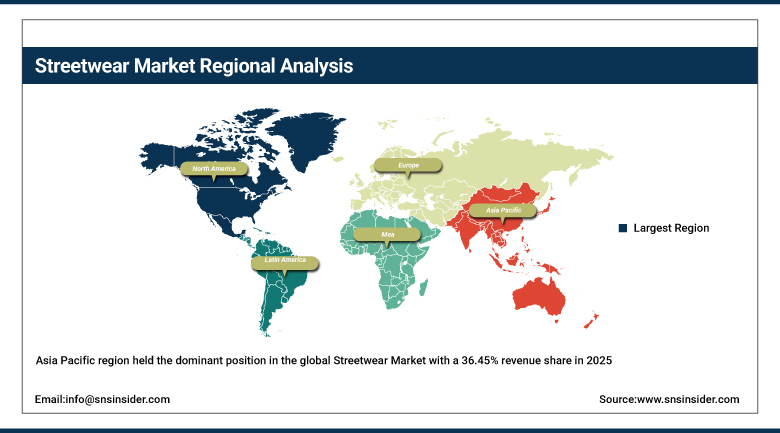
The Asia Pacific region held the dominant position in the global Streetwear Market with a 36.45% revenue share in 2025, and it is also projected to register the highest CAGR of 6.54% from 2026–2035, motivated by fast-growing urbanization, a growing number of young consumers, and an immense impact of fashion trends in K-fashion, J-fashion, and hip-hop. Countries like China, India, Japan, and South Korea are driving this growth trend due to their vibrant digital commerce networks and extensive acceptance of global and local streetwear.
Adidas and regional Asian designers have expanded limited-edition collaborations in China, Japan, and South Korea, driving stronger localization of global streetwear trends and boosting drop-based demand.
Alibaba’s Tmall and other e-commerce platforms have strengthened livestream shopping and drop-based fashion commerce models, significantly accelerating digital streetwear sales across Gen Z consumers in the region.
Get Customized Report as per Your Business Requirement - Enquiry Now
Europe Streetwear Market Insights
The European continent has an important presence within the Streetwear Market globally, with the continent having a rich history in luxury fashion industry, preference for high-end clothing by consumers, and incorporation of streetwear into high fashion brands. The UK, France, Germany, and Italy are major players in this market, with cities like Paris and Milan being international fashion centers affecting the fusion of streetwear and luxury fashion products. There is also growing interest in sustainable streetwear products in the region.
Zalando enhanced its AI-powered fashion recommendation and sustainable streetwear assortment strategy, improving personalization and driving eco-conscious streetwear adoption across key EU markets.
Additionally, rising popularity of fashion weeks featuring streetwear collections, expansion of boutique retail ecosystems, and increasing influence of youth-driven fashion subcultures are reinforcing Europe’s role as a key innovation-driven market for streetwear evolution.
Latin America, Middle East & Africa (LAMEA) Streetwear Market Insights
The LAMEA Streetwear Market is currently experiencing consistent growth due to factors like rising number of youths, urbanization, and greater influence of global pop culture and fashion trends in music and sports. Nations like Brazil, Mexico, United Arab Emirates (UAE), Saudi Arabia, and South Africa are now becoming important players in the market, courtesy of the development in retail sector and increased presence of global Streetwear brands.
Additionally, increasing partnerships between global streetwear brands and regional distributors, along with expansion of e-commerce platforms and influencer-led marketing ecosystems, are improving accessibility and strengthening market penetration across emerging economies.
UAE-based retail groups expanded premium streetwear and sneaker boutique formats in Dubai and Abu Dhabi, strengthening the region’s position as a luxury streetwear hub.
Streetwear Market Growth Drivers:
-
Rising dominance of sneaker culture, limited-edition drop economy, and luxury–streetwear convergence is driving strong demand for premium, scarcity-led fashion products across global urban consumers.
The critical structural factor affecting the global streetwear market is the rising trend towards identity-oriented fashion, where consumers—particularly Gen Z and Gen Alpha—are adopting fashion as an expression of their personalities associated with music, sports, and online influence. It has led to a sharp rise in demand for collaboration-based fashion, influencer fashion collections, and swift adoption of trends enabled by social media apps like Instagram and TikTok. Moreover, the swift growth of e-commerce, direct-to-consumer fashion brands, and global secondary marketplaces is impacting consumer behavior by providing them easy access to limited editions and insights into secondary market prices. The convergence of luxury fashion brands and streetwear fashion labels is also contributing to premiumization, driving streetwear into the lucrative lifestyle fashion and fashion-luxury hybrid categories.
Additionally, recent developments such as Nike expanding AI-driven SNKRS exclusive drop allocation and personalization engine across global markets to enhance demand targeting and reduce bot-driven purchases and StockX strengthening its real-time resale pricing index and authentication technology infrastructure to improve transparency and trust in global sneaker and streetwear trading ecosystems are reinforcing digitalization and scarcity-driven growth dynamics in the Streetwear Market.
Streetwear Market Restraints:
-
Rising dependence on fast-moving trend cycles, resale-driven pricing volatility, and counterfeit streetwear circulation is creating challenges for brand consistency and revenue predictability in the global Streetwear Market.
The primary structural constraint that influences the Streetwear Market is the rising volatility of the market due to hype-driven consumer behaviour and reduced lifecycles of products. Different from other apparel categories, streetwear tends to be more socially driven, influenced by celebrities and online trends, causing sudden volatility of demand. In turn, such volatility poses difficulties for brand managers who find it increasingly hard to manage inventory and predict future demand. Furthermore, a rising number of secondary and gray markets for the streetwear market make price control harder. A growing difference between the prices in retail shops and resale markets causes accessibility problems and reduces demand in mid-price range products.
Streetwear Market Opportunities:
-
Rising creator-driven commerce, resale ecosystems, and luxury–streetwear convergence is creating strong opportunities for premium drops and collaborations across digital and physical markets.
The main opportunity within the Streetwear Market is the fast-paced transformation of fashion consumption from an offline experience to a community-driven one, whereby influence, rarity, and identity become the key drivers behind consumer decisions. The emergence of social media celebrities, fashion influencers, and celebrity partnerships with streetwear brands creates the potential for extremely targeted drops that instantly reach a global audience and have high levels of emotional engagement. Moreover, the development of authenticated resale platforms and pricing intelligence will open up new income sources through secondary markets, which will not only enhance transparency but also elevate brand perception. Lastly, the integration of streetwear brands into luxury fashion labels and gaming/metaverse spaces presents a unique path forward in terms of creating hybrid physical-digital products.
Recent Developments:
-
2026: Supreme (VF Corporation) expanded its global drop strategy by increasing region-specific limited releases across North America, Europe, and Asia, strengthening scarcity-driven demand and improving control over resale market inflation through tighter product allocation systems.
-
2026: Puma enhanced its streetwear positioning through new celebrity-led collaborations and sports–fashion crossover collections, integrating digital-first marketing campaigns to accelerate Gen Z engagement across global urban markets.
-
2025: New Balance strengthened its premium sneaker streetwear portfolio through high-demand collaborations with independent designers and lifestyle brands, significantly boosting its presence in the luxury–streetwear crossover segment.
-
2025: StockX introduced upgraded market intelligence tools for sellers and buyers, including predictive resale pricing trends and improved authentication workflows, enhancing transparency and liquidity in the global sneaker resale ecosystem.
Streetwear Companies are:
-
Nike
-
Supreme (VF Corporation)
-
Off-White (LVMH)
-
BAPE (A Bathing Ape)
-
Stüssy
-
Puma
-
Vans (VF Corporation)
-
Converse (Nike Inc.)
-
Under Armour
-
Balenciaga (Kering)
-
Louis Vuitton (LVMH)
-
Gucci (Kering)
-
Palace Skateboards
-
Fear of God
-
Anti-Social Social Club
-
Carhartt WIP
-
Billionaire Boys Club
-
HUF Worldwide
Streetwear Market Report Scope:
| Report Attributes | Details |
|---|---|
| Market Size in 2025 | USD 273.67 Billion |
| Market Size by 2035 | USD 484.32 Billion |
| CAGR | CAGR of 6.08% From 2026 to 2035 |
| Base Year | 2025 |
| Forecast Period | 2026-2035 |
| Historical Data | 2022-2024 |
| Report Scope & Coverage | Market Size, Segments Analysis, Competitive Landscape, Regional Analysis, DROC & SWOT Analysis, Forecast Outlook |
| Key Segments | • By Product Type (Apparel, Footwear, Accessories, Others) • By Distribution Channel (Brand-Owned Stores, Online Retail / E-commerce, Multi-Brand Retail Stores, Resale Platforms, Specialty Streetwear Boutiques) • By Consumer Type (Men, Women, Unisex) • By Price Positioning (Mass Market Streetwear, Mid-Range Streetwear, Premium Streetwear, Luxury Streetwear) • By End User / Style Influence (Skateboarding Culture, Hip-Hop & Music Culture, Sports & Sneaker Culture, High-Fashion / Luxury Fusion, Digital / Influencer-led Streetwear) |
| Regional Analysis/Coverage | North America (US, Canada), Europe (Germany, UK, France, Italy, Spain, Russia, Poland, Rest of Europe), Asia Pacific (China, India, Japan, South Korea, Australia, ASEAN Countries, Rest of Asia Pacific), Middle East & Africa (UAE, Saudi Arabia, Qatar, South Africa, Rest of Middle East & Africa), Latin America (Brazil, Argentina, Mexico, Colombia, Rest of Latin America). |
| Company Profiles | Nike, Adidas, Supreme (VF Corporation), Off-White (LVMH), BAPE (A Bathing Ape), Stüssy, Puma, New Balance, Vans (VF Corporation), Converse (Nike Inc.), Under Armour, Balenciaga (Kering), Louis Vuitton (LVMH), Gucci (Kering), Palace Skateboards, Fear of God, Anti Social Social Club, Carhartt WIP, Billionaire Boys Club, A Bathing Ape (duplicate avoided note: consolidated as BAPE but retained as core brand identity in ranking), HUF Worldwide. |
Frequently Asked Questions
The Streetwear Market is expected to grow at a CAGR of 6.08% from 2026 to 2035.
The Streetwear Market was valued at USD 273.67 billion in 2025.
Rapid expansion of creator-led fashion ecosystems, social media-driven trend cycles, and sneaker culture dominance is the primary growth driver of the Streetwear Market.
The Apparel (T-shirts, Hoodies, Sweatshirts, Jackets, Sweatpants, Denim) segment dominated the Streetwear Market in 2025.
Asia Pacific dominated the Streetwear Market in 2025.
