
Crop Insurance Market Report Scope & Overview:
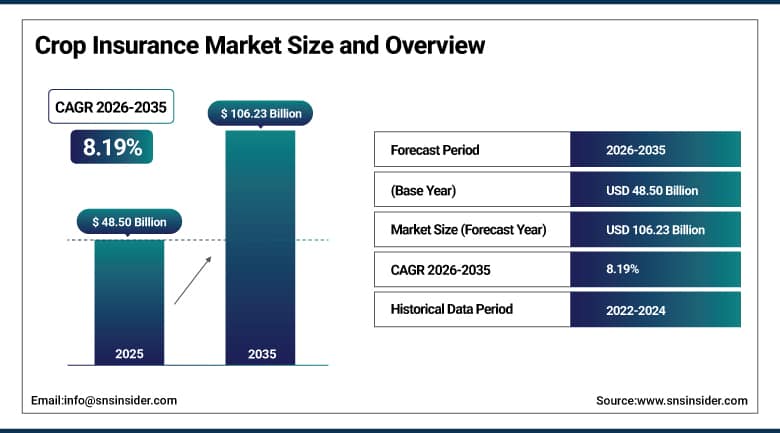
The Global Crop Insurance Market was valued at USD 48.50 billion in 2025 and is expected to reach USD 106.23 billion by 2035, growing at a CAGR of 8.19% from 2026 to 2035.
The Crop Insurance Market is growing due to increasing climate variability, increase in frequency of extreme weather occurrences, and the concern over agricultural productivity and the financial well-being of farmers. Governments and private insurers provide crop insurance coverage through multi-peril crop insurance, yield protection, and weather insurance to improve agricultural resilience. Using satellite imagery, artificial intelligence, remote sensing and data analytics, insurers are able to accurately assess risk, process claims quickly and design insurance products that meet farmers’ needs. Moreover, the adoption of precision agriculture and digital agriculture is providing a huge opportunity to crop insurance providers through better risk assessment and underwriting processes.
Zurich Australia established a business relationship with agricultural specialist Crop Risk Underwriting in 2025, which provides crop insurance in Australia. The strategic business partnership combines Zurich’s insurance capabilities with the agricultural knowledge and technology-based risk management systems of Crop Risk Underwriting, including spatial-temporal exposure monitoring technology.
To Get More Information On Crop Insurance Market - Request Free Sample Report
Crop Insurance Market Trends:
-
Increasing adoption of AI, satellite monitoring, and digital agriculture technologies is enhancing crop risk assessment, improving underwriting accuracy, and enabling faster insurance claim processing.
-
Rising climate-related risks, including droughts, floods, and extreme weather events, are increasing farmer demand for comprehensive crop insurance protection solutions.
-
Expansion of government-supported agricultural insurance programs and public-private partnerships is improving insurance accessibility and coverage among farmers globally.
-
Growing adoption of precision farming technologies and farm-level data analytics is enabling customized insurance products based on specific crop and weather risks.
-
Increasing collaborations between insurance providers and agricultural technology companies are accelerating digital insurance platforms, automated claims processing, and improved risk management capabilities.
U.S. Crop Insurance Market Outlook:
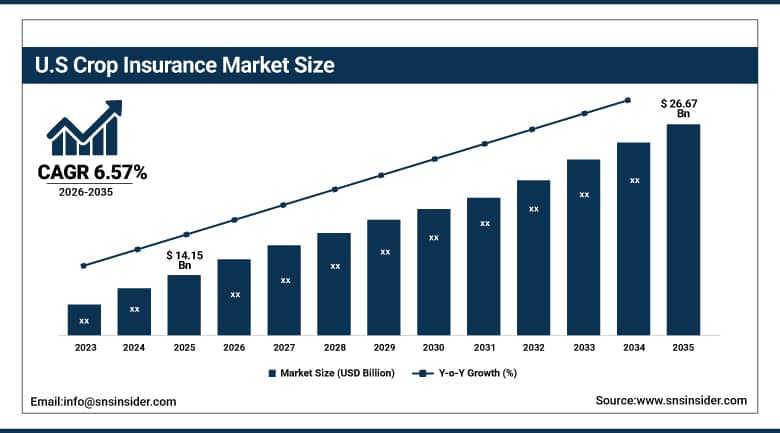
The U.S. Crop Insurance Market was valued at USD 14.15 billion in 2025 and is expected to reach USD 26.67 billion by 2035, growing at a CAGR of 6.57% from 2026 to 2035.
As climate risks increase, extreme weather events become more frequent, and farmers seek increased financial protection from crop losses, the U.S. crop insurance market is expanding. Government-backed insurance programmes and efforts from the USDA Risk Management Agency are improving farmers’ access to coverage and participation. In addition, improved satellite monitoring, artificial intelligence, precision agriculture and data analytics are improving risk assessment, accuracy of underwriting and claims processing. In addition, rising adoption of controlled environment agriculture and technology-enabled farming practices is driving demand for customised crop insurance solutions across the U.S.
In 2026, USDA Risk Management Agency expanded the Controlled Environment pilot crop insurance programme to additional U.S. counties, increased maximum coverage levels from 75% to 85%, and added protections for qualifying quarantine events.
Crop Insurance Market Segment Analysis:
-
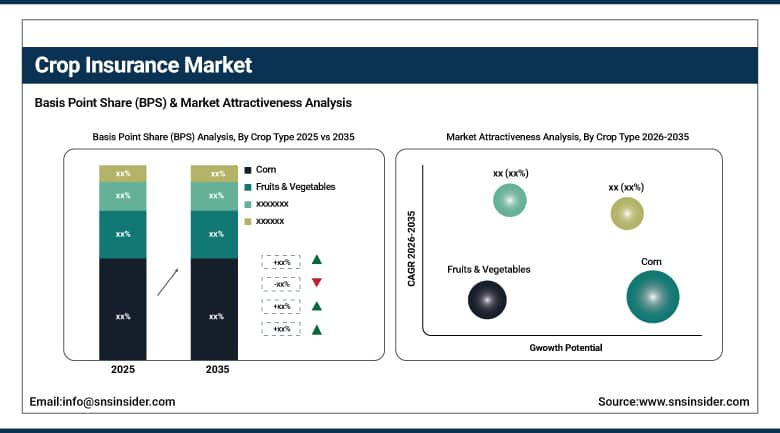
By Crop Type, Corn dominated the Crop Insurance Market with 28.70% share in 2025, while Fruits & Vegetables are the fastest-growing crop type segment with a CAGR of 9.53% from 2026–2035.
-
By Coverage Type, Multi-Peril Crop Insurance (MPCI) dominated the Crop Insurance Market with 42.60% share in 2025, while Revenue Protection Insurance is the fastest-growing coverage type segment with a CAGR of 9.27% from 2026–2035.
-
By Farming Practice, Conventional Agriculture dominated the Crop Insurance Market with 74.20% share in 2025, while Organic Farming is the fastest-growing farming practice segment with a CAGR of 12.49% from 2026–2035.
-
By Insurance Provider Type, Government-Sponsored Insurance Programs dominated the Crop Insurance Market with 54.80% share in 2025, while Private Insurance Companies are the fastest-growing provider segment with a CAGR of 10.07% from 2026–2035.
-
By Distribution Channel, Insurance Agents & Brokers dominated the Crop Insurance Market with 56.30% share in 2025, while Digital Platforms are the fastest-growing distribution channel segment with a CAGR of 13.31% from 2026–2035.
By Crop Type, Corn dominated the Crop Insurance Market, while Fruits & Vegetables are expected to register the fastest CAGR during the forecast period 2026–2035
Corn dominated the Crop Insurance Market with a revenue share of 28.70% in 2025. It continues being dominant owing to cultivation of this plant in major agricultural countries and presence of strong corn growers in crop protection schemes. Insurance solutions are frequently utilized by corn farmers to cope with financial risks related to droughts, floods, pest attacks, and unstable weather conditions. In addition to crop insurance solutions offered by governments, multi-peril insurance solutions and increased awareness of agricultural risk management facilitate the development of corn insurance coverage in different parts of the world.
The increasing number of high value crops cultivated, growing demand for fresh products among consumers, and increased risks caused by climate changes become factors that facilitate the development of the market. Fruit and vegetable farmers require specialized insurance solutions to cover losses incurred during crop production due to the fact that these plants have high perishability and are susceptible to environmental factors. Increasing popularity of greenhouse farming, precision farming and crop monitoring solutions opens up new opportunities for the development of specialized insurance solutions.
By Coverage Type, Multi-Peril Crop Insurance (MPCI) dominated the Crop Insurance Market, while Revenue Protection Insurance is expected to register the fastest CAGR during the forecast period 2026–2035
Multi-Peril Crop Insurance (MPCI) dominated the Crop Insurance Market and had the largest market share of 42.60% in 2025 . Because of its comprehensive coverage against various agricultural risks such as drought, excess rainfall, floods, pests, diseases and other uncertainties linked with production, the segment continues to be a dominant one. Farmers have widely accepted MPCI programmes because of government support, subsidies on premiums and the fact that they are available over large agricultural areas. The segment continues to feel the increased climate variability and increased awareness of farmers of the need to protect crop production and farm income from unforeseen losses.
Revenue Protection Insurance is expected to grow at the fastest CAGR of 9.27% during the forecast period 2026-2035. Growth is being driven by rising demand for insurance products to safeguard crop production and market price volatility. Farmers are increasingly seeking revenue-based coverage solutions to help them manage the financial risk of volatile commodity prices and uncertain agricultural conditions. Revenue protection products are becoming more efficient thanks to better data analytics, weather prediction technology and digital insurance platforms. Additional adoption of revenue protection insurance solutions is expected to be driven by increased focus on income stability of farmers.
By Farming Practice, CoZnventional Agriculture dominated the Crop Insurance Market, while Organic Farming is expected to register the fastest CAGR during the forecastc period 2026–2035
Conventional Agriculture dominated the Crop Insurance Market in 2025, with a revenue share of 74.20%. This segment still rules the roost because of its widespread acceptance, extensive cultivated land coverage, and current insurance systems to facilitate conventional farming activities. Production losses represent a financial risk that large scale commercial producers of corn, wheat, soybeans, and other major crops have depended on conventional crop insurance programmes to mitigate. The promotion of crop insurance by government-supported insurance schemes, incentives for farmers’ participation and availability of standardised insurance products continue to support crop insurance adoption among conventional agricultural methods globally.
Organic Farming is projected to witness the fastest CAGR of 12.49% during the forecast period 2026-2035. The segment growth is driven by increasing consumer preference for sustainably produced food, expansion of organic farming practices, and growing need for financial protection against production uncertainties. Organic farmers face unique challenges, including increased production costs, fewer pest control options and more rigors farming requirements, leading to a need for more specialised insurance coverage. Increasing government initiatives to support sustainable agriculture, coupled with an availability of tailored crop insurance products, are expected to speed up the adoption of insurance solutions in organic farming.
By Insurance Provider Type, Government-Sponsored Insurance Programs dominated the Crop Insurance Market, while Private Insurance Companies are expected to register the fastest CAGR during the forecast period 2026–2035
The Crop Insurance Market is dominated by Government sponsored insurance programmes which held a share of 54.80% in 2025. These programmes remain the market leaders due to attractive policies and premium subsidies. Agricultural insurance schemes which give farmers a way of protecting themselves against production risks also go down well. The government has launched insurance schemes which have facilitated the provision of low cost insurance schemes for agriculture. This also allows participation of farmers especially small and medium farmers in such insurance programmes. The continued market leadership of the government sponsored insurance programmes is also supported by the sound national insurance framework and the improvement in agricultural risk management policies.
The Private Insurance Companies segment is projected to achieve the fastest CAGR of 10.07% during the forecast period of 2026-2035. This is being driven by demand for customised insurance products and the use of technology. New technologies, including artificial intelligence and satellite imaging, have been used increasingly to enhance insurance and claims processing. In agriculture, insurance companies are increasingly working with technology companies to develop new insurance products for farmers.
By Distribution Channel, Insurance Agents & Brokers dominated the Crop Insurance Market, while Digital Platforms are expected to register the fastest CAGR during the forecast period 2026–2035
Insurance Agents & Brokers segment dominated the Crop Insurance Market, which accounted for a revenue share of 56.30% in 2025. The segment is the leading distribution channel due to the importance of personalised assistance, policy recommendations and support throughout the insurance process. Farmers generally seek agents and brokers to help them understand types of coverages, select policies, and complete claims procedures. Strong relationships between insurers and agricultural communities, especially in rural areas, continue to support the widespread use of traditional insurance distribution methods.
Digital Platforms is accounted to grow at the fastest CAGR of 13.31% during the forecast period 2026-2035. The segment growth is driven by increasing digitalisation of agricultural services, rising adoption of smartphones and increasing preference for convenient online insurance solutions. Digital platforms enable farmers to review policies, buy coverage, track agricultural risks and make claims efficiently. Digital insurance capabilities are being enhanced with the integration of artificial intelligence, satellite monitoring and automated assessment tools. The movement for technology enabled agriculture ecosystems is expected to quicken the rise of digital platforms for crop insurance distribution across the globe.
Regional Insights:
|
Region |
Major Country |
Share within Region, 2025 (%) |
|---|---|---|
|
North America |
United States |
82.91% |
|
Europe |
United Kingdom |
31.18% |
|
Asia Pacific |
China |
36.94% |
|
Middle East & Africa |
UAE |
25.11% |
|
Latin America |
Brazil |
46.27% |
North America Crop Insurance Market Insights
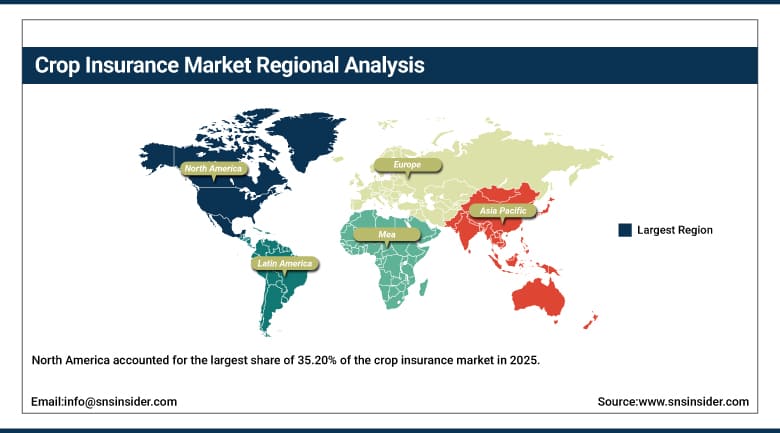
North America accounted for the largest share of 35.20% of the crop insurance market in 2025. The regional growth is attributed to the advent of strong government-supported agricultural insurance programmes, high adoption of risk management solutions among farmers, advanced farming practices, and increasing exposure to climate-related risks. The region is home to a well-established crop insurance framework, significant agricultural production, and major insurance providers that offer multi-peril and revenue protection solutions. The heavy participation of the federal crop insurance programmes, large commercial farming operations and growing demand for technology-enabled agricultural risk assessment solutions from the United States make up about 82.91% of the regional revenue.
The U.S. remains in the lead with extensive coverage of farmland, growing use of precision agriculture and escalating demand to be financially protected against extreme weather events including droughts, floods and storms. Regional growth is also being driven by increased adoption of agricultural insurance programmes, expanding support to farmers and growing demand for customised crop protection solutions in Canada. The forecast period is likely to see the North American market strengthened by government initiatives, increased digital farming technologies, and increased integration of satellite-based monitoring systems.
Get Customized Report as Per Your Business Requirement - Enquiry Now
Europe Crop Insurance Market Insights
The European crop insurance market is fueled by sophisticated agricultural infrastructure, increasing climate risks and growing awareness of farm income protection solutions. Agricultural policies are strong and government supports risk management tools and innovative insurance models are seeing increasing take-up in the region. Germany, France, United Kingdom, Italy and Spain are the main contributors, all with developed agricultural sectors, high insurance penetration and an increasing focus on sustainable farming practices. Farmers need more certainty about their finances—and the need is growing. The weather is becoming more unpredictable too, and more impactful. This is also prompting more farmers in Europe to buy crop insurance.
Germany is a major player in the European market with a well-developed agricultural ecosystem, robust farming infrastructure and increasing adoption of technology-driven insurance solutions. In the United Kingdom and France, government efforts to boost agricultural resilience, along with increased awareness of crop protection products and adoption of digital agricultural services are contributing significantly. The European market is anticipated to grow in the forecast period owing to the rising demand for customised insurance coverage, growing precision farming, and constant innovation in agricultural risk management solutions.
Asia Pacific Crop Insurance Market Insights
The Asia Pacific region is the fastest growing market for crop insurance with a CAGR of 10.30% during 2026–2035. The growth is being driven by increasing dependence on agriculture, increasing climate related risks, increasing government insurance initiatives and growing adoption of digital agriculture technologies. The region’s growth is driven by increasing farmer awareness on financial protection, growing adoption of crop insurance plans and fast adoption of precision agriculture solutions. Emerging economies are focusing on building resilience in the agricultural sector through technology-based risk assessment, satellite monitoring and better insurance outreach.
China’s large agricultural production volumes, expanding government-supported crop insurance programmes and increasing adoption of technology-enabled farming practices position the country well in the Asia Pacific market. Agricultural modernisation initiatives, growing digital insurance adoption and government efforts to improve farmer protection are also major contributors to regional growth in India, Japan and South Korea. The growth of online agricultural platforms, growing use of artificial intelligence in risk assessment and increasing focus on sustainable farming practices are likely to further accelerate the adoption of crop insurance in the Asia Pacific region.
Middle East & Africa and Latin America Crop Insurance Market Insights
In Middle East & Africa and Latin America, crop insurance markets are slowly growing due to the increasing awareness about the management of agricultural risks, better access to insurance and government initiatives to support farmers. The region has strong agricultural production activities, in particular countries such as Brazil, Mexico, and Argentina, where the adoption of crop insurance is increasing with exposure to droughts, floods, and changing weather patterns. Brazil’s strong agricultural sector, wider coverage of farmers under insurance programmes and expansion of digital agricultural services, support growth in the region.
Middle East & Africa region is driven by agricultural modernisation initiatives, increasing investments in food security programmes and rising adoption of technology-based farming solutions. Countries like the UAE and Saudi Arabia are focusing on enhancing agricultural resilience with advanced farming techniques and risk management solutions. The growth in Latin America and the Middle East & Africa also comes from the increasing adoption of digital insurance platforms, government supported agricultural protection schemes and the rising demand for tailored crop insurance coverage. However, affordability issue, absence of awareness among small scale farmers and uneven insurance penetration may restrain the market growth in some developing regions during the forecast period.
Growth Drivers: Rising climate risks and increasing adoption of agricultural insurance solutions driving market expansion
The adoption of crop insurance solutions is increasing worldwide due to increasing extreme weather conditions such as droughts, floods, storms, and unpredictable weather conditions. In their search for financial security against crop losses and income instability, farmers are increasingly turning to multi-peril crop insurance and revenue protection programmes. Also, government supported insurance schemes, premium subsidies and risk management policies in agriculture are encouraging farmers to participate in the market in developed and emerging countries.
Precision agriculture, satellite monitoring, artificial intelligence and digital farming technologies are increasingly used to enhance risk assessment, underwriting accuracy and claims processing, and thus improve crop insurance efficiency. The growing awareness among the farmers about the importance of income protection, along with rising agricultural investments and demand for sustainable farming practices, is likely to drive demand for advanced crop insurance solutions in the forecast period.
Restraints: High premium costs and limited insurance penetration affecting market adoption
High insurance premiums and affordability issues, especially for small and medium-sized farmers in developing regions, are the main factors limiting the growth of the Crop Insurance Market. Low awareness of existing insurance schemes, complicated policy formats and challenges in interpreting coverage details hinder broader uptake among farming sectors. In some emerging markets, market penetration is still challenged by the lack of rural insurance infrastructure and access to financial services.
Moreover, insurance companies are faced with operational challenges such as proper risk assessment, late claim settlements, and lack of sufficient historical agriculture data. The effectiveness and accessibility of crop insurance programmes are also influenced by regional variation in farming practices, climate conditions, and government support mechanisms. Such challenges continue to constrain farmers’ participation despite increased awareness on agricultural risk management solutions.
Opportunities: Expansion of digital agriculture and technology-driven crop insurance solutions
The Crop Insurance Market offers significant growth opportunities driven by the increasing adoption of digital technologies, artificial intelligence, satellite imagery, and data analytics in agricultural insurance solutions. Insurers are increasingly investing in technology-enabled platforms that allow real-time monitoring of crops, automated risk evaluation, faster claims processing, and customised insurance coverage based on farm-level conditions. Weather-based insurance models and precision agriculture tools are creating new opportunities to improve transparency and efficiency across the crop insurance ecosystem.
Asia Pacific, Latin America and Middle East & Africa emerging markets have huge growth potential, driven by agricultural modernisation, government initiatives to protect farmers and increased awareness of financial risk management. The insurance providers are expanding through digital platforms, partnerships with agricultural technology companies, and customised insurance products for small-scale farmers. Increasing investments in sustainable agriculture, climate resilience programmes, and food security initiatives are likely to further drive the adoption of crop insurance solutions worldwide.
Recent Developments:
-
2023: Chubb expanded its agricultural insurance portfolio in the U.S. and Brazil, focusing on specialty crop coverage and climate resilience programs. The company also invested in digital underwriting platforms to streamline farmer onboarding and improve insurance accessibility.
-
2024: Swiss Re partnered with governments in Latin America to launch index-based crop insurance programs. These solutions leveraged rainfall and drought indices to protect smallholder farmers while supporting sustainability and food security initiatives.
-
2025: Allianz entered the Indian market through partnerships with local insurers under the PMFBY program, providing reinsurance support and risk-sharing models. The company emphasized digital claim processing and AI-driven yield estimation technologies.
-
2025: Munich Re expanded its parametric crop insurance solutions across Africa and Asia by utilizing satellite data and weather indices to enable faster payouts. The initiative aimed to reduce claim delays and improve farmer confidence in climate-vulnerable regions.
Crop Insurance Market Key Players:
-
Chubb
-
Zurich Insurance Group
-
Allianz
-
Swiss Re
-
Munich Re
-
AXA
-
Tokio Marine Holdings
-
Sompo Holdings
-
American International Group (AIG)
-
Berkshire Hathaway Specialty Insurance
-
Great American Insurance Group
-
Rural Community Insurance Services (RCIS)
-
FMH (Farmers Mutual Hail Insurance Company of Iowa)
-
QBE Insurance Group
-
CNA Financial Corporation
-
W. R. Berkley Corporation
-
Federal Crop Insurance Corporation (FCIC)
-
Crop Risk Services
-
ProAg
-
NAU Country Insurance Company
Crop Insurance Market Report Scope:
| Report Attributes | Details |
|---|---|
| Market Size in 2025 | USD 48.50 Billion |
| Market Size by 2035 | USD 106.23 Billion |
| CAGR | CAGR of 8.19% From 2026 to 2035 |
| Base Year | 2025 |
| Forecast Period | 2026-2035 |
| Historical Data | 2022-2024 |
| Report Scope & Coverage | Market Size, Segments Analysis, Competitive Landscape, Regional Analysis, DROC & SWOT Analysis, Forecast Outlook |
| Key Segments | • By Coverage Type (Multi-Peril Crop Insurance, Revenue Protection Insurance, Yield Protection Insurance, Weather-Based Insurance) • By Crop Type (Corn, Soybeans, Wheat, Rice, Cotton, Fruits & Vegetables) • By Farming Practice (Conventional Agriculture, Organic Farming, Precision Agriculture) • By Insurance Provider Type (Private Insurance Companies, Government-Sponsored Insurance Programs, Mutual Insurance Companies) • By Distribution Channel (Direct Sales, Insurance Agents & Brokers, Digital Platforms) |
| Regional Analysis/Coverage | North America (US, Canada), Europe (Germany, UK, France, Italy, Spain, Russia, Poland, Rest of Europe), Asia Pacific (China, India, Japan, South Korea, Australia, ASEAN Countries, Rest of Asia Pacific), Middle East & Africa (UAE, Saudi Arabia, Qatar, South Africa, Rest of Middle East & Africa), Latin America (Brazil, Argentina, Mexico, Colombia, Rest of Latin America). |
| Company Profiles | Chubb, Zurich Insurance Group, Allianz, Swiss Re, Munich Re, AXA, Tokio Marine Holdings, Sompo Holdings, American International Group (AIG), Berkshire Hathaway Specialty Insurance, Great American Insurance Group, Rural Community Insurance Services (RCIS), FMH (Farmers Mutual Hail Insurance Company of Iowa), QBE Insurance Group, CNA Financial Corporation, W. R. Berkley Corporation, Federal Crop Insurance Corporation (FCIC), Crop Risk Services, ProAg, NAU Country Insurance Company. |

Frequently Asked Questions
The major growth factor driving the Crop Insurance Market is increasing climate-related risks, rising adoption of agricultural risk management solutions, growing government-supported crop insurance programs, and advancements in digital farming and risk assessment technologies.
