
Data Exfiltration Market Report Scope & Overview:
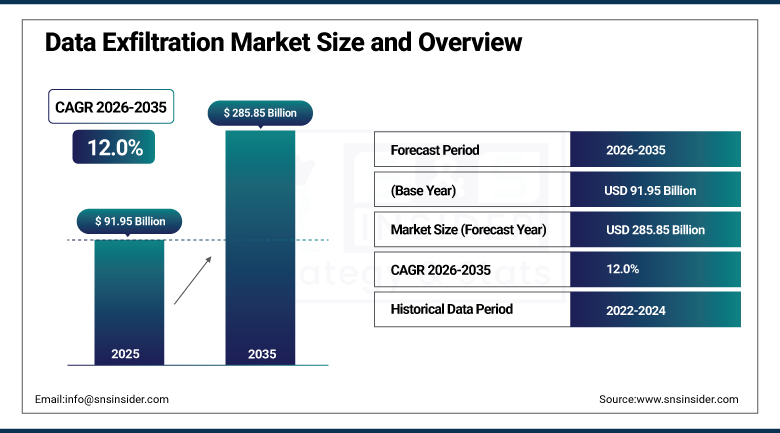
The Data Exfiltration Market was valued at USD 91.95 Billion in 2025 and is expected to reach USD 285.85 Billion by 2035, growing at a CAGR of 12.0% from 2026 to 2035.
The global data exfiltration market encompasses the technologies and solutions used to prevent the unauthorised transfer of sensitive data outside organisational boundaries. The market is evolving rapidly due to increasing concerns around data security and the growing number of data breaches across both public and private sectors. Organisations are prioritising advanced data protection strategies to safeguard intellectual property, customer records, financial data, and operational information from both external attackers and malicious or negligent insiders. The market is driven by the escalating frequency and sophistication of cyber-attacks including ransomware, phishing, persistent intrusion campaigns, and supply chain compromises. According to IBM's Cost of a Data Breach Report, the average cost of a data breach reached USD 4.88 million in 2024, the highest recorded level, creating financial exposure that far exceeds the investment required for comprehensive data exfiltration prevention.
In December 2023, CrowdStrike announced the general availability of CrowdStrike Falcon Data Protection, a solution designed to disrupt legacy data loss prevention products. The offering prevents adversary exfiltration and accidental data leakage by leveraging the AI native Falcon XDR platform. It allows customers to consolidate outdated DLP point products and enhance data security with a unified agent-based architecture that correlates endpoint activity, identity behaviour, and network data movement patterns into a single exfiltration risk assessment without requiring separate DLP agent installation.
To Get more information On Data Exfiltration Market - Request Free Sample Report
Data Exfiltration Market Trends
-
AI-powered behavioral analytics are enhancing data loss prevention capabilities by identifying anomalous user activities, unusual data transfers, and potential exfiltration attempts in real time
-
Adoption of Zero Trust security architectures is strengthening data protection through continuous verification of user identity, device security, and access permissions
-
Growing deployment of Cloud Access Security Broker (CASB) solutions is improving visibility and control over data movement across cloud applications and storage environments
-
Increasing investment in insider threat detection programs is driving adoption of user and entity behavior analytics (UEBA) platforms to identify risky behavior before data breaches occur
-
AI-driven data classification and discovery technologies are automating the identification of sensitive information, improving the effectiveness of data protection and exfiltration prevention strategies across enterprise environments
U.S. Data Exfiltration Market Outlook
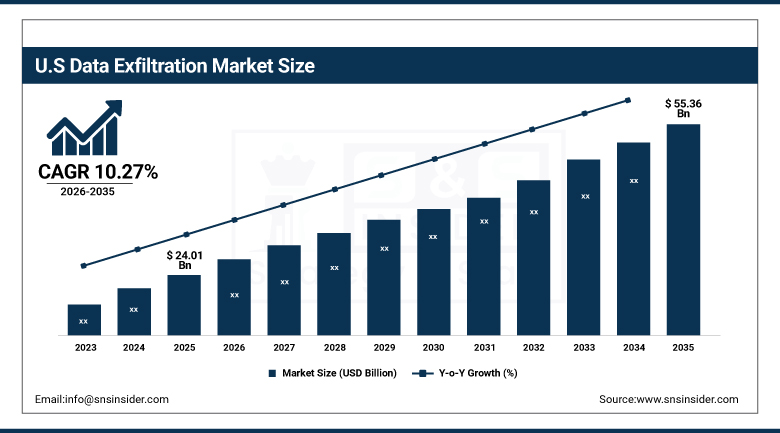
The U.S. Data Exfiltration Market was valued at approximately USD 24.01 Billion in 2025 and is expected to reach approximately USD 55.36 Billion by 2035, growing at a CAGR of approximately 10.27%.
The U.S. is the world's most commercially significant data exfiltration prevention market. Broadcom's Symantec Data Loss Prevention, CrowdStrike Falcon Data Protection, Cisco Secure Endpoint, Forcepoint DLP, Zscaler Cloud DLP, and Palo Alto Networks’ Enterprise DLP collectively define the domestic commercial landscape. The SEC's cybersecurity incident disclosure rules, the FTC's data breach notification requirements, state level regulations including the California Consumer Privacy Act and New York's SHIELD Act, and sector specific frameworks including HIPAA's PHI protection requirements and PCI DSS's cardholder data security mandates collectively create a layered compliance environment that sustains non-discretionary data exfiltration prevention investment across U.S. enterprises.
In 2024, Palo Alto Networks launched its Enterprise DLP product as a cloud delivered service integrated with its SASE platform, enabling organisations to enforce consistent data exfiltration prevention policies across network, cloud, and endpoint data channels from a single unified management console. The product addresses the policy fragmentation challenge that organisations face when managing separate on premise DLP, CASB, and email security solutions whose disconnected policies create coverage gaps that sophisticated exfiltration attempts exploit.
Data Exfiltration Market Segment Analysis
-
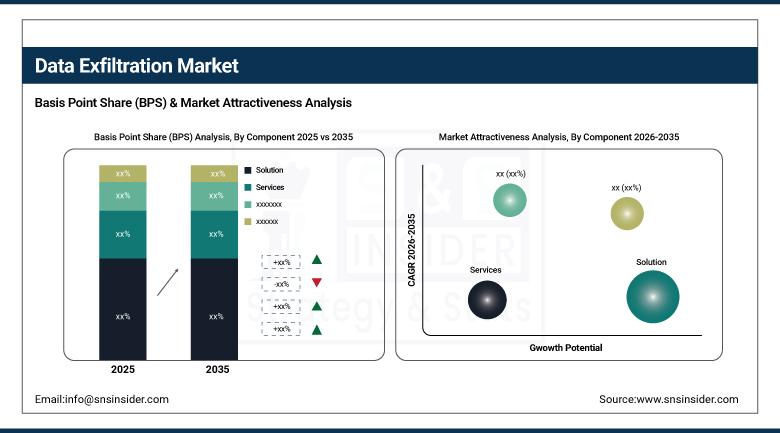
By Component, the Solution segment dominated the Data Exfiltration Market with approximately 67% share in 2025, while the Services segment is the fastest growing at an expected CAGR of 13.1%.
-
By Deployment, the Active Data Exfiltration segment dominated the Data Exfiltration Market in 2025, while the Passive Data Exfiltration segment is the fastest growing.
-
By Organization Size, the Large Enterprises segment dominated the Data Exfiltration Market in 2025, while the Small and Medium-sized Enterprises segment is the fastest growing.
-
By Vertical, the BFSI segment dominated the Data Exfiltration Market in 2025, while the Healthcare segment is the fastest growing.
By Component, solution dominates, services grow fastest
The solution segment retained the dominant component position with approximately 67% of the data exfiltration market in 2025. Software based data exfiltration prevention platforms constitute the primary technology investment in enterprise data protection programmes. Real time data movement monitoring that detects bulk file transfers to external destinations, encryption solutions that prevent readable data extraction even when transfer occurs, endpoint DLP agents that block copy, print, and upload operations for classified data, and network DLP appliances that inspect outbound traffic for sensitive content collectively define the most commercially significant solution investment categories. The solution segment's commercial dominance reflects the enterprise security architecture shift from reactive incident response toward proactive prevention, where solution platforms provide the continuous monitoring and enforcement capability that creates the most commercially certain reduction in exfiltration risk.
Services are the fastest growing component at 13.1% CAGR because the global cybersecurity talent shortage, whose unfilled positions now exceed 3.4 million globally, creates structural motivation for organisations to outsource data exfiltration prevention programme design, implementation, and operation to specialist service providers. Each organisation whose internal security team lacks DLP programme design expertise creates managed security service procurement whose recurring revenue structure sustains services segment growth above the one time solution purchase model. Incident response retainer services whose guaranteed breach investigation capability creates procurement motivation before any exfiltration occurs, and penetration testing whose data exfiltration simulation validates prevention control effectiveness, collectively sustain above average services revenue growth.
By Deployment, active data exfiltration solutions dominate, passive grows fastest
Active data exfiltration prevention retained the dominant deployment position in 2025. Real time prevention of data breaches represents the primary commercial objective for enterprise data security investment. Active prevention solutions whose immediate blocking of unauthorised data transfers, network traffic monitoring, and automatic policy enforcement create the most commercially certain reduction in breach probability and breach cost. Forcepoint's Data Loss Prevention, Digital Guardian's Managed Security Program, and Symantec DLP collectively represent the most commercially established active data exfiltration prevention platform deployments whose real time enforcement capability defines the solution category standard. The commercial priority for active prevention reflects the asymmetric financial consequence of exfiltration events whose cost substantially exceeds the investment required for prevention, creating budget allocation toward active blocking over passive monitoring alternatives.
Passive data exfiltration detection is the fastest growing deployment category because the rising sophistication of covert exfiltration techniques employed by advanced persistent threat actors, state sponsored attackers, and sophisticated ransomware operators creates demand for detection capabilities that complement and extend active prevention. DNS tunnelling, where data is encoded within DNS query strings to bypass DLP inspection, steganography, where data is hidden within image or audio files to evade content inspection, and low and slow extraction, where small data volumes are transferred over extended periods to avoid anomaly detection thresholds, create exfiltration vectors that active rule-based prevention cannot address. Each organisation whose threat model includes advanced persistent threat actors creates passive detection investment whose value sustains the fastest growing deployment category designation.
By Organization Size, large enterprises dominate, SMEs grow fastest
Large enterprises retained the dominant organisation size position in 2025. The concentration of data exfiltration prevention investment among large enterprises reflects their combination of high value data assets whose theft creates the most commercially severe breach consequences, extensive regulatory compliance obligations whose data breach penalty exposure creates non discretionary security investment motivation, and complex IT environments whose hybrid cloud, multi cloud, and interconnected third party access creates a data movement perimeter that requires comprehensive monitoring infrastructure. Each large enterprise whose annual data breach exposure exceeds hundreds of millions of dollars in potential penalty, litigation, and reputational cost creates DLP investment whose ROI calculation justifies premium platform specification that smaller organisations cannot economically justify at equivalent data value risk levels.
Small and medium sized enterprises are the fastest growing organisation size because the combination of increasing frequency of SME targeted ransomware and data theft attacks, growing cyber insurance market requirements for minimum data security controls, and the declining cost of cloud delivered DLP services creates first time data exfiltration prevention investment at scale across the SME population. Each ransomware incident affecting an SME whose data exfiltration component creates extortion leverage beyond encryption alone creates peer enterprise awareness that motivates preventive investment. The cyber insurance market's progressive tightening of minimum-security control requirements creates structured compliance motivation that sustains SME DLP market growth through the forecast period.
By Vertical, BFSI dominates, healthcare grows fastest
BFSI retained the dominant vertical position in 2025. Financial services firms’ custodianship of financial transaction data, customer account credentials, trading strategies, and regulatory reporting information creates the most commercially valuable data asset portfolio of any industry vertical whose theft creates immediate financial fraud risk and substantial regulatory penalty exposure. The layered compliance framework under PCI DSS for cardholder data, GLBA for financial customer information, SOX for financial reporting data, and emerging DORA requirements for European financial entities creates mandatory data protection investment whose compliance motivation sustains premium DLP specification. Each financial services data breach whose scope includes cardholder data creates per record penalties under PCI DSS that create financial exposure substantially exceeding enterprise DLP investment at any implementation scale.
Healthcare is the fastest growing vertical because the digitisation of patient health records through electronic health record system adoption, the proliferation of connected medical devices creating new data access points, and HIPAA's PHI protection requirements whose violation penalties of up to USD 1.9 million per violation category per year create structured compliance motivated investment. Each healthcare organisation whose breach of PHI triggers HIPAA investigation creates retroactive DLP investment whose scope and urgency create premium service procurement. The extraordinary sensitivity of personal health information, whose unauthorised disclosure creates patient harm risk beyond financial loss, sustains healthcare vertical data protection investment independent of financial ROI calculation.
Regional Insights
|
Region |
Major Country |
Share within Region, 2025 (%) |
|---|---|---|
|
North America |
United States |
87.4% |
|
Europe |
Germany |
22.3% |
|
Asia Pacific |
China |
44.8% |
|
Middle East & Africa |
UAE |
31.2% |
|
Latin America |
Brazil |
44.2% |
North America Data Exfiltration Market Insights
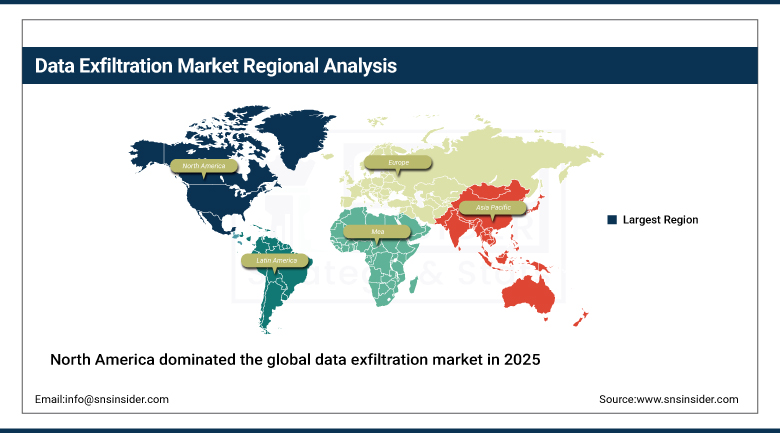
North America dominated the global data exfiltration market in 2025 with the largest revenue share, driven by strong regulatory frameworks, advanced cybersecurity infrastructure, high enterprise data security awareness, and the commercial presence of the world's leading data loss prevention platform vendors. The United States accounts for approximately 87.4% of North American revenues through Broadcom Symantec, CrowdStrike, Cisco, Forcepoint, Zscaler, and Palo Alto Networks’ enterprise DLP commercial operations.
Canada contributes approximately 12.6% of North American revenues through its financial services sector's data protection compliance investment, the federal government's Privacy Act and PIPEDA compliance requirements, and the technology sector's intellectual property protection investment in data exfiltration prevention platforms.
Get Customized Report as per Your Business Requirement - Enquiry Now
Europe Data Exfiltration Market Insights
Europe is a technically sophisticated and compliance driven data exfiltration prevention market where the GDPR's data breach notification requirements and per record penalty structure, the NIS2 Directive's expanded incident reporting obligations, and the DORA regulation's financial sector data resilience requirements create a comprehensive regulatory motivation for enterprise DLP investment. Germany accounts for approximately 22.3% of European revenues through its manufacturing sector's intellectual property protection, the financial services industry's compliance investment, and the federal data protection authority's active GDPR enforcement that sustains commercial urgency for data security.
The United Kingdom, France, and the Netherlands are significant secondary markets where the FCA's data security requirements, BNP Paribas and HSBC's financial data protection programmes, and the Amsterdam Internet Exchange's critical infrastructure data security create consistent procurement. Atos SE's and Thales Group's DLP service practices sustain European commercial supply.
Asia Pacific Data Exfiltration Market Insights
Asia Pacific is the fastest growing regional data exfiltration market, driven by rapid digital transformation in China, India, Japan, South Korea, and Southeast Asia where cloud adoption, remote work proliferation, and expanding enterprise data volumes create growing exfiltration risk that increasing cybersecurity regulatory frameworks are addressing. China accounts for approximately 44.8% of Asia Pacific revenues through its Cybersecurity Law and Data Security Law compliance requirements, the extraordinary scale of Chinese enterprise data assets, and the government's critical information infrastructure protection mandate that creates structured DLP procurement.
India represents the most commercially dynamic emerging market within Asia Pacific where the CERT-In's mandatory incident reporting framework, the Digital Personal Data Protection Act's data security obligations, and the IT and BPO sector's client data protection contractual requirements create above average data exfiltration prevention procurement growth from both compliance driven and commercially motivated enterprise buyers.
MEA & Latin America Data Exfiltration Market Insights
The UAE leads MEA revenues at approximately 31.2% through its ADGM and DIFC data protection frameworks, the financial services sector's GDPR equivalent compliance investment, and smart city infrastructure data security creating structured institutional procurement. Saudi Arabia's NCA data protection standards add complementary Gulf demand. Brazil leads Latin American revenues at approximately 44.2% through LGPD compliance investment, the financial services sector's data security procurement, and the IT industry's client data protection obligations. Mexico's financial sector and Colombia's growing enterprise IT sector collectively sustain regional market growth through 2035.
Growth Drivers: Escalating data breach cost and regulatory compliance creating non-discretionary DLP investment
The escalating financial impact of data breaches is the data exfiltration prevention market's most commercially compelling structural growth driver. IBM's 2024 Cost of a Data Breach Report documented the average breach cost at USD 4.88 million globally, representing a 10 percent increase from the prior year and the highest recorded level in the report's 19 year history. Each organisation that experiences a data breach discovers that the total cost, encompassing incident response, regulatory notification, legal liability, customer compensation, and reputational damage, substantially exceeds the investment required for comprehensive DLP implementation. This financial asymmetry creates ROI justification for premium data exfiltration prevention investment that sustains market growth independent of regulatory mandate.
Regulatory compliance mandates create an additional non discretionary investment layer that sustains data exfiltration prevention procurement through economic cycles. The GDPR's penalties of up to 4 percent of global annual revenue, HIPAA's per violation penalty structure, PCI DSS's cardholder data security requirements, and emerging national data protection legislation across Asia Pacific collectively create financial penalty exposure that motivates DLP investment at scales exceeding the compliance cost alone. Each new data protection regulation enacted in a new jurisdiction creates incremental DLP compliance investment across the enterprises operating within that regulatory scope.
Restraints: Sophisticated evasion techniques and cybersecurity talent shortage limiting DLP effectiveness
The sophistication of modern data exfiltration evasion techniques creates a persistent effectiveness challenge for data loss prevention platforms. Attackers increasingly use encrypted channels, steganographic concealment, legitimate cloud service abuse for data staging, and compromised privileged credentials to bypass rule based DLP inspection. Each evasion technique that successfully bypasses deployed DLP controls creates a detection gap whose exploitation reduces the commercial value of prevention investment and motivates additional detection capability procurement whose cost compounds with the initial DLP deployment.
The cybersecurity talent shortage creates an operational capability constraint that limits the effectiveness of deployed DLP platforms whose alert triage, policy tuning, and false positive management require skilled security analyst engagement. Each DLP deployment whose alert volume exceeds the security team's investigation capacity creates alert fatigue that erodes detection effectiveness, motivating managed DLP service outsourcing whose cost compounds with the initial platform investment.
Opportunities: AI powered DLP automation and quantum resistant encryption for exfiltration prevention
AI powered DLP automation represents the most commercially accessible near term market development whose autonomous alert triage, false positive reduction, and behavioural anomaly detection capability reduces the analyst workload that limits DLP effectiveness in talent constrained security operations. Each DLP deployment whose AI automation reduces tier 1 analyst workload by 70 to 80 percent creates a measurable security operations efficiency improvement whose value sustains premium AI enhanced platform pricing above conventional rule based DLP alternatives. The market for AI security automation compounds with the DLP market's growth, creating above average revenue expansion in the AI enhanced solution sub category.
Quantum resistant encryption development for data in transit protection represents a long duration market opportunity whose NIST post quantum cryptography standard publication in 2024 creates a defined migration timeline for organisations to upgrade encryption protecting sensitive data transfers from quantum computer decryption risk. Each enterprise whose encrypted data movement or VPN infrastructure requires quantum safe algorithm replacement creates a systematic security upgrade investment whose commercial aggregate across the global enterprise installed base sustains incremental data protection procurement through the 2030s.
Recent Developments:
-
2023: CrowdStrike announced the general availability of Falcon Data Protection in December 2023, a solution designed to disrupt legacy DLP products by preventing adversary exfiltration and accidental data leakage through the AI native Falcon XDR platform, enabling customers to consolidate fragmented point DLP products.
-
2024: Palo Alto Networks launched its Enterprise DLP as a cloud delivered SASE integrated service in 2024, enabling consistent data exfiltration prevention policies across network, cloud, and endpoint channels from a single unified management console that eliminates the coverage gaps of fragmented point DLP solutions.
-
2024: Zscaler expanded its Zero Trust Exchange platform in 2024 with enhanced cloud DLP capabilities including AI powered data classification, advanced optical character recognition for image based sensitive data detection, and expanded integration with Microsoft Purview for unified data governance across hybrid enterprise environments.
-
2024: Forcepoint launched its Next Generation DLP platform in 2024 with behavioural risk adaptive capabilities that dynamically adjust security policy enforcement intensity based on individual user risk scores derived from historical behaviour patterns, reducing false positive burden while maintaining effective exfiltration prevention.
-
2023: Microsoft launched Microsoft Purview Data Loss Prevention enhancements in 2023 with expanded trainable classifier coverage, adaptive protection integration with Microsoft Defender XDR insider risk signals, and improved Teams and SharePoint Online coverage that addresses the growing volume of sensitive data in enterprise collaboration platform environments.
Data Exfiltration Market Key Players
-
Broadcom Inc.
-
Cisco Systems Inc.
-
Palo Alto Networks Inc.
-
Forcepoint LLC
-
Zscaler Inc.
-
McAfee LLC
-
Trend Micro Inc.
-
Check Point Software Technologies Ltd.
-
Fortinet Inc.
-
GTB Technologies Inc.
-
Digital Guardian
-
Juniper Networks Inc.
-
IBM Corporation
-
Netskope Inc.
-
Varonis Systems Inc.
-
Code42 Software Inc.
-
Teramind Inc.
-
Safetica Technologies s.r.o.
Data Exfiltration Market Report Scope:
| Report Attributes | Details |
|---|---|
| Market Size in 2025 | USD 91.95 Billion |
| Market Size by 2035 | USD 285.85 Billion |
| CAGR | CAGR of 12.0% From 2026 to 2035 |
| Base Year | 2025 |
| Forecast Period | 2026-2035 |
| Historical Data | 2022-2024 |
| Report Scope & Coverage | Market Size, Segments Analysis, Competitive Landscape, Regional Analysis, DROC & SWOT Analysis, Forecast Outlook |
| Key Segments | • by Component (Solution, Services) • by Deployment (Active Data Exfiltration, Passive Data Exfiltration) • by Organization Size (Large Enterprises, Small and Medium-sized Enterprises) • by Vertical (BFSI, Government & Defense, IT & Telecom, Healthcare, Retail & E-Commerce, Energy & Utilities, Manufacturing, Others) |
| Regional Analysis/Coverage | North America (US, Canada, Mexico), Europe (Eastern Europe [Poland, Romania, Hungary, Turkey, Rest of Eastern Europe] Western Europe] Germany, France, UK, Italy, Spain, Netherlands, Switzerland, Austria, Rest of Western Europe]), Asia Pacific (China, India, Japan, South Korea, Vietnam, Singapore, Australia, Rest of Asia Pacific), Middle East & Africa (Middle East [UAE, Egypt, Saudi Arabia, Qatar, Rest of Middle East], Africa [Nigeria, South Africa, Rest of Africa], Latin America (Brazil, Argentina, Colombia, Rest of Latin America) |
| Company Profiles | Broadcom Inc., CrowdStrike Holdings Inc., Cisco Systems Inc., Palo Alto Networks Inc., Forcepoint LLC, Zscaler Inc., McAfee LLC, Trend Micro Inc., Check Point Software Technologies Ltd., Fortinet Inc., GTB Technologies Inc., Digital Guardian, Juniper Networks Inc., Microsoft Corporation, IBM Corporation, Netskope Inc., Varonis Systems Inc., Code42 Software Inc., Teramind Inc., Safetica Technologies s.r.o. |
Frequently Asked Questions
The escalating financial impact of data breaches averaging USD 4.88 million per incident creating investment motivation that substantially exceeds DLP deployment cost, and layered regulatory compliance mandates under GDPR, HIPAA, PCI DSS, and national data protection legislation creating non discretionary data exfiltration prevention investment across global enterprises.
The Data Exfiltration Market was valued at USD 91.95 Billion in 2025.
North America dominated the Data Exfiltration Market in 2025, while Asia Pacific is the fastest growing region driven by digital transformation, cloud adoption, and strengthening data protection regulatory frameworks across China, India, and Southeast Asia.
The Solution segment dominated the Data Exfiltration Market with approximately 67% share in 2025, while the Services segment is the fastest growing at a CAGR of 13.1%.
The Data Exfiltration Market is expected to grow at a CAGR of 12.0% from 2026 to 2035.
