
Database Management System Market Report Scope & Overview:
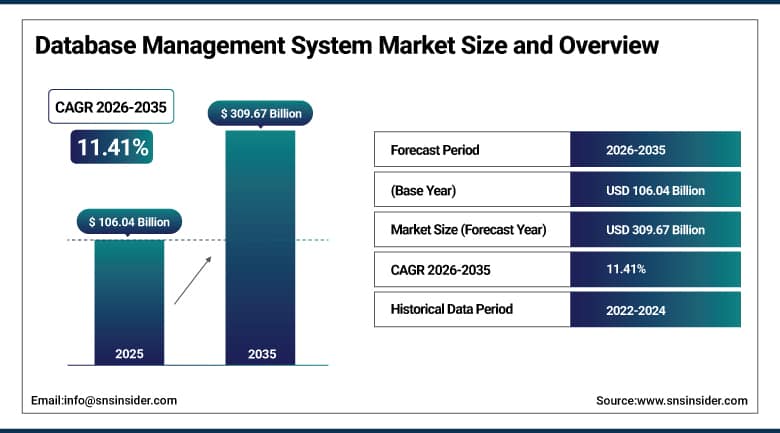
The Database Management System Market was valued at USD 106.04 Billion in 2025 and is expected to reach USD 309.67 Billion by 2035, growing at a CAGR of 11.41% from 2026 to 2035.
The global database management system market stands at the forefront of digital transformation, serving as the backbone of enterprise data infrastructure across every industry. Enterprises are increasingly dependent on reliable, scalable, and secure data management solutions to support analytics, automation, and real time decision making across hybrid and multi-cloud environments. The market is expanding rapidly due to the surge in data generated from digital platforms, cloud applications, IoT devices, and enterprise systems. Organisations managing growing volumes of structured and unstructured data simultaneously demand faster query performance, higher availability, and stronger regulatory compliance. Cloud migration continues to reshape database adoption as businesses seek flexibility, cost efficiency, and global accessibility.
In November 2023, IBM announced the general availability of Amazon Relational Database Service for Db2 at AWS reinvent 2023. IBM collaborated with Amazon Web Services to deliver a fully managed cloud offering designed to make it easier for database customers to manage data for artificial intelligence workloads across hybrid cloud environments. This offering extends IBM Db2's enterprise-grade reliability and SQL compatibility into the AWS managed services ecosystem, enabling organisations running Db2 workloads on-premise to migrate or operate hybrid configurations without rewriting application logic or retraining database administration staff.
To Get More Information On Database Management System Market - Request Free Sample Report
Database Management System Market Trends:
-
Adoption of autonomous database platforms is increasing as AI-driven capabilities such as self-tuning, self-patching, and automated security management reduce administrative complexity and operational costs
-
Rapid growth of generative AI applications is accelerating demand for vector databases that efficiently store and query high-dimensional embedding data used in AI and machine learning workloads
-
Organizations are increasingly adopting multi-model databases that support relational, document, graph, and key-value data structures within a unified platform
-
Rising implementation of data mesh architectures is driving demand for federated data governance, distributed data management, and cross-domain query capabilities
-
Growing preference for open-source databases such as PostgreSQL, MySQL, and MongoDB is increasing adoption among enterprises seeking cost-effective, flexible, and cloud-native data management solutions
U.S. Database Management System Market Outlook:
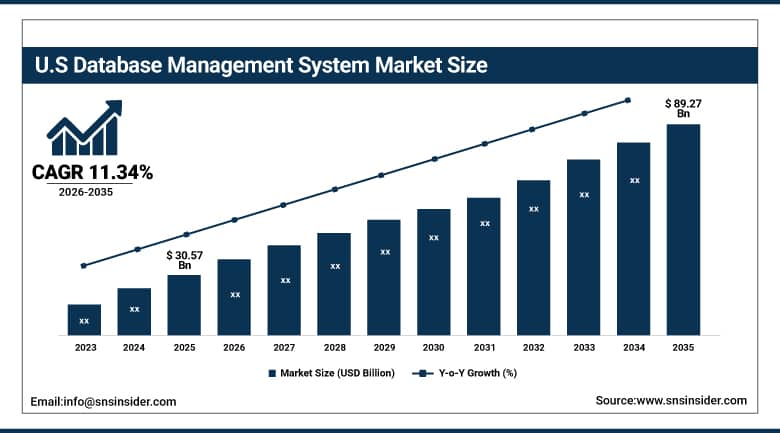
The U.S. Database Management System Market was valued at approximately USD 30.57 Billion in 2025 and is expected to reach approximately USD 89.27 Billion by 2035, growing at a CAGR of approximately 11.34%.
The U.S. is the world's most commercially significant DBMS market within North America's dominant 41% global revenue position. Oracle Corporation, Microsoft Corporation, Amazon Web Services, Google Cloud, IBM, Snowflake, and MongoDB collectively define the domestic commercial landscape. The U.S. market benefits from the highest enterprise cloud adoption rates globally, with 73% of enterprises now operating at least one database in a public cloud environment. Over 1.5 million cloud-hosted databases operate within U.S. enterprises, representing a 21% increase from the prior year. The financial, healthcare, and e-commerce sectors collectively drive 56% of total U.S. DBMS demand, with AI-driven analytics investment creating above-average database platform procurement across technology-forward enterprise segments.
In 2024, Snowflake launched its AI-powered data collaboration features on Snowflake Cortex, enabling natural language query capabilities, automated anomaly detection, and cross-organisation data sharing through a unified data cloud architecture. This launch reflects the commercial convergence of DBMS and AI development platforms into integrated data intelligence environments that organisations prefer over separate database and machine learning infrastructure investments.
Database Management System Market Segment Analysis:
-
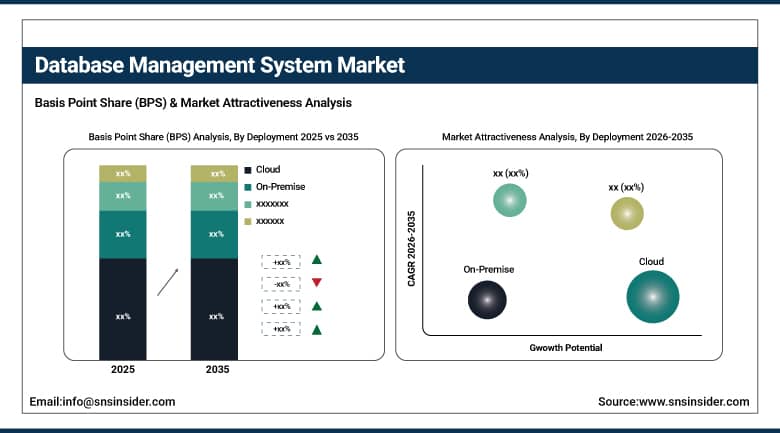
By Deployment, the Cloud segment dominated the Database Management System Market with approximately 66% share in 2025, while the Cloud segment is also the fastest growing at a CAGR of 12.12%.
-
By Type, the Relational Database Management System segment dominated the Database Management System Market with approximately 64% share in 2025, while the Non-Relational/NoSQL Database Management System segment is the fastest growing at a CAGR of 12.81%.
-
By Organization Size, the Large Enterprises segment dominated the Database Management System Market with approximately 71% share in 2025, while the Small and Medium-sized Enterprises segment is the fastest growing at a CAGR of 12.96%.
-
By Vertical, the BFSI segment dominated the Database Management System Market with approximately 24% share in 2025, while the Healthcare & Life Sciences segment is the fastest growing at a CAGR of 14.57%.
By Deployment, cloud dominates and also grows fastest
Cloud deployment retained the dominant position with approximately 66% of the database management system market in 2025 and is simultaneously the fastest growing deployment model. This dual dominance reflects the completion of the enterprise database market's fundamental architecture transition from on-premise to cloud-hosted systems whose commercial momentum now sustains both the largest revenue base and the fastest incremental growth. Cloud DBMS platforms offer scalability that allows organisations to adjust storage and processing capacity based on demand without capital infrastructure investment. Automatic updates, pay-per-use economics, and native integration with analytics and machine learning services create a total cost of ownership advantage over on-premise alternatives that sustains cloud specification across all enterprise size categories. AWS Aurora, Microsoft Azure SQL Database, Google Cloud Spanner, and Oracle Cloud Database collectively represent the most commercially significant managed cloud DBMS offerings whose feature velocity and global infrastructure availability sustain customer retention.
On-premise deployment retains 34% market share where data sovereignty requirements, compliance mandates preventing cloud data residency, and existing capital infrastructure investment justify continued local database operation. Government and defence organisations, financial institutions in regulated jurisdictions, and healthcare systems in data-sovereignty-sensitive markets create the most commercially stable on-premise DBMS retention base. However, hybrid deployment architectures that combine on-premise database operation with cloud analytics and disaster recovery are progressively eroding pure on-premise deployment as organisations seek the operational benefits of cloud integration without fully abandoning local data control.
By Type, relational dominates, non-relational grows fastest
Relational database management systems retained the dominant type position with approximately 64% of the database management system market in 2025. Their commercial primacy reflects decades of enterprise adoption whose SQL-based query language standardisation, ACID transaction compliance, and referential integrity enforcement create the most commercially trusted data management architecture for financial transactions, patient records, and regulatory reporting workloads. Oracle Database, Microsoft SQL Server, PostgreSQL, and MySQL collectively represent the world's most commercially deployed DBMS platforms whose enterprise installation base creates a replacement cycle of 10 to 15 years that sustains relational database licence and subscription revenue independent of NoSQL competitive momentum. Industries including BFSI, healthcare, and retail continue to rely heavily on relational databases for transaction processing and regulatory compliance, as their structured data handling and well-established query languages provide proven frameworks for managing critical workloads.
Non-relational databases are the fastest growing type at 12.81% CAGR because the extraordinary commercial expansion of social media platforms, IoT device networks, real-time analytics applications, and generative AI deployments collectively create demand for flexible schema design, horizontal scaling, and high-velocity unstructured data ingestion that relational database architecture cannot accommodate without prohibitive performance and cost penalties. MongoDB Atlas, Amazon DynamoDB, Apache Cassandra, and Redis collectively represent the most commercially significant NoSQL platform deployment environments whose managed cloud service delivery creates commercial accessibility for development teams without specialised database administration expertise. The growing vector database segment within the non-relational category, driven by large language model embedding storage, represents the most commercially dynamic new DBMS category whose growth compounds with enterprise generative AI adoption.
By Organization Size, large enterprises dominate, SMEs grow fastest
Large enterprises retained the dominant organisation size position with approximately 71% of the database management system market in 2025. Banking, healthcare, and manufacturing sectors use robust DBMS solutions to manage vast datasets, ensure security, and maximise business intelligence across complex multi-system enterprise environments. Large enterprises' capacity to invest in sophisticated technologies, including AI-driven analytics, autonomous database management, and enterprise-specific multi-cloud database configurations, further consolidates their leadership. Partner vendor relationships and enterprise-specific licensing structures create long-duration commercial relationships whose renewal and expansion revenue sustains the segment's market dominance. Oracle's and Microsoft's enterprise agreement structures, whose multi-year contracts create predictable database revenue across thousands of large enterprise accounts, demonstrate the commercial concentration of large enterprise DBMS spending.
Small and medium-sized enterprises are the fastest growing segment at 12.96% CAGR because cloud-based and subscription-driven DBMS solutions lower adoption barriers that previously confined sophisticated database management to organisations with substantial IT budgets and specialised staff. Each SME whose digital transformation programme requires customer data management, inventory tracking, or business intelligence creates DBMS procurement whose aggregate across millions of small businesses creates the most commercially scalable growth opportunity in the database market. MySQL, PostgreSQL, and MongoDB Atlas's freemium to subscription commercial models create on-ramps for SME adoption that enterprise Oracle and SAP alternatives cannot match on acquisition cost, creating structured SME market growth that sustains the segment's fastest-growing designation.
By Vertical, BFSI dominates, healthcare grows fastest
BFSI retained the dominant vertical position with approximately 24% of the database management system market in 2025. Banks, financial institutions, and insurance organisations depend on DBMS for transaction processing, fraud detection, regulatory compliance, and risk management across the most commercially intensive per-organisation data management workloads of any industry vertical. Growing adoption of digital banking, fintech advancements, and real-time analytics enhance demand for high-performance DBMS platforms. Strict data protection regulations including GDPR, PCI DSS, and sector-specific banking regulations, combined with the need for high availability and disaster recovery capabilities, further drive premium DBMS platform specification in the financial services sector. Each major bank's trading system, loan origination platform, and customer data management infrastructure creates DBMS procurement whose per-organisation commercial value substantially exceeds equivalent deployments in less data-intensive vertical markets.
Healthcare and life sciences is the fastest growing vertical at 14.57% CAGR because rising electronic health records adoption, telemedicine expansion, AI-driven diagnostic application deployment, and genomic medicine's extraordinary data volume requirements create above-average DBMS investment across a vertically broadening set of clinical, research, and administrative applications. Each hospital that implements an EHR system, each pharmaceutical company that builds a clinical trial data management platform, and each genomics laboratory that deploys a sequence data storage architecture creates DBMS procurement whose regulatory validation, data integrity, and audit trail requirements create premium platform specification above commodity database alternatives. The FDA's 21 CFR Part 11 compliance requirement for electronic records in regulated pharmaceutical environments and HIPAA's patient data protection standards create compliance-driven DBMS feature investment that sustains above-average healthcare vertical spending.
Regional Analysis:
|
Region |
Major Country |
Share within Region, 2025 (%) |
|---|---|---|
|
North America |
United States |
87.4% |
|
Europe |
Germany |
22.3% |
|
Asia Pacific |
China |
44.8% |
|
Middle East & Africa |
UAE |
31.2% |
|
Latin America |
Brazil |
44.2% |
North America Database Management System Market Insights
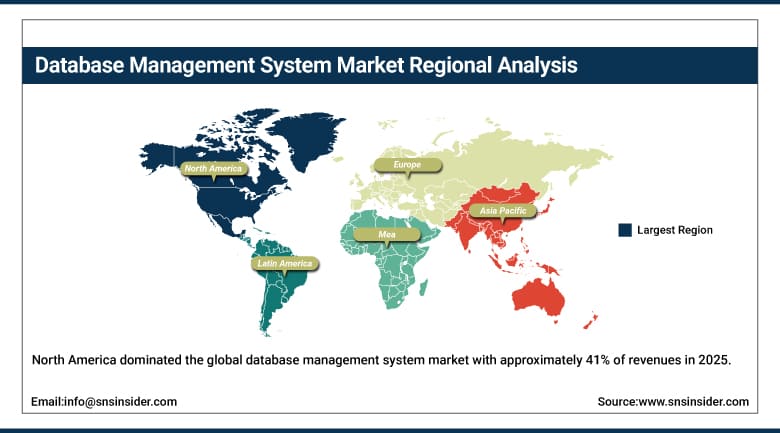
North America dominated the global database management system market with approximately 41% of revenues in 2025, attributed to the presence of top technology companies, advanced cloud usage rates, and substantial investments in data-driven technologies. The United States accounts for approximately 87.4% of North American revenues through Oracle, Microsoft, AWS, Google Cloud, IBM, Snowflake, and MongoDB's enterprise procurement relationships.
Canada contributes approximately 12.6% of North American revenues through its financial services sector's database investment, the government's digital transformation programme, and the growing technology sector's cloud database adoption across major urban technology clusters in Toronto and Vancouver.
Get Customized Report as Per Your Business Requirement - Enquiry Now
Europe Database Management System Market Insights
Europe is a technically sophisticated DBMS market where GDPR's data processing and residency requirements, the EU's AI Act's data governance obligations, and the Digital Operational Resilience Act's financial sector data management standards create compliance-driven DBMS investment. Germany accounts for approximately 22.3% of European revenues through its automotive sector's manufacturing data management, SAP's enterprise database leadership, and the financial services sector's regulatory compliance investment.
The United Kingdom, France, and the Netherlands are significant secondary markets where financial sector database investment, pharmaceutical company data management, and technology sector cloud database adoption create consistent procurement. SAP SE's German headquarters and Software AG's enterprise data management platform sustain regional supply capability.
Asia Pacific Database Management System Market Insights
Asia Pacific is the fastest growing regional DBMS market, driven by China's extraordinary digital economy database infrastructure investment, India's IT sector growth and financial inclusion digitisation, Japan's enterprise database modernisation, South Korea's technology sector adoption, and the extraordinary data generation from the region's digital platforms. China accounts for approximately 44.8% of Asia Pacific revenues through Alibaba Cloud's PolarDB, Tencent Cloud's TDSQL, and domestic enterprise database investment driven by the government's data governance regulation.
India represents the most commercially dynamic emerging market within Asia Pacific where the banking sector's digital transformation, the Unified Payments Interface's transaction data management requirement, and the IT services sector's enterprise database platform adoption create above-average DBMS market growth from both domestic and export-oriented procurement sources.
MEA & Latin America Database Management System Market Insights
The UAE leads MEA revenues at approximately 31.2% through its smart city database infrastructure investment, the financial services sector's digital banking platform adoption, and the government's data sovereignty framework creating structured domestic DBMS procurement. Saudi Arabia's Vision 2030 digital transformation adds complementary Gulf demand. Brazil leads Latin American revenues at approximately 44.2% through its financial services sector's technology investment, the government's digital infrastructure programme, and the growing e-commerce sector's database management requirements. Mexico's financial technology sector and Colombia's digital economy collectively sustain regional growth through 2035.
Market Dynamics:
Growth Drivers: Data explosion and cloud adoption mandating scalable DBMS platform investment
The data explosion driven by digital platforms, IoT device networks, social media, mobile applications, and enterprise system integration is the DBMS market's most commercially certain structural growth driver. Global data generation is estimated to exceed 120 zettabytes annually, creating storage, processing, and governance requirements that fuel demand for scalable and intelligent database systems. Each new connected device, digital application, and enterprise system integration creates incremental data management requirements whose aggregate across the global digital economy sustains above-average DBMS market growth independent of economic cycle variation.
Cloud adoption's continued expansion creates DBMS platform migration investment that sustains above-average market revenue growth beyond organic data volume increase alone. Each enterprise that migrates on-premise database workloads to cloud-managed database services creates cloud DBMS subscription revenue that typically exceeds prior on-premise licensing expenditure through the combination of managed service premium and expanded capability adoption. The 18% year-over-year cloud database adoption growth documented in enterprise surveys reflects the commercial momentum that sustains cloud DBMS as both the dominant and fastest-growing deployment category simultaneously.
Restraints: Data security concerns and high implementation cost for complex enterprise migrations
Data security and privacy concerns create adoption barriers for cloud database migration, particularly in regulated industries and jurisdictions with data sovereignty requirements that restrict cross-border data transfer. Each organisation whose regulatory environment prevents cloud data residency creates on-premise database retention that moderates cloud DBMS market growth below the potential that unconstrained cloud adoption would generate. GDPR's data processing restriction, China's Cybersecurity Law's data localisation requirement, and sector-specific data sovereignty mandates collectively sustain on-premise retention in commercially significant market segments.
High implementation and migration cost for enterprise-scale DBMS transitions, whose schema conversion, application rewriting, data quality remediation, and testing requirements create multi-year programme investments, creates procurement caution that moderates the pace of legacy database system replacement. Each enterprise whose core banking system, ERP database, or clinical data repository requires complex migration creates a risk aversion dynamic that sustains legacy platform maintenance investment over modernisation programme initiation.
Opportunities: AI-native database development and autonomous DBMS for operational efficiency
AI-native database development whose natural language query interface, automated schema design, intelligent index management, and real-time anomaly detection capabilities create a database user experience accessible to business users without SQL expertise represents the most commercially transformative near-term market opportunity. Each enterprise that deploys natural language database querying eliminates the business analyst bottleneck that SQL-only database access creates, expanding the addressable user base for DBMS investment beyond the data engineering team to the entire business user population.
Autonomous database management whose self-tuning, self-patching, self-optimising, and self-securing capabilities dramatically reduce database administration labour costs represents the most commercially compelling operational efficiency opportunity. Oracle's Autonomous Database documentation of 90% database administration task automation and Google AlloyDB's AI-optimised query planning demonstrate the measurable ROI from autonomous database investment that creates purchasing motivation beyond pure functionality comparison with conventional managed alternatives.
Recent Developments:
-
2024: Snowflake launched AI-powered data collaboration features on Snowflake Cortex in 2024, enabling natural language query capabilities, automated anomaly detection, and cross-organisation data sharing through a unified cloud data platform serving enterprise analytics and machine learning workloads.
-
2024: Microsoft announced Azure Cosmos DB for PostgreSQL enhancements in 2024 with distributed query parallelism and vector search integration for AI application workloads, enabling enterprises to run multi-model transactional and analytics workloads from a single managed cloud database service.
-
2023: IBM announced the general availability of Amazon Relational Database Service for Db2 at AWS re:Invent in November 2023, a fully managed cloud offering enabling database customers to manage AI workloads across hybrid cloud environments with Db2 compatibility.
-
2023: MongoDB released MongoDB 7.0 in 2023, introducing sharding-based time series collection support, compound wildcard indexes, and enhanced change stream performance for real-time data pipeline applications, extending MongoDB Atlas capabilities for IoT and analytics use cases.
-
2023: Oracle launched Oracle Database 23c as a free developer release in 2023, introducing JSON Relational Duality enabling unified access to data as both relational tables and JSON documents, and native vector data type support for AI application development within the Oracle Database ecosystem.
Database Management System Market Key Players:
-
Oracle Corporation
-
Microsoft Corporation
-
Amazon Web Services Inc.
-
Google LLC
-
IBM Corporation
-
SAP SE
-
Snowflake Inc.
-
MongoDB Inc.
-
Teradata Corporation
-
MariaDB Corporation
-
Redis Ltd.
-
Databricks Inc.
-
Cloudera Inc.
-
Percona LLC
-
SingleStore Inc.
-
CockroachLabs Inc.
-
PlanetScale Inc.
-
Citus Data
-
EnterpriseDB Corporation
-
Actian Corporation
Database Management System Market Report Scope:
| Report Attributes | Details |
|---|---|
| Market Size in 2025 | USD 106.04 Billion |
| Market Size by 2035 | USD 309.67 Billion |
| CAGR | CAGR of 11.41% From 2026 to 2035 |
| Base Year | 2025 |
| Forecast Period | 2026-2035 |
| Historical Data | 2022-2024 |
| Report Scope & Coverage | Market Size, Segments Analysis, Competitive Landscape, Regional Analysis, DROC & SWOT Analysis, Forecast Outlook |
| Key Segments | • by Type (Relational Database Management System, Non-Relational/NoSQL Database Management System) • by Deployment (Cloud, On-Premise) • by Organization Size (Large Enterprises, Small and Medium-sized Enterprises) • by Vertical (BFSI, Healthcare & Life Sciences, IT & Telecom, Retail & E-commerce, Government & Defense, Manufacturing, Others) |
| Regional Analysis/Coverage | North America (US, Canada, Mexico), Europe (Eastern Europe [Poland, Romania, Hungary, Turkey, Rest of Eastern Europe] Western Europe] Germany, France, UK, Italy, Spain, Netherlands, Switzerland, Austria, Rest of Western Europe]), Asia Pacific (China, India, Japan, South Korea, Vietnam, Singapore, Australia, Rest of Asia Pacific), Middle East & Africa (Middle East [UAE, Egypt, Saudi Arabia, Qatar, Rest of Middle East], Africa [Nigeria, South Africa, Rest of Africa], Latin America (Brazil, Argentina, Colombia, Rest of Latin America) |
| Company Profiles | Oracle Corporation, Microsoft Corporation, Amazon Web Services Inc., Google LLC, IBM Corporation, SAP SE, Snowflake Inc., MongoDB Inc., Teradata Corporation, MariaDB Corporation, Redis Ltd., Databricks Inc., Cloudera Inc., Percona LLC, SingleStore Inc., CockroachLabs Inc., PlanetScale Inc., Citus Data, EnterpriseDB Corporation, Actian Corporation |
Frequently Asked Questions
The Database Management System Market is expected to grow at a CAGR of 11.41% from 2026 to 2035.
The Database Management System Market was valued at USD 106.04 Billion in 2025.
The surge in data generated from digital platforms, IoT devices, and enterprise systems creating demand for scalable DBMS solutions, and enterprise cloud adoption accelerating migration from on-premise to cloud-managed database services that deliver scalability, cost efficiency, and native AI integration.
Relational Database Management System dominated with approximately 64% share in 2025, while Non-Relational/NoSQL is the fastest growing segment at 12.81% CAGR.
North America dominated the Database Management System Market with approximately 41% of revenues in 2025, while Asia Pacific is the fastest growing region.
